





Green Resin Handle Damascus Hunting Knife – Distinctive Outdoor Style
The Green Resin Handle Damascus Hunting Knife combines a striking patterned blade with a two-tone handle, polished metallic detailing, and traditional outdoor-inspired styling. Its distinctive appearance makes it an appealing option for knife collectors, outdoor enthusiasts, and customers who appreciate decorative fixed-blade knives.
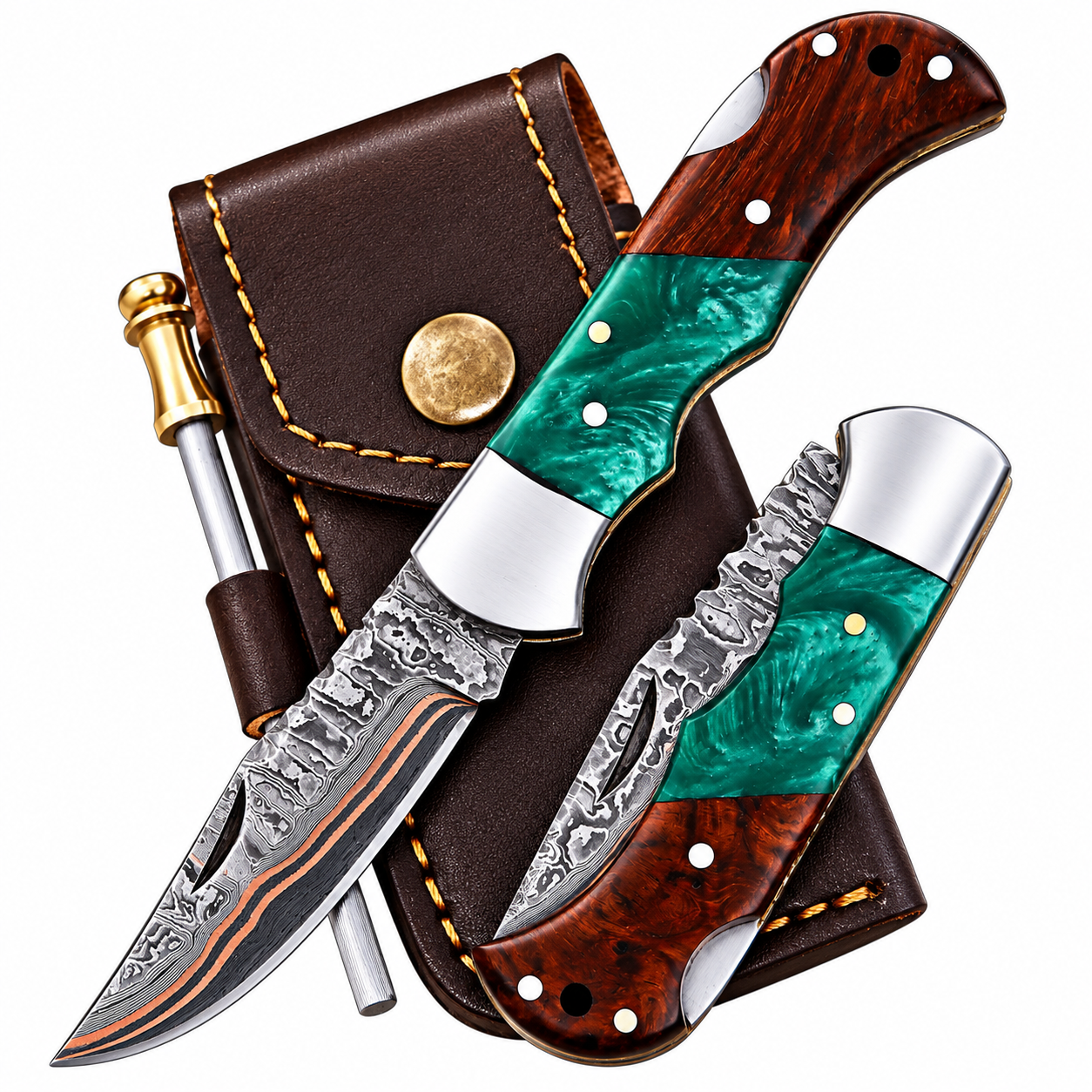
One of the most noticeable characteristics of this knife is its combination of green marbled and reddish-brown handle sections. The emerald-green portion displays flowing, swirling patterns, while the upper section has a dark wood-grain appearance. Together, these elements create a bold contrast against the silver-colored bolster and the layered-looking metal blade.
The blade features an intricate Damascus-style surface design with gray and silver patterns and a copper-colored line running toward its pointed tip. The different colors create depth across the blade, making the knife visually distinctive.
Also pictured is a dark brown sheath with contrasting golden-yellow stitching, a snap-button closure, and an accompanying metal rod resembling a sharpening or maintenance accessory.
For customers seeking a fixed-blade knife with an unusual handle finish and detailed metalwork, this design offers an attractive alternative to conventional outdoor knives.
Damascus-Style Blade with Copper-Colored Accents
The blade is the central visual feature of the Green Resin Handle Damascus Hunting Knife.
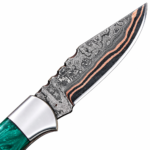
Its surface displays flowing silver and charcoal-gray patterns commonly associated with Damascus-style steel. The design incorporates irregular waves, layered lines, and intricate markings that extend along the blade.
A contrasting copper-colored decorative stripe runs through a darker section near the cutting edge.
This warm metallic accent complements the reddish-brown handle and provides an appealing contrast with the silver-gray blade.
The outer cutting edge appears brighter than the surrounding patterned surface, helping define the blade’s gently curved profile.
Damascus-pattern blades are appreciated by collectors for their distinctive appearance. The layered-looking patterns provide visual variety compared with conventional plain-finished blades.
However, the surface design alone cannot establish whether the knife is made from genuine forge-welded Damascus steel, another type of pattern-welded steel, or a steel blade with a decorative treatment.
The exact blade composition, layer count, heat treatment, and hardness remain unverified and should be confirmed with the manufacturer before publication as technical specifications.
Classic Fixed Blade Hunting Knife Profile
The Green Resin Handle Damascus Hunting Knife has the general silhouette of a compact fixed-blade hunting knife.
Its blade is permanently extended from the handle rather than being mounted on a folding mechanism.
The cutting edge curves gradually toward a pointed tip, while the upper blade area features a more angular profile.
Near the front portion of the blade is a visible notch or hooked-looking cutout. This detail gives the knife an unusual appearance.
It should not automatically be described as a gut hook or specialized cutting feature without manufacturer confirmation.
The blade also has a defined transition into the silver-colored bolster, which separates the metal blade from the decorative handle.
This arrangement creates a recognizable hunting-style knife profile.
The image does not establish exact blade length, thickness, weight, or cutting performance. Those specifications should be supplied by the manufacturer.
Emerald-Green Marbled Handle Section
A standout feature of this knife is the green marbled section of its handle.
The material has a rich emerald-green appearance with lighter and darker swirling patterns.
Its glossy-looking surface catches the light, bringing attention to the color variation.
The handle section resembles decorative resin or a stabilized composite commonly found on custom-style knives.
Its actual composition cannot be determined from photography alone, so it is best described as a resin-look or green marbled handle section until the material has been verified.
The flowing pattern is especially attractive because it adds contrast to the more traditional wood-grain appearance of the upper handle.
Several light-colored fastening pins are visible along this section.
These details add visual interest and contribute to the overall design.
The green color also gives the knife an identifiable appearance, making it easy to distinguish from standard black, brown, and single-color handled knives.
Dark Wood-Grain Upper Handle
The rear section of the handle has a dark reddish-brown wood-grain appearance.
Its coloring ranges from warm red-brown highlights to deeper, nearly black streaks.
The pattern resembles polished natural wood, although the precise material has not been verified.
The upper portion is gently curved and widens toward the rear, where a circular opening is visible.
Additional metal-colored fastening pins appear along the surface.
This section provides a traditional visual element that balances the bright green marbled area below it.
The dark wood-grain finish gives the knife a warmer and more classic appearance than designs with entirely synthetic-looking grips.
For collectors, this combination of modern decorative color and natural-looking texture is one of the product’s most appealing characteristics.
Two-Tone Handle Design
The Green Resin Handle Damascus Hunting Knife features a carefully coordinated combination of colors.
Its green lower section creates a vibrant focal point, while the darker upper section introduces a more subdued, traditional finish.
A smooth transition between these areas helps create a unified handle appearance.
The curved handle profile includes a shallow finger contour near the bolster.
This is a visible design characteristic rather than a guarantee of ergonomic performance.
Actual comfort and grip security depend on the knife’s dimensions, surface texture, balance, and the user’s hand size.
The handle is therefore best described as a shaped two-tone grip with green marbled and dark wood-grain sections.
The combination is particularly suited to customers interested in decorative outdoor knife designs.
Polished Silver-Colored Bolster
A broad silver-colored bolster is located between the blade and handle.
Its smooth metallic surface contrasts with both the patterned blade and the two-tone grip.
The bolster has a curved shape that follows the handle’s front contour.
This detail gives the knife a defined separation between its blade and grip.
It also adds a bright visual accent, complementing the lighter lines within the Damascus-style pattern.
Although the bolster appears metallic, the photograph does not reveal its exact material.
It should not be described as stainless steel, nickel silver, or another specific alloy without supporting specifications.
The visible construction can accurately be described as having a polished silver-colored bolster.
Decorative Metalwork and Blade Detailing
The visual presentation includes several contrasting finishes.
The blade has intricate layered-looking markings.
A copper-colored stripe follows the blade’s shape.
The bolster has a polished silver finish.
The handle combines green marbling with reddish-brown grain.
These features work together to create a decorative yet traditional hunting-style appearance.
The blade’s patterned surface is especially distinctive because the markings vary across its length.
The lighter and darker areas provide visual depth, while the copper-colored accent helps connect the blade with the warmer handle tones.
Rather than relying on branding or exaggerated styling, the knife’s appearance comes from these visible design details.
Brown Sheath with Contrasting Stitching
The product photograph includes a dark brown sheath positioned behind the knife.
The sheath has a smooth leather-like surface and visible golden-yellow stitching along its edges.
A folded flap extends over the upper section and fastens with a circular gold-colored snap button.
The stitching creates a neat border around the sheath.
Its dark brown shade coordinates with the wood-grain section of the knife handle.
The sheath appears shaped to accommodate the blade and is presented as an accompanying accessory.
Its exact material has not been independently established. Although it resembles leather, confirmation is required before advertising it as genuine leather.
The photograph also does not establish whether the sheath has a particular belt attachment configuration.
For a customer-facing product page, its safest description is a dark brown, leather-look knife sheath with contrasting stitching and snap closure.
Accompanying Metal Sharpening Rod
A slim metal rod is also visible beside the sheath.
The accessory features a silver-colored shaft and gold-colored details toward its upper end.
It resembles a compact sharpening or maintenance rod.
A brown loop appears to hold the rod against the sheath.
Its presence adds to the outdoor-inspired presentation of the knife.
However, the photograph cannot confirm whether it is a honing steel, sharpening rod, ferrocerium fire starter, or another type of accessory.
The precise function should be confirmed by the supplier before it is advertised.
Until verified, the accessory should be described as an accompanying metal rod rather than being assigned a specific function.
Fixed Blade Construction
This knife uses a fixed-blade configuration.
Unlike a folding pocket knife, the blade remains extended from the handle.
The design includes a clearly defined blade, bolster, and shaped grip.
Fixed-blade knives are frequently considered by customers who prefer a simple knife format without a visible folding mechanism.
The image does not reveal the internal tang arrangement.
For example, it is not possible to establish whether the knife has full-tang, hidden-tang, or another construction.
The presence of external fastening pins also does not conclusively identify the internal structure.
Customers interested in technical construction should request the manufacturer’s tang specifications before making a purchasing decision.
Designed for Collectors and Outdoor Knife Enthusiasts
The Green Resin Handle Damascus Hunting Knife has several characteristics that may appeal to collectors.
Its patterned blade provides a distinctive metal finish.
The green marbled handle section creates a bright decorative accent.
The dark wood-grain upper grip adds traditional styling.
The polished bolster introduces another contrasting material appearance.
The accompanying sheath creates a complete visual presentation suitable for customers comparing collectible fixed-blade knife designs.
For outdoor enthusiasts, the knife has a familiar hunting-style silhouette.
However, specific outdoor applications should only be advertised after confirming its blade geometry, material properties, and intended use.
A knife’s suitability for a task cannot be established from appearance alone.
The model should therefore be evaluated using verified specifications rather than assumptions based on its styling.
A Distinctive Knife for Display Collections
Customers who collect knives often appreciate diversity in blade patterns, handle colors, and overall proportions.
This model offers several distinguishing characteristics.
The copper-colored stripe differs from the more common silver-and-gray Damascus-look patterns.
The emerald-green marbled material adds color and depth.
The reddish-brown rear handle provides contrast.
The dark brown sheath adds another traditional element.
Together, these features create an attractive visual composition.
For a display collection, the knife can represent a contemporary interpretation of traditional fixed-blade knife styling.
Collectors should use a suitable protective display or storage arrangement and keep sharp items securely away from unauthorized handling.
Understanding Damascus-Pattern Steel
The term Damascus is widely associated with distinctive patterned steel blades.
Some Damascus blades are produced through pattern welding, which combines different steels to create visible layered designs.
Other blades can feature surface patterns produced by different methods.
The visible appearance does not establish the exact process used to manufacture this knife.
Likewise, a decorative pattern does not independently confirm cutting performance, strength, corrosion resistance, or durability.
The steel grade and manufacturing process must be confirmed through supplier documentation.
A transparent product listing should distinguish between visible decorative features and verified technical characteristics.
This helps customers understand what they are purchasing without relying on unsupported claims.
Blade Shape and Intended Use
The blade has a gradually curved cutting edge and pointed tip.
This profile is commonly found on hunting-style and general-purpose fixed-blade knives.
The visible design may be attractive to customers who prefer a blade with a pronounced point and gently sweeping edge.
Nevertheless, the exact intended applications remain dependent on specifications not supplied with the photograph.
Before recommending the knife for a particular outdoor activity, customers should confirm its blade length, steel composition, edge geometry, construction method, and safety information.
The patterned surface and decorative handle should be treated as design characteristics, not proof of specialized performance.
General Cleaning and Maintenance
Appropriate cleaning and storage are important for preserving the appearance of patterned steel knives.
After handling, the blade should be wiped carefully to remove moisture, fingerprints, and residue.
Any cleaning products should be suitable for the confirmed blade material.
If the manufacturer identifies the steel as susceptible to corrosion, an appropriate protective oil may be recommended.
Abrasive scrubbing materials should generally be avoided because they can affect decorative finishes.
The handle should be wiped with a soft cloth and kept away from unnecessary exposure to harsh solvents.
Because the exact green and brown handle materials are unverified, specialized resin or wood treatments should not be recommended without supplier guidance.
The sheath should also be kept clean and dry.
If confirmed to be genuine leather, use care products appropriate for its finish.
For extended storage, avoid leaving a blade in a damp sheath.
Always store the knife securely and protect the cutting edge from accidental contact.
What Customers Should Check Before Buying
The photograph provides a clear view of the knife’s appearance, but several specifications still require confirmation.
Customers should check the blade length, overall length, blade thickness, and product weight.
They should also confirm the steel grade, manufacturing process, hardness, and tang construction.
Handle materials are another consideration.
The upper portion has a wood-grain appearance, while the lower section resembles decorative resin, but neither can be established conclusively from the image alone.
The sheath material, sharpening accessory function, and included package contents should also be verified.
This information helps buyers compare visually similar products accurately.
A Combination of Traditional and Contemporary Styling
What makes this knife distinctive is its combination of finishes and colors.
The blade draws inspiration from traditional Damascus-style metalwork.
The silver-colored bolster gives the handle-to-blade transition a polished appearance.
The green marbled grip adds a modern decorative element.
The darker wood-grain section keeps the overall design connected to traditional outdoor knife aesthetics.
The brown stitched sheath complements the warm colors of the handle.
These visual features make the knife a recognizable addition to a collection.
Explore the Green Resin Handle Damascus Hunting Knife
The Green Resin Handle Damascus Hunting Knife offers a distinctive combination of a patterned fixed blade, contrasting handle sections, polished metal detailing, and a matching outdoor-style sheath.
Its copper-accented blade, emerald-green marbled handle, and dark wood-grain grip create a memorable design.
For customers interested in decorative knives, collectible fixed blades, and traditional hunting-style aesthetics, this model provides an interesting option to explore.
Discover its contrasting finishes and detailed appearance as part of your knife collection.







Reviews
There are no reviews yet.