






Ivory Style Damascus Hunting Knife with Burgundy Protective Sheath
Introduction to the Ivory Style Damascus Hunting Knife
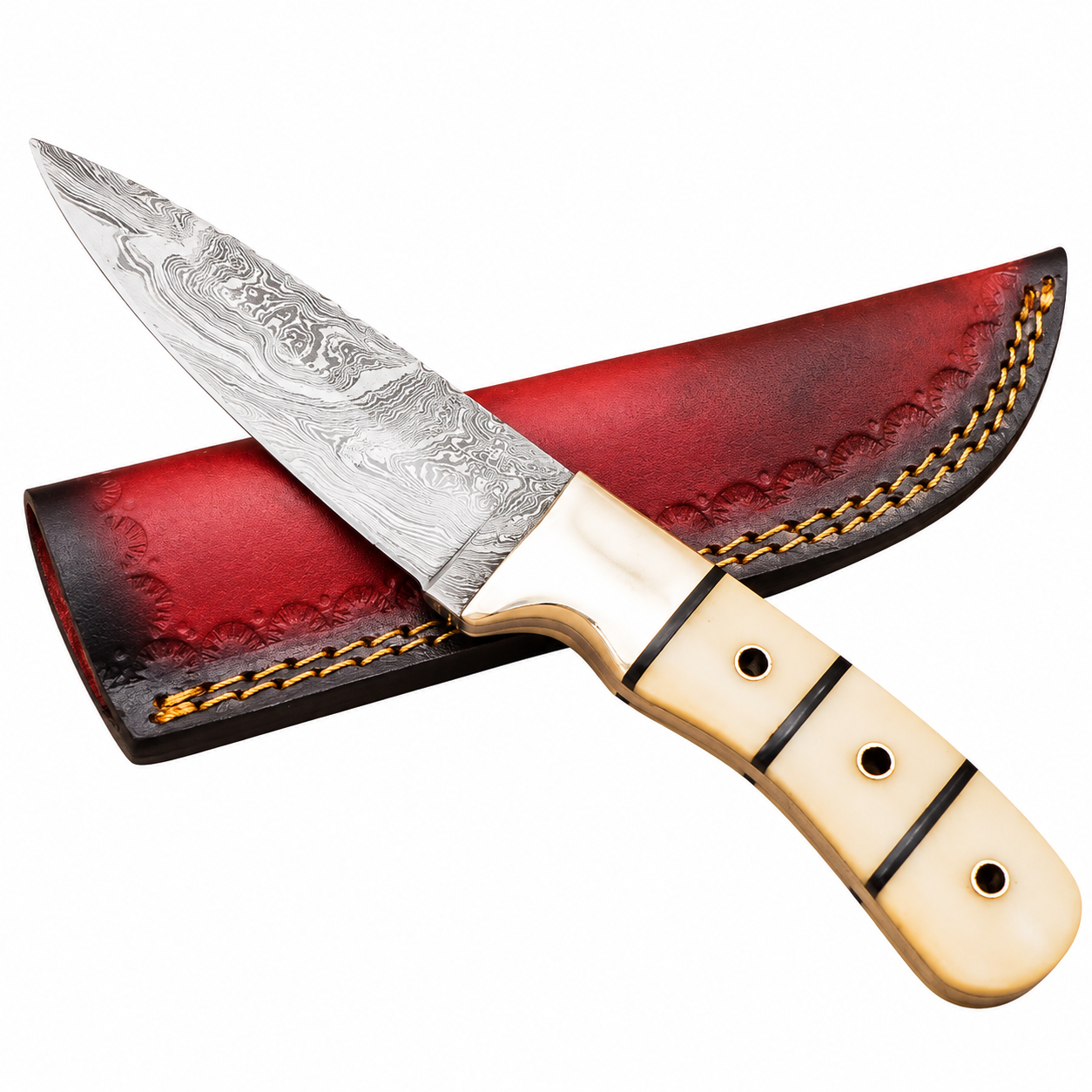
The Ivory Style Damascus Hunting Knife presents an attractive combination of traditional fixed blade styling, decorative patterned steel, and a distinctive cream-colored handle. Designed with a pointed blade profile and a coordinated protective sheath, this knife stands out through its contrasting colors, visible metal details, and carefully shaped silhouette.
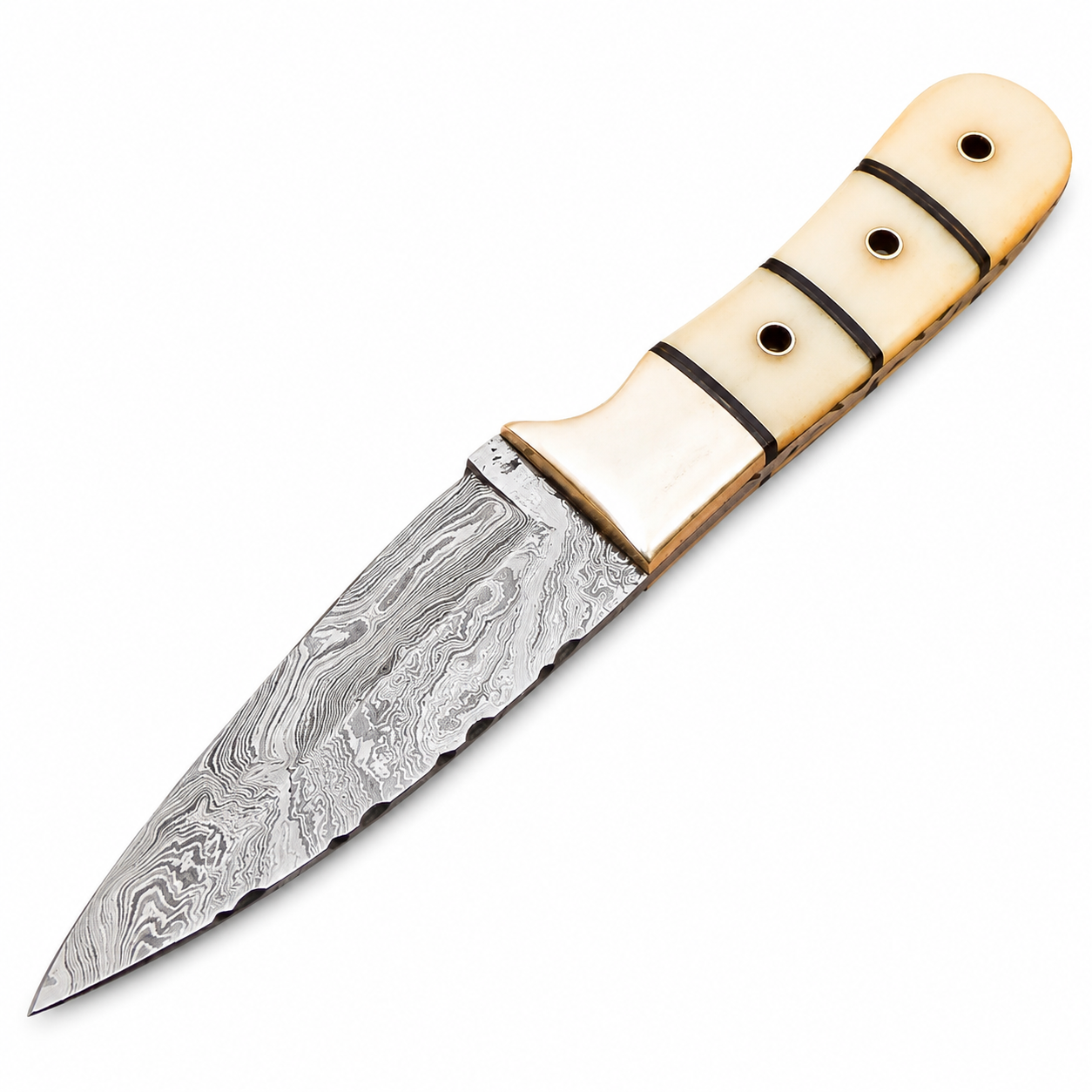
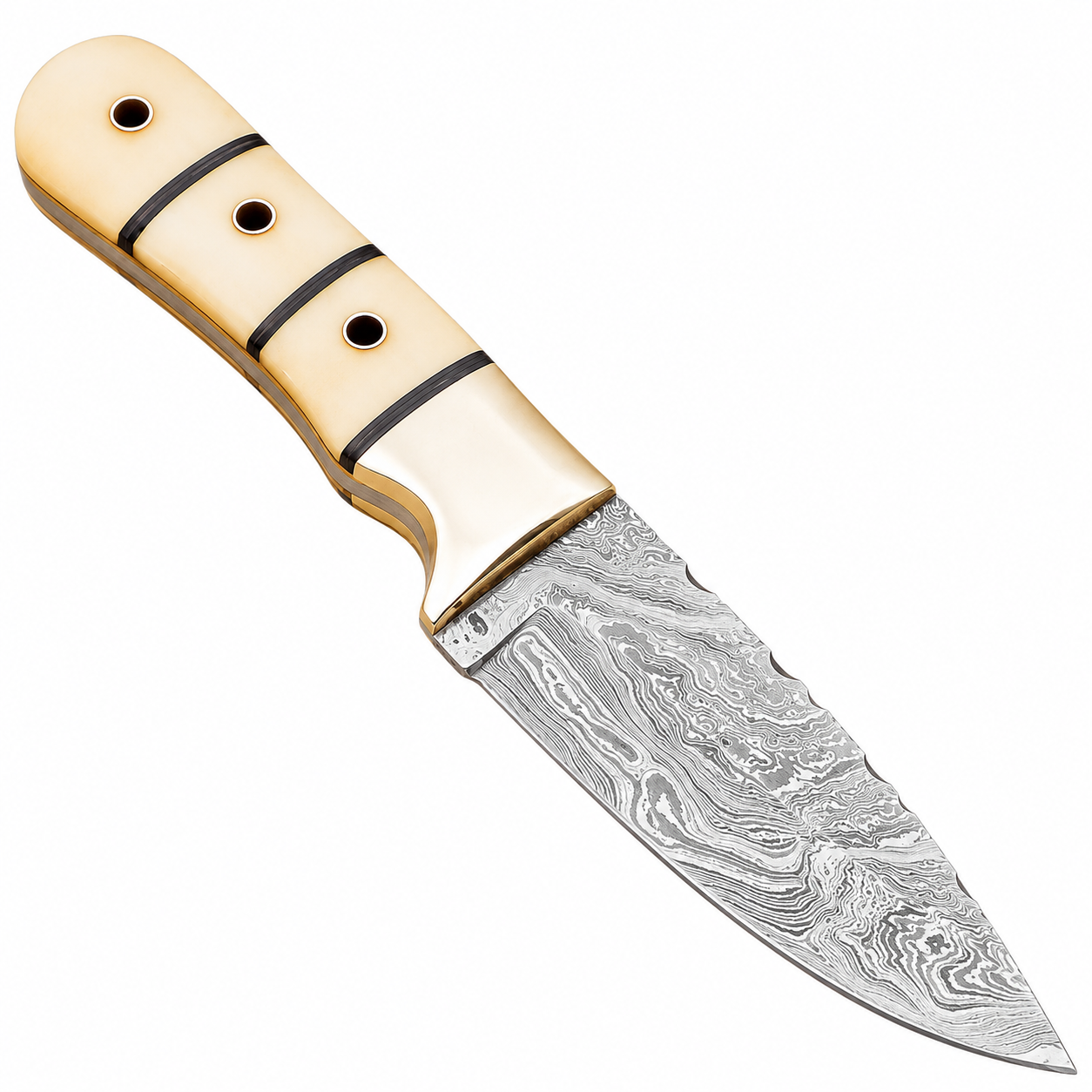
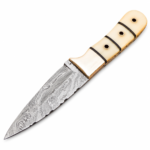
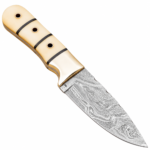
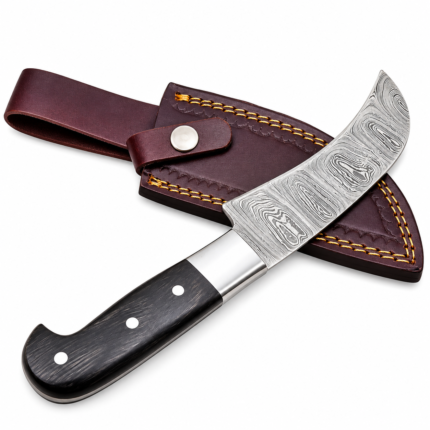
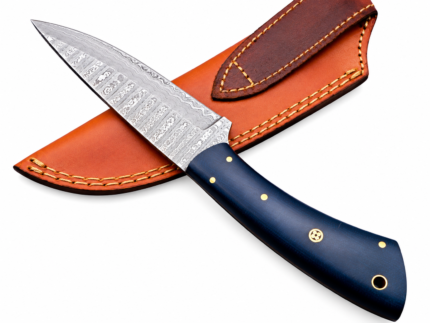
The blade features an intricate silver and grey Damascus-style pattern. Flowing lines, layered shapes, and irregular wave formations extend across its surface, creating a visually detailed finish. The pointed tip and gently sweeping cutting edge give the knife a recognizable hunting-style profile.
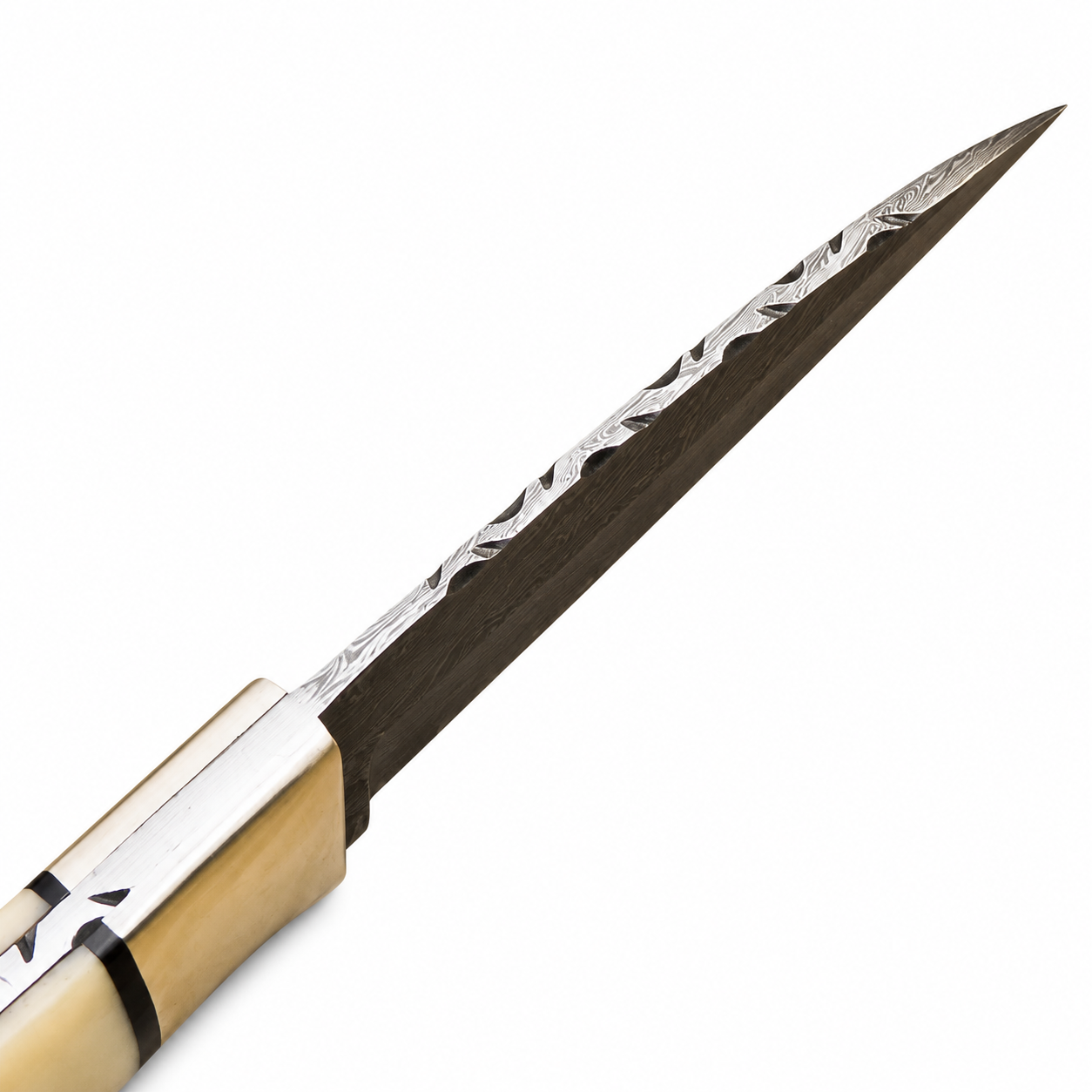
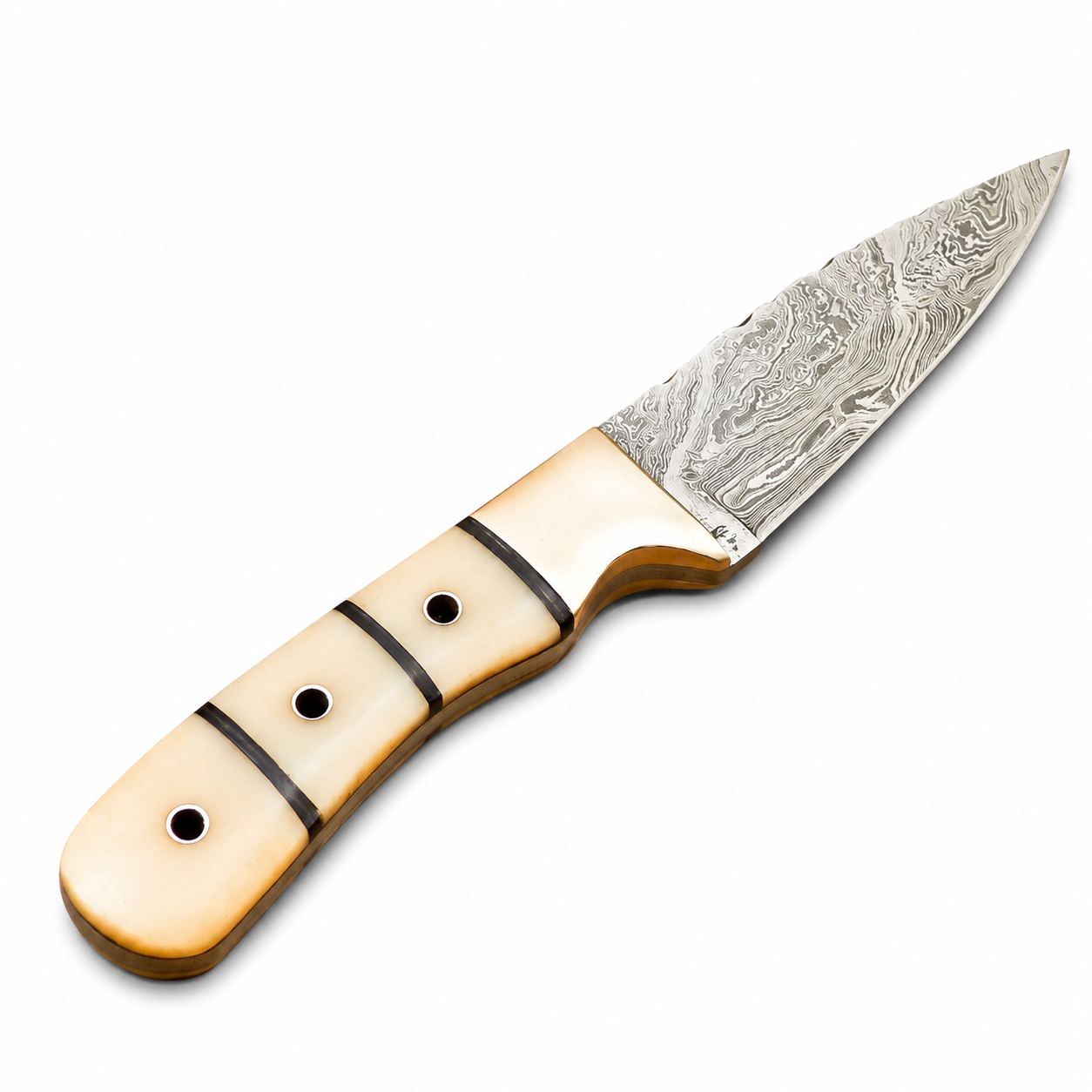
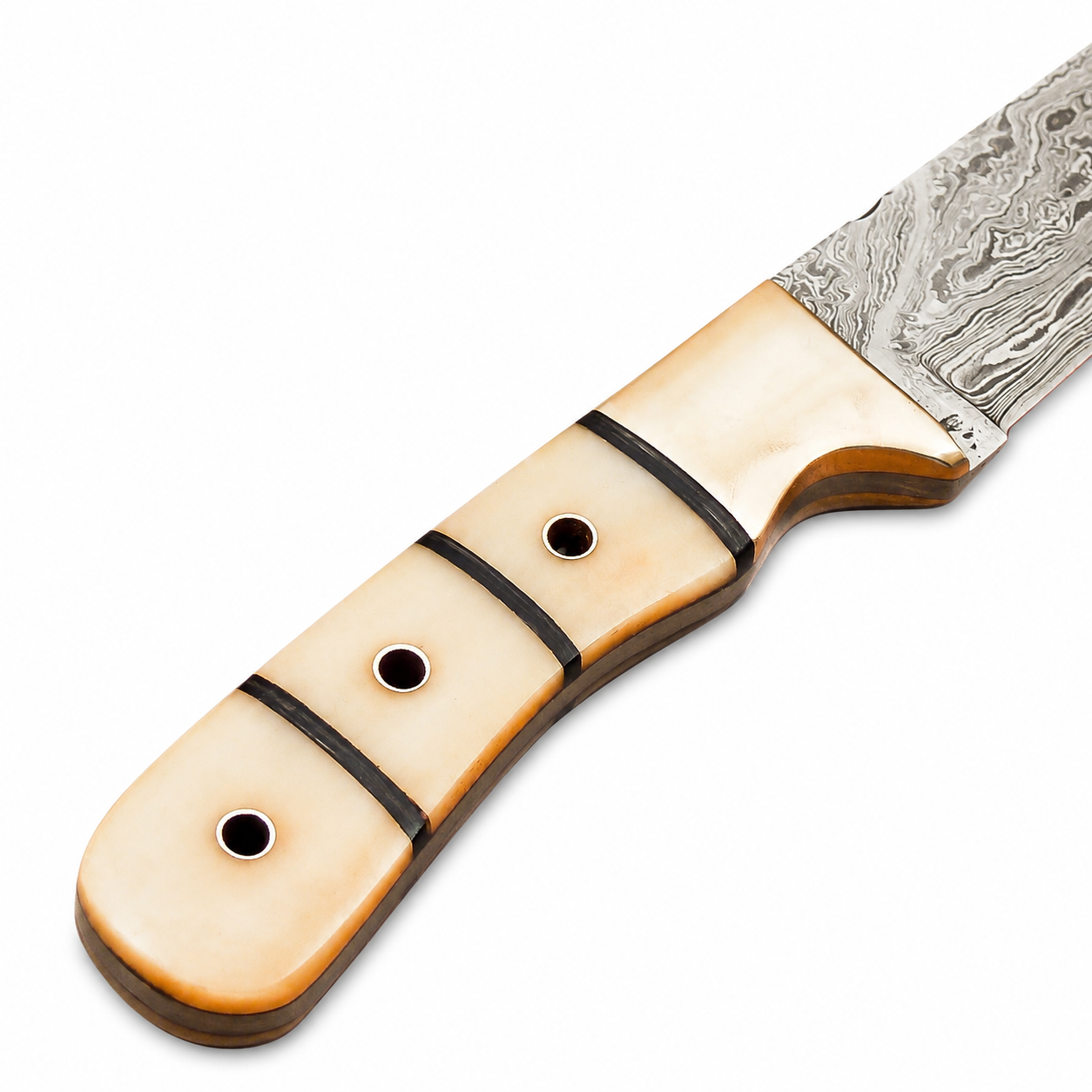
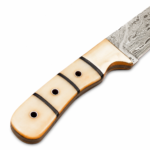
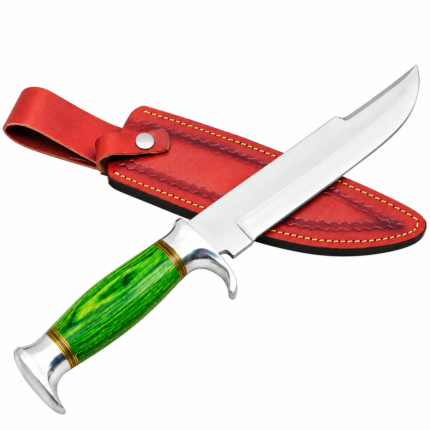
The ivory-colored handle adds a classic appearance that contrasts with the patterned blade. Three circular metal-lined openings and several black spacer bands create a recognizable design. These elements are particularly noticeable in the close-up photographs.
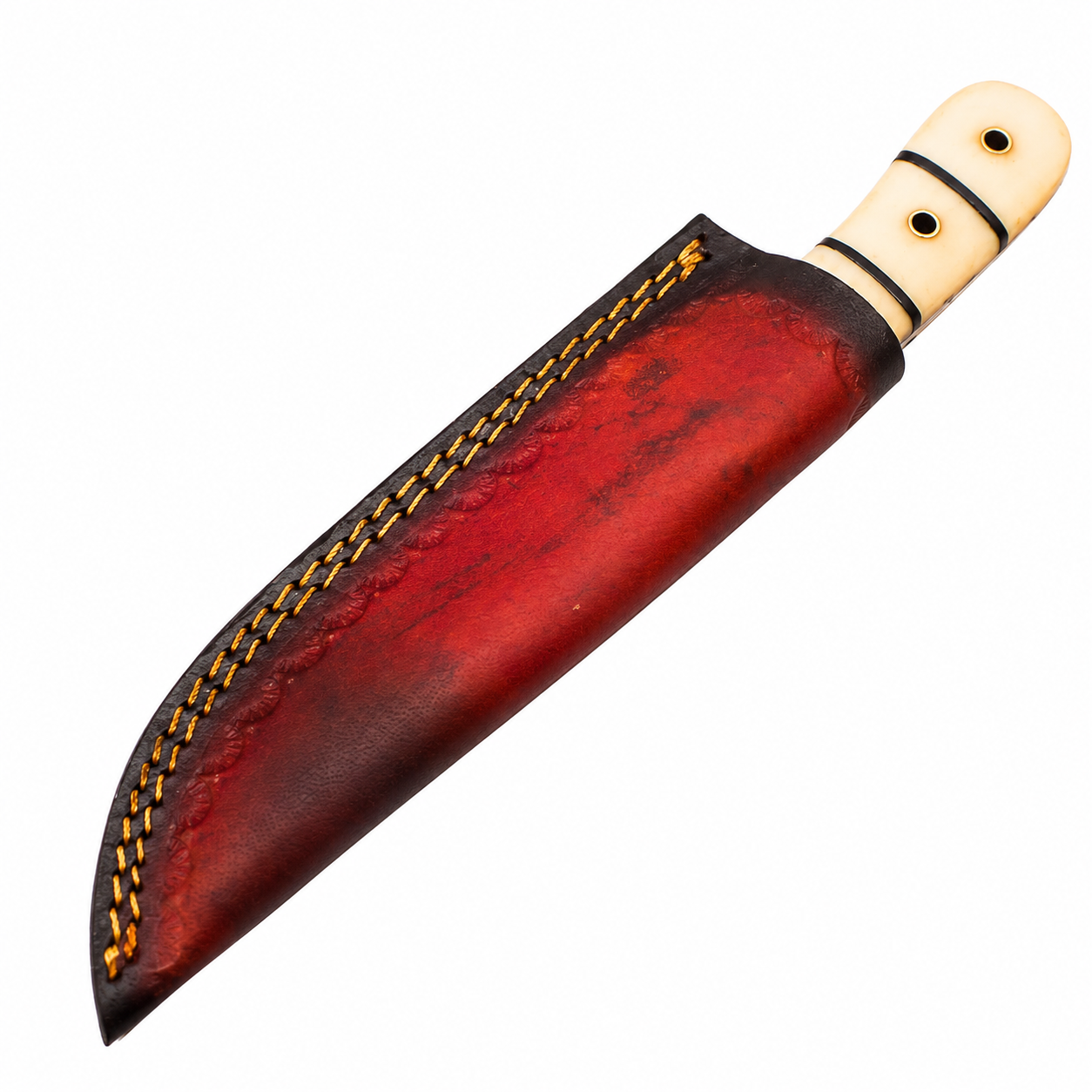
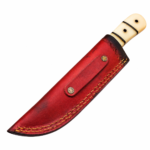
Completing the product is a red-to-burgundy protective sheath with contrasting stitching and embossed decoration. The combination of the cream handle, patterned blade, and richly colored sheath makes this knife visually distinctive.
For collectors and enthusiasts who appreciate traditional knife designs, the Ivory Style Damascus Hunting Knife offers several decorative and structural details worth exploring.
1. Distinctive Damascus-Style Patterned Blade
The most prominent feature of the Ivory Style Damascus Hunting Knife is its patterned blade.
The steel surface displays intricate flowing lines that resemble traditional Damascus steel patterns. These lines vary in thickness and direction, creating a layered appearance across the metal.
Some areas feature closely spaced parallel waves, while others show broader swirling formations.
This irregular arrangement makes the blade visually interesting from different angles.
The combination of silver and grey tones creates a refined decorative finish.
A patterned steel surface is frequently associated with traditional knife collections and specialty cutting tools.
However, visible markings alone cannot establish the blade’s exact metallurgy.
The actual steel grade, pattern-welding process, and hardness should be verified with the manufacturer.
For an accurate product listing, the visible finish can be described as Damascus-style until its composition is confirmed.
2. Traditional Pointed Hunting Blade Profile
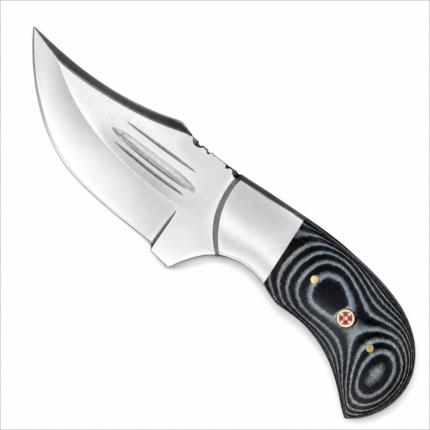
The knife features a pointed blade with a gently curving cutting edge.
Its shape provides a distinctive profile associated with traditional hunting-style fixed blade knives.
The cutting edge follows a subtle upward curve toward the tip, while the upper blade surface gradually narrows.
This arrangement creates a balanced visual transition from the handle to the pointed end.
The blade’s shape differs from heavily curved skinning knives and broad cleaver-style tools.
Instead, it combines a relatively straightforward profile with decorative steel patterning.
The photographs show the blade clearly from several perspectives.
These views highlight the relationship between the pointed tip, blade spine, and patterned surface.
Actual suitability for particular cutting activities depends on verified measurements, edge geometry, steel composition, and manufacturer guidance.
3. Detailed Silver and Grey Blade Finish
The blade has a bright metallic appearance with darker patterned lines.
Its decorative surface creates a layered contrast that changes with the viewing angle.
Under bright lighting, the lighter sections appear reflective, while the darker lines emphasize the pattern.
This contrast allows the blade to remain visually distinctive against the cream-colored handle.
The patterned surface is visible across much of the blade.
Close-up photographs reveal fine lines that are difficult to appreciate in smaller product thumbnails.
Such details are important for collectors who value decorative knife finishes.
The metal’s corrosion resistance, cutting performance, and surface treatment cannot be assessed reliably from photographs.
These properties depend on material composition and manufacturing processes.
The visible pattern remains one of the strongest distinguishing characteristics of this product.
4. Fixed Blade Design
The Ivory Style Damascus Hunting Knife features a fixed blade configuration.
Unlike folding knives, a fixed blade knife has no visible folding mechanism between the blade and handle.
The blade remains extended in its normal configuration.
This produces a continuous silhouette and a traditional appearance.
The blade connects directly to the ivory-colored handle section.
The photographs also show metal-colored material along portions of the handle’s exterior.
However, these images do not establish the exact tang arrangement.
Specific descriptions such as full tang or hidden tang should only be used after manufacturer confirmation.
Fixed blade construction is a recognizable design category, but strength and durability depend on verified technical properties.
The product’s visible construction makes it suitable for classification within traditional fixed blade knife collections.
5. Elegant Ivory-Colored Handle
The handle is one of the most distinctive elements of this knife.
Its warm cream color creates a strong contrast against the silver and grey patterned blade.
The surface appears smooth and lightly polished, with subtle variations in tone.
The shape is gently contoured rather than completely straight.
Its rounded rear end gives the handle a traditional silhouette.
The light-colored surface also helps highlight the darker spacer bands.
These elements create a layered appearance that is visible in photographs taken from different angles.
The term ivory-colored describes the appearance only.
It does not mean that the handle is made from genuine ivory.
The actual material may be a manufactured or alternative natural material and requires supplier confirmation.
6. Contrasting Black Spacer Bands
Several narrow black spacer bands divide sections of the cream-colored handle.
These dark lines are positioned across the handle at visible intervals.
The bands create a segmented appearance without interrupting the overall shape.
Their dark color contrasts sharply with the warm ivory-style finish.
This combination introduces a geometric detail into an otherwise traditional design.
The spacing also helps distinguish the different handle sections.
Black spacer accents are often used in decorative knife handles to provide visual contrast.
The actual materials and methods used to create these bands cannot be identified from the images.
They should therefore be described as black spacer bands until further details are available.
Their contribution to the knife’s appearance is particularly evident in close-up product photographs.
7. Three Circular Metal-Lined Handle Openings
Three circular openings are visible along the handle.
Each opening features a metallic-colored border surrounding a dark center.
These details are positioned in separate sections of the cream-colored grip.
They create a repeated design that complements the black spacer bands.
The openings are more prominent than conventional small decorative handle pins.
Their arrangement makes the handle easy to distinguish from other ivory-style knife designs.
The exact structural purpose of the openings cannot be confirmed through photographs.
For example, it is not possible to determine whether they are intended primarily for assembly, decoration, or another function.
The listing should describe their visible appearance without assigning unsupported technical properties.
Together, these three details give the handle its distinctive character.
8. Smooth Contoured Grip Shape
The handle follows a gentle curve from the blade connection toward its rounded rear section.
Its upper and lower edges are not completely parallel.
This creates a shaped appearance that complements the pointed blade.
The handle looks wider near certain sections and slightly narrower around its middle.
The transitions between these areas appear gradual rather than angular.
Such contours are common in traditional knife design.
However, physical handling comfort depends on the actual handle dimensions, material texture, and individual hand size.
These properties cannot be established from photographs alone.
Customers should review confirmed measurements before purchasing for a particular application.
As a visual feature, the curved handle creates a coordinated transition between the light grip and patterned steel blade.
9. Decorative Handle and Blade Transition
The transition between the blade and handle is an important element of the product’s overall appearance.
A broad ivory-colored front section sits immediately behind the patterned blade.
The shape includes a curved lower contour near the blade connection.
This creates a distinctive silhouette around the front of the grip.
Metallic-colored edging is visible along the handle.
The warm color of this edging complements the cream surface.
The combination produces a refined contrast against the cooler silver and grey blade.
This area is especially noticeable in photographs showing the complete knife.
The exact materials and assembly method require manufacturer verification.
Nevertheless, the visible transition is an important design detail that enhances the knife’s traditional appearance.
10. Coordinated Cream, Black, and Silver Colors
The Ivory Style Damascus Hunting Knife uses three primary visual elements.
The handle features a warm cream finish.
The spacer bands and circular openings introduce darker tones.
The blade provides a silver and grey patterned surface.
Together, these colors create a coordinated appearance.
The dark spacer bands divide the light handle into visually distinct sections.
The metal-lined openings provide additional contrast.
The patterned blade then introduces a more detailed surface texture.
This balance of simple and complex design elements makes the knife visually distinctive.
The light handle also stands apart from more conventional black or dark wood knife grips.
For collectors interested in decorative finishes, this combination provides an attractive traditional alternative.
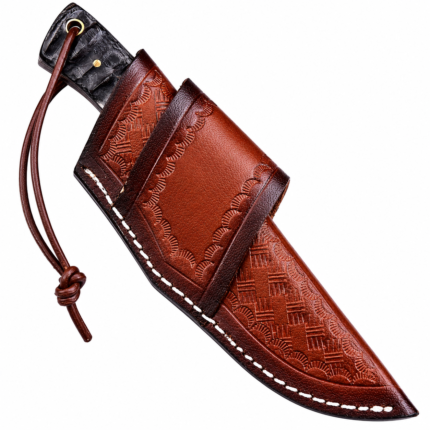
11. Red-to-Burgundy Protective Sheath
The included protective sheath is another recognizable feature.
It displays a rich red center that gradually transitions into darker burgundy and brown tones near the edges.
This creates a shaded appearance.
The sheath follows the general shape of the blade and ends in a curved pointed section.
Its exterior has a leather-like texture.
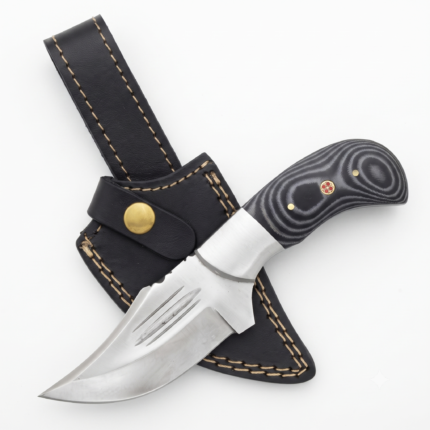
The photographs show the knife inserted into the sheath as well as positioned alongside it.
Both arrangements highlight the contrast between the cream handle and red protective cover.
The sheath material should be verified before describing it as genuine leather.
The visible color gradient and shaped construction remain important details regardless of the material.
The sheath is an integral part of the coordinated product presentation.
12. Decorative Embossed Sheath Pattern
The protective sheath features repeated embossed markings.
These impressions follow sections of the sheath’s outer edge.
Their curved arrangement complements the sheath’s overall shape.
The decorative pattern becomes more visible where the red material transitions into a darker burgundy finish.
Embossing introduces texture and visual detail.
It also gives the sheath a more traditional appearance than a completely plain cover.
The exact decorative process is not established by the photographs.
Claims of hand-tooling or individual handcrafting should be supported by manufacturer information.
The visible embossed design can nevertheless be described accurately.
For product listings, close-up photographs of these markings help buyers understand the accessory’s exterior finish.
13. Contrasting Gold-Tone Edge Stitching
The sheath features prominent stitching along its curved perimeter.
The thread has a golden-yellow appearance.
This creates a noticeable contrast with the red and dark burgundy material.
The stitching follows the shape of the protective cover.
Its placement emphasizes the sheath’s outline and decorative construction.
The contrast is particularly strong near the darker outer edges.
Stitching is an important visual feature in many traditional knife sheaths.
However, thread composition, stitch durability, and manufacturing method cannot be verified from photographs.
The visible arrangement should not be treated as proof of particular strength or quality standards.
For this product, the gold-tone stitching contributes to the distinctive red-and-cream presentation.
14. Sheath Belt Attachment
A belt attachment is visible on the rear of the sheath.
The attachment has the same red-burgundy appearance as the main body.
It is secured with two circular metal fittings decorated with star-shaped designs.
The arrangement is clearly visible in the photographs showing the sheathed knife.
This feature contributes to the sheath’s traditional styling.
Its dimensions and compatibility with specific belts have not been supplied.
Any claims about carrying capacity, belt size, or retention strength should be verified.
The sheath should be inspected before use.
Customers should also follow applicable laws concerning knife storage and transportation.
As a decorative accessory, the belt attachment adds another recognizable detail to the overall set.
15. Knife and Sheath Color Coordination
The combination of the knife and sheath creates a distinctive visual presentation.
The ivory-colored handle introduces warm neutral tones.
The blade adds silver and grey patterned details.
The red-burgundy sheath provides a deeper color contrast.
Gold-tone stitching further complements the warm appearance.
These colors work together without making the product look overly complicated.
The knife remains the visual centerpiece, while the sheath provides a contrasting background.
When displayed together, the cream handle stands out clearly against the red cover.
This arrangement is especially effective for product photography.
For online stores, photographs showing both pieces together can help communicate the complete product set.
The coordinated appearance is a notable advantage for collectors interested in traditional decorative designs.
16. Collectible Hunting-Style Knife Design
Decorative fixed blade knives appeal to enthusiasts who appreciate differences in blade profiles, handle materials, and traditional accessories.
The Ivory Style Damascus Hunting Knife contains several recognizable design elements.
Its Damascus-style blade pattern provides visual detail.
The cream handle creates a distinctive contrast.
Three circular metal-lined openings add decorative character.
Black spacer bands introduce a segmented appearance.
The burgundy sheath completes the traditional presentation.
Together, these elements distinguish the knife from plain fixed blade models.
Collectors may appreciate the combination of blade patterning and handle decoration.
Those seeking particular steel grades or construction methods should request supplier documentation.
Aesthetic features can be appreciated independently of unverified technical claims.
17. Product Photography and Gallery Presentation
The supplied images provide several useful views of the product.
One photograph shows the knife stored inside the sheath.
Another displays the complete patterned blade with the protective cover underneath.
Additional views highlight the blade profile and handle.
Close-up photographs show the black spacer bands and circular openings.
The blade’s layered appearance is visible from multiple angles.
The sheath’s decorative stitching and shaded finish are also clearly shown.
These photographs can be arranged into a comprehensive e-commerce product gallery.
For WooCommerce, an image showing the full unsheathed knife and its burgundy cover is suitable as the main image.
Other photographs can support the listing by showing individual details.
Descriptive alt text and filenames can improve accessibility and media organization.
18. Product Classification and Intended Audience
The knife fits within the hunting-style fixed blade category based on its visible form.
Its pointed blade and decorative finish also make it relevant to specialty knife collections.
Customers may include traditional knife enthusiasts, collectors, and buyers interested in patterned steel designs.
However, the photographs do not establish the knife’s technical performance.
Specific cutting applications depend on blade geometry, steel grade, hardness, handle construction, and manufacturer guidance.
Therefore, product descriptions should distinguish between visual design and verified functional specifications.
This helps customers understand exactly what information is available.
The product’s primary visible characteristics are its patterned blade, cream handle, black spacers, and burgundy sheath.
These details provide a useful foundation for accurate catalog classification.
19. Blade Cleaning and Maintenance
Proper maintenance helps protect the appearance of decorative steel.
After appropriate use, the blade should be cleaned according to the manufacturer’s instructions.
Moisture and residue should be removed carefully.
The steel should be dried thoroughly before storage.
Some blade materials may require a suitable protective coating to reduce the risk of corrosion.
The correct treatment depends on the actual steel grade and finish.
Abrasive cleaning materials should not be used unless approved for the blade.
Aggressive polishing may alter decorative patterns.
The blade should also be inspected periodically for visible surface damage.
Sharpening methods should be selected according to verified material specifications.
Following appropriate care guidance helps preserve the knife’s appearance.
20. Handle and Sheath Care
The cream-colored handle should be cleaned using products compatible with its confirmed material.
A soft cloth may be suitable for ordinary surface dust.
Strong solvents should be avoided unless specifically approved.
The black spacer bands and metallic-colored fittings should be inspected periodically.
Any looseness, cracking, or material separation should be assessed before use.
The sheath should also be kept clean and dry.
Its stitching, embossed areas, and belt attachment require occasional inspection.
If the sheath is confirmed as genuine leather, suitable leather-care products may be recommended.
Synthetic leather-style materials can require different maintenance.
The blade should be dry before storage.
For long-term storage, follow manufacturer guidance concerning direct contact between the blade and sheath.
21. Important Specifications to Confirm
Several visible characteristics can be identified from the images.
These include the Damascus-style patterned blade, ivory-colored handle, black spacer bands, three circular openings, and red-burgundy protective sheath.
However, technical measurements are not available.
Buyers should confirm overall length, blade length, blade width, blade thickness, handle length, and total weight.
The exact steel grade and hardness are also important.
Handle material, sheath composition, and tang construction should be documented.
This information helps customers evaluate the product accurately.
Retailers should avoid inserting estimated measurements into specifications.
For wholesale orders, verified dimensions and material descriptions can help ensure consistent listings.
Accurate technical information is particularly valuable when comparing different fixed blade knife models.
22. Responsible Handling and Storage
The Ivory Style Damascus Hunting Knife is a fixed blade cutting tool and should be handled responsibly.
Its exposed edge and pointed tip require appropriate care.
Users should inspect the blade, handle, and fittings before any permitted use.
The knife should only be used in accordance with manufacturer guidance.
When not required, the blade should be placed in a properly fitted protective sheath.
The sheath should be inspected for damage before use.
The knife should be stored securely away from children and unauthorized individuals.
Owners should follow all applicable laws relating to knife possession, use, transportation, and storage.
Decorative appearance does not eliminate the need for safe handling.
Frequently Asked Questions
What is the Ivory Style Damascus Hunting Knife?
It is a traditional fixed blade knife featuring a patterned steel blade, cream-colored handle, black spacer bands, circular metal-lined openings, and matching burgundy protective sheath.
Is the handle made from genuine ivory?
The handle has an ivory-like appearance. Its actual material has not been confirmed, so genuine ivory should not be claimed.
Is the blade genuine Damascus steel?
The blade displays a Damascus-style pattern. Its exact steel composition and manufacturing process require supplier verification.
How many circular openings are visible in the handle?
Three circular metal-lined openings are visible along the cream-colored grip.
Does the knife include a protective sheath?
Yes. The images show a red-to-burgundy sheath with contrasting stitching and decorative embossed detailing.
Does the sheath have a belt attachment?
Yes. A rear attachment with two star-decorated metal fittings is visible.
What is the blade length?
The exact blade length has not been supplied and should be confirmed by the manufacturer.
Is the knife suitable for a collection?
Its patterned blade, cream handle, black spacer bands, and coordinated sheath make it visually distinctive for traditional knife collections.
How should the knife be maintained?
Follow manufacturer instructions for cleaning, drying, surface protection, handle maintenance, and secure storage.
Final Product Overview
The Ivory Style Damascus Hunting Knife combines a decorative patterned blade with a distinctive cream-colored handle and richly colored protective sheath.
Its silver and grey Damascus-style lines create a visually detailed blade finish.
The handle features three circular metallic-lined openings, contrasting black spacer bands, and a gently contoured shape.
The accompanying red-burgundy sheath adds further character through embossed markings, gold-tone stitching, and a traditional belt attachment.
Together, these elements give the knife a coordinated appearance suited to specialty fixed blade collections and traditional hunting-style knife assortments.
The product’s distinctive appearance can be accurately described using the supplied photographs, while material composition and performance specifications should be confirmed with the manufacturer before publication.




Reviews
There are no reviews yet.