







Patterned Handle Knife with a Coordinated Blade Design
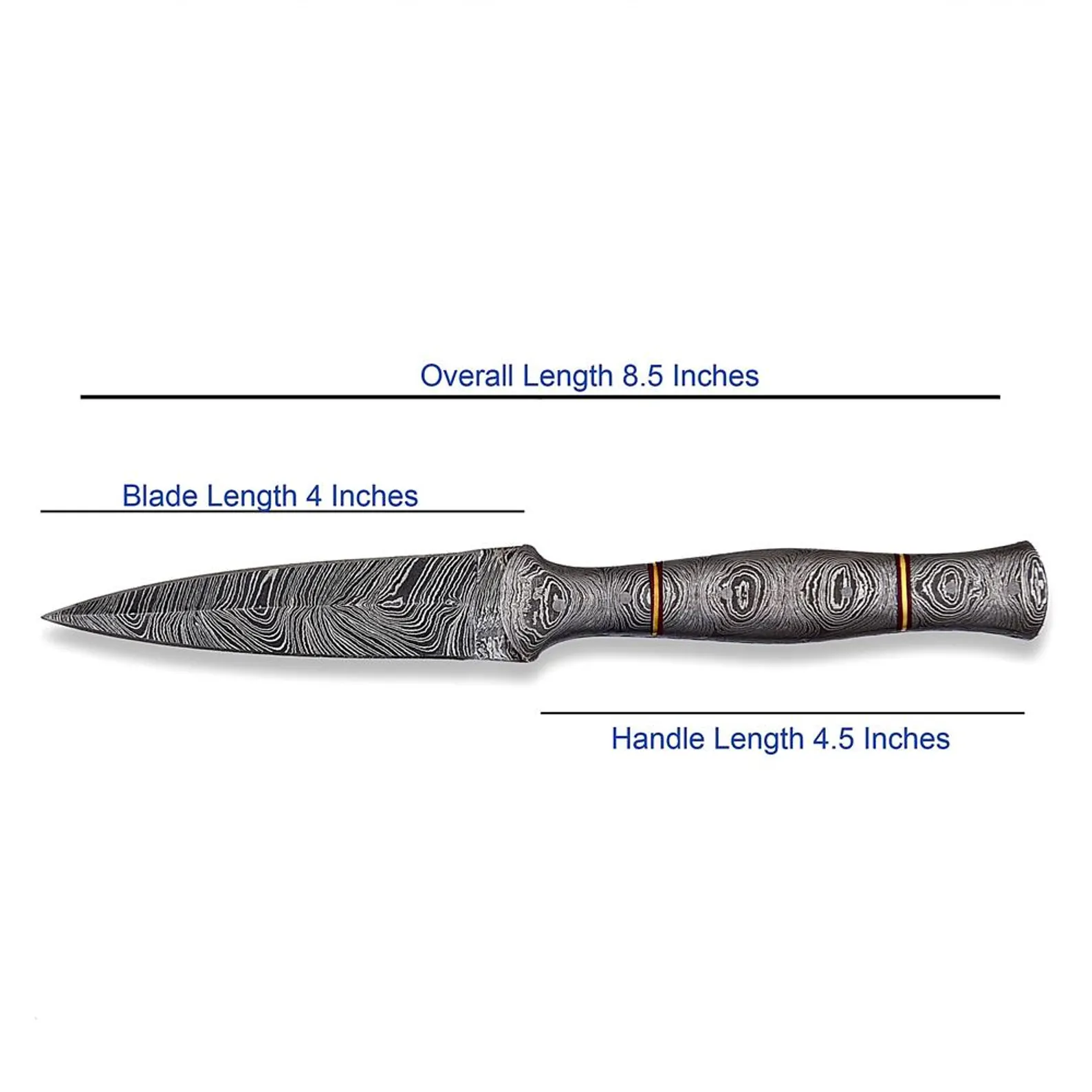
This patterned handle knife combines a slim fixed blade with an equally detailed handle. Grey and silver-toned lines extend across both sections, creating a coordinated appearance from the pointed blade to the rounded handle end. Two narrow red-and-gold-tone bands interrupt the otherwise monochrome design, adding small areas of colour without dominating the overall finish.
The knife’s appeal comes from the relationship between its shape and surface detail. Its outline is relatively simple, while the pattern changes from flowing lines on the blade to rounded, ring-like formations along the handle. This gives the product several details to explore without relying on a large guard, bright handle scales or prominent lettering.
The visible pattern has a Damascus-style appearance. That description refers to the finish shown in the image; it does not confirm the steel composition, handle material or manufacturing process.
A Slim Fixed-Blade Profile
The blade has an elongated, narrow outline that gradually tapers toward a pointed tip. Its width decreases along its length, giving the knife a different appearance from broad hunting blades, cleavers or heavily curved skinner designs.
This slim profile allows the surface pattern to remain prominent. Rather than spreading across a wide blade face, the lines follow a relatively narrow area and draw attention toward the point. The result is a design in which the pattern and silhouette work closely together.
The photograph establishes the proportions between blade and handle, but it does not provide actual measurements. The knife should therefore not be described as a particular size, weight or compact format. Those details need confirmation before a buyer can assess how it fits a planned use or storage arrangement.
Flowing Lines across the Blade
The blade face displays closely spaced light and dark lines. Some travel in longer bands, while others change direction and form smaller curves. These variations give the surface a flowing appearance rather than the uniform finish of a plain blade.
The pattern is visible across most of the blade face and continues close to the point. This makes it a central feature of the product, not simply an accent near the handle or along the upper edge.
Customers who enjoy patterned cutlery may appreciate how the lines change across the available surface. However, their appearance does not reveal whether they result from layered steel, an applied finish or another process. The correct material and production description should come from documentation for this exact knife.
Rounded Patterns along the Handle
The handle carries grey-and-silver markings that visually coordinate with the blade. Here, the pattern includes several rounded and oval formations surrounded by closely spaced contours. These create a different effect from the longer, more directional lines visible on the blade.
That difference helps distinguish the two sections while keeping the design cohesive. The blade looks more linear, while the handle introduces a sequence of ring-like shapes along its length.
The patterned finish also means that the handle remains visually interesting even when considered separately from the blade. For a customer selecting primarily on appearance, this is a useful distinguishing feature: the decoration extends beyond the cutting section and forms part of the entire knife design.
Matching Appearance without Material Assumptions
The blade and handle share a similar colour palette and pattern style. This creates an almost continuous visual theme, with the two coloured bands providing the clearest interruptions.
A coordinated appearance does not necessarily mean that the blade and handle are made from the same material. It also does not establish that the knife was formed from one piece. The image shows the external design, not the internal construction or the manufacturing sequence.
For that reason, this product is described as having a patterned blade and handle rather than as an all-Damascus or solid-steel knife. Customers can appreciate the matching finish while relying on confirmed specifications for material claims. This keeps the description useful to both design-focused buyers and those comparing construction details.
Two Red-and-Gold-Tone Bands
Two narrow bands add colour to the handle. Each combines dark red with a thinner gold-tone line, creating a warm accent against the grey and silver background.
Their spacing divides the handle visually into three areas. One band sits closer to the blade end, while the other is nearer the rounded rear. This arrangement gives the handle a sense of structure without covering much of its patterned surface.
The bands are decorative features visible in the image. Their materials and assembly are not confirmed, so they should not be advertised as brass spacers, precious-metal inlays or a particular synthetic material. Their verified contribution is the contrast they introduce through colour, position and width.
A Restrained Colour Combination
Most of the knife is finished in shades of grey, charcoal and silver. These neutral tones allow the fine lines to remain the main visual detail rather than competing with a strongly coloured handle.
The red-and-gold-tone accents introduce a deliberate change within that palette. Because they are narrow, they remain secondary to the overall pattern. They may appeal to customers who prefer a small amount of colour rather than a fully coloured grip.
This balance makes the design visually distinct from knives that use wood grain, bright resin scales or plain black handles. Its identity comes from patterned surfaces first, with the accent bands providing a finishing detail. The image offers a clear basis for deciding whether that combination suits an existing collection.
A Shaped Handle Outline
The handle is elongated and gently contoured. It narrows near the blade junction, broadens through the main grip area and finishes with a rounded, slightly flared end.
These changes in width give the handle a more shaped appearance than a straight rod or rectangular slab. The circular markings follow the visible surface across these contours, so the pattern remains integrated with the form.
The image does not show the full handle cross-section. It cannot establish whether the grip is round, oval or differently shaped on the reverse side. Likewise, comfort depends on dimensions and finish as well as outline. Buyers selecting for regular handling should review those details rather than assume a particular fit from the side view alone.
The Transition between Handle and Blade
Near the blade, the handle widens into a small flared section. This creates a visible boundary between the grip and the blade face without a large projecting crossguard.
The pattern continues across this transition, helping it remain part of the coordinated design. Its shape also gives the base of the handle a more defined outline than a simple straight junction would provide.
This feature can be described accurately through its appearance, but it should not be presented as a tested protective guard. The photograph does not establish its functional performance or the way the components are joined. For customers comparing models, it is primarily a useful visual distinction from knives with large guards or completely unflared handles.
A Rounded Handle End
The rear of the handle finishes in a rounded, slightly widened shape. The grey-and-silver pattern continues across this area rather than ending at a separate, plain-coloured cap.
This treatment keeps the visual theme consistent through to the end of the grip. It also gives the handle a softer outline than a squared or sharply angled rear section.
Small circular details are visible within the patterned surface, but their structural role cannot be established from the image. They should not be used to infer a particular fastening system or tang configuration. What is clear is that the rear remains relatively simple in shape, allowing the pattern to provide most of its decorative interest.
A Pointed Blade with a Plain Edge
The blade tapers to a clearly defined point. A narrow, lighter edge line is visible along one side, and no serrated teeth appear along the pictured blade outline.
This gives the knife a clean, uninterrupted profile. The surface pattern remains the dominant detail, while the point completes the elongated shape.
The image does not confirm the sharpening arrangement on both sides of the blade. It would therefore be inaccurate to call the product double-edged or to assign a specialised blade classification solely from this view. Sharpness, edge angle and cutting capability also require confirmation. The visible description can establish a pointed, non-serrated appearance without making performance claims that the photograph cannot support.
Fixed-Blade Format and Storage Considerations
The knife is shown in a fixed-blade configuration, without a folding pivot or closing mechanism. Its full outline remains extended, so any storage accessory must accommodate both blade and handle.
This is relevant when comparing it with a folding knife. A closed folder may fit a small pouch, whereas a fixed-blade design requires storage matched to its complete dimensions and blade shape.
No sheath or protective cover appears in the image. Inclusion should be checked through the actual package contents. A compatible accessory should be selected using confirmed measurements rather than visual similarity alone, since blade width, thickness and the shape of the handle junction can all affect fit.
Decorative Interest for Adult Collectors
This design may appeal to adult collectors who look for coordinated patterns across multiple parts of a knife. Its handle is as visually detailed as its blade, making the full object the focus rather than one decorated component.
The red-and-gold-tone bands provide another point of distinction. They separate areas of the handle while preserving most of the monochrome finish, giving collectors a recognisable feature to compare with other patterned knives.
No rarity, historical origin or limited production claim is established. The knife can be appreciated for the appearance shown without an unsupported story about its background. Buyers interested in provenance, maker information or a particular production method should obtain those details separately from the seller.
Comparing It with Other Patterned Knives
Many patterned knives combine a decorative blade with a visibly different handle material. This model instead presents a similar pattern style across both sections, producing a more unified appearance.
That distinction may matter when choosing between designs. A wood-handled knife creates contrast through material and colour, while this knife relies on the changing arrangement of lines and rings. The narrow bands then add contrast in a more concentrated way.
For a design-focused comparison, look at the complete arrangement: blade proportions, handle outline, pattern coverage and accent placement. These visible characteristics help distinguish the product without relying on unverified steel grades or manufacturing descriptions. Functional comparisons should then be made using the confirmed specifications of each individual model.
Considering It as a Gift
The coordinated finish and small coloured accents may make this knife worth considering as a gift for an adult enthusiast. Its decorative character is visible immediately, while the finer pattern details offer something to examine more closely.
The recipient’s interests should guide the choice. A collector who enjoys patterned finishes may value the appearance, while a buyer focused on practical use may place greater importance on steel, dimensions and construction.
A gift box, sheath, stand or engraving service is not confirmed by the image. These should be checked before ordering if presentation or personalisation is important. The pictured knife should not be described as a complete gift set unless the seller explicitly confirms the additional contents.
Practical Use Requires the Product Specification
Although the item is visibly a knife, the photograph does not establish its specific intended application. Its slim profile alone is insufficient to classify it as a fillet knife, steak knife, carving knife, letter opener or specialist outdoor tool.
Customers considering practical use should review the manufacturer’s stated purpose alongside blade dimensions, material and edge preparation. Those details provide a more reliable basis for choosing than appearance alone.
The same applies to claims about precision, flexibility or strength. A narrow blade may look suited to certain tasks, but its actual performance depends on geometry and construction that are not fully visible. This listing therefore focuses on the identifiable fixed-blade form and decorative design while leaving specialised applications unclaimed.
Measurements That Help Buyers Decide
Overall length, blade length, blade thickness and handle dimensions are not supplied in the image. There is no ruler or other dependable reference from which to calculate them.
These measurements are important because photographs can make small and large products appear similar. The relative proportions are visible, but they do not reveal whether the knife will fit a particular case or feel suitable in the hand.
Weight is also unconfirmed. The metallic-looking surface does not establish how heavy the handle is or where the balance point lies. A buyer comparing several knives should use actual measurements and weight figures where available. Those details complement the image by translating the visible design into a more practical understanding of the product.
Surface Appearance and Handling
The handle appears relatively smooth in overall contour, with its visual texture coming mainly from the light-and-dark pattern. The image does not show deep finger grooves, a wrapped grip or a prominently roughened surface.
This creates a clean appearance that suits the coordinated finish. However, a visible pattern should not be confused with a tested gripping texture. It does not establish how the handle behaves when dry, wet or used with gloves.
For customers who intend frequent handling, the actual finish and cross-section are worth checking. These details affect feel and grip independently of colour or pattern. The photograph helps explain the styling, while the finished product and its specifications should establish the handling characteristics.
Construction Details to Confirm
The image does not reveal the internal connection between blade and handle. It cannot confirm a full tang, hidden tang, one-piece construction or a particular fastening method.
Likewise, the two accent bands do not prove that the handle consists of three separate structural components. They may visually divide the surface, but the way they are incorporated is not shown.
These distinctions matter when assessing build specifications. Buyers should rely on information for this exact product rather than transfer details from another knife with a similar finish. The external design is clear enough to describe accurately, while claims about strength, assembly and manufacturing require separate support.
Care for the Blade and Patterned Finish
Appropriate care depends on the actual blade material, handle composition and surface treatment. Those details have not been confirmed, so a specific oil, polish or cleaning chemical cannot be recommended for this model.
The seller’s care instructions should explain cleaning, drying, storage and any maintenance needed to preserve the finish. Guidance is particularly useful when the surface pattern is a central reason for buying the product.
Sharpening recommendations should also correspond to the actual steel and edge geometry. Neither the pattern nor the slim silhouette establishes the correct sharpening method. Obtaining product-specific instructions allows the buyer to care for the functional edge and decorative surfaces without relying on assumptions about what a Damascus-style appearance means.
Package Contents and Available Options
One knife is shown against a white background. No sheath, presentation box, sharpening accessory or other separate item is visible.
Package contents should therefore be checked through the seller’s confirmed listing. This is also important when comparing prices, since a knife-only offer and a package with accessories are different products from a purchasing perspective.
Alternative sizes, different accent colours and personalisation services are not established. A supplier may offer customisation on another model, but that does not confirm those options here. If variations are available, the selected option should clearly identify any changes to the blade, handle pattern, bands or included accessories so that the buyer knows what to expect.
A Coordinated Design to Explore
The strongest visual feature of this patterned handle knife is its consistency. Grey-and-silver markings extend across the blade and grip, while changes in the pattern prevent the two sections from appearing identical. The coloured bands provide small, deliberate accents within that coordinated finish.
Its elongated blade and shaped handle keep the outline relatively simple, allowing the pattern to remain prominent. For an adult collector or gift buyer interested in decorative fixed-blade designs, these visible characteristics offer a clear basis for consideration.
Explore the image alongside the confirmed product specifications and package details to decide whether the design suits your preferences. Choose the combination of pattern, shape and colour that appeals to you, supported by verified information about the actual item.







Reviews
There are no reviews yet.