






Red and Blue Chef Knife with a Distinctive Two-Tone Blade
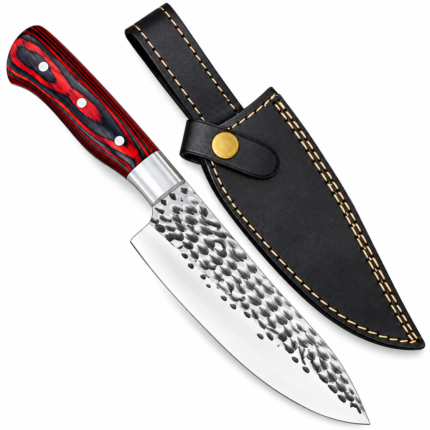
This red and blue chef knife combines a pointed blade, a contrasting dark upper finish, and a colorful handle with three silver-tone pins. Its appearance brings together the familiar outline of a kitchen knife and a more individual choice of colors. The bright blade face provides a simple background for the red, blue, and black pattern running through the handle.
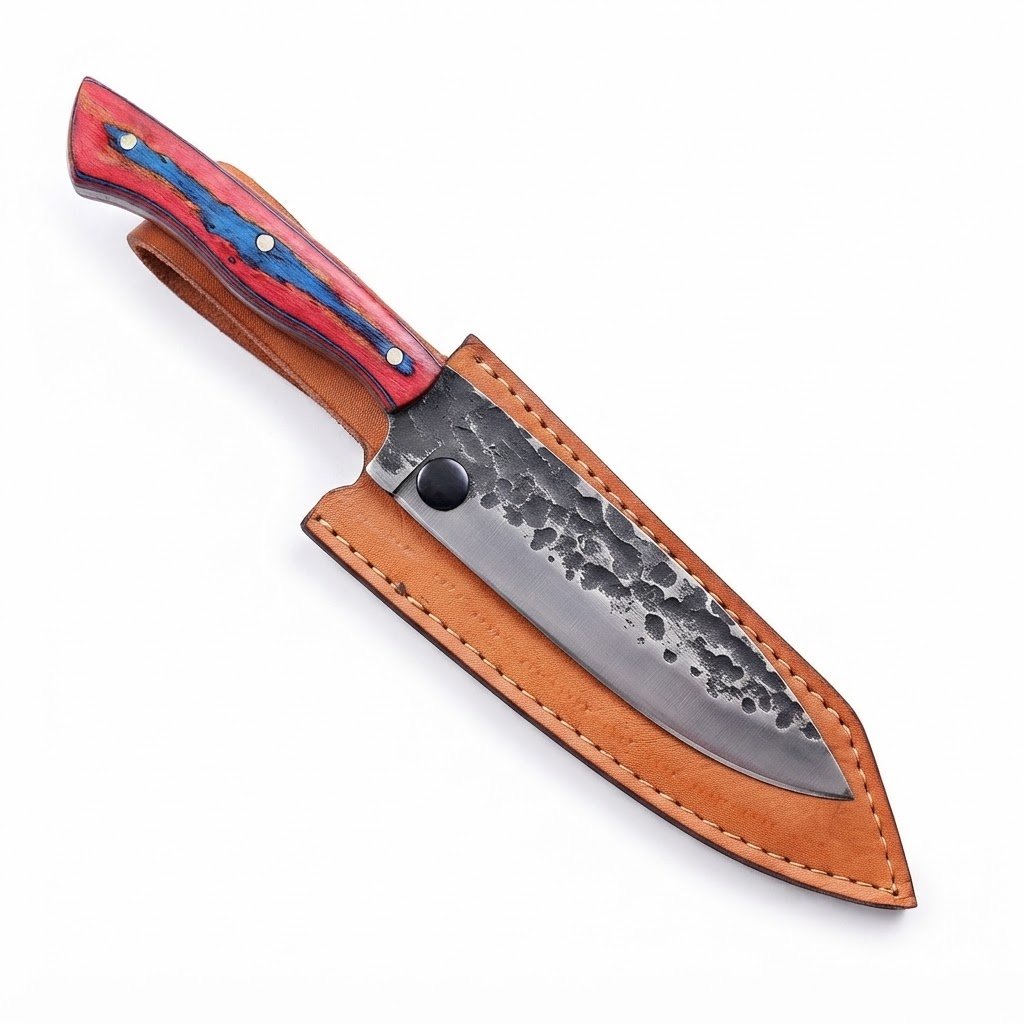
The knife is pictured diagonally across a tan stitched sheath. Together, the cool blade color, vivid handle, and warm sheath create a distinctive presentation. The sheath is visible in the photograph, although its inclusion in the purchase needs confirmation. The knife itself is the main product described here.
Its broad heel and progressively narrowing blade give it a chef-style profile. This is the type of shape associated with general food preparation, rather than a folding pocket knife or a rectangular cleaver. Exact suitability for particular ingredients depends on specifications that are not supplied with the image, including blade thickness, edge geometry, and material.
For customers drawn to colorful kitchen tools, the handle is the immediate attraction. For those who prefer a restrained blade design, the uninterrupted silver-colored lower face provides balance. The result is a knife with a clear visual identity that can be assessed without relying on exaggerated performance claims.
A Pointed Blade with a Broad Heel
The blade is widest near the handle and narrows gradually toward its pointed tip. Its cutting edge has a gentle upward curve as it approaches the front. This creates a flowing outline from the heel to the tip, with a profile that looks familiar within the chef’s knife category.
A broad blade near the heel gives the knife a substantial appearance in the photograph. However, width alone does not establish weight, strength, or suitability for heavy chopping. Those characteristics depend on the blade’s actual construction and measurements. Customers who prefer a lighter or heavier knife should compare the confirmed weight before choosing.
The pointed front distinguishes this design from kitchen knives with rounded or squared ends. It contributes to the long, tapered silhouette and gives the blade a more precise-looking outline. The photograph does not show the blade from above, so the thickness of the tip and the amount of taper along the spine remain unknown.
The visible cutting edge is plain rather than serrated. This supports its identification as a chef-style preparation knife. It should not be presented as a bread knife, saw-edge knife, or dedicated bone cleaver. A customer looking for those specific tools would need a different profile and confirmed specifications for the intended task.
Bright Blade Face and Dark Upper Detail
Much of the blade has a silver-colored finish with visible fine surface lines. Above it, a dark strip follows the spine and extends down toward the bright face in an irregular series of rounded marks. This contrast is one of the most recognizable details in the product image.
The transition between the two finishes gives the blade a rustic appearance. It is reasonable to describe what is visible as a dark textured upper section, but the photograph alone does not establish how that finish was created. Terms such as hand-forged, hammer-forged, or blacksmith-made would require information from the actual manufacturer.
The bright lower section remains visually simple. There is no visible flowing Damascus-style pattern across the blade face. The design instead depends on the contrast between the dark upper band and the lighter lower area. That distinction matters for customers comparing patterned blades with knives that have a more understated cutting face.
These finish details are primarily visual observations. They do not demonstrate corrosion resistance, reduced food sticking, edge retention, or ease of sharpening. Buyers can appreciate the appearance while checking the blade specification separately. This keeps the choice grounded in both personal taste and the practical requirements of the kitchen.
Red, Blue, and Black Handle Pattern
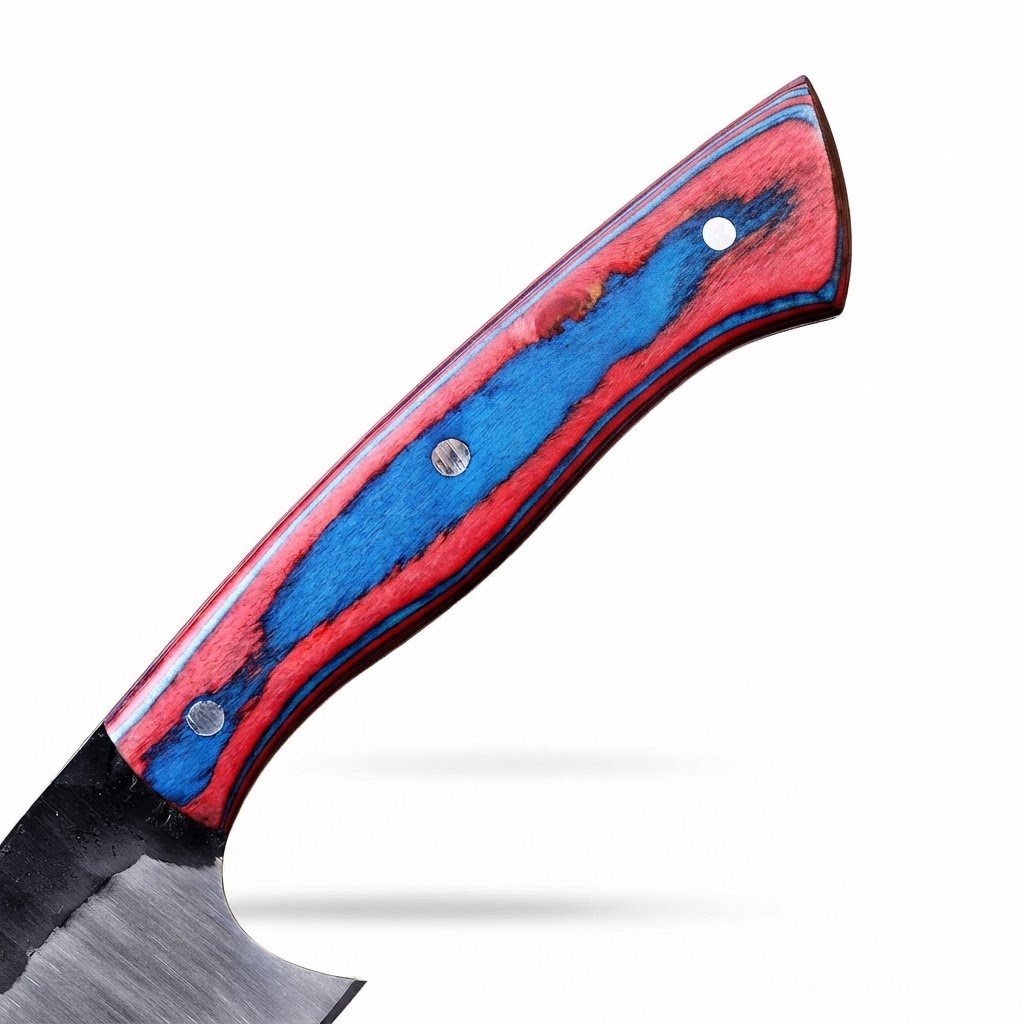
The handle features a vivid blue central area surrounded by red sections and irregular black boundaries. The colors run along its length in a flowing, grain-like arrangement. Rather than forming neat geometric blocks, they create an organic pattern that follows the curved shape of the handle.
Red is especially noticeable around the outer sections, while blue creates a strong line through the middle. Black accents divide the brighter colors and add definition. The combination gives the handle a bold appearance without requiring decoration on the blade itself. It is the main feature that separates this knife visually from plain-handled alternatives.
The image shows a grain-like surface, but it does not confirm whether the handle is wood, laminated wood, resin, a composite, or another material. Each of those materials can have different maintenance needs and physical properties. The appropriate description at this stage is a multicolored patterned handle.
The photographed colors should also be treated as a guide to appearance. Lighting, screen settings, and production differences can affect how a handle looks in person. If matching this exact red-and-blue arrangement is important, the supplied product photographs and variation details should be checked before ordering.
Three Silver-Tone Pins
Three round silver-tone pins are visible along the handle. One sits near the blade, another near the middle, and the third toward the rear. Their simple circular shape contrasts with the irregular colored pattern beneath them, giving the handle a more structured appearance.
The pins are spaced along the length of the grip rather than grouped in one section. Their placement creates a clear visual rhythm from front to back. Because they are bright and relatively plain, they complement the silver-colored blade without introducing another strong color into the design.
A narrow metallic-looking strip is also visible along parts of the handle edge. This appearance is consistent with a handle assembled around a tang, but one angled photograph is not enough to establish the complete internal construction. A confirmed full-tang specification should come from the manufacturer or a clear supporting view.
The visible pins should not be used as evidence of a particular fastening method, metal grade, or strength rating. For customers evaluating construction, close-up photographs and an accurate specification sheet are more useful than assumptions. The image does establish the three-pin appearance clearly, making it a suitable detail for the title and product summary.
A Curved Handle with a Flared Rear
The handle has a curved outline rather than a straight cylindrical shape. It narrows near the blade, follows a gentle sweep through the grip, and becomes broader toward the rear. This shape gives the knife a continuous visual flow from the cutting end to the handle tip.
At the back, the handle rises into a slightly flared end. The red, blue, and black pattern continues into this area, so the decoration remains consistent across the visible surface. Fine contrasting lines are also visible near the outer edge, adding definition to the silhouette.
The contour may appeal to customers who prefer shaped handles over straight-sided designs. However, comfort cannot be established from appearance alone. Hand size, grip preference, handle thickness, and the location of the knife’s balance point all influence how a knife feels during use.
Before choosing it for extended food preparation, compare the confirmed handle measurements with a knife that already feels comfortable. A front view, side view, and overall weight would help clarify the fit. The current image is useful for judging style and outline, but it does not show every aspect of the grip.
The Transition Between Blade and Handle
Near the front of the handle, the blade curves inward before meeting the broader heel below. This creates a pronounced rounded recess in the profile. The shape contributes to the knife’s distinctive appearance and separates the grip visually from the wider working section of the blade.
There is no large projecting metal guard or separate bright bolster visible in this view. Instead, the colorful handle meets the dark upper blade area directly. This keeps the transition visually compact and allows the contrast between the handle and blade finishes to remain prominent.
The recess should not automatically be advertised as a finger rest or a safety feature. Its intended function, edge treatment, and suitability for contact need confirmation. Customers who use different kitchen grips should assess the actual knife rather than assume the photographed contour is designed for a particular hand position.
This area also matters when comparing chef-style knives. Some customers prefer a substantial bolster, while others favor a more open heel. The photograph helps show this knife’s general arrangement, but details about sharpening access, balance, and finger clearance require measurements or an in-hand assessment.
Tan Stitched Sheath Shown in the Photograph
The accompanying sheath has a warm tan surface, darker edges, and contrasting light stitching. Its body narrows toward a pointed end that broadly follows the blade’s outline. The stitching traces the perimeter and gives the accessory a clearly defined border.
Near the opening, a short strap carries a dark round snap fastener. The strap is visible above the knife and adds another contrasting detail to the presentation. The reverse side of the sheath is not shown, so there is no basis for promising a belt loop, attachment system, or particular carrying arrangement.
The surface has a leather-like appearance, but genuine leather is not confirmed by the photograph. The same caution applies to its construction, lining, and fastening strength. Those details would need to be supplied separately if the sheath forms part of the sale.
Customers should check whether the sheath is included, optional, or used only for photography. If it is included, its fit should be confirmed for this specific knife. A pictured sheath can help explain the product’s presentation, but it does not establish package contents or a tested level of protection.
A Chef-Style Design for Food-Preparation Buyers
The blade’s shape places it most naturally within the chef’s knife category. Its broad rear section, pointed front, and plain edge resemble a general kitchen preparation tool. That makes kitchen knives a more informative website category than a broad label such as accessories or outdoor equipment.
Customers shopping in this category often want one knife for several ordinary preparation tasks. Vegetables, herbs, and boneless ingredients are common considerations when comparing chef’s knives. Whether this particular model is suitable for those tasks should be checked against the actual blade specification and the seller’s intended-use information.
Its appearance does not establish specialist performance. The product should not be described as a flexible filleting knife, a heavy bone chopper, or a dedicated carving knife without supporting details. Those categories depend on more than a pointed silhouette and can involve different blade dimensions and handling characteristics.
For a buyer, the useful starting point is to identify the preferred role in the kitchen, then compare the knife’s verified measurements and material. The red-and-blue handle can be a deciding style preference once the practical requirements are met. This approach makes the purchase more meaningful than choosing on color alone.
For Customers Who Prefer Colorful Kitchen Tools
The handle makes this design especially relevant to shoppers who enjoy a more colorful kitchen collection. It introduces strong red and blue accents while the blade remains largely neutral. That balance may appeal to someone who wants a distinctive individual knife without changing the appearance of every tool they own.
The black divisions within the handle help connect the bright colors to the blade’s dark upper finish. Meanwhile, the three silver-tone pins echo the lighter blade face. These repeated colors give the design visual consistency, even though the knife combines several contrasting surfaces.
Customers comparing several similar chef-style knives can use these details to distinguish this version quickly. The combination of a blue center, red outer areas, three pins, and dark blade strip is more specific than a generic description such as colorful knife. Clear photographs remain useful for checking the precise pattern.
This design may also interest someone choosing a kitchen-related gift. In that case, the recipient’s preferences matter as much as the appearance. Their preferred knife size, handle shape, and maintenance routine should guide the decision, with packaging and sheath inclusion confirmed separately.
Choosing the Right Size and Feel
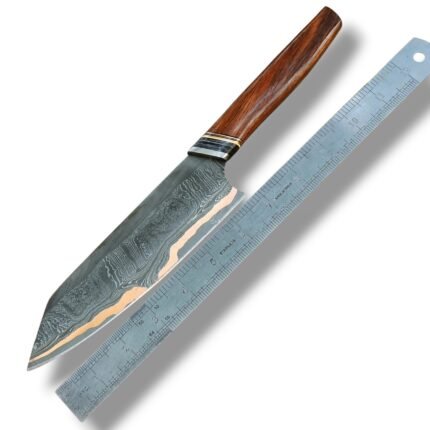
There is no ruler or other reliable scale reference in the photograph. As a result, the blade length, overall length, and handle dimensions cannot be stated accurately. The knife may look substantial in the image, but an isolated product photograph does not establish its actual size.
Blade length affects how a knife fits the user’s working space and preferred preparation style. Handle length and thickness affect grip, while total weight influences the overall feel. These measurements should be considered together rather than treating one number as a complete description of the product.
The photograph also cannot establish the balance point. A knife with a similar outline could feel blade-heavy, handle-heavy, or relatively neutral depending on its construction. Customers with a strong preference should request the weight and, where possible, information about how the knife balances.
A useful comparison is an existing kitchen knife that the customer already enjoys using. Checking its measurements against the product specification can make an online choice more informed. The image provides a good view of the design, while dimensions supply the practical context needed to judge suitability.
Material and Finish Details to Confirm
The blade alloy is not identified in the image. It should therefore be described by its visible finish rather than labeled stainless steel, high-carbon steel, Damascus steel, or a named alloy. The silver color and dark upper section are appearance details, not a reliable material test.
Likewise, the handle’s grain-like pattern does not prove a particular wood species or manufacturing process. Descriptions such as stabilized wood, pakkawood, resin-infused wood, or G10 require confirmation. Choosing the right material description matters because customers use that information to judge maintenance and everyday suitability.
Hardness, sharpening angle, edge retention, and factory sharpness are also unverified. These can be important purchase considerations, but they should come from reliable specifications or testing. A product image cannot support promises about how long an edge lasts or how easily it cuts.
The strongest basis for choosing this knife is therefore a combination of its documented appearance and a completed specification sheet. Its visual appeal is clear already. Confirmed material and construction details would allow customers to assess the practical qualities with the same confidence.
Care Information and Package Contents
Product-specific care instructions have not been supplied. Before regular use, obtain the manufacturer’s guidance for the blade, handle, and any included sheath. This is particularly useful where a knife combines several finishes or materials that may need different treatment.
Dishwasher compatibility, soaking resistance, oiling requirements, and suitable cleaning products should not be assumed. The same applies to sharpening equipment and recommended angles. Following instructions for the actual materials is more reliable than applying care advice intended for a different knife.
The photograph contains one knife and one sheath. It does not show a presentation box, sharpening stone, cleaning cloth, or additional accessories. Those items should only be listed as included when the package contents have been confirmed.
Color variations, engraving, custom logos, and alternative sheath options are also unconfirmed for this product. Similar knives may be offered with those services elsewhere, but availability on another supplier’s listing does not establish availability here. Customers should use the options explicitly attached to this product when making their selection.
A Distinctive Addition to a Kitchen Knife Collection
This knife’s strongest visual qualities are straightforward: a long pointed blade, a bright lower face, a dark textured upper strip, and a red-and-blue handle accented by black lines and three silver-tone pins. Each feature contributes to a recognizable design without needing decorative branding.
The tan sheath adds warmth to the photograph and shows how a contrasting accessory can complement the knife. Its material and inclusion remain separate details to confirm. The main product retains its individual appearance whether the customer is focused on the blade profile, handle colors, or overall combination.
For someone comparing chef-style knives, this design offers a clear aesthetic choice. It suits a preference for visible color and contrasting finishes, while its practical suitability depends on the confirmed dimensions, materials, and intended use.
Explore the product photographs, check the available specifications and package details, and choose this red and blue chef knife if its style and confirmed features suit your kitchen.






Reviews
There are no reviews yet.