





Red Blue Handle Karambit Knife – Distinctive Curved Blade and Colorful Handle Design
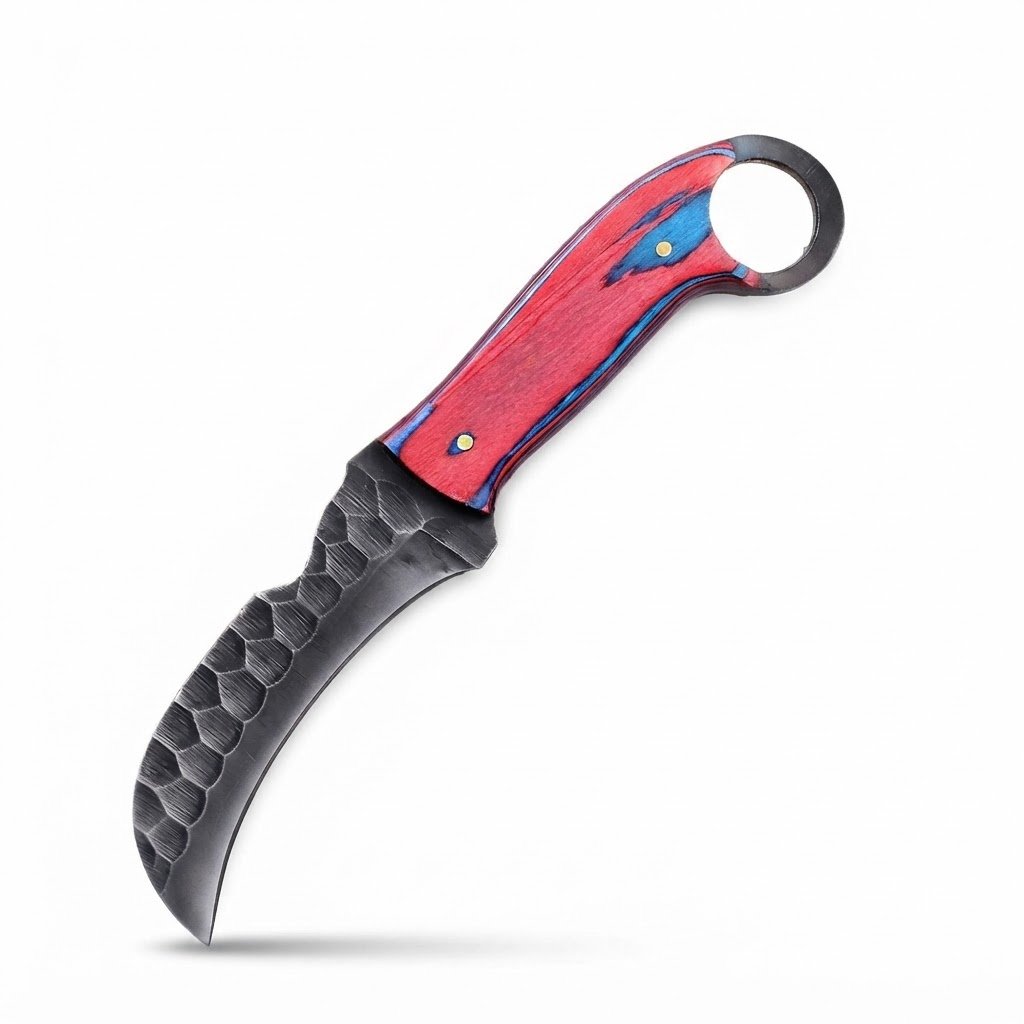
The Red Blue Handle Karambit Knife combines an unmistakable claw-shaped blade with a vibrant red-and-blue handle and a circular metal finger ring. Its curved fixed-blade design stands apart from conventional straight-edged knives, making it a distinctive addition to an adult knife collection.
The dark metallic blade contrasts with the colorful handle, while the patterned surface introduces a rugged visual character. The handle features red as its dominant color, enhanced by blue accents and black lines. Two small gold-colored pins complement the design.
At the rear, a large circular opening forms the characteristic finger ring associated with karambit-style knives.
The overall appearance is compact, decorative, and visually striking. This product is particularly suited to adult collectors and enthusiasts who appreciate unusual blade profiles and colorful handle designs.
The image does not confirm the blade’s steel composition, precise dimensions, hardness, country of manufacture, or handle material. Accordingly, the following description focuses on the visible design rather than unsupported technical performance claims.
Unique Claw-Shaped Blade Profile
The most recognizable feature of the Red Blue Handle Karambit Knife is its deeply curved blade.
The blade follows a pronounced inward-sweeping arc, creating the claw-like silhouette associated with karambit knives.
Rather than extending straight from the handle, the cutting portion curves substantially toward its pointed end.
This creates a dramatically different appearance from traditional hunting knives, kitchen knives, and utility blades.
The blade is relatively broad near its connection to the handle before narrowing along its curve.
The outer surface features a series of repeating, curved, scalloped impressions.
These marks give the blade a textured, forged-looking appearance.
The lower cutting region appears smoother and more reflective than the patterned upper section.
This contrast highlights the blade’s distinctive geometry.
The exact manufacturing process responsible for the surface pattern cannot be determined from the photograph.
It may be a decorative finish, a textured forging pattern, or another treatment.
Without supplier confirmation, the blade should not be described as hand-forged, Damascus steel, or made from a particular high-carbon steel alloy.
Dark Black Metallic Blade Finish
The blade features a dark charcoal-black appearance that complements the colorful handle.
Its surface includes lighter gray highlights where the metal catches the light.
The outer section has a repeating textured pattern, while the inward-facing blade surface appears smoother.
The combination produces a layered metallic appearance.
Dark blade finishes are commonly used to create visual contrast on decorative and outdoor-style cutlery.
However, the visible color alone does not establish whether this knife has a protective coating, chemical blackening treatment, heat-produced coloration, or another surface finish.
Likewise, corrosion resistance cannot be determined from its appearance.
The blade has a recognizable curved point, and the bright highlights emphasize its changing profile.
Because of this unusual geometry, the knife is best identified by its karambit form rather than classified under ordinary straight-edged knife designs.
Red Blue Handle Karambit Knife with Decorative Layered Grip
The handle is one of the most distinctive parts of this product.
It features a vivid red main surface with bright blue markings and darker outlining.
The red color covers most of the visible handle, creating a bold contrast with the black blade.
Blue accents appear along the edges and across parts of the upper handle.
Thin dark lines separate the colors and emphasize the layered appearance.
The handle surface resembles colored laminated wood or a similar composite material.
However, the exact material cannot be confirmed from the image alone.
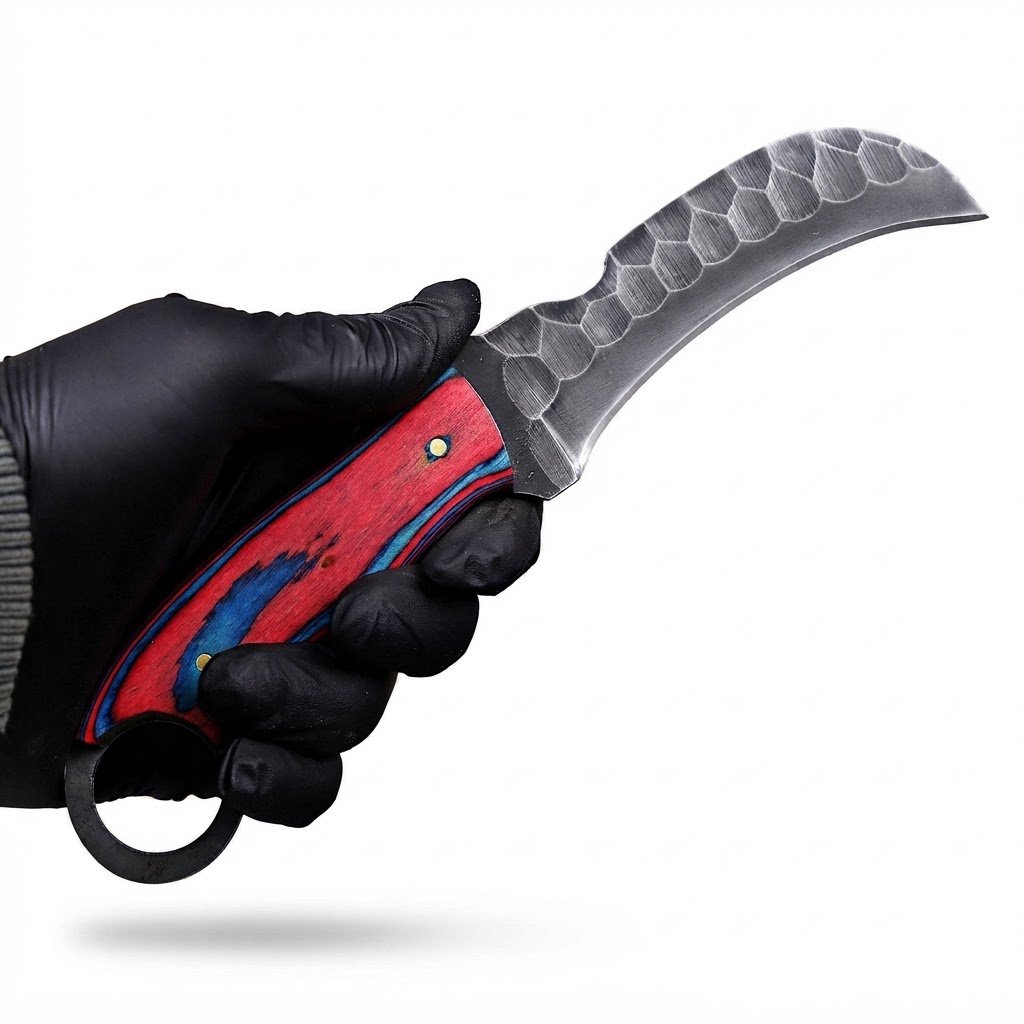
The handle has a gently curved profile that follows the overall shape of the knife.
Its front section tapers toward the blade connection, while the rear section rises toward the circular finger ring.
Two small gold-colored circular fittings are visible on the handle.
These provide contrasting decorative accents.
The photograph does not reveal the internal handle construction, the exact fastening method, or the material used for the colored scales.
For accurate product specifications, these details should be verified with the manufacturer before publication.
Circular Finger Ring Design
The Red Blue Handle Karambit Knife includes a large circular metal finger ring at the rear of the handle.
This is one of the defining features of a karambit-style knife.
The ring appears to be formed from a dark metallic section that extends beyond the colored handle.
Its circular shape is easily visible against the white background of the product photograph.
The metal around the opening has a smooth-looking outer profile.
The ring contributes significantly to the knife’s recognizable silhouette.
Its size and internal diameter are not available from the photograph.
Therefore, it would be inaccurate to claim that the opening fits all finger sizes or provides any particular level of retention.
The exact finish and material of the ring should also be confirmed with the supplier.
For collectors, the inclusion of a full circular ring is an important visual detail that separates this knife from ordinary curved-blade cutlery.
Compact Fixed-Blade Construction
The knife has a fixed-blade configuration.
This means the blade remains in an extended position rather than folding into the handle.
The image shows no folding hinge or blade-locking mechanism.
A dark metallic section connects the curved blade to the colorful grip.
This transition creates a clear visual boundary between the handle and blade.
Although the knife appears to have a continuous metal profile around the finger ring, the photograph does not confirm whether the blade uses full-tang or another internal construction method.
The exact construction should be checked before making strength or durability claims.
Fixed-blade knives come in numerous shapes and configurations, ranging from conventional outdoor knives to decorative specialty designs.
This particular model is distinguished by its claw-shaped blade and rear finger ring.
Its compact appearance may appeal to adult enthusiasts interested in specialized knife silhouettes.
Actual size should be provided in millimeters or inches once the manufacturer supplies the measurements.
A Distinctive Red, Blue, and Black Color Combination
The combination of red, blue, and black gives this karambit-style knife a strong visual identity.
The dark blade serves as a contrast to the colorful handle.
The red handle surface provides the dominant color, while blue accents introduce a decorative secondary tone.
Black lines and darker areas add depth to the pattern.
The two small gold-colored pins introduce another subtle metallic accent.
The overall effect is noticeably different from knives featuring plain black, natural brown, or uniformly colored grips.
The bright handle can make the product visually recognizable in a collection containing multiple knives.
For product photography and display purposes, the contrast between the handle and blade is particularly prominent.
This makes the knife suitable for catalog presentations focused on decorative blade designs and visually distinctive cutlery.
Traditional Karambit Influence
The karambit is a curved knife form historically associated with Southeast Asia, particularly the Indonesian region.
Its defining characteristics include a pronounced curved blade and, on many modern versions, a circular ring near the handle’s end.
Contemporary designs vary substantially in blade length, handle materials, finishes, and overall appearance.
The Red Blue Handle Karambit Knife reflects the modern decorative interpretation of this distinctive knife shape.
Its colorful handle and dark textured blade give it a more contemporary appearance than many traditional examples.
While its form resembles recognized karambit designs, the photograph does not establish its manufacturing origin or historical authenticity.
It should therefore be marketed as a modern karambit-style knife rather than a historical reproduction.
Collectors interested in various knife traditions may appreciate the product’s recognizable curved profile.
Decorative Blade Surface
The black blade includes a repeating series of raised-looking or recessed-looking marks along the outer portion.
These markings extend from near the blade’s connection to the handle toward its curved end.
Their shape resembles overlapping scallops or hammered metal impressions.
The pattern creates a visually textured effect.
Because the markings are arranged along the blade’s outer surface, they remain prominent when viewed from the side.
The polished-looking inner region contrasts with the patterned portion.
This makes the blade visually interesting even without additional decoration.
The exact depth of these marks cannot be reliably judged from the image.
They should be described as visible surface texture rather than specific mechanical features.
The pattern does not establish the blade’s steel grade, edge quality, or manufacturing method.
Those details require separate supplier verification.
An Interesting Addition to Knife Collections
Knife enthusiasts often collect designs that represent different shapes, finishes, and handle styles.
The Red Blue Handle Karambit Knife offers a recognizable combination of these characteristics.
Its short, strongly curved blade differs from conventional clip-point and drop-point profiles.
The blackened metal surface gives the blade a distinctive appearance.
The red-and-blue grip makes the knife immediately recognizable.
The circular finger ring completes the characteristic karambit silhouette.
Together, these details create a visually distinctive collectible knife design.
Collectors may choose products like this to explore variations in modern fixed-blade cutlery.
The knife can also serve as a visual reference for enthusiasts comparing handle decorations, blade finishes, and design proportions.
Its value and manufacturing quality should be assessed using verified specifications and physical inspection rather than appearance alone.
Materials and Construction Considerations
When evaluating the Red Blue Handle Karambit Knife, buyers should consider several important specifications.
The blade’s steel composition is especially relevant.
Different steels vary in maintenance requirements, hardness, and resistance to corrosion.
Since no material certificate or supplier specification is available, the blade cannot accurately be labeled as stainless steel, D2, 1095, or Damascus steel.
The handle material also requires confirmation.
Although its appearance resembles colored laminated wood, similar visual effects can be achieved with other materials.
The metallic pins and finger ring should likewise be identified by their actual compositions.
Blade length, overall length, thickness, and weight are important product details.
These figures should be measured or obtained from the manufacturer.
Providing accurate specifications helps potential buyers understand the physical characteristics of the product before purchasing.
Care and Maintenance
Proper knife maintenance depends on the materials and surface treatments used.
After handling, wipe the blade carefully with a clean, dry cloth.
Avoid leaving moisture or residue on exposed metal surfaces.
The blade’s dark finish should be treated cautiously until the manufacturer provides cleaning instructions.
Avoid abrasive cleaners that might damage decorative surface treatments.
If the blade requires a protective oil, choose a product appropriate for its confirmed steel type and intended use.
The colored handle should be cleaned gently without prolonged soaking.
Natural wood, laminated materials, and synthetic composites can respond differently to cleaning agents.
Because the handle composition is unknown, harsh solvents should be avoided.
Store the knife in a dry and secure location.
Inspect it periodically for surface deterioration, loosened fittings, or other visible signs of damage.
Safe Storage and Handling
The Red Blue Handle Karambit Knife has a curved cutting blade and pointed end.
It should be handled with care and stored securely when not in use.
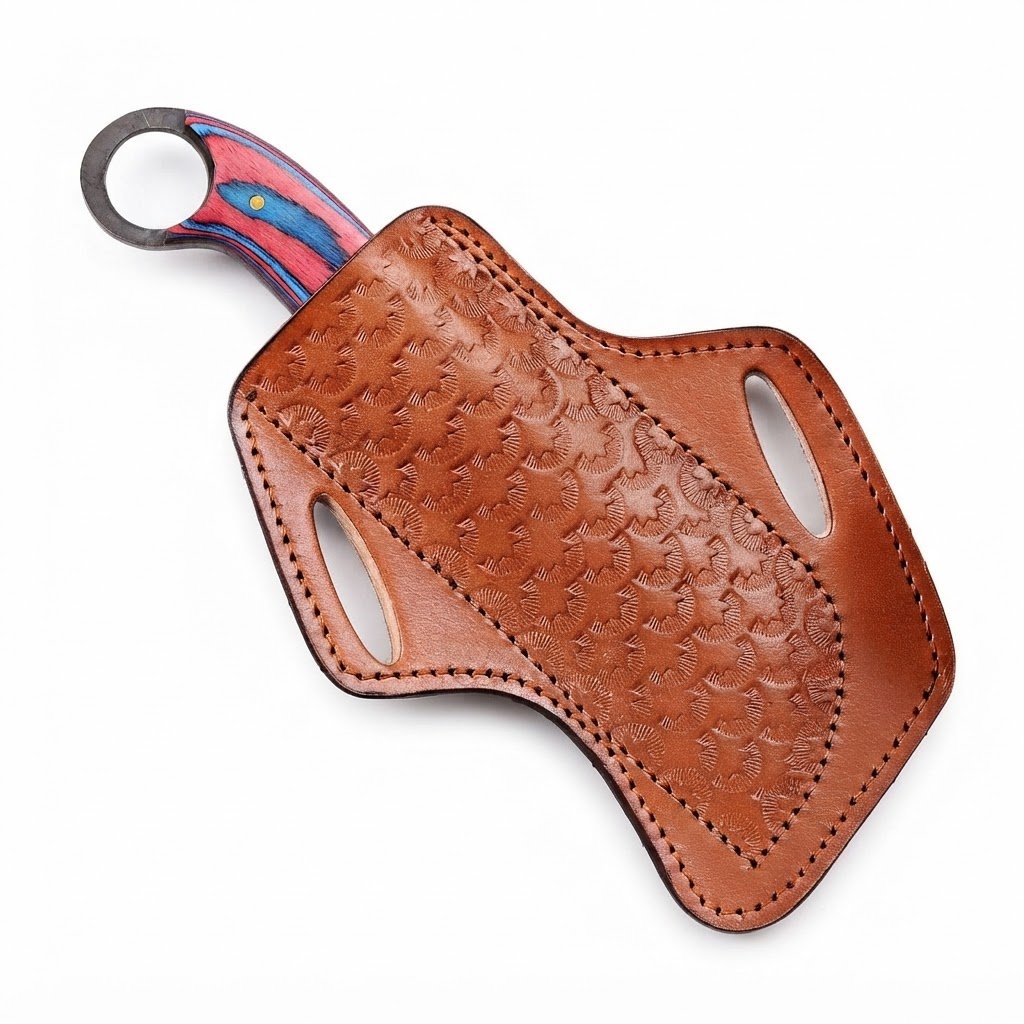
The image does not show a sheath, protective case, or blade cover.
Therefore, an included sheath should not be advertised unless the supplier confirms one is supplied.
A suitable protective storage solution should cover the entire blade and prevent accidental contact.
Keep the knife away from children and unauthorized users.
Owners should follow local regulations concerning possession, transportation, display, and storage.
The finger ring is part of the knife’s design, but its presence does not eliminate the need for careful handling.
Avoid making unverified safety or performance claims about the ring or handle.
Product Specifications to Confirm Before Purchase
A complete product page should include manufacturer-confirmed specifications.
Important information includes the overall knife length, blade length, blade thickness, blade steel, handle material, and product weight.
The exact finish of the black blade should also be identified.
Customers may want to know whether the handle has natural wood scales, layered composite scales, or another material.
The manufacturer should confirm the construction method and describe the included packaging.
If a sheath is supplied, its design and material should be specified.
These details are not established by the uploaded image.
Accurate information is particularly important when sourcing knives from wholesale suppliers, because visually similar designs can differ significantly in materials and manufacturing quality.
Wholesale and Supplier Considerations
Businesses sourcing karambit-style knives should confirm the exact product configuration before placing wholesale orders.
The supplier should provide clear photographs of the blade, handle, finger ring, and any included accessories.
A specification sheet can help distinguish the product from similar-looking models.
If customization is required, available colors, logos, packaging, and minimum quantities should be discussed directly with the manufacturer.
No specific customization service has been verified for the pictured knife.
The manufacturer should also confirm whether the quoted price applies to a single knife or a particular wholesale quantity.
Shipping charges, applicable import rules, and product restrictions can vary by destination.
These factors should be reviewed before placing an order.
Why Choose the Red Blue Handle Karambit Knife?
The Red Blue Handle Karambit Knife stands out because of its unusual blade profile and bright decorative handle.
Its claw-shaped blade is immediately recognizable.
The black metallic finish creates a striking visual contrast with the red-and-blue grip.
The textured blade surface adds character.
The gold-colored fittings provide subtle decorative accents.
The circular finger ring completes the design.
For adult knife collectors who appreciate modern karambit forms, these visible characteristics give the product an identifiable style.
Its overall appeal comes from the combination of curved metalwork and colorful decorative elements.
Before purchasing for a specific practical application, confirm the manufacturer’s technical specifications and intended-use recommendations.
Final Overview
The Red Blue Handle Karambit Knife features a dark, claw-shaped fixed blade, textured metal surface, colorful layered-looking handle, and circular metal finger ring.
Its distinctive design makes it an interesting option for adult collectors and enthusiasts of modern curved-blade knives.
Explore this karambit-style knife if you appreciate unusual blade geometries, decorative handle finishes, and recognizable fixed-blade designs.




Reviews
There are no reviews yet.