







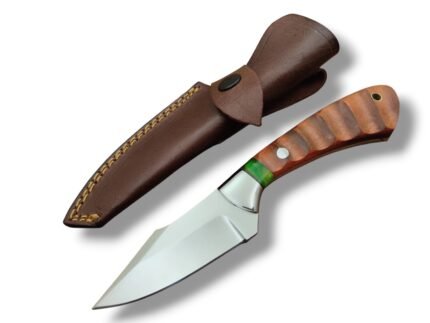
A rustic fixed blade knife with contrasting finishes
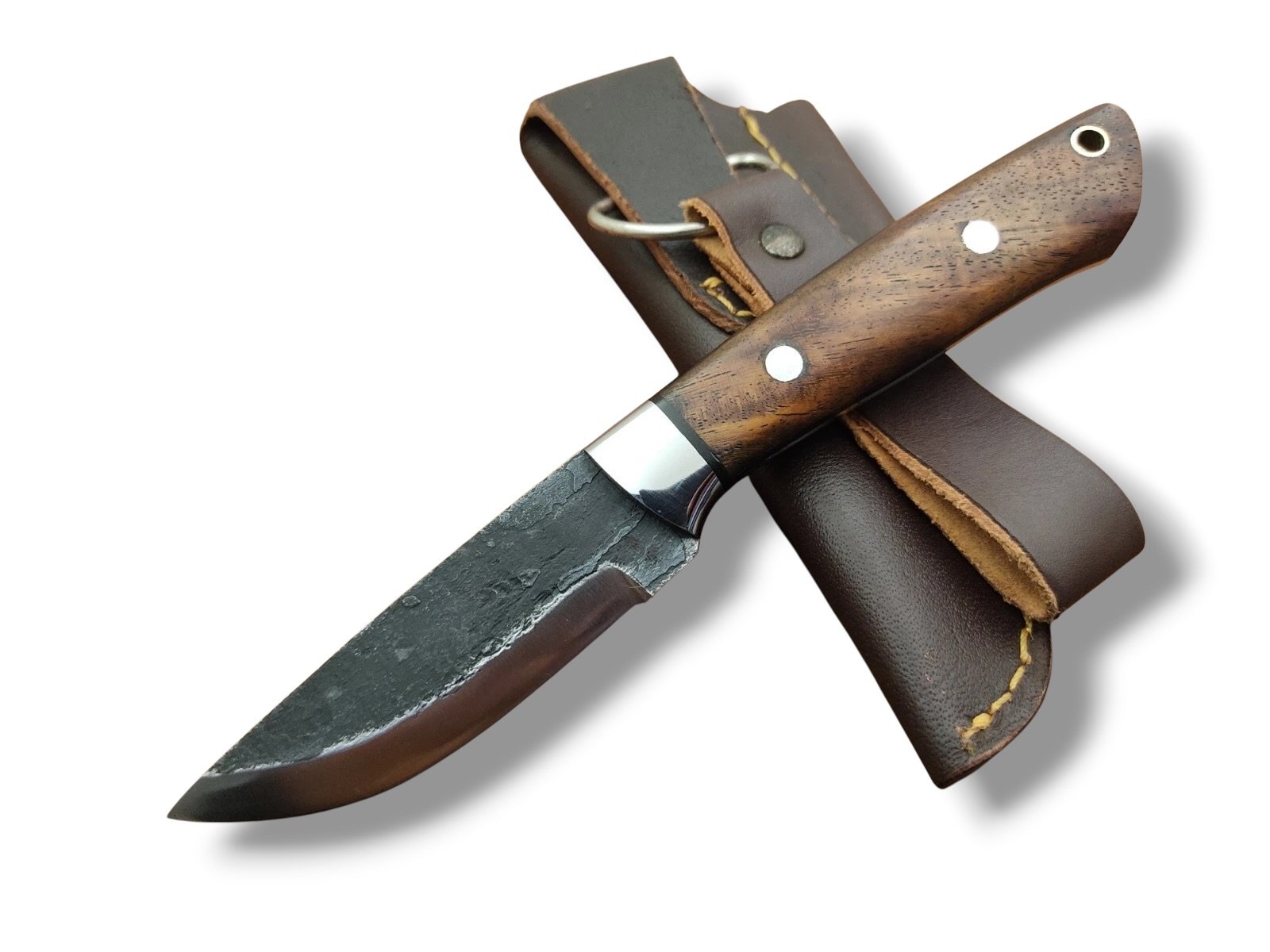
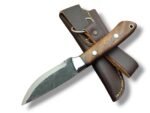
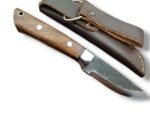
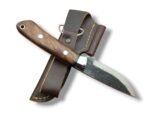
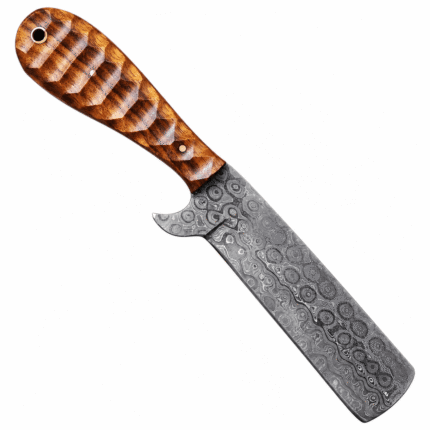
This rustic fixed blade knife combines a dark textured blade with a brown grain-pattern handle and a bright silver-tone bolster. Its appearance comes from the contrast between those surfaces: the blade face looks uneven and weathered, the lower bevel is smoother, and the handle introduces warm brown tones. Two round silver-tone pins and a metal-lined opening near the rear complete the visible handle details.
A brown stitched sheath is pictured behind the knife. Its broad straps, exposed edges, and metal hardware complement the knife’s understated appearance. Together, the pictured components create a coordinated look built around brown, charcoal, and silver rather than bright colors or elaborate decoration.
The design may appeal to buyers who prefer visible surface texture and traditional-looking handle styling. The photograph provides a clear view of those exterior features, while material specifications, dimensions, and intended applications require separate confirmation.
A dark blade face with visible surface character
The upper portion of the blade has a dark charcoal appearance with irregular marks and changes in texture. Some areas look relatively flat, while others show shallow ridges, patches, and uneven boundaries. This gives the blade a distinctly different appearance from a uniformly polished or patterned surface.
The texture continues across much of the visible face, from the area near the bolster toward the forward section. It is especially noticeable where the darker surface meets the smoother lower bevel. That uneven transition contributes to the knife’s rustic styling.
This appearance can resemble a forge finish, but the photograph does not prove that the blade was hand forged or identify how the texture was created. “Dark textured blade” accurately describes what is visible. Buyers specifically seeking a forged product should obtain manufacturing information for this exact knife before treating the surface appearance as evidence of its production method.
A smoother bevel creates a clear contrast
Below the textured face, a smoother band follows the blade’s curved lower outline. It appears more reflective than the upper section and catches warmer tones from the surrounding scene. The difference in finish makes the blade’s shape easier to distinguish.
The boundary between the two surfaces is irregular rather than perfectly straight. That detail adds visual interest without requiring etched artwork, printed markings, or a decorative pattern. The blade’s character comes primarily from its texture and changes in reflection.
The image does not establish the precise grind type, bevel angle, thickness behind the edge, or supplied sharpness. Those are technical characteristics that need measurement or manufacturer documentation. What can be described confidently is the visible contrast between the dark upper face and the smoother lower section. For buyers choosing by appearance, this contrast is one of the product’s most recognizable features.
A curved edge leading toward a tapered point
The blade has a continuous curved lower edge that rises toward the forward point. Its upper outline also narrows toward the tip, producing a tapered profile without a visible hook or serrated section. The overall silhouette is straightforward and uncluttered.
Near the handle, the blade broadens beneath the bolster before transitioning into the main cutting profile. The photograph shows this area from an angle, so the exact heel shape and cross-section cannot be established. A side-on photograph would make those details clearer.
The plain edge and curved outline are useful visual features when comparing this knife with other fixed blades. They do not, on their own, establish suitability for a specific task. That decision should also consider confirmed blade dimensions, steel specification, treatment, construction, and edge condition. The profile provides part of the picture; the technical specification supplies the rest.
A bright bolster separates blade and handle
A reflective silver-tone bolster sits at the front of the handle. It creates a clear visual break between the dark blade and the warm brown grip. Its smooth appearance also contrasts with the uneven texture immediately ahead of it.
The bolster follows the transition into the handle rather than forming a large projecting crossguard. Its lower outline curves into the blade area, giving the junction a shaped appearance. Reflections across the face make it one of the brightest parts of the product.
The photograph does not identify the bolster material or its attachment method. It should not be described as stainless steel, nickel silver, or another specific alloy without confirmation. Its visible role in the design is clear: it frames the front of the handle and connects the blade and grip through a contrasting finish. That detail adds definition while keeping the overall styling restrained.
Warm brown grain across the handle
The handle has a medium-brown appearance with darker markings and lighter streaks running along its length. Fine speckling and irregular lines create a wood-grain look that remains visible around the pins and near the rear opening.
Its color introduces warmth beside the charcoal blade and silver-tone fittings. The grain also provides a quieter form of detail than a brightly colored inlay or a strongly patterned composite. This makes the handle an important part of the knife’s rustic appearance without overwhelming the blade.
Although the surface looks like wood, the photograph does not establish a species or confirm whether it is solid wood, treated wood, or another material with a similar appearance. Buyers should avoid assuming walnut, rosewood, or another named timber from color alone. A verified material specification would allow the listing to describe the handle more precisely and support appropriate care guidance.
A gently shaped handle outline
The grip is relatively simple in outline, with a modest taper near the bolster and a fuller rear section. Its edges appear rounded, and the end is shaped rather than cut into a plain rectangular block. There are no visible deep finger grooves or large sculpted recesses.
That restrained shape complements the blade’s uncomplicated profile. The handle’s visual interest comes mainly from its grain, metal fittings, and changing width rather than an elaborate outline. It gives the knife a balanced appearance in the photograph.
Comfort cannot be assessed from the image. Handle length, thickness, cross-section, surface finish, and the user’s hand size all affect fit. Buyers who care about how the grip feels should request measurements and additional views. The photograph supports describing a gently contoured handle, but it does not justify claims about fatigue reduction, exceptional grip security, or universal ergonomic suitability.
Two silver-tone pins keep the detailing simple
Two round silver-tone pins are visible on the handle face. One sits closer to the bolster, while the other is positioned farther back. Their bright appearance connects visually with the bolster and provides contrast against the brown surface.
The pins are undecorated in the photograph, which suits the knife’s understated styling. Their spacing allows much of the grain pattern to remain uninterrupted. This simple arrangement is also a useful identifying detail when comparing the product with similar brown-handle knives.
The visible pins do not reveal the full internal construction. Their presence alone is not sufficient to confirm a full tang, a particular fastening method, or a strength rating. If tang construction matters to your purchase, obtain a clear specification or suitable additional photograph. The accurate description at this stage is a brown grain-pattern handle with two visible silver-tone pins.
A metal-lined opening near the handle end
A circular opening appears near the rear of the handle. A light metal-colored ring lines its perimeter, separating it visually from the surrounding brown surface. Its position close to the end makes it distinct from the two handle pins.
The opening may be intended for a lanyard or similar attachment, but its purpose and dimensions should be confirmed. No cord, strap, or bead is shown fitted through it. The product therefore should not be described as including a lanyard.
For buyers planning to add an accessory, the internal diameter and available clearance would be useful measurements. Those details cannot be reliably estimated from the photograph. As a visible feature, the opening adds a practical-looking finishing detail and helps distinguish the handle design. Any claims about accessory compatibility should wait until the actual measurements and intended use of the opening are known.
A brown sheath complements the knife’s appearance
The sheath pictured behind the knife has a dark brown outer surface and lighter exposed edges. Its color works with the handle while remaining dark enough to complement the blade. The knife and sheath therefore share a coordinated palette without using identical finishes.
The visible sheath outline narrows toward the lower end. Light-colored stitching follows part of the perimeter, and broad strap sections cross the upper area. Metal hardware adds another point of contrast near the top.
The surface resembles leather, but genuine leather is not confirmed by the photograph. The image also does not establish lining, thickness, retention, or the exact fit of the knife inside it. Its inclusion in the sale should be confirmed separately. “Brown sheath pictured” is accurate until the order specification establishes that the knife and sheath are supplied together.
Stitching, straps, and metal hardware
The sheath has several visible construction details. Yellow-tan stitching contrasts with the dark brown surface, while exposed edges reveal a lighter inner appearance. A broad loop-like section and a narrower tab with a round fastener are visible near the upper portion.
A metal ring sits within this arrangement, adding to the sheath’s traditional-looking presentation. Another broad strap section extends across the body behind the handle. These elements make the accessory more visually substantial than a plain sleeve.
The photograph does not establish how each strap functions when the knife is inserted or how the sheath attaches to clothing or equipment. It would be premature to specify a belt size, carry orientation, retention system, or removable mounting arrangement. Buyers who need a particular configuration should request photographs of the sheath on its own, including its reverse side and any closures.
A restrained combination of brown, charcoal, and silver
The product’s color palette is simple, but the differences in texture keep it visually interesting. The dark blade face provides the strongest surface character. The handle contributes warmer grain, while the bolster and pins introduce small reflective accents.
The pictured sheath repeats the brown tones in a darker shade. Its stitching and raw-looking edges add another layer of detail without competing with the knife. This creates a coordinated presentation based on related colors rather than matching decorative patterns.
For buyers who prefer understated designs, that balance may be part of the appeal. The knife can be appreciated for its silhouette and material-like textures without needing elaborate artwork or branding. Actual shades and reflectivity may differ under other lighting. Neutral-light photographs would be useful when comparing the product with an existing collection or matching it to separately purchased accessories.
A fixed-blade format with a fitted handle
The image shows a blade extending directly from a completed handle. There is no visible pivot, folding joint, or opening mechanism. The appropriate broad product category is therefore fixed-blade knives.
This distinguishes the product from a folding pocket knife or an unhandled knife blank. The pictured grip is already fitted, and the bolster forms a visible transition between the handle and blade. The presentation is of a complete knife rather than a component for handle-making.
That identification does not establish the construction hidden inside the grip. The tang’s length, width, and attachment cannot be verified from this angle. Those details should be requested if they influence the intended use. Keeping the exterior format separate from unseen construction allows the listing to describe the product clearly without assigning specifications that the photograph does not support.
Choosing the product around your intended use
This design may interest buyers who like rustic-looking fixed blades, brown handles, and textured blade surfaces. Collectors and design-focused gift buyers may find those visual qualities sufficient to shortlist the product for closer consideration.
Practical users will need more information. A photograph cannot confirm which cutting tasks the manufacturer approves, how the blade performs, or what level of use the construction supports. Those questions depend on specifications and guidance for the exact model.
Before choosing the knife for a particular purpose, establish its intended application and compare the relevant dimensions, materials, and construction with your requirements. Avoid relying on another knife that happens to look similar. A matching handle color or blade texture does not establish equivalent performance. The most useful purchase decision combines the appearance you prefer with verified details that suit how you expect to use the product.
Measurements that help establish scale
There is no ruler or reliable size reference in the photograph. The knife occupies much of the frame, but that does not establish its overall length or whether it should be described as compact, medium-sized, or large.
Useful measurements include overall length, blade length, maximum blade width, blade thickness, and handle dimensions. Total weight would provide further context when comparing it with another fixed blade. A side view would also help show the thickness of the handle and bolster.
If the sheath is supplied, its dimensions and compatibility should be confirmed as well. This is particularly important when buying online, where the product cannot be handled before purchase. Measurements should apply to the exact version being ordered. If several variants share the same listing, check that the selected size, photograph, and specifications refer to the same item.
Confirming the material and supplied edge condition
The dark blade surface does not establish carbon steel, stainless steel, Damascus construction, or a particular heat treatment. It also does not confirm hardness or corrosion resistance. These characteristics require manufacturer information or reliable documentation.
The same applies to the handle, bolster, pins, and sheath. Their visible appearance provides useful descriptive language, but specific material names should only be added after confirmation. This prevents a similar supplier’s specifications from being applied to the wrong product.
The supplied edge condition is another point to verify. A smoother bevel and defined edge in a photograph do not prove that the knife arrives sharpened to a particular standard. Ask the seller to state the supplied condition and provide relevant maintenance guidance. Accurate information about these details is more helpful to a buyer than unsupported promises about sharpness, durability, or long-term performance.
Checking the complete package
The image presents one knife with one sheath behind it. It does not show a box, certificate, sharpening accessory, spare fittings, or additional items. None of those should be assumed to be part of the order.
Even the pictured sheath should be confirmed in the package description before the product title promises that it is included. Some sellers use accessories for presentation, while others supply them as part of a complete package. A clear statement from the seller resolves that uncertainty.
If you are purchasing the knife as a gift, packaging details may matter alongside the product itself. Confirm whether it arrives in a basic shipping package or a presentation box. If you are buying several units, also check whether each knife has its own sheath and packaging. These details help establish exactly what the quoted price covers.
Care information should follow confirmed materials
No product-specific care instructions accompany the photograph. The correct cleaning, maintenance, and storage guidance depends on the actual blade alloy, handle material, bolster finish, and sheath construction.
For that reason, this description does not assign a particular oil, polish, conditioner, or sharpening method. A product with several different surfaces may need more specific guidance than a plain all-metal item. The dark blade finish also deserves attention because some treatments could alter its appearance.
Request care instructions for the exact version supplied and keep them with the product. If the sheath is included, obtain its maintenance guidance separately where necessary. This is especially useful for a gift or collection piece, since the eventual owner may not have been involved in confirming the materials. Reliable care advice should follow the product specification rather than assumptions based on texture or color.
Take a closer look at the details
This rustic fixed blade knife stands out through the contrast between its dark textured blade, smoother bevel, warm brown handle, and reflective bolster. The two pins and rear opening provide simple finishing details, while the pictured sheath reinforces the coordinated brown-and-charcoal appearance.
Additional photographs would help complete the view. The opposite side, blade spine, handle cross-section, and sheath reverse could clarify details that are hidden in the main image. These views are particularly useful when comparing similar products or checking a specific feature before ordering.
Review the confirmed dimensions, materials, intended application, and package contents alongside the design. If those details match your requirements, explore this knife as an understated choice with visible surface character and traditional-looking styling. Choose the version whose verified specifications support the appearance and purpose you have in mind.








Reviews
There are no reviews yet.