





Stag-Style Handle Knife with Traditional Detailing
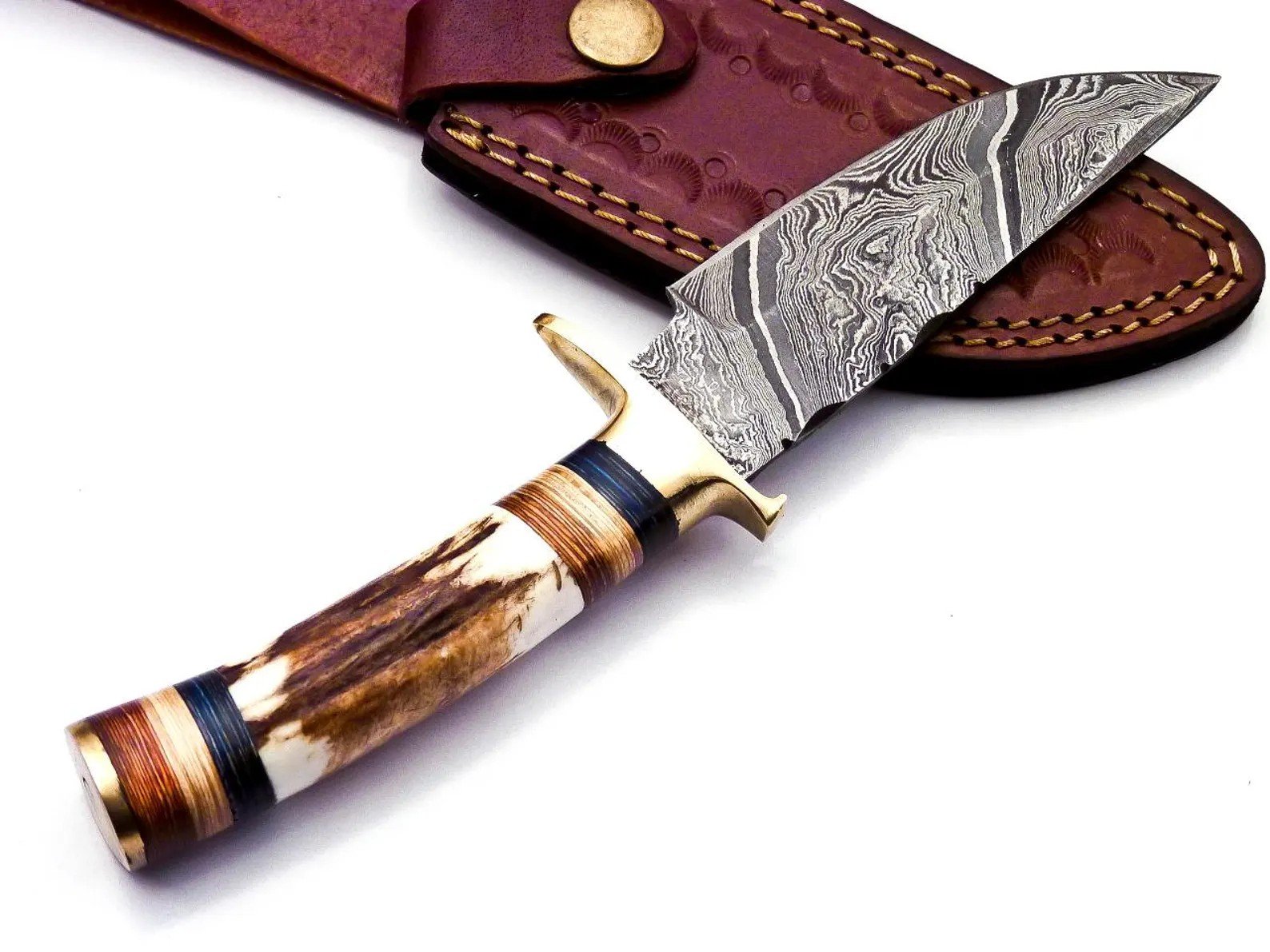
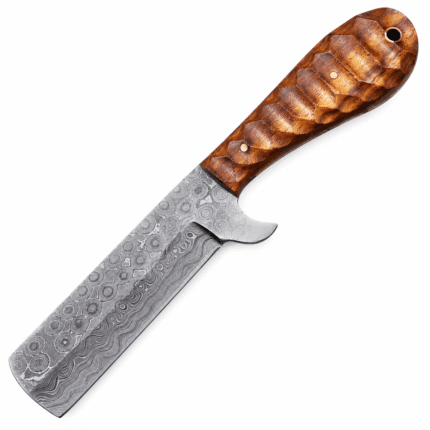
This stag-style handle knife combines a patterned fixed blade with a cream-and-brown textured grip, contrasting handle bands, and a gold-tone guard. Its appearance draws on traditional knife styling, with a broad blade, a prominent handguard, and a handle assembled visually from several distinct sections. The contrast between the darker blade markings and the lighter central grip makes each part easy to appreciate.
The design offers more than a single decorative feature. Fine lines run across the blade, irregular brown texture breaks up the cream handle, and narrow bands introduce reddish-brown, pale, and near-black colouring. A gold-tone end cap completes the rear of the grip. Together, these elements create a coordinated appearance for customers who enjoy detailed fixed-blade knives.
A Broad Blade with a Sweeping Edge
The blade has a broad face and a plain cutting edge that sweeps upward toward the point. Its outline is fuller through the middle and gradually narrows toward the front. Close to the guard, a short, more rectangular blade section creates a visible transition into the main blade face.
These proportions are an important part of the knife’s appearance. The broad surface gives the pattern room to develop, while the curved lower edge creates a continuous line toward the tip. The photograph does not provide a scale reference, so the knife’s overall size cannot be determined accurately. Its substantial appearance should not be confused with a confirmed blade length, thickness, or weight.
Flowing Damascus-Style Blade Markings
The blade displays closely spaced silver-grey and dark lines arranged in flowing curves. Some sections form irregular concentric shapes, while others stretch across the surface in longer waves. Broader dark bands interrupt the finer markings, adding contrast and making the pattern more varied along the blade’s length.
“Damascus-style” describes this visible appearance. It does not confirm the steel grade, number of layers, or manufacturing method. Those specifications require information about the exact product. Customers who value the patterned look can assess it directly from the photograph, while buyers seeking a particular Damascus construction should obtain supporting material details before making their selection.
Pattern Variation from Heel to Tip
Near the handle, the markings include relatively straight lines mixed with tighter curves. Across the main blade face, the pattern changes into larger irregular shapes surrounded by fine parallel lines. Toward the point, the markings follow the narrowing blade outline and continue almost to the visible edge.
This variation gives the blade a different appearance at different viewing distances. From farther away, the contrast between light and dark areas is most noticeable. Up close, the finer lines become the main point of interest. The photograph shows this particular pattern arrangement; it does not establish whether every supplied knife has an identical pattern or whether individual examples differ.
A Cream-and-Brown Central Grip
The middle of the handle has a pale cream base with irregular brown textured areas. The brown section appears rougher and more pronounced than the surrounding lighter surface, creating the stag-style appearance that distinguishes this design. Its uneven colouring contrasts with the more orderly bands at either end.
The description uses “stag-style” to identify the look without confirming genuine antler. The image alone cannot establish the material’s source or composition. Natural antler, another natural material, and an imitation finish can require different product descriptions and care methods. For buyers who specifically want genuine stag antler, confirmation from the seller is an essential specification rather than something to infer from appearance.
Texture That Gives the Handle Character
The central grip has visible changes in texture and colour rather than a completely smooth, uniform face. Brown ridges and irregular patches run along part of its length, while cream areas remain exposed around them. This creates a rustic appearance that suits the patterned blade and traditional fittings.
Texture can influence how a handle feels, but the photograph does not demonstrate grip performance. The depth of the ridges, the shape of the reverse side, and the overall thickness are not shown clearly enough to assess handling. The reliable visual benefit is character: the centre section introduces a distinctive surface that separates this knife from models with plain or consistently patterned grips.
Contrasting Bands Near the Guard
Between the central grip and the guard, the handle includes several contrasting bands. Reddish-brown and pale sections sit beside a darker near-black band. Fine lines within the brown areas give them a layered appearance, adding detail even before the eye reaches the blade.
These bands create a deliberate transition between the lighter central handle and the brighter guard. They also make the design more specific when comparing potential matches. A similar knife with a plain handle may differ considerably in appearance. The photograph does not confirm whether these sections are wood, resin, leather, or another material, so their colours and visible arrangement are the appropriate features to describe.
Matching Detail at the Rear
The rear of the handle repeats the same general colour family: reddish brown, pale cream, dark colouring, and a gold-tone end cap. This repetition gives the grip a coordinated appearance from front to back. The central textured section is framed by more regular bands, making it stand out clearly.
The rear bands are not presented as adjustable or removable components. Their internal construction cannot be seen, and the image does not show how the handle is assembled. What can be assessed is their visual role. They finish the handle with a more structured appearance and echo the detailing near the guard without introducing an unrelated colour or decorative theme.
A Prominent Gold-Tone Guard
The guard extends beyond the handle and blade junction, with a longer curved projection on one side and a shorter upturned end on the other. Its bright gold-tone surface contrasts strongly with the grey blade and darker handle bands. This is one of the clearest features in the knife’s silhouette.
The photograph shows the guard’s shape, but not its exact dimensions, material, or attachment method. It should therefore be described as gold-tone rather than confirmed brass. Its presence also does not establish a tested level of hand protection. Customers comparing traditional designs can appreciate the visible form while relying on manufacturer information for construction and operating details.
A Coordinated Gold-Tone End Cap
At the opposite end of the handle, a gold-tone cap repeats the guard’s warmer metallic colouring. This creates a visual connection between the front and rear fittings. The cap is smaller and simpler in appearance than the guard, allowing the blade junction to remain the stronger focal point.
Only part of the end cap is visible from this angle. The photograph does not reveal its complete rear face, fastening arrangement, or whether it has any intended function beyond finishing the handle. It should not be described as an impact tool or assigned a particular metal composition without confirmation. Its supported role in the listing is a visible decorative and finishing detail.
Fixed-Blade Configuration
This knife has a fixed-blade layout. The blade extends directly from the guarded handle, and no folding pivot or opening mechanism is visible. The overall arrangement is appropriate for the fixed blade knife category rather than folding or pocket knives.
That format describes the configuration, not the knife’s strength or intended workload. The image does not reveal the internal tang, heat treatment, or assembly quality. Terms such as full tang, heavy-duty, or one-piece construction would require separate evidence. Customers choosing a fixed blade for practical use should consider those specifications alongside its appearance, especially if they have a particular application in mind.
For Customers Who Appreciate Traditional Designs
This model may appeal to collectors who enjoy the combination of patterned blades, textured light-coloured grips, and contrasting fittings. Its appearance brings together several details that are easy to identify individually, yet visually connected through repeated colours and finishes.
The cream-and-brown centre gives the handle a rustic character, while the darker bands add definition. The guard and end cap introduce brighter highlights, and the blade supplies the most intricate pattern. For a design-focused buyer, these visible elements offer a useful basis for comparison with simpler fixed-blade knives. They help explain why this particular style may suit a collection without making claims about rarity or craftsmanship.
Considering It as a Gift
A traditionally styled knife can interest a recipient who already enjoys collecting or studying knife designs. This example offers a patterned blade and a handle with several contrasting sections, giving the recipient multiple details to examine. Its appearance may be especially relevant when the buyer knows that the recipient prefers lighter, textured handles over plain dark ones.
Practical preferences still matter. Size, weight, blade material, handle composition, and included storage accessories can all influence whether the knife is a suitable choice. No gift box or presentation packaging appears in the photograph. Such items should be confirmed separately rather than assumed from the decorative nature of the product.
Matching the Knife to Its Intended Use
A knife is a cutting tool, but the approved applications for this exact model have not been supplied. The photograph does not establish suitability for specific outdoor, workshop, or food-preparation tasks. Customers planning regular use should review the manufacturer’s recommended purpose and technical specifications.
The patterned finish does not demonstrate sharpness or edge retention. Similarly, the guard and textured-looking grip do not prove performance under demanding conditions. A useful purchasing decision combines the visible design with confirmed information about the blade, handle, and construction. This allows customers to choose for their actual needs rather than treating traditional styling as evidence of a particular capability.
Measurements That Make Comparison Easier
Overall length, blade length, blade width, blade thickness, handle length, and weight are all important details for an online knife purchase. They help translate a photograph into a clearer understanding of the physical item. None of these measurements can be verified from the supplied image.
Handle measurements are particularly useful because the central grip and contrasting bands occupy different portions of its length. A customer may prefer more gripping space or a different thickness. The guard’s width may also matter for storage. Comparing confirmed measurements with a knife the customer already owns is more dependable than estimating size from the image alone.
Materials and Manufacturing Details
The photograph establishes the colour, shape, and visible surface details of the knife. It does not confirm genuine stag antler, brass fittings, layered Damascus steel, or a particular species of wood. Those material claims should be added only when the seller has documentation or reliable manufacturer information for this exact model.
Manufacturing descriptions also need their own evidence. The decorative appearance does not establish that the knife is handmade, hand-forged, or produced in a particular country. Clear specifications help customers distinguish between design preferences and technical requirements. They also prevent details from a similar-looking supplier product from being incorrectly applied to the pictured knife.
What Is Included in the Photograph
The supplied image shows one fixed-blade knife positioned diagonally against a white background. The visible side includes the patterned blade, gold-tone guard, textured central grip, contrasting bands, and rear cap. No sheath, storage pouch, display stand, sharpening accessory, or box is shown.
The reverse side and a full view of the spine are also unavailable. Additional photographs would help customers inspect the opposite handle face and understand the knife’s thickness. Package contents should be stated separately when confirmed. This keeps the listing clear about the item shown and avoids promising accessories that may not be part of the order.
Care and Final Selection
Material-specific maintenance should follow the manufacturer’s instructions. The correct approach depends on the actual blade alloy, handle materials, and fitting finishes. A patterned blade is not automatically stainless, and a textured light-coloured handle should not be assumed to tolerate soaking or strong cleaners. No verified care instructions have been supplied for this model.
This stag-style handle knife offers a distinctive combination of flowing blade markings, cream-and-brown texture, contrasting handle bands, and gold-tone fittings. Review the visible design together with confirmed dimensions, materials, intended uses, and package contents. Explore this model if you are looking for a traditional fixed-blade appearance with detailed finishes from the blade through to the handle end.







Reviews
There are no reviews yet.