



A turquoise accent fixed blade knife with Western-inspired styling
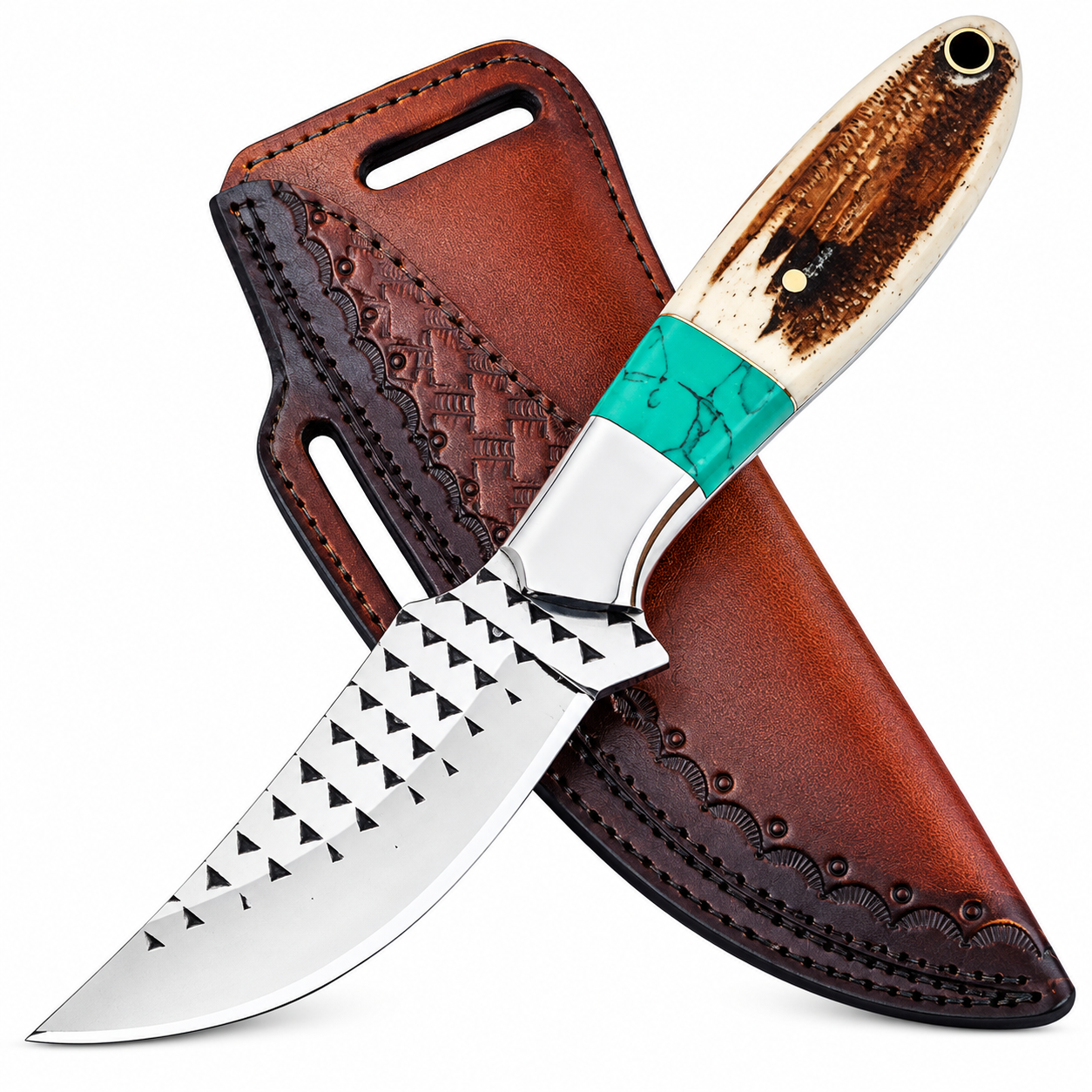
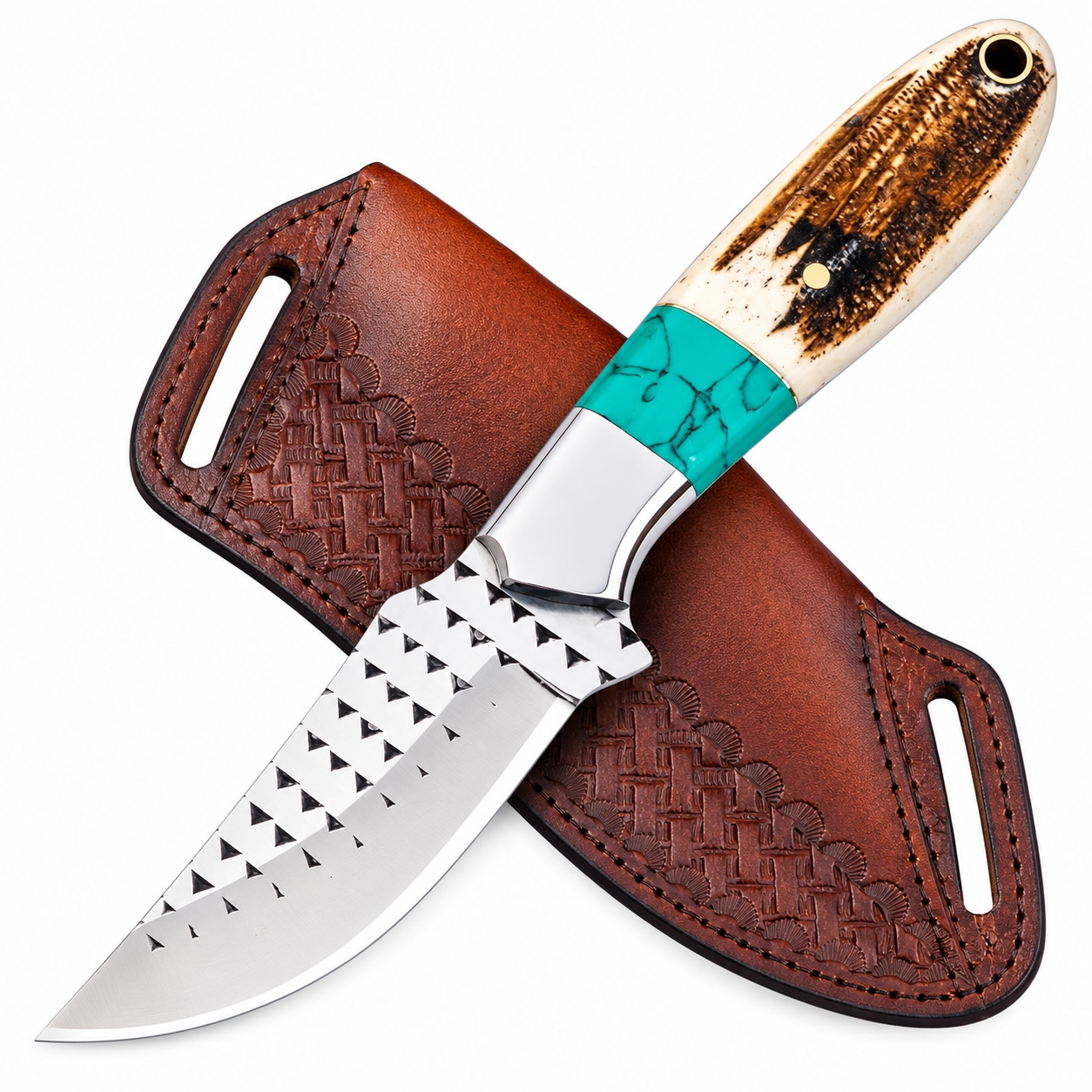
This turquoise accent fixed blade knife combines a broad, curved blade with a cream-and-brown handle, a polished-looking silver-tone bolster, and a vivid turquoise-green accent. Small triangular details across the upper blade give it a distinctive appearance, while the brown patterned sheath shown alongside it adds a coordinated Western-inspired finish.
The design brings together contrasting colours and surfaces without relying on a visible logo or large decorative lettering. The blade has a bright metallic appearance, the handle combines pale edges with darker textured areas, and the turquoise-green section creates a clear transition between the handle and bolster. Together, these features make the knife visually different from a plain-handled fixed blade.
The photograph establishes the product’s appearance, but it does not confirm its dimensions, steel grade, handle composition, or sheath material. The description therefore uses colour and design terms where materials remain unknown. The sheath is pictured with the knife; its inclusion in the supplied package should be confirmed before ordering.
A broad blade with a sweeping lower edge
The blade is wide near the handle and narrows toward a defined point. Its lower outline follows a long, sweeping curve, creating a substantial-looking blade profile. The upper outline is comparatively straighter, with the decorated section extending from near the handle toward the front of the blade.
This shape gives the knife a recognisable outdoor fixed-blade appearance. It may interest buyers who prefer a broad blade face and a curved silhouette over a narrow, straight-sided design. The photograph provides a clear view of that outline, making it useful for comparing the style with other knives.
The broad blade face also provides space for the triangular decoration to remain visible above the smoother lower section. Both areas contribute to the overall design: one introduces detail, while the other keeps the blade from looking uniformly patterned.
Actual cutting characteristics cannot be established from the outline alone. Blade thickness, edge geometry, heat treatment, and supplied sharpness remain unverified and should be checked when assessing suitability for a particular task.
Distinctive triangular blade detailing
Rows of small, dark triangular forms appear across the upper portion of the blade. Their spacing and changing size create a geometric pattern that stands out against the bright metallic surface. Some appear more prominent than others because of the lighting and the angle of the photograph.
This decoration is one of the clearest identifying features of the pictured knife. It differs from the flowing lines commonly associated with Damascus-style patterns and from the irregular dimpling often seen on hammered-looking blades. Here, the repeated triangular shapes provide a more angular visual effect.
The triangles remain separate from the continuous lower cutting-edge outline. They should not be described as serrations. The photograph also does not establish whether they were stamped, cut, forged, machined, or created through another process.
For a buyer interested in appearance, the practical value of this detail is straightforward: it gives the blade a recognisable decorative character. It should not be treated as evidence of improved strength, reduced friction, or enhanced cutting performance without supporting information.
A smoother lower blade surface
Below the triangular detail, the blade has a comparatively smooth, satin-looking surface. Fine directional lines are visible in the photograph, along with a narrow brighter outline near the edge. This simpler area balances the stronger pattern above it.
The contrast helps the blade’s shape remain easy to read. Rather than covering every part of the face with decoration, the design leaves a broad lower area visually quieter. That makes the curve of the blade and its narrowing tip noticeable even when viewed as a small product image.
For buyers comparing decorative knives, this balance may be appealing. The blade offers visible detail without presenting a densely patterned surface from spine to edge. Its appearance combines geometric decoration with a more conventional metallic finish.
The surface should not be described as stainless, scratch-resistant, or corrosion-resistant based on its brightness. Those are material or performance characteristics. The photograph supports a description of the visible finish, while the underlying alloy and treatment require confirmation.
A bright silver-tone bolster
A broad silver-tone bolster sits between the blade and the turquoise-green handle section. Its reflective appearance contrasts with the darker blade details and the textured-looking rear handle. The bolster creates a clearly defined transition between the main parts of the knife.
Its outline narrows and curves along the underside, following the change from blade to grip. The smooth-looking face offers a visual pause between the triangular pattern and the dark veining of the coloured accent. This makes the handle’s different sections easier to distinguish.
The bolster is also an important part of the product’s overall proportions. It introduces a substantial metallic section at the front of the handle, giving the design a more structured appearance than a handle that meets the blade without an obvious transition.
The photograph does not establish the bolster’s metal composition or attachment method. It should be described as silver-tone until the seller confirms whether it is stainless steel, another alloy, or a different material with a metallic finish.
A turquoise-green accent with dark veining
The coloured section immediately behind the bolster is a vivid turquoise green. Dark branching lines cross its surface, producing a stone-like appearance. This section is relatively short compared with the rear handle, but its colour makes it a strong focal point.
Its position is significant to the design. Rather than covering the entire handle, the colour acts as an accent between the bright bolster and the cream-and-brown grip. This gives the knife a more varied appearance while keeping the larger handle section visually prominent.
The dark veining connects with the darker areas farther back on the handle. At the same time, the green colour contrasts with the warm brown sheath. Buyers who enjoy combinations of earthy shades and brighter accents may appreciate this arrangement.
“Turquoise” here describes the colour and visual style. The photograph does not confirm natural turquoise, reconstructed stone, resin, or another composite. If a specific material is important to your purchase, obtain written confirmation for the actual product.
A cream-and-brown handle with a textured appearance
The main handle section has pale cream-coloured edges surrounding darker brown and nearly black areas. Elongated ridges and irregular markings give the surface a textured appearance. The variation is especially noticeable along the centre of the visible handle face.
This creates a rustic visual character that contrasts with the smooth bolster and geometric blade details. The handle looks less uniform than a solid-colour moulded grip, making its surface an important part of the product’s appearance.
Its outline broadens gently through the grip and rounds toward the rear. The pale border remains visible around much of the darker centre, helping define the shape against the white background. The result is a handle that contributes both colour contrast and surface detail.
The appearance resembles materials used in traditional antler-style handles, but the photograph does not authenticate antler, bone, horn, or any particular substitute. Material-specific claims should be added only after the seller confirms the construction.
Small gold-tone details
A round gold-tone pin is visible in the main handle section. Near the rear, a larger circular opening has a matching gold-tone rim. A thin warm-coloured separator also appears at the boundary between the turquoise-green accent and the cream-and-brown section.
These details are small, but they help connect the different handle components visually. The warm metallic colour works with the brown areas of the grip and the reddish-brown sheath, while standing apart from the silver-tone bolster.
The circular rear opening resembles a lanyard hole. No lanyard is shown, and its diameter is not provided. Buyers planning to use it with an accessory should confirm its intended purpose and measurements rather than assuming compatibility.
The visible colour does not establish that the pin, rim, or separator is brass. Likewise, the photograph does not reveal the complete internal attachment arrangement. Their appearance can be described confidently; their composition and construction need additional information.
A complete handle rather than an unfinished blank
The pictured product has a fitted handle and is presented as a fixed-blade knife. It is not an uncovered blade blank intended primarily for adding handle scales. This distinction matters when choosing the correct product category and understanding what stage of assembly is shown.
There is no visible folding joint or opening mechanism. The blade extends directly from the bolster area, creating a continuous fixed-blade silhouette. The photograph therefore supports identifying the product as a fixed-blade design rather than a folding pocket knife.
It does not, however, reveal the full tang construction inside the handle. A visible metal section near the bolster is not enough to prove a particular tang length or attachment method. Claims such as full tang or hidden tang require separate confirmation.
For the buyer, the key visible difference is that the knife is shown with its decorative handle already fitted. Any remaining finishing requirements, supplied edge condition, and inspection standards should come from the seller’s product information.
A brown sheath with basketweave-style decoration
The sheath shown behind the knife has a warm reddish-brown colour, darkened edges, and a prominent basketweave-style pattern. Its central surface contains repeated interlocking shapes, while a curved decorative border runs around portions of the patterned area.
This gives the sheath a strong visual connection to Western-style accessories. It contributes to the presentation rather than appearing as an unrelated plain cover. The warmer brown colour also complements the darker handle markings and small gold-tone details.
The sheath tapers toward a pointed lower end and has a broader upper section. Its outline is visible around the knife, although the blade overlaps part of the surface. The photograph shows enough detail to assess the exterior style, but not the complete interior fit.
The surface has a leather-like appearance. Genuine leather, leather grade, lining, and manufacturing method are not verified. “Brown patterned sheath” is therefore the most accurate description until its material is confirmed.
Visible stitching and two belt slots
Dark stitching follows the sheath’s outer edge. It is clearly visible against the brown surface and helps define the border around the tapered body and wider upper section. The contrast also makes the construction details easier to inspect in the photograph.
Two elongated slots appear in the upper portion, one on each side. This arrangement is consistent with a pancake-style belt sheath. It is a useful visible feature for buyers comparing sheath layouts, particularly when the carrying arrangement is part of the purchasing decision.
The slots’ dimensions are not supplied, so compatibility with a particular belt cannot be confirmed. The image also does not establish the intended carry angle, handedness, retention strength, or fit when the knife is fully inserted.
Those practical details matter independently of the decorative pattern. Before selecting the product for belt carry, check the sheath measurements and the seller’s intended-use information. The photographed layout provides a starting point for that comparison.
A coordinated Western-inspired presentation
The knife and sheath share a warm, rustic visual style. Brown handle markings relate to the sheath’s colour, while the turquoise-green accent introduces a brighter contrast. The metallic blade and bolster keep the overall presentation from becoming entirely earthy in tone.
The design also combines different kinds of pattern. The blade uses small geometric triangles, the handle has irregular linear markings, and the sheath carries a basketweave-style surface. These patterns are distinct enough to remain identifiable rather than merging into one continuous decoration.
For someone assembling a collection around Western-inspired designs, this combination offers clear aesthetic reasons to consider the product. It may also suit buyers who prefer a decorated sheath to a plain synthetic-looking cover.
“Western-inspired” describes the styling only. It does not identify a place of manufacture, cultural origin, or maker. No brand or production location can be established from the uploaded image.
Choosing according to appearance and intended use
A fixed-blade knife is a cutting-tool format, but the practical suitability of this particular item depends on specifications that the photograph does not provide. The blade’s decorative appearance should be assessed separately from its functional capability.
If your main interest is the design, the image offers several clear comparison points: the broad blade, triangular detailing, green accent, cream-and-brown grip, and patterned sheath. These features may make it appealing as part of a knife collection or a Western-themed display.
If you intend to use it for outdoor cutting tasks, confirm the steel grade, heat treatment, dimensions, edge condition, and handle construction. Those details are more relevant to performance than the colour of the accent or the decoration on the sheath.
This distinction helps keep the buying decision focused. You can appreciate the visible design while still requesting the technical information needed to decide whether the product suits your intended application.
Dimensions and fit before purchase
No measurement reference appears in the image. Overall length, blade length, blade thickness, handle length, and weight remain unconfirmed. A large, closely cropped photograph can make an item appear substantial without showing its actual size.
Handle thickness is particularly difficult to judge from this angle. The side profile reveals the outline and decoration, but not the complete cross-section. Buyers concerned about grip size should request measurements and an additional view from above or behind.
Sheath dimensions deserve the same attention. Belt-slot width, the size of the opening, and the relationship between the sheath and the supplied knife affect practical compatibility. The photograph shows the two items together but does not demonstrate the knife fully seated inside.
Accurate measurements would make comparison with an existing knife or carrying setup much easier. Until those details are available, use the image to judge styling and proportions rather than to estimate fit.
Material information that matters
The product combines several visually different surfaces, and each needs its own material description. The blade alloy, bolster material, coloured accent, main handle section, and sheath should not be treated as one confirmed material package based on appearance.
For example, the bright blade does not establish stainless steel, and the textured cream-and-brown handle does not establish genuine antler. Similarly, a stone-like accent may be made from several different materials that can look alike in a photograph.
Knowing the actual composition helps with more than comparison shopping. It also supports appropriate care, realistic expectations, and an accurate understanding of the product’s value. A clear supplier specification is more useful than borrowing details from a similar-looking listing.
If a seller provides multiple variations, make sure the specifications correspond to the exact version being purchased. A product family may share a general outline while differing in handle materials, blade finish, sheath design, or dimensions.
Collection and gift considerations
The combination of a decorated blade and coordinated sheath may appeal to an adult collector who enjoys distinctive fixed-blade designs. The turquoise-green accent gives the product a recognisable colour detail, while the brown sheath supports its traditional-looking presentation.
As a gift, it would be most relevant to someone whose preferences are already known. Some buyers value a particular steel grade or maker, while others focus on the overall design. Confirming those preferences can help determine whether this item is a suitable choice.
A presentation box, engraving service, personalized sheath, or additional accessories are not shown. These should not be assumed to be part of the purchase. The visible photograph contains one knife and one sheath, but the final packing list still needs confirmation.
If the appearance is especially important, request confirmation that the supplied item matches the photographed design. This is useful where sellers offer several similar handle combinations or sheath patterns under one listing.
Care and keeping the presentation consistent
Product-specific maintenance instructions have not been supplied. Suitable care depends on the confirmed blade alloy, handle components, fittings, and sheath material. Obtain the seller’s guidance before selecting a polish, cleaner, conditioner, or protective treatment.
This is particularly relevant because the knife combines metallic, stone-like, and textured-looking surfaces. A product intended for one material may not be appropriate for another. The sheath may also require different treatment from the knife itself.
If the decorative finish is a major reason for purchasing, ask how the seller recommends preserving it. Care information should relate to the actual supplied materials rather than to a different knife that happens to look similar.
The same principle applies to replacement accessories. A compatible sheath or lanyard should be selected using measurements and confirmed fittings. Appearance alone is not enough to establish that a replacement will fit correctly.
A distinctive fixed-blade design to explore
This turquoise accent fixed blade knife stands out through its combination of geometric blade decoration, contrasting handle sections, bright bolster, and brown patterned sheath. Its strongest confirmed qualities are the visible design choices and the way those details work together.
For a considered purchase, pair that visual assessment with confirmed dimensions, materials, package contents, and intended-use information. Those details will help establish whether the product meets your practical requirements as well as your preference for its appearance.
Explore the triangular blade detail, turquoise-green accent, and coordinated sheath to decide whether this Western-inspired design belongs in your collection, then confirm the specifications before placing your order.






Reviews
There are no reviews yet.