





Turquoise Straight Edge Knife
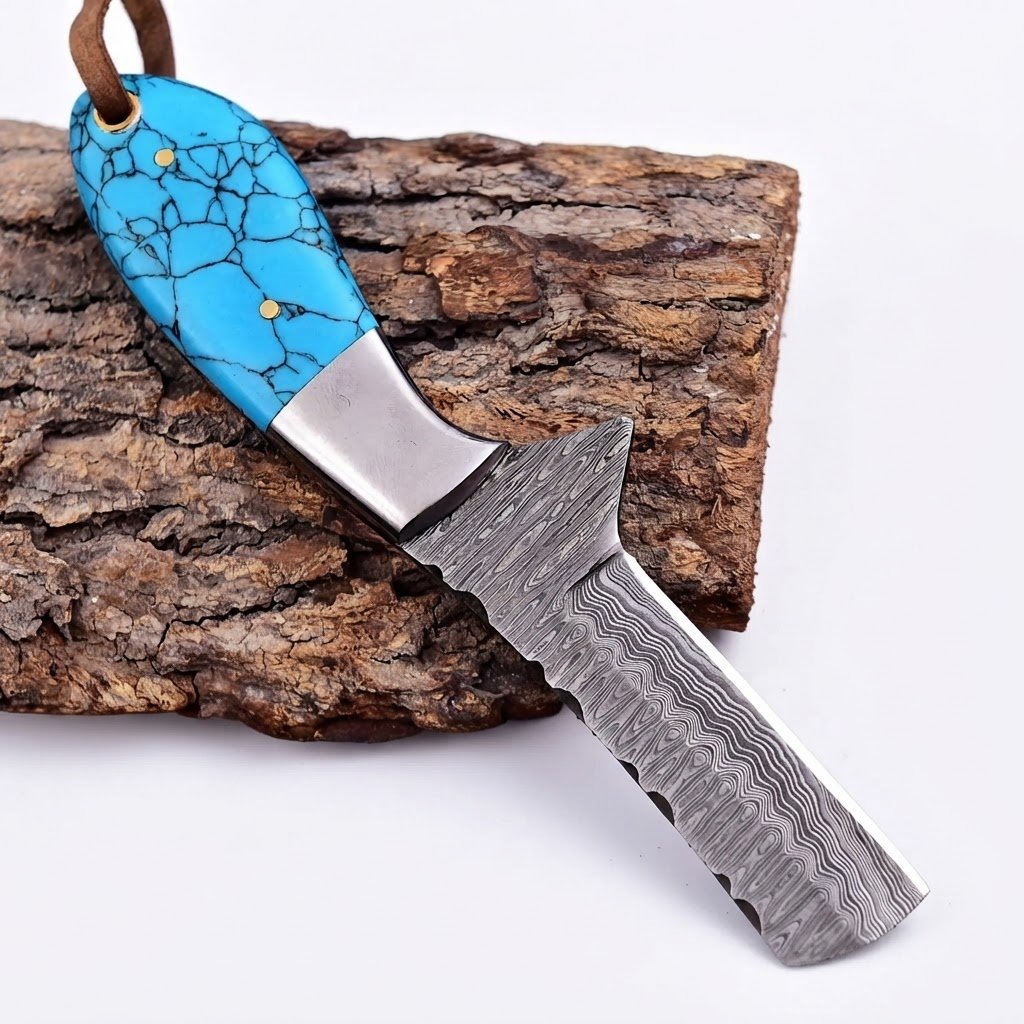
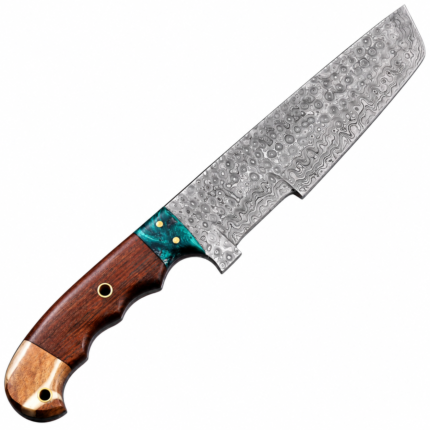
This turquoise straight edge knife combines a squared blade profile with a vivid blue handle and contrasting metal details. Fine silver-grey patterns cover the blade, while irregular black veins run across the turquoise-coloured grip. A broad silver-tone bolster separates the two sections, giving the knife a clearly defined silhouette.
Two small gold-tone pins and a matching rear eyelet add warmer accents to the handle. A brown strap passes through the eyelet, and a reddish-brown sheath with pale stitching is pictured behind the knife. Together, these features create a colourful design with several different textures to appreciate.
The photograph confirms the visible shape, colour arrangement, and fittings. It does not establish the steel composition, handle material, dimensions, or performance specifications. In this description, “turquoise” refers to the handle’s colour, while the blade is described by its visible pattern rather than an unverified material claim.
A Distinctive Squared Blade Profile
The blade has a long, relatively narrow forward section with an approximately straight cutting-edge outline and a squared end. Near the handle, the profile becomes wider, forming a pronounced shoulder before meeting the bolster.
This shape gives the knife a different appearance from a conventional pointed hunting knife. The squared end is particularly noticeable, creating a strong visual boundary at the front rather than narrowing to a fine tip. The transition near the handle adds another angular feature to the outline.
The silhouette has a razor-like appearance, but the photograph does not confirm that the product is intended for shaving. It is presented here as a fixed-blade knife with a straight-edge profile.
Customers looking for this particular shape can identify it clearly from the image. Its suitability for any specific cutting task should be assessed separately using the manufacturer’s intended applications and verified blade specifications.
Fine Patterns Across the Blade Face
The blade face carries closely spaced light and dark lines, with elongated oval shapes appearing along parts of the surface. Through the narrower section, the lines form flowing waves that travel towards the squared end.
The wider area near the bolster has a somewhat different pattern direction, creating a visible distinction between the blade’s sections. This change adds detail without introducing a separate colour or decorative insert.
The appearance resembles patterns associated with Damascus-style blades. However, a photograph cannot confirm pattern-welded construction, the steels used, a layer count, or how the surface pattern was produced. Those details require reliable product documentation.
The visible benefit is aesthetic: the blade provides a finely detailed surface that contrasts with the handle’s larger black veins. Customers choosing a knife partly for its appearance can appreciate that contrast without relying on an assumed manufacturing process.
The Turquoise-Blue Handle
The handle is the brightest part of the design. Its blue colour stands out against the silver-grey blade and reddish-brown sheath, making it easy to distinguish from knives with darker or more neutral grips.
Black lines divide the blue surface into irregular shapes. Some areas have a dense network of small veins, while others show larger uninterrupted patches of colour. This gives the handle a varied appearance rather than a repeated printed-looking pattern.
The surface resembles the look of turquoise stone, but the material itself remains unverified. It could not responsibly be described as natural turquoise, reconstructed stone, resin, or another specific substance based on the photograph alone.
For customers who enjoy vivid colour and stone-like patterns, this is a defining feature. The handle provides most of the visual emphasis, while the smaller fittings and plain bolster keep the surrounding details relatively restrained.
A Rounded and Shaped Grip
The handle broadens towards the rear and narrows near the bolster. Its outer edges appear rounded, creating a smooth transition around the blue surface rather than a sharply rectangular outline.
The photographed side has a gently curved shape, with the rear eyelet positioned close to the upper end. The dark veins continue across the visible surface, helping the handle read as one coordinated design.
This outline is useful for customers comparing styles, but it does not establish how the knife will feel in the hand. Usable grip length, thickness, weight, and surface texture would all affect comfort.
A rounded appearance also does not prove a non-slip finish or suitability for wet conditions. Buyers who intend regular use should obtain measurements and handling information, especially if they have a strong preference for a particular handle size or profile.
A Broad Silver-Tone Bolster
Between the blue handle and patterned blade is a wide, bright silver-tone section. This bolster creates a clean visual break between the two more detailed surfaces.
Its face appears relatively plain and reflective, with a curved lower outline that follows the transition into the grip. Because it has little visible decoration, it gives the eye a resting point between the black-veined handle and closely patterned blade.
The bolster is one of the features that makes the knife’s construction visually easy to understand. The coloured grip, metal transition, and blade are clearly separated in the photograph.
Its exact material and internal attachment method are not established. It should therefore be described as silver-tone rather than stainless steel, nickel silver, or another named alloy. The image also does not demonstrate any particular protective or structural performance.
Gold-Tone Pins and Rear Eyelet
Two small circular gold-tone pins are visible on the photographed side of the handle. Their warm colour contrasts with the blue background and gives the grip a few simple points of detail.
A larger gold-tone eyelet surrounds the opening near the rear. This fitting matches the pins visually and provides the attachment point for the brown strap shown in the image.
The restrained use of these fittings helps preserve the handle’s main pattern. Rather than covering the blue surface with a large emblem, the design leaves the black veins and colour variation clearly visible.
The photograph does not confirm whether these components are brass or another material. It also does not reveal the complete fastening arrangement beneath the handle. Their visible colour, position, and relationship to the strap are the features that can be described confidently.
The Attached Brown Strap
A flat brown strap passes through the rear eyelet and extends down the right side of the photograph. A knot is visible farther along its length, although the complete end is outside the frame.
The strap introduces a softer-looking element beside the metal and blue handle. Its colour also connects the knife to the brown sheath, helping the accessories feel coordinated despite the handle’s much brighter tone.
The strap has a leather-like appearance, but its composition and dimensions have not been verified. It should not be described as genuine leather, a wrist strap of a particular size, or a load-rated retention accessory.
Customers who want the pictured arrangement should confirm that the strap is included and matches the supplied example. The image shows how it is attached, but does not establish replacement options, alternative colours, or approved uses.
The Brown Sheath in the Photograph
The knife is displayed over a reddish-brown sheath with a patterned front surface. Pale stitching follows the outer edges, creating a clearly visible border against the darker material.
The sheath includes a broad upper section and a narrower lower section with a rounded end. Both visible areas carry an interlocking, basketweave-style pattern bordered by smaller curved impressions.
These details give the sheath a more decorative appearance than a plain cover. Its brown colour offers a warm contrast to the blue handle, while the light stitching echoes the brighter metal tones elsewhere in the arrangement.
The photograph does not confirm genuine leather, thickness, internal lining, or the material used between the layers. The pictured sheath should therefore be described by its appearance until the seller confirms its construction and whether it is included with the knife.
Embossed Pattern and Contrasting Stitching
The sheath’s central design consists of repeated rectangular impressions arranged in alternating directions. This creates a woven-looking effect across the visible panels.
Around the patterned areas, smaller curved marks form decorative borders. The stitching sits farther towards the edges, separating the patterned centre from the darker outer outline.
This arrangement offers several levels of detail. From a distance, the sheath reads as a warm brown accessory. Closer inspection reveals the alternating impressions, decorative border, and individual pale stitches.
The visible pattern does not establish whether the sheath was tooled by hand, embossed mechanically, or made using another process. Similarly, the stitching alone does not verify its strength. Those manufacturing and performance details should come from the supplier rather than the product photograph.
A Contrast of Colours and Textures
The turquoise straight edge knife brings together three distinct surface treatments. The blade has fine flowing lines, the handle has larger irregular veins, and the sheath has a repeated geometric pattern.
Each element is different enough to remain recognisable without making the overall presentation difficult to follow. The plain silver-tone bolster separates the two busiest parts of the knife, while the small gold-tone fittings add a modest accent.
The colour arrangement is equally clear. Blue provides brightness, silver-grey keeps the blade visually neutral, and reddish-brown adds warmth behind it.
Customers who prefer colourful knife designs may appreciate this combination, particularly if they enjoy patterned accessories. The product’s appeal comes from the relationship between these visible elements, rather than a claim that any one material is rare, precious, or exclusive.
Choosing It for a Collection
This design may interest customers who collect knives for their shapes, finishes, and handle treatments. Its squared blade end offers a different silhouette from pointed fixed blades, while the blue handle gives it a strong visual identity.
The patterned blade can be examined independently of the handle’s black veining. Displayed with the pictured sheath, the knife also introduces contrasting stitching and embossed detail into the arrangement.
For a collection organised around colour, this example could complement other blue-handled pieces. For one organised around blade shapes, its long straight section and squared end may be the more important features.
No maker, model, country of manufacture, production date, or limited-edition status has been verified. Its collection appeal in this listing is based on appearance, not provenance, rarity, or an expectation of future value.
Understanding the Intended Use
The image shows a fixed-blade knife, but does not establish a specialised application. Its razor-like outline should not be taken as confirmation that it is a shaving tool, and its squared end does not prove suitability for chopping or scraping.
The most useful information for a working purchase would be the manufacturer’s intended tasks, steel specification, blade thickness, and edge geometry. Those details explain performance more reliably than visual resemblance to another product.
The handle and bolster also need to be considered as part of the complete tool. Their dimensions, construction, and finish affect how the knife is held and used.
Customers choosing primarily for design can assess the visible features directly. Customers choosing for a specific job should first confirm that the supplied product is intended for that purpose and meets the relevant practical requirements.
Dimensions and Fit
Overall length would establish the knife’s true scale. The photograph fills much of the frame, so it cannot reliably show whether the product is small, medium, or large.
Blade length, cutting-edge length, and handle length would make comparisons more useful. Because the blade changes width near the bolster, measurements of both the narrow section and broader shoulder would also help describe its proportions.
Handle thickness and total weight are important details that this single view does not provide. A side photograph would show the grip’s depth and give a clearer view of the blade spine.
If the sheath is part of the package, its dimensions and attachment arrangement should be confirmed too. A visually similar shape is not enough to establish secure fit, retention, or compatibility with a particular belt.
What to Confirm About the Sheath and Package
The photograph shows one knife, an attached brown strap, and a brown sheath. It does not include a written package list, so accessory inclusion remains a detail to confirm before ordering.
The sheath’s reverse side is not visible. A belt loop, clip, fastening system, or particular carry orientation should not be assumed from the front view. Buyers who need these features should request photographs showing the back and opening.
Packaging is another separate consideration. A gift box, display stand, care kit, or certificate is not shown and should not be treated as included.
Clarifying these details helps customers compare complete offers rather than just the photographed knife. It also avoids treating a decorative presentation as proof of the exact quantity and accessories supplied with an order.
Materials, Maintenance, and Available Options
Product-specific care depends on the confirmed materials. The blade pattern, blue handle, bolster, and sheath may each need a different approach, so the manufacturer’s instructions should guide cleaning and storage.
No verified instructions are available for polishing, oiling, sharpening, washing, or conditioning this particular product. Applying a treatment intended for a different material could change the appearance, so a material-specific care guide is worth obtaining.
Additional handle colours, blade patterns, and sheath finishes have not been verified. The listing describes the photographed blue version only.
Custom engraving and personalisation are also unconfirmed. Customers interested in initials, logos, packaging changes, or alternative fittings should request availability, price, and lead time. A product’s decorative appearance does not itself establish that made-to-order options are offered.
A Distinctive Knife to Explore
The turquoise-blue handle, squared blade profile, and contrasting fittings make this knife easy to recognise. Fine blade patterns and larger black handle veins give it detail at different scales, while the plain bolster helps keep the design visually organised.
The pictured brown sheath adds another layer of texture and colour. Its embossed-looking panels and pale stitching complement the attached strap without competing with the brighter handle.
For customers who value unusual profiles and colourful finishes, this turquoise straight edge knife offers a clear visual character. Explore the photographed details, confirm the specifications and package contents that matter to you, and choose it when its design and verified capabilities suit your needs.





Reviews
There are no reviews yet.