



Two-Tone Wood Handle Damascus Hunting Knife – Classic Fixed Blade Design
The Two-Tone Wood Handle Damascus Hunting Knife combines a distinctive patterned blade with an attractive dual-color wooden-looking handle and a traditional brown leather-style sheath. Designed in the classic style of outdoor hunting knives, this fixed-blade model offers an appealing combination of natural tones, detailed metal patterns, and practical visual features.
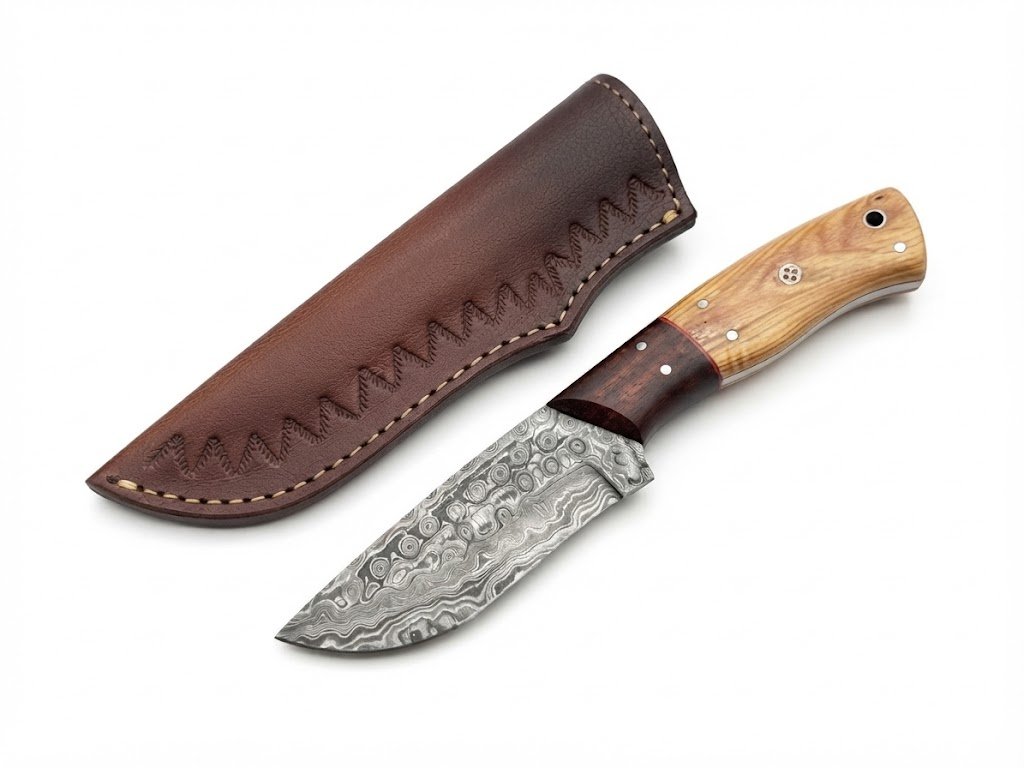
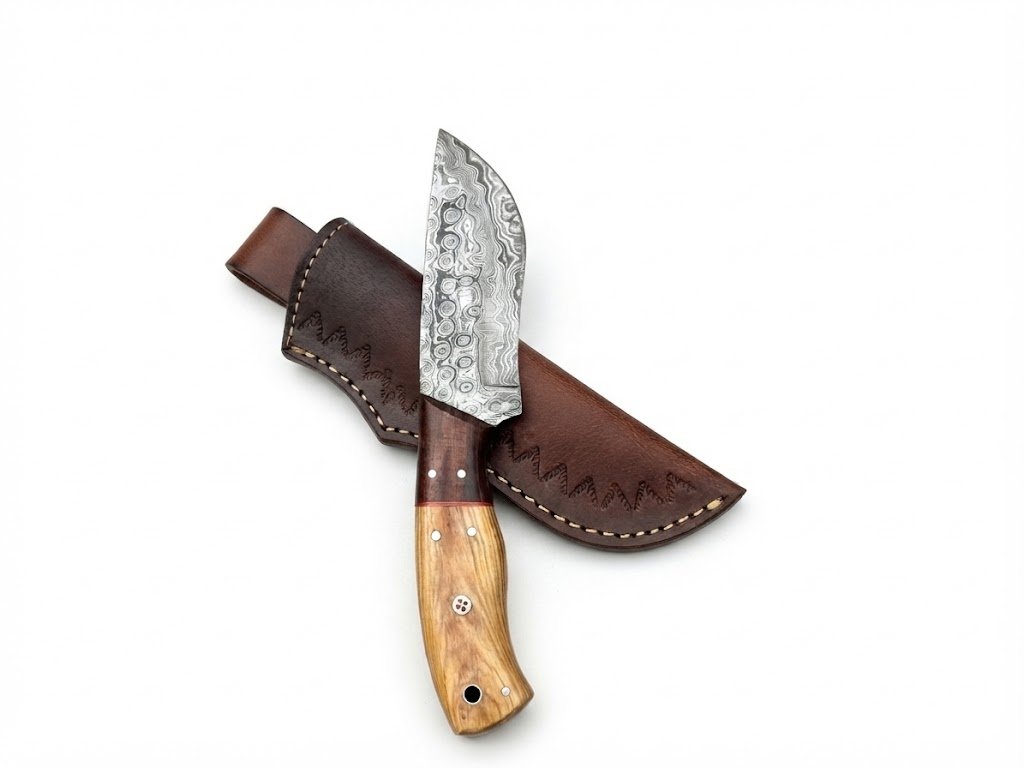
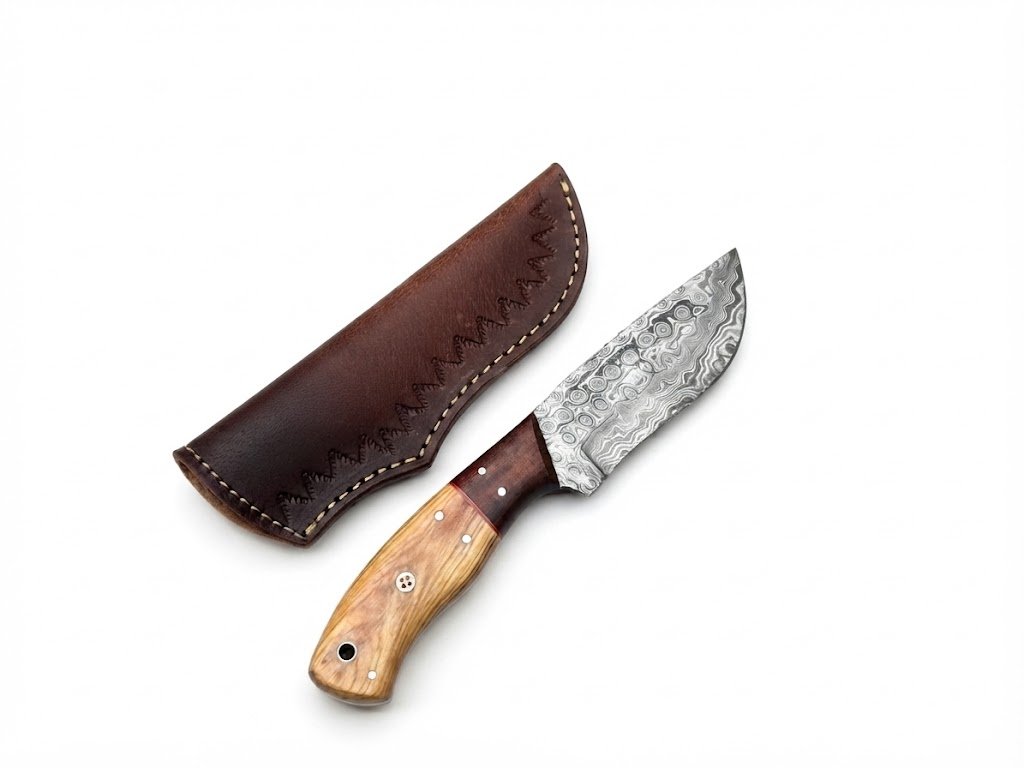
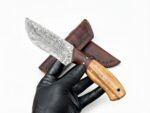
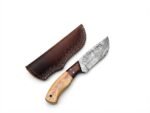
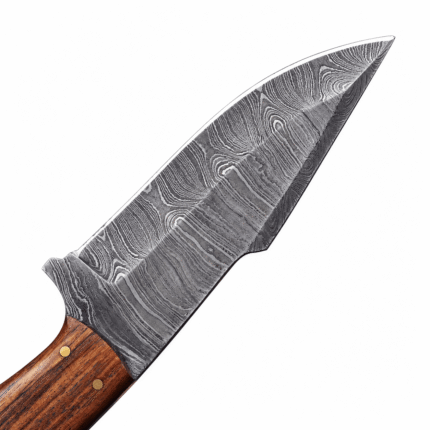
The blade displays an intricate series of circular and flowing lines, creating a Damascus-style finish that stands out against the contrasting handle. The handle features two noticeably different sections: a warm, golden-brown wood-grain portion toward the rear and a deeper reddish-brown section closer to the blade.
Small metallic pins and a circular decorative inlay complement the handle design. A separate stitched sheath completes the product’s traditional appearance.
For adult collectors, hunting enthusiasts, and outdoor-tool buyers, this design offers a distinctive alternative to ordinary fixed-blade knives.
Distinctive Damascus-Style Patterned Blade
The most recognizable feature of this knife is its patterned metal blade.
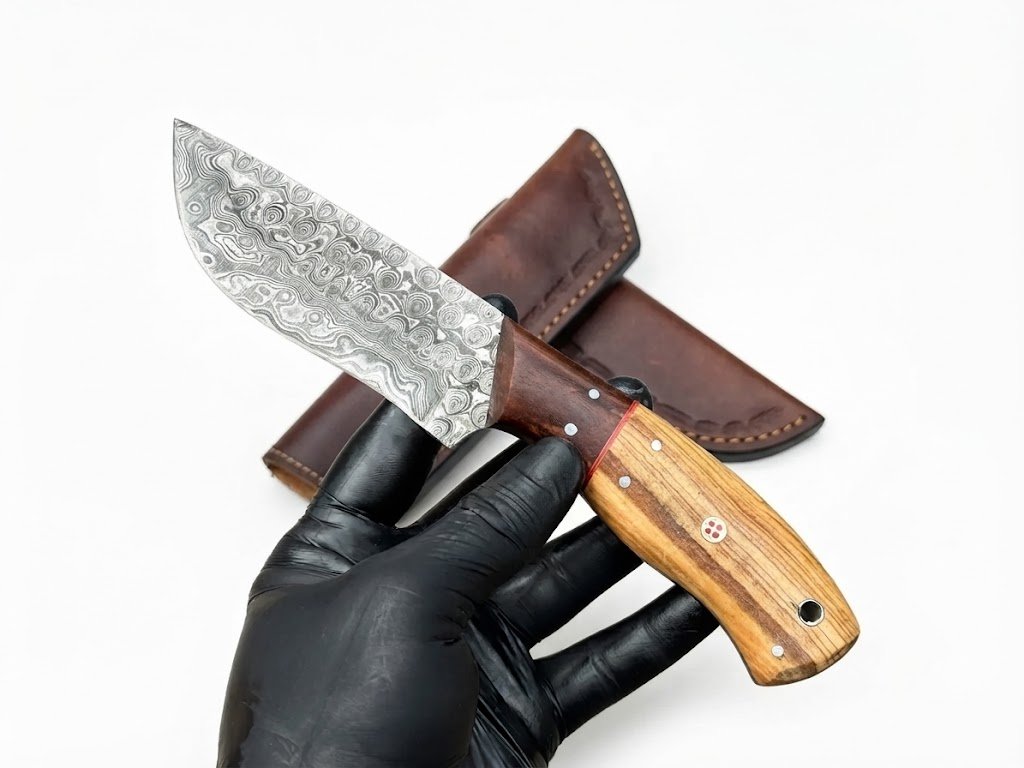
The surface displays overlapping circular formations near the upper portion, with flowing wave-like lines extending toward the cutting edge.
These patterns create a textured visual effect that resembles the layered appearance associated with Damascus steel.
The combination of circular shapes and curved lines gives the knife a distinctive appearance.
Unlike a plain polished blade, this design presents a more decorative surface, making it particularly interesting to collectors and buyers who appreciate patterned metalwork.
The blade has a slightly curved cutting edge and a pointed tip. Its overall outline is consistent with a drop-point-style hunting knife.
A drop-point profile is commonly associated with general-purpose outdoor knives because of its controlled tip geometry and versatile cutting-edge shape.
However, the exact geometry, edge thickness, and practical capabilities of this particular knife require manufacturer verification.
Although the blade visibly has a Damascus-style pattern, the photograph does not establish whether the material is pattern-welded Damascus steel, another layered steel, or steel with a decorative surface treatment.
The manufacturer should confirm the steel composition and manufacturing process before the product is advertised as genuine Damascus steel.
Attractive Two-Tone Wood Handle Damascus Hunting Knife Design
The Two-Tone Wood Handle Damascus Hunting Knife has an especially noticeable handle design.
The rear section displays a warm, golden-brown appearance with clearly visible grain-like markings.
The front section, positioned near the blade, has a darker reddish-brown color.
This contrast creates a naturally layered appearance and helps distinguish the model from simpler single-color hunting knives.
The transition between the two sections is clearly visible.
The darker portion curves toward the blade, while the lighter section extends toward the rounded end of the handle.
Several small metallic pins are positioned along the handle surface.
A circular decorative pin with a patterned center is also visible in the lighter section.
These small details add character without overwhelming the overall design.
The handle has a gentle curve that follows the traditional shape of many fixed-blade outdoor knives.
Its surface appears smooth, with an elongated profile and a slightly expanded rear section.
The exact wood species cannot be verified from the photograph. The visible grain suggests a wood or wood-like material, but claims such as rosewood, walnut, olive wood, or stabilized hardwood would require confirmation.
Fixed Blade Construction
This knife has a fixed-blade design, meaning the cutting blade does not fold into the handle.
Fixed-blade knives are widely used in outdoor-tool collections, hunting equipment ranges, and traditional knife designs.
The absence of a folding mechanism gives the knife a simple overall profile.
The visible blade connects directly to the handle through a shaped transition.
This creates a continuous appearance from the patterned metal section to the darker handle material.
Fixed-blade construction is commonly selected for products intended for outdoor activities because it avoids the moving blade joints found in folding knives.
However, the internal construction of this particular knife cannot be seen.
The photograph does not confirm whether the blade has a full tang, partial tang, hidden tang, or another attachment arrangement.
Tang construction is an important specification because it influences how the blade is secured inside the handle.
Buyers who intend to use the knife regularly should request this information from the supplier.
Traditional Drop-Point-Style Blade Shape
The blade has a broad base near the handle and gradually narrows toward its pointed end.
Its cutting edge follows a gentle curve.
The spine descends toward the tip, giving the knife a recognizable drop-point-like shape.
This type of silhouette is frequently found in hunting and outdoor knives.
The blade also has a relatively broad face, which provides a large visible area for its decorative pattern.
The patterned surface is particularly noticeable near the blade’s upper portion.
Closer to the cutting edge, the wavy lines become more elongated.
This creates visual movement across the metal.
The blade shape, patterned surface, and wood-grain handle work together to create a traditional hunting-knife appearance.
Exact blade dimensions, thickness, edge angle, and weight are not available from the image.
These specifications should be confirmed before assigning the knife to demanding cutting applications.
Warm Natural Colors and Decorative Details
The Two-Tone Wood Handle Damascus Hunting Knife uses a restrained combination of natural-looking materials and colors.
The light section of the handle has a golden-brown appearance.
The darker front section has reddish-brown tones.
The blade is predominantly silver and gray.
The sheath has a deep brown finish.
These colors complement one another and give the knife a cohesive appearance.
Small metallic pins provide subtle highlights.
The patterned circular inlay near the handle’s rear adds another decorative feature.
A small hole near the end of the handle appears to be suitable for a lanyard, although the photograph does not show a cord attached.
The combination of these details makes the knife visually distinctive while preserving a relatively simple traditional silhouette.
Brown Leather-Style Protective Sheath
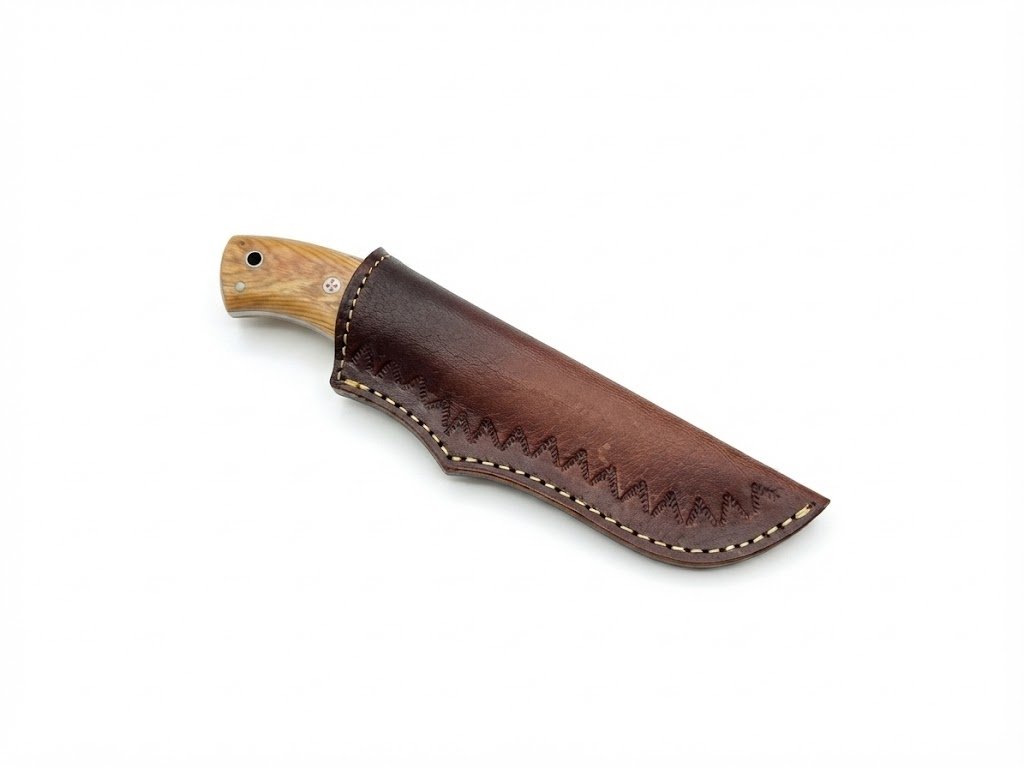
The supplied image also shows a separate brown leather-style sheath.
The sheath has a long, tapered shape that follows the general outline of the knife’s blade.
Its outer surface has a textured brown appearance.
Decorative impressions are visible along the lower side of the sheath.
Contrasting thread runs around its perimeter, creating a stitched border.
The stitch line follows the curved lower portion and continues toward the upper opening.
The sheath provides a traditional visual complement to the knife.
Protective sheaths are important accessories for fixed-blade knives because they help shield the cutting edge during storage and transportation.
A properly fitted sheath can reduce accidental contact with the blade and help protect nearby equipment from direct exposure to the edge.
However, the exact fit and retention of this sheath cannot be determined from the image alone.
The sheath’s material also requires verification before being advertised as genuine leather.
The image establishes its leather-like appearance but not its composition, thickness, or manufacturing process.
Outdoor and Hunting Knife Applications
Fixed-blade hunting knives are commonly associated with outdoor activities, general camp utility, and field equipment.
Different knife designs may be suitable for different tasks, depending on their blade geometry, material, size, and construction.
This model has a shape consistent with conventional hunting-style fixed-blade knives.
Its drop-point-like blade and elongated handle give it a recognizable outdoor appearance.
Potential buyers may consider this design when comparing hunting knives, camping tools, or collectible outdoor blades.
However, the manufacturer’s specifications should determine its actual suitability for field use.
A decorative blade pattern does not independently establish cutting performance, edge retention, corrosion resistance, or durability.
These properties depend on the underlying steel, heat treatment, blade geometry, and manufacturing quality.
For this reason, claims regarding professional hunting performance, heavy-duty cutting, or specialized outdoor applications should not be made without technical verification.
An Appealing Choice for Knife Collectors
Knife collectors often pay close attention to blade patterns, handle designs, finishing details, and accessories.
This model combines several noticeable elements.
The patterned blade creates an intricate metal surface.
The two-tone handle provides a contrast between light and dark wood-like materials.
Small decorative pins add detail.
The brown sheath completes the presentation.
Together, these features create a traditional-looking knife that may appeal to adults interested in outdoor equipment and decorative blade designs.
Its appearance is particularly suitable for collectors who appreciate wood-grain handles and Damascus-inspired metal patterns.
The product may also appeal to buyers seeking a gift for an adult knife enthusiast, subject to applicable laws and local regulations.
Before purchasing, customers should review the confirmed materials, dimensions, and sheath specifications to ensure the product meets their expectations.
Understanding Damascus Steel
Damascus steel is a term commonly used in knife manufacturing to describe blades with distinctive patterned surfaces.
Modern pattern-welded Damascus is typically produced by combining and working multiple steel layers to create visible patterns.
The final appearance can vary depending on the manufacturing method and finishing process.
Some knives feature flowing waves, while others display circular, ladder-like, or more irregular formations.
This product shows a combination of circular and flowing patterns.
However, similar-looking patterns can also be created through surface finishing or other processes.
Consequently, the visible pattern should not be treated as proof of a specific steel composition.
Customers interested in authentic pattern-welded Damascus construction should ask the supplier about the steel grades, manufacturing method, and relevant quality-control information.
These details are more useful than appearance alone when comparing technical performance.
Handle Materials and Construction
The handle combines two contrasting sections with a smooth transition.
The front portion appears darker and more compact in shape.
The rear section has a lighter wood-grain finish.
Metallic pins are visible in both sections.
The handle terminates in a rounded end with a small opening near the tip.
This general configuration is common among traditional outdoor knife handles.
The pins may serve a decorative role, a fastening role, or both.
Their exact construction cannot be established from the photograph.
Similarly, the internal attachment between the blade and handle is not visible.
Potential buyers should confirm the handle material, tang construction, and assembly method.
This is particularly important when choosing a knife for regular use.
The materials should also be appropriate for the conditions in which the tool will be stored and handled.
Knife Blade Care and Maintenance
Proper knife maintenance helps preserve appearance and reduce the risk of corrosion or damage.
After use, the blade should be cleaned carefully with a suitable soft cloth.
Remove visible moisture before storage.
If necessary, follow the manufacturer’s recommendations for cleaning and protective oil.
Avoid leaving the knife wet for extended periods.
The surface should not be cleaned using unnecessarily harsh chemicals or abrasive products that could damage its finish.
Patterned blades may require particular attention because aggressive polishing can alter their visible appearance.
Before using sharpening tools, confirm the blade material and recommended edge geometry.
Routine inspection is also important.
Check the cutting edge for chips, bends, or other damage.
If a defect is found, discontinue use until the knife has been properly inspected.
Caring for the Two-Tone Handle
The handle should be kept clean and dry.
After handling, gently remove moisture and dirt from its surface.
Avoid soaking the handle in water.
Do not expose it to unnecessary heat or prolonged direct sunlight.
If the handle is confirmed as natural wood, suitable care may depend on the specific species and finish.
Some natural wood handles benefit from appropriate conditioning products, while treated or sealed surfaces may require different maintenance.
Follow manufacturer guidance instead of applying an unsuitable product.
Inspect the handle regularly for cracks, looseness, or separation between sections.
Check the visible pins and decorative fittings.
If the handle becomes damaged or unstable, the knife should not be used until the problem is resolved.
Protective Sheath Care
The brown sheath should also be maintained in suitable condition.
Remove surface dust using a soft, dry cloth.
Keep the sheath away from prolonged exposure to moisture.
If it becomes wet, allow it to dry naturally.
Avoid placing it directly against radiators, heaters, or other intense heat sources.
For confirmed genuine leather, a suitable leather-care product may be appropriate.
For synthetic materials, use the manufacturer’s recommended cleaning method.
Inspect the stitching regularly.
Damaged stitches may affect the sheath’s integrity.
Also check the opening and fit.
A sheath that has become loose or damaged may not adequately cover the cutting edge.
For extended storage, follow the manufacturer’s recommendations regarding whether the knife should remain inside its sheath.
Choosing the Right Fixed Blade Hunting Knife
When comparing fixed-blade hunting knives, buyers should consider both appearance and verified construction details.
Blade length and overall length influence the knife’s physical dimensions.
Blade thickness and steel composition contribute to its intended applications.
Handle shape and material affect handling comfort.
Tang construction influences the way the blade and handle connect.
Weight can also affect balance and portability.
The Two-Tone Wood Handle Damascus Hunting Knife has a number of visually distinctive qualities, but its exact technical specifications have not been supplied.
Before purchasing for practical use, customers should obtain accurate measurements and material information.
A well-informed purchasing decision should be based on manufacturer specifications rather than assumptions drawn from promotional images.
Product Specifications
Product Type: Fixed-blade hunting-style knife
Blade Design: Drop-point-like profile with a gently curved cutting edge
Blade Appearance: Silver-gray patterned metal
Blade Pattern: Circular and flowing Damascus-style lines
Handle Appearance: Two-tone golden-brown and dark reddish-brown wood grain
Handle Decoration: Metallic pins and circular patterned inlay
Handle End: Rounded with visible lanyard hole
Sheath Appearance: Dark brown leather-style material
Sheath Details: Contrasting stitching and decorative impressions
Blade Steel Grade: Not verified
Actual Damascus Construction: Not verified
Handle Wood Species: Not verified
Tang Construction: Not verified
Sheath Material: Not verified
Blade Length: Not verified
Overall Length: Not verified
Blade Thickness: Not verified
Knife Weight: Not verified
Hardness: Not verified
Country of Manufacture: Not verified
Customization Options: Not verified
Responsible Handling and Storage
A fixed-blade knife is a sharp cutting instrument and should be handled carefully.
Before use, inspect the blade and handle for damage.
Keep the cutting edge directed away from yourself and other people.
Use the knife only for appropriate tasks within the manufacturer’s stated limitations.
Avoid using it as a pry bar or striking tool.
When handling or maintaining the blade, use suitable precautions and protective equipment.
Do not leave the knife unattended where children or unauthorized people can access it.
During storage or transportation, keep the blade inside an appropriately fitted protective sheath.
Follow applicable local laws regarding knife possession, transportation, and use.
Regular inspection and responsible care are important for maintaining any sharp-edged tool.
Why Choose the Two-Tone Wood Handle Damascus Hunting Knife?
The Two-Tone Wood Handle Damascus Hunting Knife combines a traditional fixed-blade silhouette with distinctive visual details.
Its patterned blade makes it stand out from plain-metal alternatives.
The contrasting handle sections provide warm natural-looking colors.
Metallic pins and a decorative inlay add subtle finishing touches.
The stitched brown sheath completes the classic presentation.
These features may appeal to collectors, outdoor-tool enthusiasts, and adults who appreciate traditional knife designs.
The product’s appearance is its most clearly identifiable quality from the supplied photograph.
Buyers should review the confirmed technical specifications to understand its suitability for their intended use.
Explore This Traditional Patterned Hunting Knife
The Two-Tone Wood Handle Damascus Hunting Knife offers a distinctive combination of flowing blade patterns, contrasting wood-like handle sections, decorative metallic details, and a coordinating stitched sheath.
Whether you are exploring traditional outdoor-tool designs or comparing collectible fixed-blade knives, this model provides an appealing classic appearance.
Explore its visible features and confirm the manufacturer’s specifications to determine whether it meets your requirements.





Reviews
There are no reviews yet.