








Black and Green Layered Handle Fixed-Blade Knife – Design and Craftsmanship Reference
Introduction
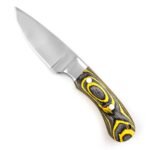
The Black and Green Layered Handle Fixed-Blade Knife is a contemporary object distinguished by its contrasting metallic and patterned surfaces. Its appearance combines a silver-gray blade, a polished-looking bolster, and a black-and-green handle containing flowing lines and concentric decorative formations.
The handle is particularly recognizable because of its layered pattern. Dark sections alternate with olive-green and brighter yellow-green lines, creating irregular circular shapes that resemble wood grain or decorative laminated material.
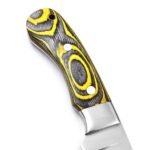
The photographs present the knife from multiple perspectives, including complete side views, close-up views of the handle, and a view along its spine.
These images provide useful information about its visible construction, shape, coloration, and external details.
However, the precise metal alloy, handle material, dimensions, manufacturing location, and mechanical specifications remain unverified.
1. Overall Design and Silhouette
The knife has a fixed-blade configuration.
Its blade remains extended from the handle rather than folding into it.
The broad blade narrows gradually toward a pointed end.
The cutting-edge outline follows a gentle curve, while the upper blade profile appears comparatively straight.
A silver-colored metal bolster separates the blade from the handle.
The handle has an elongated, contoured shape with a rounded rear end.
Together, these elements create a recognizable external silhouette.
2. Satin Silver-Colored Blade
The blade displays a silver-gray metallic appearance.
Subtle directional surface markings are visible across parts of the blade face.
These marks create an appearance resembling a brushed or satin finish.
The surface reflects light more softly than a mirror-polished metal surface.
A brighter line follows the cutting-edge region.
The photographs do not establish the exact surface treatment.
Consequently, the phrase satin-like finish describes its appearance rather than a confirmed production specification.
3. Blade Profile and Geometry
The blade has a broad base that gradually tapers toward its tip.
The lower outline forms a smooth curve.
The upper edge remains comparatively straight through much of the visible blade length.
Near the handle, a distinct transition separates the blade face from the bolster.
These geometric features are visible in several complete photographs.
The images do not provide a calibrated measurement reference.
Exact blade length, width, thickness, and weight therefore remain unknown.
4. Silver-Toned Bolster
A polished-looking silver-colored bolster appears between the blade and handle.
This component forms a clear visual boundary.
Its metallic finish differs from the patterned surface of the handle.
A small projection is visible on one side of the bolster near the blade transition.
The bolster’s simple geometry contrasts with the curved green-and-black patterns.
Its exact material and manufacturing method cannot be determined from the photographs.
5. Black and Green Layered Handle
The handle features a distinctive mixture of black, olive-green, and yellow-green coloration.
The pattern contains irregular bands that follow the handle’s length.
Some areas form concentric rings around darker central sections.
Others appear as flowing stripes.
The resulting appearance resembles layered wood grain or decorative composite material.
However, visual resemblance does not confirm the actual handle composition.
A reliable material identification would require manufacturer documentation.
6. Concentric Decorative Patterns
One of the most recognizable handle features is its series of concentric-looking formations.
A darker central region appears surrounded by several lighter green bands.
These shapes create an eye-like decorative pattern.
Smaller curved bands appear toward the rounded end.
The combination produces a flowing, organic-looking surface.
The pattern is particularly visible in the close-up photographs.
7. Handle Color Variations
The handle’s green coloration varies across the images.
Some sections appear olive green.
Others have brighter yellow-green highlights.
The darker areas range from charcoal gray to nearly black.
These differences contribute to the layered appearance.
Photographic lighting can also influence perceived color.
For accurate color matching, a standardized physical reference would be required.
8. Two Silver-Colored Circular Details
Two circular silver-colored details are visible on the main side of the handle.
They appear at different positions along its length.
Their shape contrasts with the irregular decorative pattern.
They resemble fastening pins.
However, the images do not establish their precise composition or internal construction.
For factual documentation, they are best described as circular metallic details.
9. Metal-Lined Handle Opening
A small circular opening appears near the handle’s rounded end.
The opening has a gold-toned or brass-colored border.
Its placement is particularly clear in several close-up images.
The surrounding black-and-green pattern forms curved lines around it.
The opening contributes another recognizable geometric detail.
The exact construction and intended function of the opening cannot be verified from the images alone.
10. Contoured Handle Shape
The handle has a gently curved profile.
Its rear end is rounded.
The sides narrow slightly toward the metal bolster.
A subtle inward curve is visible along portions of the lower edge.
The patterned material follows these contours.
These features can be documented as external design characteristics.
Claims about ergonomics, balance, or mechanical strength would require additional evidence.
11. Layered Appearance Along the Edges
The side photographs show the black-and-green pattern across the broad handle surface.
A separate spine-angle image reveals thin layered lines along the handle’s sides.
These alternating dark and green bands create the appearance of stacked material.
The edge view provides additional information about the object’s construction.
It does not, however, confirm the actual composition or manufacturing process.
12. Spine View and Metallic Strip
One photograph shows the knife from an elevated angle along its spine.
A central silver-colored metallic strip is visible between darker handle sections.
This view helps document the relationship between the patterned side material and the central metal portion.
The metallic strip continues toward the blade.
Although its appearance may suggest a particular internal configuration, the photographs alone do not establish the complete construction method.
13. Surface Texture
The handle has a visible directional texture.
Fine lines appear within the colored bands.
Some regions look slightly textured rather than uniformly smooth.
These details are especially noticeable in the photographs focused on the handle.
The black sections provide contrast against the lighter green lines.
The exact finishing method remains unknown.
14. Relationship Between Blade and Handle
The blade and handle use different decorative approaches.
The blade has a comparatively restrained metallic appearance.
The handle contains elaborate flowing patterns.
The silver-colored bolster creates a visual transition.
This combination separates the object’s major components.
It also highlights how contrasting colors and textures can influence the appearance of a manufactured object.
15. Metallic and Nonmetallic Color Contrast
Silver-gray dominates the blade and bolster.
Black forms much of the handle’s darker pattern.
Green appears in bands and concentric formations.
Small metallic details introduce silver and gold-colored accents.
These colors create a recognizable composition.
The neutral blade contrasts with the handle’s more complex pattern.
16. Contemporary Layered Material Aesthetics
Layered visual patterns are commonly found in decorative woodworking and composite manufacturing.
Such patterns can produce alternating bands, rings, and irregular formations.
The handle shown here resembles this broader design tradition.
Its concentric patterns are especially distinctive.
However, similar visual appearances can result from different materials and methods.
The photographs do not identify which process was used.
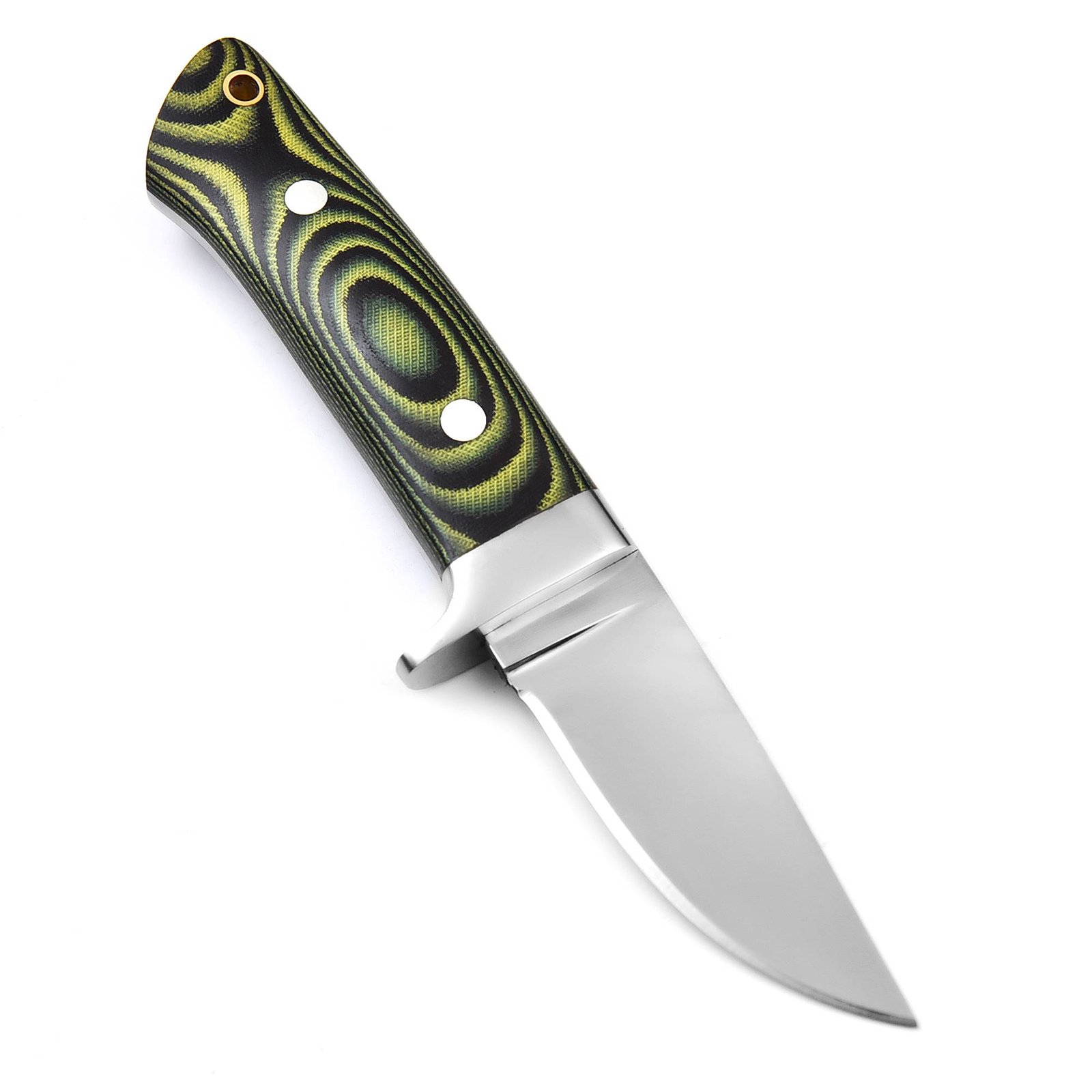
17. Full-Length Front View
The first photograph shows the knife diagonally against a white background.
The handle extends toward the upper left.
The blade points toward the lower right.
This arrangement reveals the overall silhouette.
The central green-and-black pattern remains clearly visible.
The silver-colored bolster connects the handle and blade.
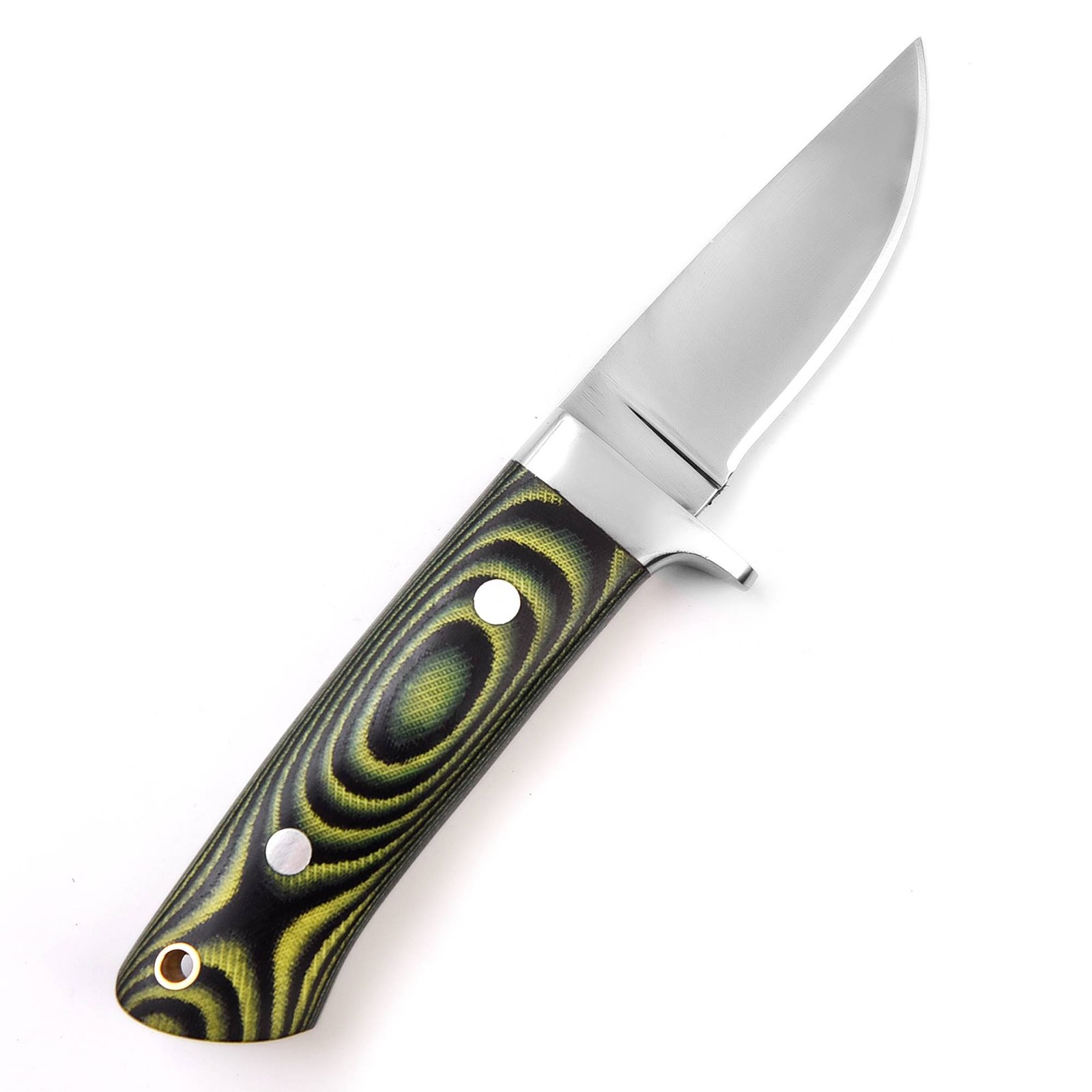
18. Alternative Side View
The second photograph presents a different orientation.
The blade extends toward the upper left.
The handle points toward the lower right.
The two circular metallic details remain visible.
The handle’s concentric pattern appears prominently in the central section.
The metal-lined opening is visible near the rounded end.
This photograph provides another view of the object’s external form.
19. Close-Up Handle Photography
Several photographs concentrate on the handle.
They reveal the alternating green-and-black bands.
The circular metal details stand out against the dark surface.
The rear opening has a contrasting gold-colored rim.
These close-ups provide useful visual documentation.
They do not reveal the precise composition of the handle material.
20. Blade and Handle Transition
The transition between blade and handle is emphasized by the silver-colored bolster.
The bolster has a smooth metallic appearance.
The handle begins immediately behind it.
A clear line separates the two components.
This detail is visible in the close-up and full-length photographs.
Its exact construction cannot be determined through image examination alone.
21. Pattern Variation Between Photographs
The supplied images show slight variations in color intensity.
Some green bands appear relatively subdued.
Others look much brighter and more yellow.
These differences may reflect lighting, viewing angle, or image processing.
The overall concentric pattern remains consistent.
A technical record should avoid interpreting photographic color variation as evidence of different materials.
22. Internal Construction Limitations
The spine view provides information about the visible central metal portion.
However, it does not show the entire internal structure.
The photographs therefore cannot independently verify full-tang construction or other specific assembly methods.
Similarly, the visible circular details do not confirm how the handle material is attached.
Such information should be sourced from reliable technical documentation.
23. Material Identification
The blade and bolster appear metallic.
The handle has a patterned, layered appearance.
The circular details have a silver-colored finish.
The rear opening includes a gold-toned rim.
These observations describe visible characteristics.
They do not establish the exact alloys or handle material.
24. Technical Specifications Requiring Verification
A complete technical reference would require:
- Manufacturer and model identification
- Blade material and alloy
- Surface finishing method
- Overall dimensions
- Blade dimensions
- Handle composition
- Handle attachment details
- Metallic fitting composition
- Object weight
- Manufacturing location
- Production date
These characteristics remain unverified.
25. Accurate Reference Terminology
For an informational catalog, descriptive language should reflect what the photographs establish.
“Black-and-green layered handle” communicates the visible pattern.
“Satin silver-colored blade” describes the metallic finish.
“Silver-toned bolster” identifies the transition component.
“Two circular metallic details” describes the handle markings.
“Metal-lined opening” identifies the circular hole at the rounded end.
These terms avoid unsupported technical claims.
Conclusion
The Black and Green Layered Handle Fixed-Blade Knife is distinguished by its satin silver-colored blade, polished-looking metal bolster, and contoured handle with concentric black-and-green patterns.
Two circular silver-colored details and a gold-rimmed opening provide additional visual features.
The photographs document the object from multiple side, close-up, and spine perspectives.
Together, they establish a useful record of its external appearance.
Exact materials, dimensions, construction methods, and manufacturer specifications remain unverified.





Reviews
There are no reviews yet.