





Damascus Pattern Skinner Knife with Brown Wood-Grain Handle
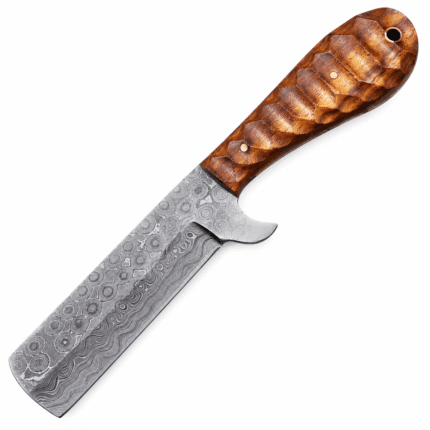
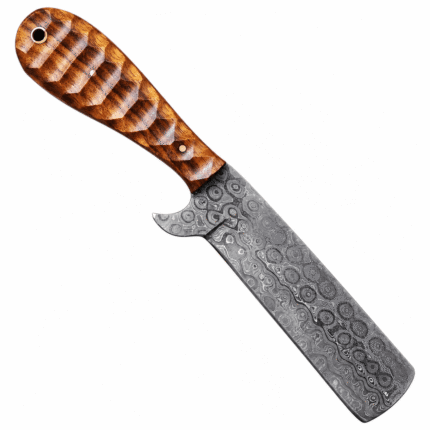
Discover the distinctive appearance of this Damascus Pattern Skinner Knife, featuring an intricately patterned blade, a curved cutting-edge profile, and a traditional brown wood-grain handle. Combining decorative metalwork with the recognizable shape of a compact hunting-style knife, this design offers visual character for collectors and outdoor cutlery enthusiasts.
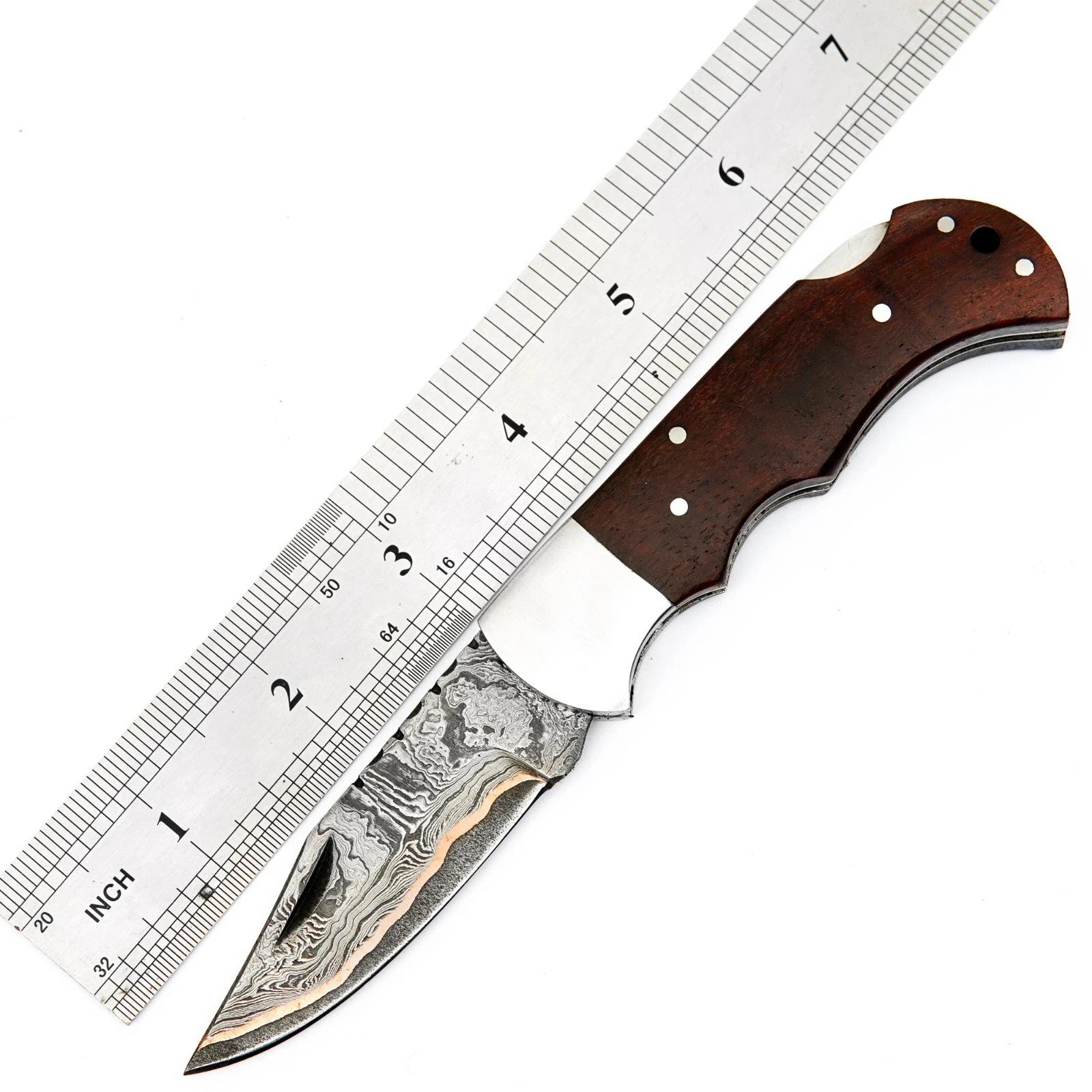
The blade immediately draws attention with its flowing silver-gray patterns. Irregular lines, layered formations, and circular details create a distinctive surface appearance commonly associated with Damascus-style knives. A narrow copper-colored accent follows part of the cutting-edge area, adding contrast between the patterned metal and the darker section near the edge.
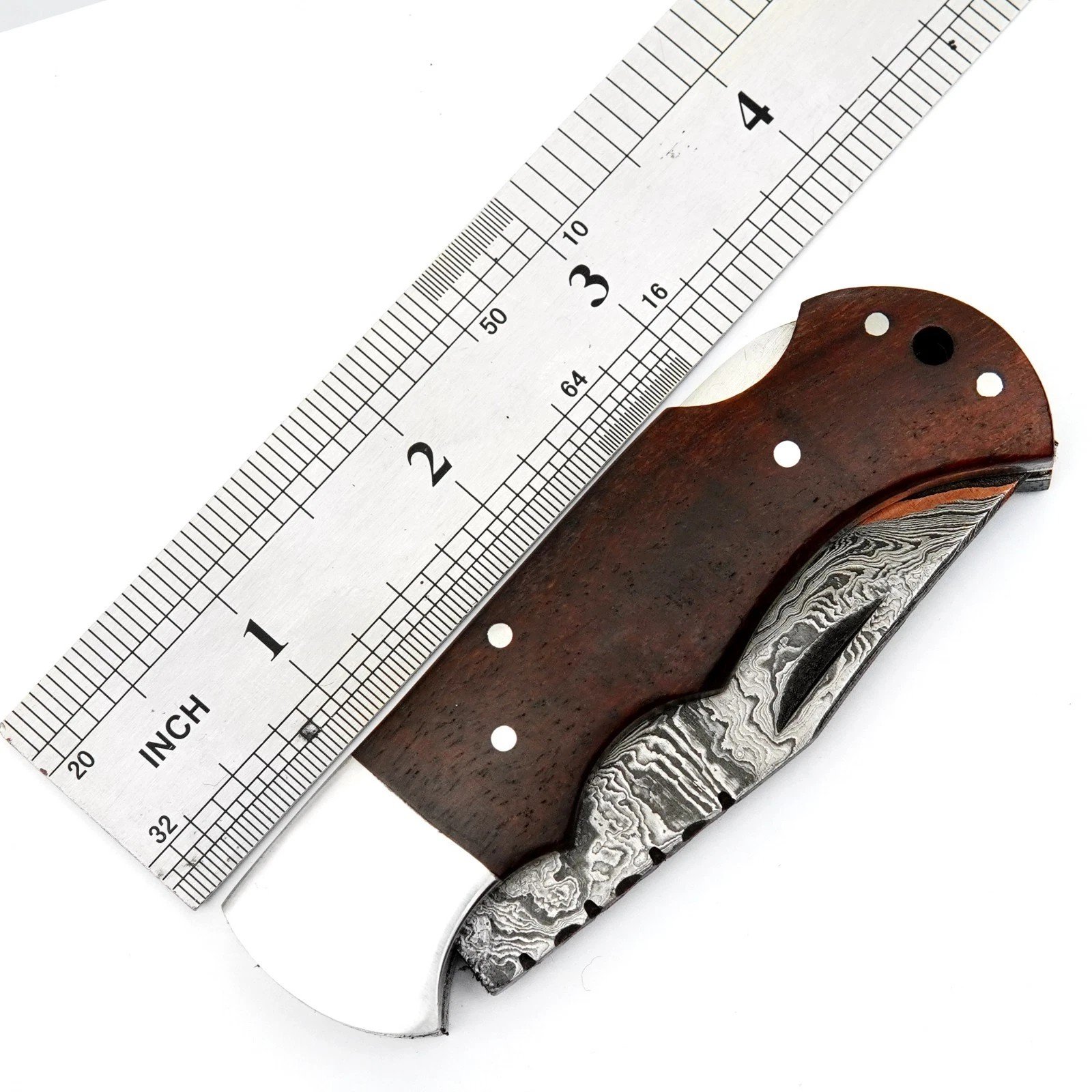
The handle features warm brown coloring with darker wood-grain-like markings. Its lower edge includes several finger contours, while small circular metal fittings create subtle decorative highlights. A larger dark opening near the rear provides another recognizable detail.
The knife is photographed beside a measurement ruler, offering a useful visual reference for its general size.
This combination of patterned metal, warm handle colors, and traditional styling makes the knife interesting for customers who appreciate distinctive fixed-blade cutlery.
The exact steel grade, handle material, dimensions, and cutting performance require manufacturer confirmation.
Damascus Pattern Skinner Knife with a Distinctive Blade
One of the defining features of this knife is its patterned blade surface.
The silver-gray metal displays numerous flowing lines and layered formations across the exposed blade.
Some markings form closely grouped waves, while others create irregular circular shapes.
These patterns contribute to the decorative appearance traditionally associated with Damascus-style metalwork.
Near the blade’s wider section, the surface features several darker formations surrounded by lighter lines.
Toward the tip, the markings continue through narrower sections of the blade.
This variation makes the blade visually interesting without relying on painted colors or elaborate external accessories.
The blade’s profile is relatively compact, with a curved cutting edge and pointed end.
Its appearance resembles the general shape of certain hunting and skinning knives.
However, the photograph cannot confirm whether the blade is manufactured from layered Damascus steel, pattern-welded steel, or another material with a decorative patterned finish.
For that reason, the product is described as a Damascus-pattern knife until its exact construction has been verified.
Compact Fixed-Blade Design
The knife has a fixed-blade appearance, with the blade extending directly from the handle.
No folding hinge or opening mechanism is visible.
The overall silhouette resembles traditional compact hunting cutlery.
Its cutting edge curves gently toward the pointed tip, while the upper section follows a different contour.
This arrangement creates a recognizable blade profile that differs from broad kitchen knives and straight-edged utility cutters.
The relatively short-looking blade and shaped handle give the product a compact appearance.
A ruler appears beside the knife, but the photograph does not provide a manufacturer-approved measurement chart.
Perspective and placement can affect the apparent dimensions.
For accurate product information, the supplier should confirm the overall length, blade length, thickness, and weight.
The photograph also does not establish whether the knife uses full-tang or another internal construction.
Such information is important when evaluating its suitability for practical cutting work.
Traditional Brown Wood-Grain Handle
The handle introduces warm natural-looking tones that contrast with the silver-gray blade.
Its surface contains medium and dark brown areas with irregular grain-like markings.
These details give the handle a rustic appearance.
Rather than featuring a perfectly uniform finish, the brown section displays visible variation along its length.
Several darker markings follow the handle’s curved outline.
The end is rounded and relatively broad, while the front portion narrows toward the blade.
The handle also has a contoured lower edge with several recessed areas.
These contours contribute to its distinctive traditional knife styling.
The handle appears wooden, but the precise material cannot be identified conclusively.
Natural hardwood, stabilized wood, laminated wood, and wood-effect composites can produce similar appearances.
The manufacturer should confirm the actual composition before claims about a particular wood species, treatment, or material performance are published.
Contoured Grip with Finger Grooves
The lower handle features several curved recesses resembling finger grooves.
These contours distinguish the design from knives with straight, rectangular handles.
Their arrangement creates a sculpted appearance.
The handle becomes narrower toward the blade, with additional shaping near the transition between the grip and metal.
This gives the knife a recognizable profile commonly associated with certain hunting and specialty cutlery designs.
The contours may interest customers who prefer knives with visibly shaped grips.
However, the image does not prove that the handle provides a particular level of comfort, grip security, or slip resistance.
These characteristics depend on the handle’s actual dimensions, surface texture, and construction.
For a reliable product listing, the handle should be described according to its visible shape rather than through unverified ergonomic performance claims.
Decorative Circular Handle Fittings
Several small light-colored circular fittings appear along the handle.
They are positioned at different points across the brown surface.
Their metallic-looking finish contrasts with the darker wood-grain appearance.
These fittings resemble the pins often found in traditional fixed-blade knife handles.
However, the photograph does not reveal their exact material or structural function.
They may serve as fasteners, decorative elements, or a combination of both.
The handle also includes a larger dark circular opening near its rear end.
This feature resembles a lanyard hole.
No lanyard is shown, so a cord or attachment should not be listed as included.
The exact dimensions and purpose of the opening require supplier confirmation.
Together, these small details give the handle an attractive and recognizable appearance.
Silver-Gray Blade with Copper-Colored Accent
An especially noticeable decorative feature is the narrow copper-colored line running along part of the blade.
The accent follows the curved region near the cutting edge.
Its warm metallic appearance provides contrast with the cooler silver and charcoal tones.
The line is particularly visible around the middle portion of the blade.
This subtle color difference creates visual separation between the heavily patterned surface and the darker section near the edge.
The design adds character without covering the blade in elaborate ornamentation.
However, the photograph does not establish whether the accent is made from copper, a copper-colored alloy, or a surface treatment.
It should therefore be described according to its appearance rather than as a confirmed material.
Similarly, the image cannot establish the blade’s edge angle, actual sharpness, or manufacturing method.
These details require manufacturer documentation.
A Traditional Hunting-Style Appearance
The knife’s overall shape is consistent with the visual styling of certain hunting and skinning knives.
Its curved cutting-edge profile, pointed tip, fixed-blade configuration, and contoured handle contribute to that appearance.
Different hunting-style knives may be designed for different practical applications.
Some have broad blades, while others feature narrower or more specialized profiles.
The photographed model has a relatively compact appearance and an extended, curved cutting edge.
However, identifying the knife’s visual category does not confirm that it is suitable for a particular field-dressing or outdoor task.
Practical suitability depends on the steel composition, edge geometry, structural construction, and manufacturer guidance.
Customers should review those specifications before purchasing the knife for regular use.
Until the details are confirmed, it is more accurate to market this product based on its visible design and general cutlery category.
Damascus Pattern Skinner Knife for Collectors
The Damascus Pattern Skinner Knife may appeal to collectors interested in distinctive blade patterns and traditional handle designs.
Its flowing metal markings create several visual points of interest.
The curved blade profile adds a recognizable silhouette.
The brown wood-grain handle introduces warm coloring.
The circular fittings and lanyard-style opening contribute additional details.
These features make the knife visually different from models with plain polished blades and simple synthetic grips.
Collectors may appreciate the combination of organic-looking blade patterns and handle markings.
The knife could complement a securely stored collection of specialty hunting-style cutlery.
For an accurate collection record, details such as manufacturer, country of origin, blade construction, and dimensions should be confirmed.
The photograph alone does not establish those characteristics.
Understanding Damascus-Style Blade Patterns
Damascus-style blade patterns are widely recognized for their flowing lines and layered appearance.
These designs can vary considerably between knives.
Some show narrow waves, while others feature large swirls or irregular formations.
The photographed knife displays several of these characteristics.
However, different manufacturing techniques can produce similar patterns.
Modern pattern-welded steel involves joining different metals through a particular manufacturing process.
Other blades may feature decorative surface treatments that create a layered-looking appearance.
The image cannot distinguish between these construction methods.
Therefore, it would be inaccurate to advertise the knife as genuine pattern-welded Damascus steel without verification.
Claims concerning specific alloys, steel layers, hardness, or heat treatment must be supported by manufacturer information.
A decorative pattern also does not automatically establish superior cutting performance.
Actual sharpness, toughness, and corrosion resistance depend on the blade’s verified material and construction.
An Appealing Combination of Natural and Metallic Styling
The overall design uses a relatively restrained color palette.
The blade features silver-gray metal with darker layered markings.
The handle introduces warm brown and dark wood-grain colors.
The narrow copper-colored accent provides another visual highlight.
Small circular fittings add contrasting details.
Together, these elements create a coordinated appearance.
The blade and handle share an organic-looking pattern, although their materials and finishes differ.
This visual similarity makes the product distinctive without requiring bright or elaborate decoration.
Customers who appreciate traditional-looking cutlery may find the combination appealing.
Its compact silhouette may also interest enthusiasts who collect knives with different blade profiles.
The final purchasing decision should consider verified specifications as well as appearance.
Size Reference and Product Photography
The uploaded image includes a metal ruler positioned diagonally alongside the knife.
The ruler has inch markings and smaller graduation lines.
This provides a useful visual reference for the product’s general scale.
However, the photograph does not establish exact manufacturer measurements.
The knife and ruler are not accompanied by a technical measurement diagram.
Perspective and alignment may affect the apparent dimensions.
For WooCommerce, it would be preferable to include confirmed measurements in the product specifications.
Additional photographs could also help customers evaluate the knife.
A close-up of the blade would make the decorative pattern easier to inspect.
A separate handle photograph could highlight the grain-like finish and fittings.
An opposite-side view could confirm whether similar details appear on the other side.
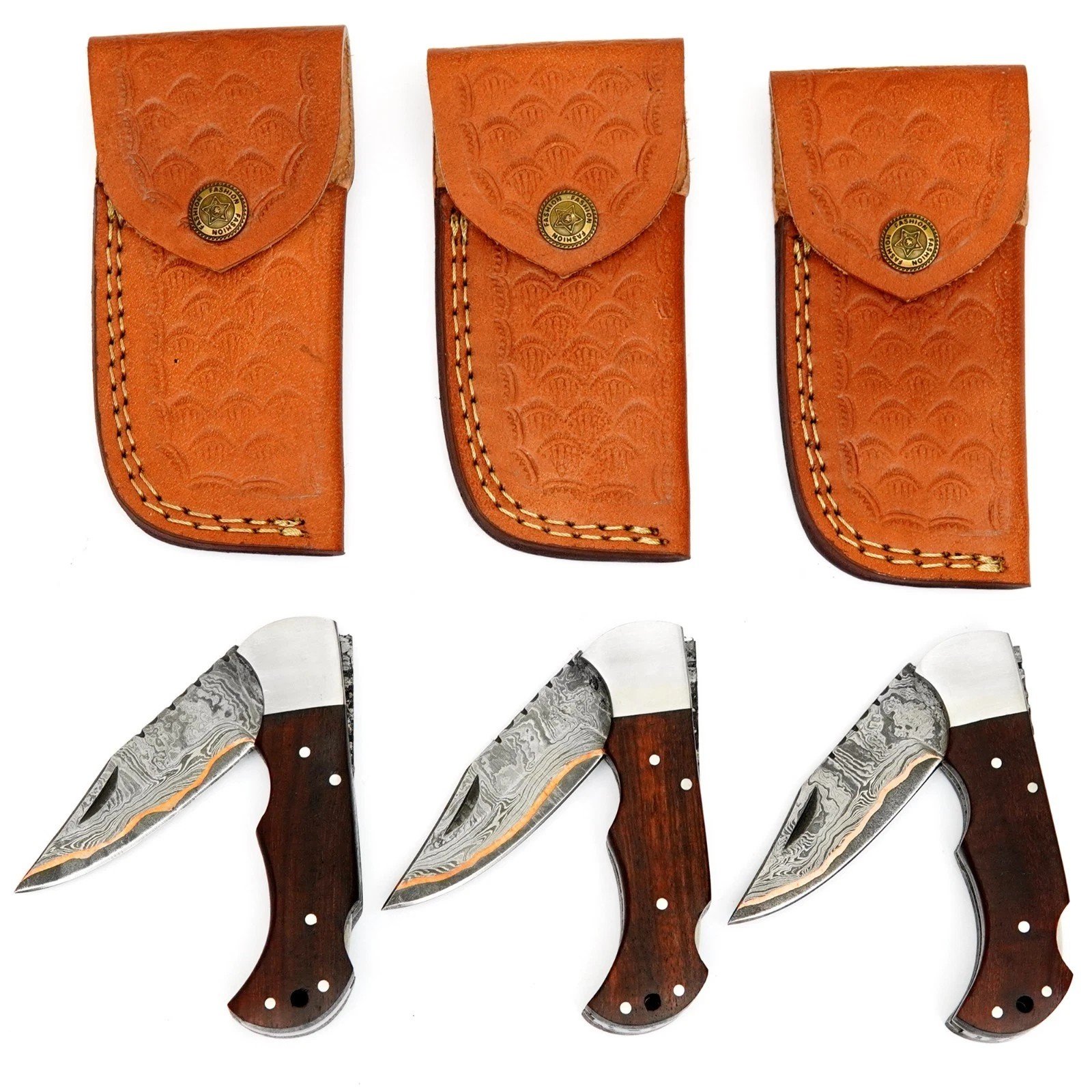
A photograph of any included sheath or packaging would help establish the complete product configuration.
Suitable Customers and Buying Considerations
This knife may interest several types of customers.
Collectors may appreciate its distinctive Damascus-style surface pattern.
Traditional cutlery enthusiasts may be attracted to the brown contoured handle and metallic details.
Customers comparing compact fixed-blade designs may find its curved profile worth examining.
The product’s appearance can be appreciated independently of its intended practical use.
However, anyone planning to use the knife for cutting tasks should obtain verified technical information.
The actual blade steel, edge geometry, dimensions, construction, and manufacturer recommendations are important.
No sheath, storage case, or additional accessories are visible in the photograph.
These items should not be advertised as included unless the supplier confirms them.
Accurate specifications will help customers compare the knife with other products and make an informed purchasing decision.
General Cleaning and Maintenance
Proper maintenance can help preserve the appearance of decorative knives.
The following recommendations are general guidance. Manufacturer-specific instructions should always take priority.
Clean the Blade Carefully
Use a soft cloth to remove dust, fingerprints, and visible residue.
If compatible with the confirmed materials, mild soap and lukewarm water may be suitable for gentle cleaning.
Avoid abrasive products that could scratch the patterned surface.
Dry Thoroughly
Dry the blade and handle after cleaning.
Pay attention to the area where the blade meets the handle.
Moisture can collect around fittings and joined components.
Protect the Decorative Pattern
Avoid aggressive polishing compounds unless approved by the manufacturer.
Some treatments can affect etched or patterned metal finishes.
The exact finishing method used on this knife is unknown.
Care for the Handle
Avoid leaving the handle submerged in water.
Different natural and synthetic handle materials require different maintenance methods.
Do not apply oils or specialty conditioners until the actual material has been verified.
Maintain the Cutting Edge
If the knife is supplied with a sharpened edge, follow the manufacturer’s recommended maintenance procedure.
The suitable sharpening method depends on the actual blade steel and edge geometry.
Store Safely
Keep the knife in a secure location away from children and unauthorized users.
Use a properly fitted protective sheath or blade guard where appropriate.
Follow applicable laws concerning knife ownership, storage, and transportation.
Important Product Specifications to Confirm
The following technical information cannot be established from the photograph:
- Exact blade steel composition
- Whether the blade is pattern-welded or surface-patterned
- Overall length
- Blade length and thickness
- Knife weight
- Steel hardness
- Edge sharpness and geometry
- Handle material and wood species
- Tang construction
- Handle attachment method
- Material of the decorative fittings
- Composition of the copper-colored accent
- Country of manufacture
- Intended cutting applications
- Included sheath or accessories
- Customization availability
- Packaging specifications
- Manufacturer warranty
These details should be confirmed directly with the supplier.
Claims such as handmade production, high-carbon steel, full-tang construction, genuine Damascus steel, or professional hunting performance should not be published without supporting documentation.
Why Choose This Damascus Pattern Skinner Knife?
The main appeal of this Damascus Pattern Skinner Knife is its combination of distinctive blade patterns and traditional handle styling.
The flowing silver-gray markings create an attractive metal surface.
The curved cutting-edge profile gives the knife a recognizable hunting-style silhouette.
Its warm brown handle features visible grain-like markings and several contoured finger recesses.
Small circular fittings and a lanyard-style opening complete the design.
The copper-colored accent introduces another detail that distinguishes the blade from plain-finished knives.
Together, these characteristics create an interesting option for collectors and enthusiasts of specialty cutlery.
Its actual cutting suitability should be evaluated using verified manufacturer specifications.
Explore This Distinctive Fixed-Blade Knife
The Damascus Pattern Skinner Knife with Brown Wood-Grain Handle combines a patterned silver-gray blade, curved profile, and traditionally styled grip in one recognizable design.
Its contrasting finishes and decorative details make it an appealing choice for customers who appreciate compact hunting-style knives.
Explore this distinctive knife for your collection, and confirm its actual dimensions, materials, intended use, and supplier specifications before purchasing.






Reviews
There are no reviews yet.