





Blue Resin Handle Damascus Hunting Knife with Leather Sheath
The Blue Resin Handle Damascus Hunting Knife combines an eye-catching blade design with a colorful handle and a traditional outdoor knife profile. Its patterned blade, blue-and-amber handle accents, and matching reddish-brown sheath create a distinctive appearance that stands apart from more conventional hunting knives.
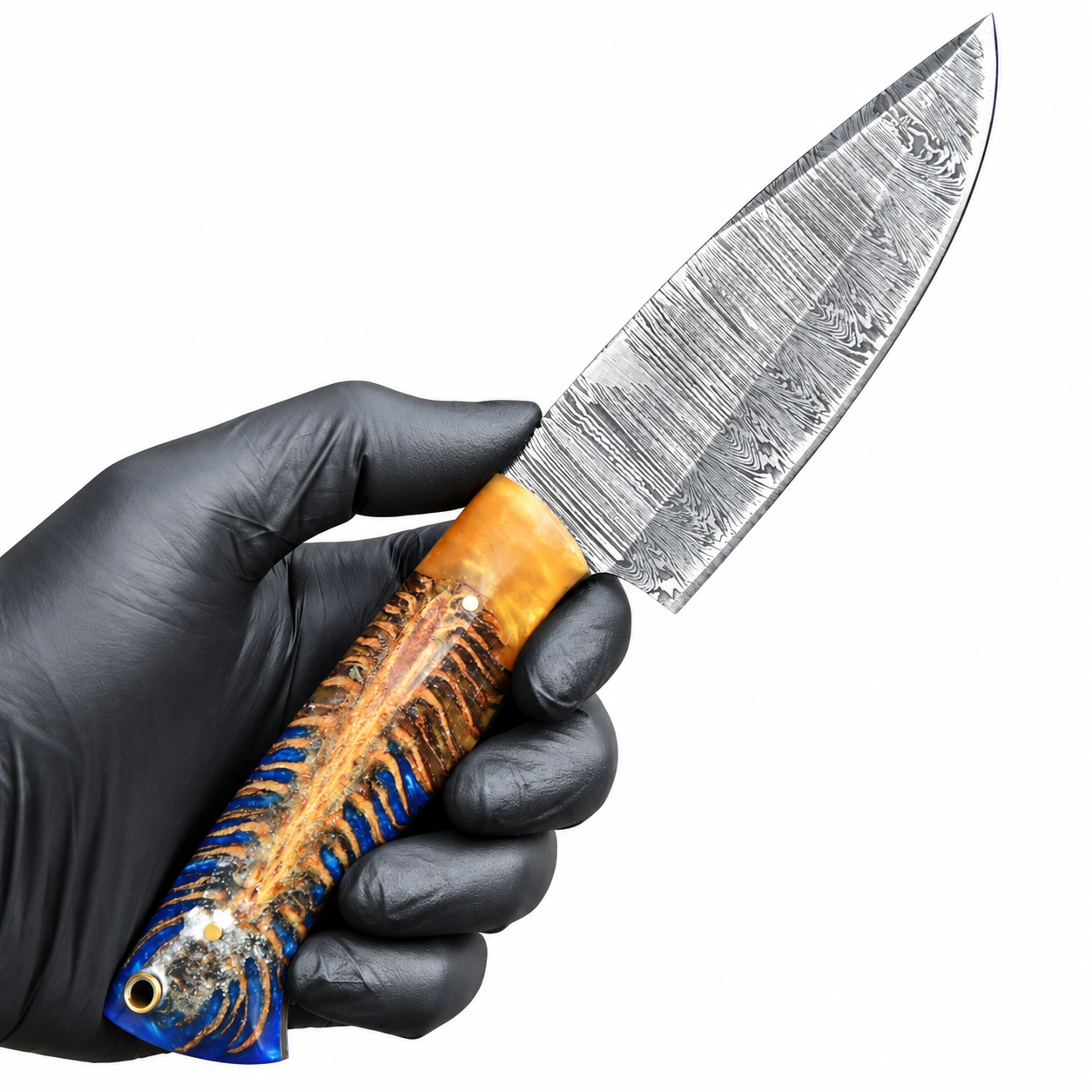
Designed in a fixed-blade style, this knife has a broad cutting profile, a gently curved edge, and a pointed tip. The blade displays flowing silver and grey lines reminiscent of traditional Damascus steel. These details give the knife an attractive finish that can appeal to outdoor enthusiasts, knife collectors, and customers who appreciate decorative knife designs.
One of the most recognizable features of this model is its multicolored handle. Deep blue sections blend with warm amber and dark natural-looking patterns, creating a striking contrast against the metallic blade. The handle also features small decorative pins and a circular opening near its end.
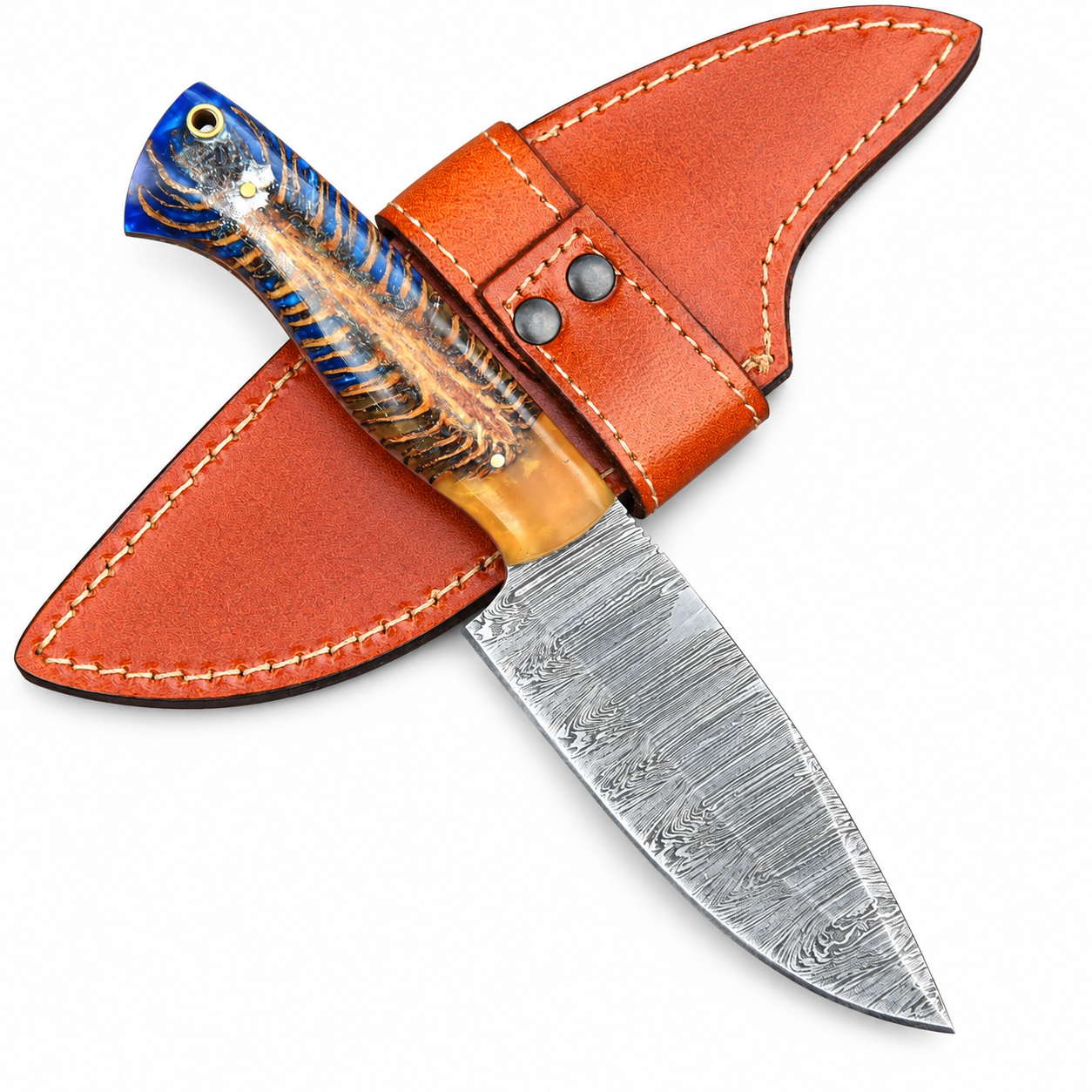
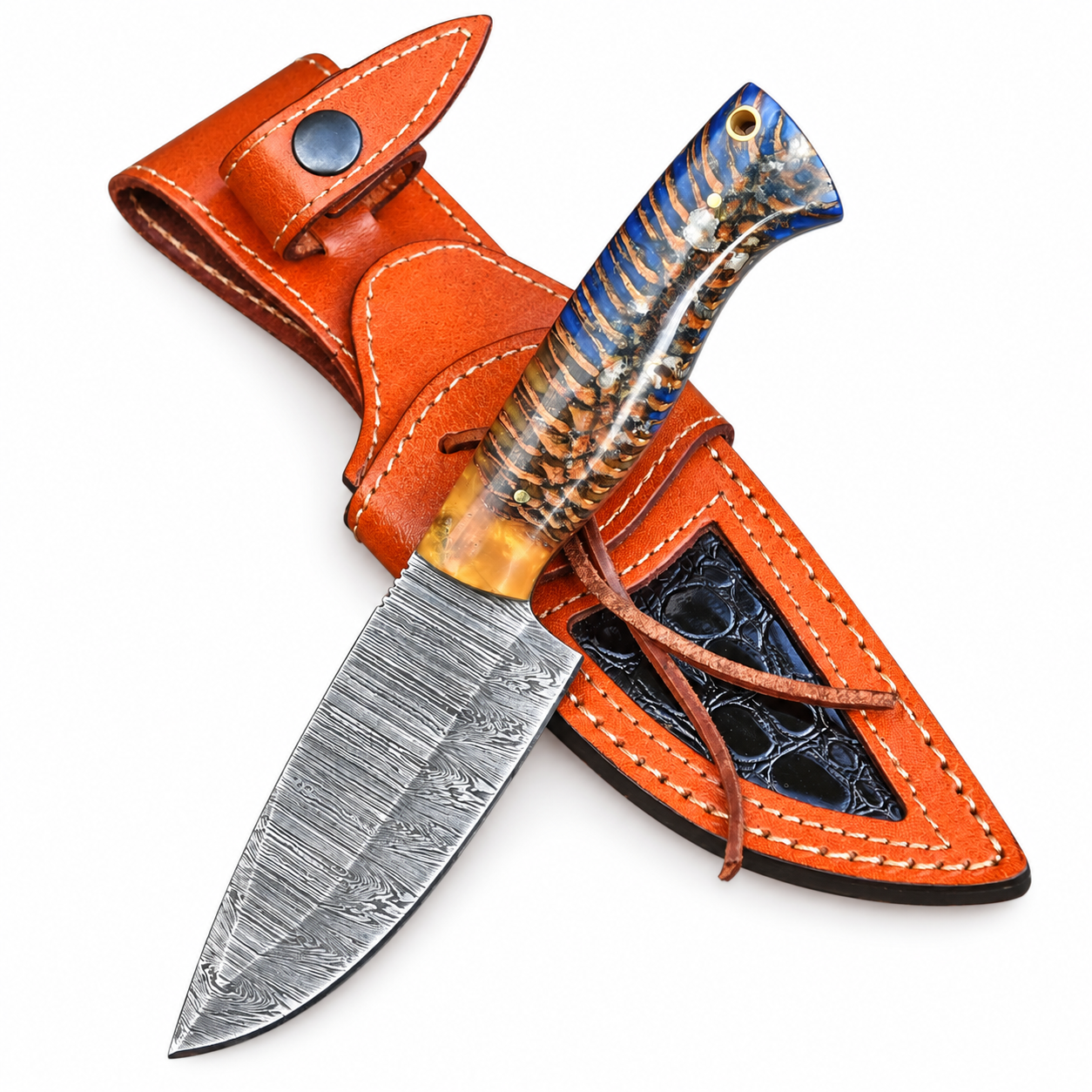
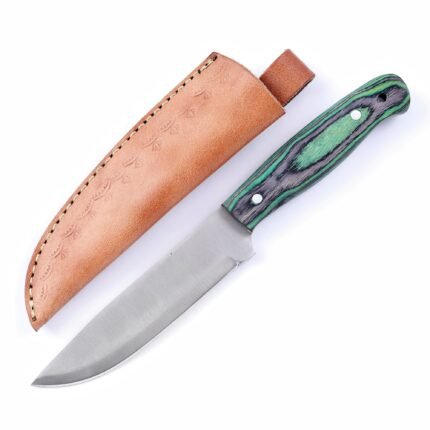
A reddish-brown sheath is shown with the knife, featuring contrasting stitching and a wide retaining strap with metal fasteners. Together, the knife and sheath make an appealing combination for customers interested in hunting-style knives, outdoor accessories, and distinctive collectible pieces.
Distinctive Damascus-Style Blade Pattern
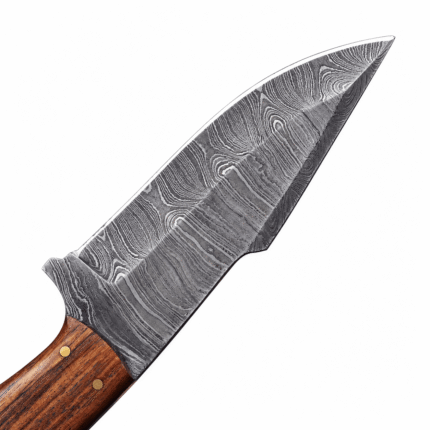
The most prominent feature of this Blue Resin Handle Damascus Hunting Knife is its patterned blade.
Fine silver and grey lines flow across the visible blade surface, forming a series of organic curves and layered shapes. Some areas feature tightly arranged parallel lines, while others display broader, swirling patterns.
This visual effect is commonly associated with Damascus-style knives. It gives the blade depth and character, especially when photographed against a clean background.
The blade is relatively broad near the handle and gradually narrows toward a pointed tip. Its cutting edge follows a smooth curve, while the upper edge slopes toward the point.
This configuration resembles the profile of an outdoor utility or hunting knife, where a curved cutting edge may be useful for controlled slicing tasks.
The layered-looking surface makes the knife visually appealing for people who prefer distinctive designs rather than plain polished blades.
However, the visible pattern alone does not establish the steel grade, number of layers, or manufacturing method. Those details should be confirmed through the manufacturer before being advertised as technical specifications.
Attractive Blue and Amber Handle Design
The handle is the feature that gives this knife its individual character.
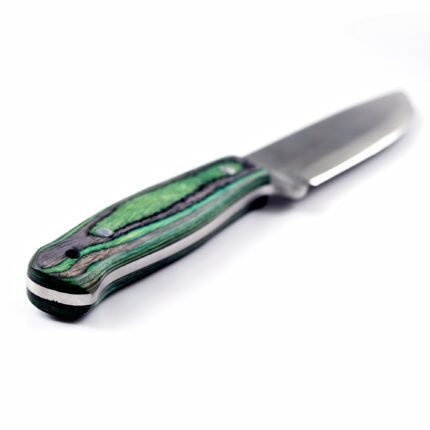
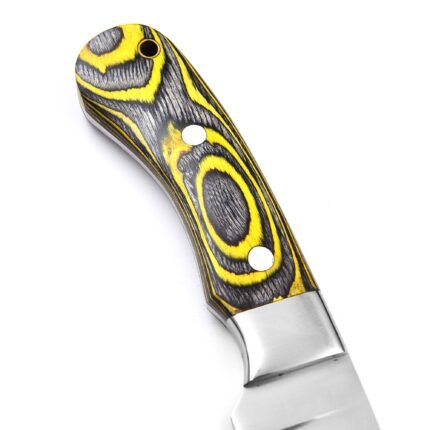
It combines deep blue, golden amber, black, and dark brown tones in an irregular decorative pattern. The blue sections are especially noticeable near the end of the handle, where they contrast with the lighter amber-colored central area.
The decorative material has a glossy, resin-like appearance. Dark natural-looking inclusions are visible within the handle, creating a textured visual effect.
These contrasting colors make the knife suitable for customers who appreciate unusual handle designs and decorative outdoor equipment.
The handle widens toward the rear, creating a flared end. Its overall shape includes gentle contours that visually distinguish it from a straight, cylindrical handle.
Small metallic pins appear along the handle, adding detail to the construction.
Near the end is a circular metal-lined opening that resembles a lanyard hole. This can provide an attachment point for a compatible cord if its construction and intended use are confirmed.
The handle is described as resin-style because of its visible appearance. The exact material, such as stabilized resin, synthetic composite, natural wood, or another combination, should be verified before publication.
Fixed Blade Hunting Knife Profile
The Blue Resin Handle Damascus Hunting Knife features a fixed-blade design rather than a folding mechanism.
A fixed blade is a familiar choice in outdoor knife design because the blade remains in a single extended position.
Unlike folding pocket knives, this design does not require opening the blade before use. The cutting section is continuously exposed unless covered by its sheath.
The profile is suitable for customers looking for a traditional hunting-style knife, a visually distinctive outdoor accessory, or a piece for a knife collection.
Its broad blade and curved edge may be appropriate for ordinary outdoor cutting and slicing tasks, depending on the actual steel properties, sharpening, construction, and overall dimensions.
The design is also visually suited to display settings because the decorative blade and handle can be appreciated together.
Buyers planning regular practical use should confirm the blade thickness, tang construction, hardness, and edge characteristics before selecting the knife for demanding work.
Reddish-Brown Protective Sheath
The product image includes a reddish-brown sheath positioned behind the knife.
Its design complements the warm colors of the handle and creates an attractive presentation.
The sheath has a shaped outline that follows the general profile of the blade. A line of contrasting stitching is visible around much of the outside edge.
A retaining strap crosses the handle area and features two dark metal fasteners. This design resembles the retention systems found on traditional hunting knife sheaths.
The sheath has a leather-like appearance, with a textured surface and neatly arranged stitching.
Its reddish-brown color also contrasts with the blue sections of the knife handle, making the complete product visually balanced.
A suitable sheath can help cover the cutting edge while the knife is not being used. It may also provide a convenient storage option when the knife is kept with other outdoor equipment.
Before advertising the sheath as genuine leather, its material should be confirmed with the supplier.
Customers should also inspect the fit of the sheath before use and make sure the knife is fully seated and the retaining strap is properly secured.
A Decorative Knife for Outdoor Enthusiasts
There are many reasons customers choose a hunting-style knife.
Some buyers are looking for an outdoor cutting tool, while others are interested in traditional knife designs, unusual handle materials, or patterned blades.
The Blue Resin Handle Damascus Hunting Knife can appeal to these different interests because of its combination of a functional-looking blade profile and decorative detailing.
For outdoor enthusiasts, the fixed-blade format may be attractive because it offers a straightforward design without a folding joint.
For collectors, the flowing blade pattern and contrasting handle colors create a distinctive appearance.
For people who enjoy displaying traditional outdoor equipment, the knife can be presented alongside other hunting accessories, sheaths, or collectible knives.
The visually textured handle also makes the product suitable for detailed photography, where close-up images can highlight the colors and decorative elements.
Its appearance makes it an interesting option for a collection that already contains traditional wooden-handle knives or simpler utility models.
Blade Shape and Cutting Profile
The blade has a relatively wide body with a curved cutting edge that narrows toward the tip.
This general shape is often associated with outdoor fixed-blade knives.
A curved edge can offer useful contact with material during ordinary slicing movements. A pointed tip may support tasks requiring more precise placement, provided the knife is suitable for the task.
The broad profile also gives the knife a substantial visual presence.
Near the handle, the blade transitions into a narrower shoulder area with several small textured-looking grooves along the upper section.
These visible details contribute to the overall design without making the knife appear excessively complicated.
Because the blade’s actual dimensions are unavailable, no specific cutting capacity or performance rating can be assigned.
Knife performance depends on more than appearance. Steel composition, blade geometry, heat treatment, edge finish, and sharpening all influence how a knife behaves in use.
These should be checked through verified supplier specifications rather than inferred from photographs.
Decorative Handle Details
A major attraction of this knife is the combination of colors and patterns visible within its handle.
Blue areas create a cool, vivid contrast, while the amber-colored section introduces a warmer tone.
Dark organic-looking shapes appear within the decorative material, giving it a layered appearance.
This kind of handle design may appeal to buyers looking for a knife that feels visually different from mass-produced models with simple black handles.
The small metallic pins provide additional accents without distracting from the main design.
A gold-colored metal ring surrounds the opening near the end of the handle, creating another detail that matches the warm colors of the sheath.
The handle’s finish appears smooth and glossy in the supplied photograph.
However, the image cannot establish how it feels in the hand or how securely it performs when wet.
For working applications, buyers should assess the actual handle size, grip comfort, and surface texture before purchase.
Suitable for Knife Collectors
Collectible knives are often selected for their visual characteristics, materials, and overall presentation.
The Blue Resin Handle Damascus Hunting Knife offers several details that can interest a collector.
Its patterned blade is the central visual feature, with flowing lines that create an intricate surface.
The handle introduces another layer of detail through its blue, amber, and dark-colored sections.
The contrasting metal fittings and reddish-brown sheath complete the appearance.
For someone building a collection of fixed-blade knives, this design provides an alternative to conventional polished steel blades and single-color handles.
It may also complement collections featuring Damascus-pattern knives, traditional outdoor knives, or decorative hunting equipment.
Collectors interested in material authenticity should request information about the steel composition, handle material, maker, and production method.
Those specifications can have a significant influence on collectibility and should not be assumed from the image alone.
Outdoor and Camping Applications
Fixed-blade knives are commonly associated with outdoor activities because of their straightforward construction.
Depending on the manufacturer’s verified specifications, this knife may be considered for ordinary camp-related cutting tasks, preparation of suitable materials, or other light outdoor applications.
Its curved edge and pointed profile resemble designs used for general outdoor utility.
The included sheath-style accessory may make storage easier when the knife is not in use.
For customers who spend time outdoors, selecting the correct knife involves considering both appearance and practical requirements.
Blade dimensions, edge sharpness, corrosion resistance, handle comfort, and sheath retention are important factors.
The Blue Resin Handle Damascus Hunting Knife has an attractive outdoor appearance, but its suitability for demanding bushcraft, heavy chopping, or other high-stress activities cannot be established without technical information.
Use it only for tasks consistent with the manufacturer’s instructions and applicable local laws.
An Attractive Display or Gift Option
This knife may also appeal to buyers seeking a decorative gift for an adult knife enthusiast.
Its distinctive color combination and patterned blade create a memorable appearance.
The reddish-brown sheath adds a traditional finishing detail and makes the set visually cohesive.
Because the knife is photographed alongside its sheath, buyers can easily appreciate how the two components complement one another.
The product may be suitable for collectors who enjoy exploring different blade patterns and handle designs.
It can also appeal to people interested in outdoor-themed displays or decorative accessories.
Before purchasing it as a gift, confirm that the recipient can legally own the knife in their location and that any applicable age or shipping restrictions are satisfied.
Gift packaging should only be advertised if it is actually supplied.
Blade and Handle Construction Considerations
A knife’s construction influences its durability, handling, and practical suitability.
The photograph shows a patterned blade connected to a shaped, multicolored handle with visible pins.
This suggests a mechanically assembled handle construction, but the image does not reveal the complete internal structure.
In particular, it is not possible to confirm whether the knife has a full tang, partial tang, concealed tang, or another construction method.
Likewise, the metal’s precise composition and the handle’s internal reinforcement cannot be determined.
When reviewing this product, customers may wish to confirm the following with the supplier:
- Actual blade and overall length
- Blade thickness and weight
- Steel composition and manufacturing method
- Hardness and heat treatment
- Handle material and construction
- Tang configuration
- Sheath material and attachment options
- Included accessories and packaging
Publishing these details once verified can help customers compare the product with other fixed-blade knives.
Accurate specifications also reduce the likelihood of misunderstandings regarding size, construction, and intended use.
Caring for the Patterned Blade
Regular maintenance is important for keeping any knife in good condition.
After appropriate use, carefully clean the blade according to the manufacturer’s recommendations.
Remove moisture and residue before placing the knife into storage.
Dry the blade thoroughly with a clean, soft cloth.
If the steel is susceptible to corrosion, an appropriate protective treatment may help preserve its condition. The correct product should be chosen according to the actual steel and intended food-contact requirements.
Avoid leaving the knife damp inside the sheath for extended periods.
Moisture trapped against the blade may contribute to corrosion, particularly if the steel is not highly corrosion resistant.
To help preserve the decorative finish, avoid unnecessary contact with harsh chemicals or abrasive cleaning products.
Sharpen the knife only with equipment and methods suitable for its edge geometry.
If the knife requires significant sharpening or repair, professional assistance may be appropriate.
The aim is to maintain the blade safely without damaging its finish or changing its original profile.
Maintaining the Decorative Handle
The multicolored handle is one of the most visually appealing parts of this knife.
To maintain its appearance, wipe it with a soft, slightly damp cloth when necessary.
Avoid prolonged exposure to aggressive cleaning products unless the handle material is known to be compatible with them.
Because the exact material has not been verified, do not assume it can tolerate prolonged soaking, high heat, or strong solvents.
Store the knife away from excessive moisture and temperature extremes.
Occasionally inspect the handle for loose fittings, cracks, or other signs of wear.
If a lanyard is fitted through the metal-lined opening, make sure the cord is appropriate for the intended purpose.
Never use an unverified lanyard attachment as a lifting or load-bearing point.
Careful storage and routine inspection can help preserve the product’s appearance.
Sheath Care and Safe Storage
The reddish-brown sheath is an important part of the product’s presentation.
Its stitched edges and retaining strap deserve the same attention as the knife itself.
If the sheath is confirmed to be leather, use maintenance products appropriate for that type of leather.
If it is made from a synthetic material, follow the relevant cleaning instructions.
Keep the sheath reasonably dry and remove dirt from the seams when necessary.
Before storing the knife, ensure that the blade is clean and dry.
Check that the retaining strap and metal fasteners are working correctly.
For long-term storage, follow the manufacturer’s recommendations regarding whether the knife should remain inside the sheath.
Keep the knife secured and out of reach of children or unauthorized users.
When handling or inspecting the knife, maintain control of the cutting edge and use appropriate safety precautions.
What Makes This Design Distinctive?
The Blue Resin Handle Damascus Hunting Knife has several recognizable characteristics that differentiate its appearance from simpler models.
The patterned blade introduces flowing silver and grey lines that remain visible across a large part of its surface.
The shaped handle combines vivid blue, amber, and dark-toned decorative sections.
Small metallic pins and a lined opening near the end provide additional visual details.
The reddish-brown stitched sheath complements the handle and creates an attractive traditional presentation.
These design elements work together rather than competing for attention.
A customer looking for a plain utility knife may prefer a simpler product. Someone who values decorative details, however, may find this model especially appealing.
Its visual character is particularly suited to collections that feature unusual blade finishes or multicolored handles.
Choosing the Right Hunting-Style Knife
Before purchasing a hunting-style knife, consider how it will be used.
For a display collection, the most important factors may be appearance, materials, finish quality, and authenticity.
For outdoor use, practical specifications become more important.
A buyer may need to compare dimensions, balance, weight, edge shape, corrosion resistance, and grip design.
For frequent field use, accurate steel and tang specifications are especially valuable.
The Blue Resin Handle Damascus Hunting Knife offers a distinctive appearance, but buyers should obtain the manufacturer’s technical information before judging its performance against other knives.
The supplied image is useful for assessing its visible colors, blade profile, and decorative design. It cannot verify hidden construction details or long-term durability.
Making this distinction helps customers choose products based on reliable information rather than assumptions.
Final Thoughts
The Blue Resin Handle Damascus Hunting Knife brings together a Damascus-style patterned blade, a striking multicolored handle, and a reddish-brown sheath in one visually distinctive design.
Its flowing blade pattern and vivid handle colors create an appearance that can interest outdoor enthusiasts and collectors alike.
For buyers who appreciate traditional fixed-blade knife shapes with more decorative styling, this model is worth exploring.
Review the available product specifications, confirm the construction materials, and consider whether its intended use matches your needs before placing an order.






Reviews
There are no reviews yet.