




Damascus-Pattern Curved Skinning Knife with Red Wood-Grain Handle
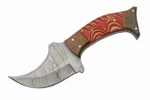
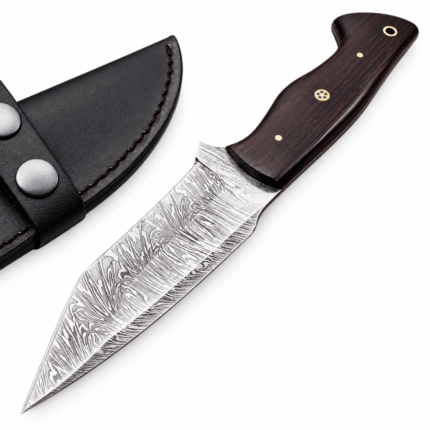
The Damascus-Pattern Curved Skinning Knife features a distinctive sweeping blade, a patterned red and brown handle, and a matching brown protective sheath. Its strongly curved cutting edge gives it a recognizable skinning-knife profile, while the layered-looking blade finish adds decorative character.
Designed in the style of traditional fixed-blade hunting and skinning knives, this model combines a broad, curved blade with a contoured handle intended for handheld use. The blade has an upswept point, a wide cutting belly, and a visually detailed silver-gray surface.
The combination of flowing blade patterns, warm handle colors, and stitched sheath gives the knife an appearance that may appeal to hunting knife enthusiasts, outdoor equipment collectors, and customers interested in distinctive fixed-blade designs.
Unlike a straight-edged utility knife, this model has a noticeably curved cutting profile. That shape is commonly associated with skinning knives, where a broad cutting belly can be useful for controlled slicing motions during appropriate field-dressing tasks.
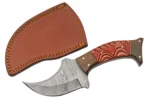
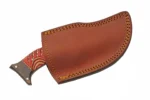
The product image also shows a separate brown sheath positioned beside the knife. Its fitted outline follows the distinctive curved shape of the blade, providing a coordinated accessory for protected storage.
The exact material specifications and manufacturing details should be confirmed before making technical performance claims.
Distinctive Curved Blade Design
The blade shape is one of the most recognizable elements of this knife.
Its cutting edge follows a broad curve, beginning near the handle and sweeping forward toward an upswept, pointed tip.
The blade also has a comparatively wide central section, creating a prominent cutting belly.
This outline differs from conventional straight-back hunting knives and narrow utility blades.
The pronounced curvature gives the knife a traditional skinner-style appearance.
Curved cutting edges are common in many hunting and skinning knife designs because their geometry can support sweeping cutting motions.
For customers comparing knife styles, the distinction between a curved skinner and a straight-edged knife is important.
A straight-edged blade may offer a different cutting experience, while a curved belly provides a longer arc along the cutting edge.
The shape should be selected according to the intended cutting task, the manufacturer’s recommendations, and the user’s level of experience.
Although the blade resembles a skinning or bull-cutter-style knife, the image alone cannot establish its suitability for every hunting or processing application.
The actual performance depends on the blade’s thickness, edge geometry, steel composition, heat treatment, and construction.
These details should be verified through the manufacturer.
Damascus-Style Patterned Blade Appearance
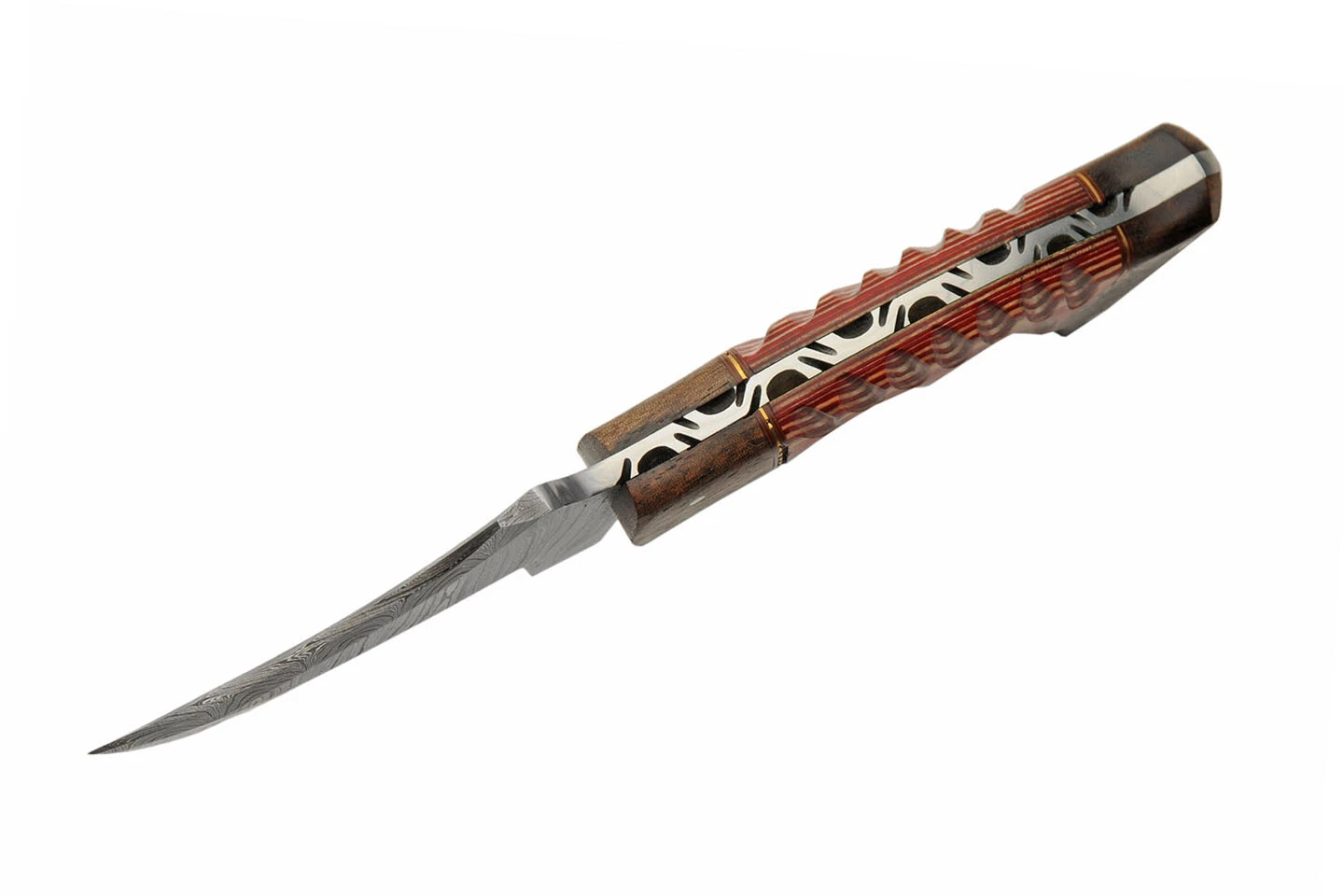
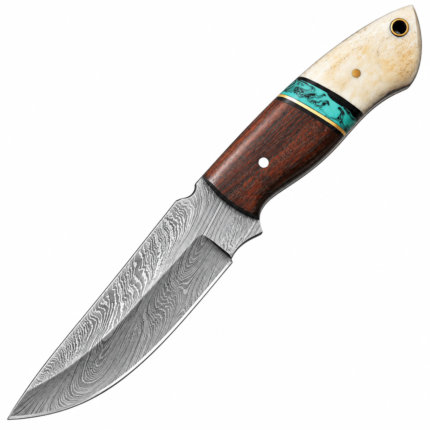
The silver-gray blade displays a flowing pattern resembling layered Damascus steel.
A series of fine, irregular lines travels across the metal surface, following the curvature of the blade.
These patterns form wave-like shapes, elongated contours, and darker sections that contrast with the lighter metallic areas.
The layered appearance is especially noticeable near the central body of the blade.
Along the cutting belly, the design continues toward the pointed end, creating a consistent visual finish.
This type of appearance is frequently associated with decorative hunting knives and collectible fixed-blade cutlery.
Damascus-style patterns can be created through different manufacturing processes.
Some blades are produced using pattern-welded steel, while others feature surface treatments designed to create a similar appearance.
The uploaded photograph does not establish which manufacturing process was used for this particular knife.
Therefore, the product is accurately described as having a Damascus-pattern blade rather than being identified as genuine layered Damascus steel without additional evidence.
Customers who specifically require pattern-welded Damascus construction should request verified material details.
The steel grade, number of layers, hardness, and manufacturing method remain unspecified.
Broad Cutting Belly and Upswept Tip
The blade’s broad cutting belly is an important part of its overall design.
Rather than extending in a completely straight line, the cutting edge curves outward before rising toward the point.
This creates the rounded cutting profile commonly associated with many skinning knives.
The tip is noticeably raised in relation to the lower cutting edge.
This upswept shape distinguishes the knife from drop-point and straight-back models.
In traditional skinning knife designs, the cutting belly and tip placement can influence how the knife moves through a cutting task.
However, a photograph cannot establish exact cutting performance or the suitability of the tip for specialized processing work.
The curvature also contributes strongly to the knife’s decorative appearance.
When viewed from the side, the blade forms a smooth arc that contrasts with the more angular handle fittings.
Its design may appeal to collectors who prefer unusual blade profiles rather than conventional hunting knife shapes.
Fixed Blade Construction
The knife shown in the photograph has a fixed-blade configuration.
Unlike a folding pocket knife, the blade does not visibly fold into the handle.
Fixed-blade knives are a recognized category of hunting and outdoor cutlery.
They are commonly selected for tasks where the user prefers a permanently extended blade.
This knife features a continuous assembled outline from the blade area through the handle.
The blade and handle are joined at a broad transition section.
The photograph shows a fitted handle with visible fastening pins, but it does not establish the internal tang construction.
Full-tang construction, hidden-tang construction, and other assembly methods cannot be reliably confirmed from this image.
The exact attachment method should therefore be checked with the manufacturer.
Likewise, claims about structural strength, impact resistance, or heavy-duty suitability should only be made when supported by technical specifications or testing.
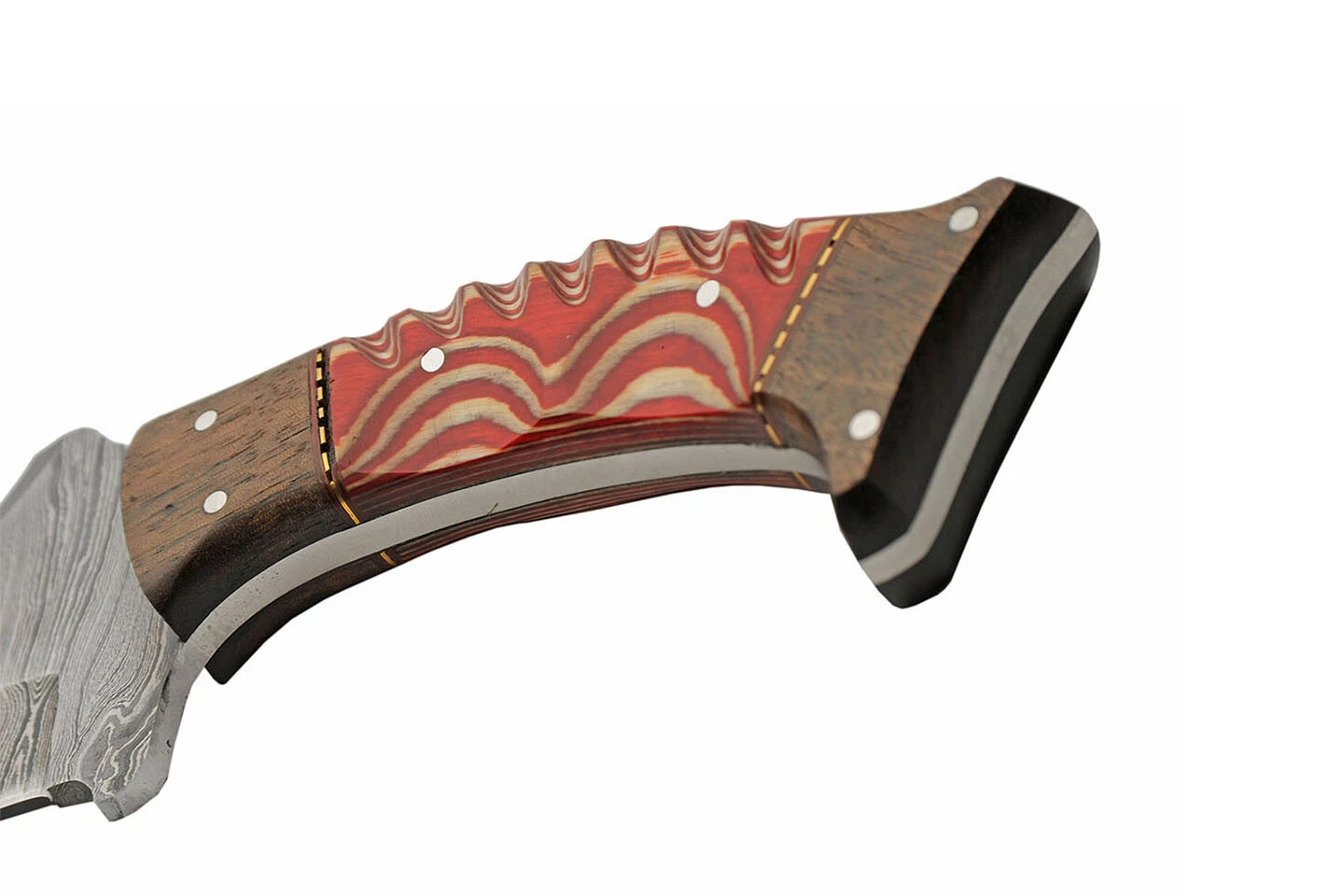
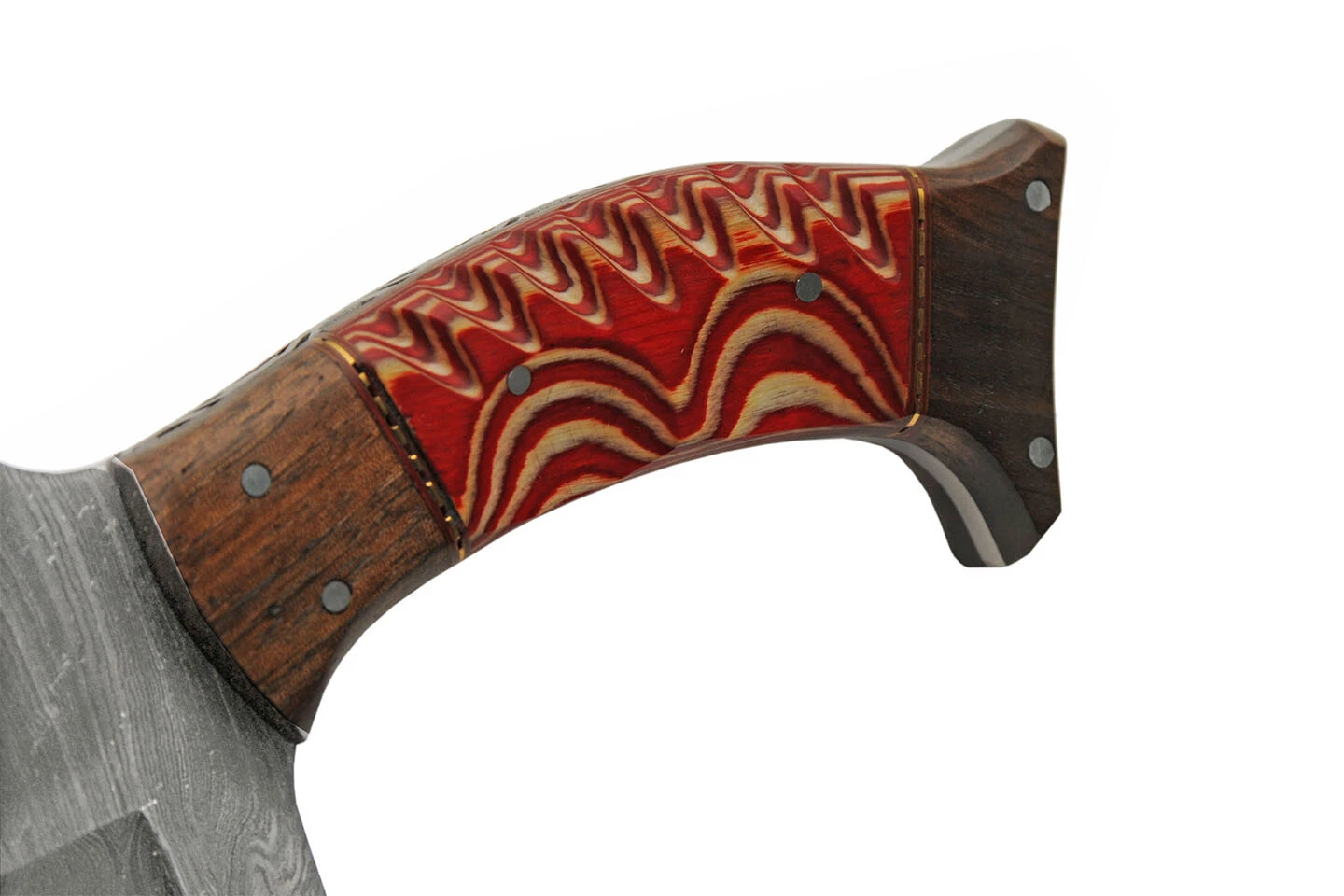
Red and Brown Decorative Handle
The handle creates a strong visual contrast with the silver-gray blade.
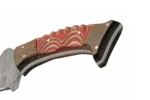
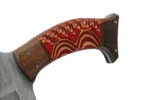
Its central section features a warm red background with flowing cream and golden-colored patterns.
These decorative lines curve across the handle surface, forming an intricate layered effect.
The pattern resembles the appearance of decorative laminated wood or colored composite handle materials.
However, the actual material cannot be identified conclusively from the image.
The red patterned section is framed by darker brown sections near the blade and at the rear of the handle.
These brown sections have a wood-like appearance, with visible grain and natural-looking color variation.
Together, the different finishes create a multi-tone handle design.
The warmer handle colors contrast with the cooler metallic blade surface.
This combination is one of the knife’s most distinctive visual features.
Customers interested in decorative hunting knives may appreciate the combination of a traditional-looking blade and a more colorful handle.
The handle’s exact material, treatment, and resistance to moisture should be verified before being included as product specifications.
Contoured Handle Profile
The handle is not completely straight.
Instead, it follows a gently curved shape designed around the knife’s overall profile.
A noticeable inward curve appears along the lower portion, while the upper edge follows a more gradual arc.
The rear section widens slightly before ending in an angled butt.
These visible features give the handle a shaped, sculpted appearance.
Contoured handles are common in fixed-blade knife design because they can help establish a defined gripping area.
The image shows this style of construction, but actual comfort and grip security depend on dimensions, surface finish, hand size, and practical handling.
The handle should therefore be described as contoured rather than guaranteed to provide a particular ergonomic result.
A prospective buyer may wish to confirm the overall handle length and width before purchase.
This is particularly relevant when selecting a knife intended for repeated practical use.
Visible Handle Fastening Details
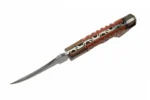
Several small metallic-looking pins are visible along the handle.
The pins appear light silver in color and contrast with the darker red and brown handle surfaces.
Their placement follows the length of the handle.
These details contribute to the knife’s traditional assembled appearance.
The photograph also shows narrow decorative lines separating the red central section from the adjacent brown sections.
These lines provide a clear visual boundary between the different handle finishes.
Although the visible pins resemble handle fasteners, their materials and installation methods are not confirmed.
They should not be described as brass, stainless steel, or structural rivets without manufacturer verification.
The image does not reveal the handle’s internal construction.
Decorative Handle Pattern
The red central section features an eye-catching layered design.
Cream-colored waves extend across the red background, creating alternating curved shapes.
The pattern has a bold appearance without completely covering the underlying red color.
Near the top edge of the handle, the design becomes more tightly arranged, while the middle section features wider flowing lines.
This creates visual variation across the handle.
The darker brown sections at either end provide contrast.
The overall appearance is more decorative than a plain black or natural wood handle.
The patterned surface may appeal to customers looking for a hunting knife with a distinctive personal style.
The design also makes the product visually recognizable in product photography.
Its combination of red, cream, brown, and metallic silver gives the knife a coordinated finish.
Brown Protective Sheath
The photograph shows a brown sheath placed beside the knife.
Its outline follows the broad curved shape of the blade.
The sheath has a warm reddish-brown finish and visible stitching along its perimeter.
The stitching appears yellow-gold in color.
This creates a contrasting border around the sheath.
The visible edge construction gives it a traditional stitched appearance.
The sheath is wider around the curved blade area and narrows toward the section corresponding to the knife’s base.
It appears designed to accommodate a knife with this distinctive profile.
The material resembles leather, but its exact composition cannot be verified from the image alone.
It may be genuine leather, bonded leather, or another leather-like material.
For accurate product information, the supplier should confirm its construction.
The fastening system, attachment method, and whether the sheath is designed for belt carry are not visible in the image.
Therefore, those features should not be assumed.
A Coordinated Knife and Sheath Presentation
The knife and sheath have complementary colors.
The warm brown sheath matches the brown sections of the handle.
Its contrasting stitching also complements the lighter decorative lines found in the red handle section.
This creates a coordinated presentation.
The sheath has a relatively simple exterior, allowing the knife’s blade pattern and handle design to remain the main visual features.
The absence of large exterior graphics gives it a traditional appearance.
A matching sheath can be useful for keeping the blade covered when the knife is not in use.
However, protective capability depends on the sheath’s material, fit, and construction.
The product should always be stored according to the manufacturer’s instructions.
Users should ensure that the sheath fits securely before carrying or storing the knife.
Traditional Skinning Knife Inspiration
The overall profile resembles traditional curved hunting and skinning knives.
These designs are generally recognized by their fixed blades, rounded cutting bellies, and curved tips.
The broad blade shape is visually different from the narrow blades found on some utility and carving knives.
The red patterned handle gives this model a distinctive identity within that traditional design category.
Knife collectors often distinguish models based on blade shape, handle materials, decorative treatment, and accompanying accessories.
This knife offers several visually identifiable characteristics.
The large cutting belly establishes its curved skinner-style profile.
The silver-gray patterned blade provides decorative contrast.
The two-tone handle adds color and variation.
The fitted brown sheath completes the presentation.
Together, these features make the product suitable for inclusion in a collection of distinctive fixed-blade knives.
Suitable Customer Interests
This knife may appeal to customers interested in fixed-blade cutlery, traditional hunting knife designs, and decorative outdoor equipment.
Customers seeking a curved blade profile may appreciate the distinctive shape.
Collectors may be drawn to the combination of patterned metal and a multicolored handle.
Outdoor equipment enthusiasts may also recognize the knife’s skinner-style silhouette.
However, actual outdoor suitability depends on technical properties that cannot be verified visually.
The final product page should distinguish the knife’s intended design category from confirmed performance capabilities.
Customers looking for a working field knife should evaluate the blade steel, corrosion resistance, edge hardness, grip material, sheath security, and overall dimensions.
Customers primarily interested in collecting or displaying knives may place greater emphasis on the appearance and finish.
The product’s decorative features make it visually different from a simple plain-blade utility knife.
Blade Material and Manufacturing Considerations
The exact blade composition has not been provided.
Although the blade shows Damascus-style patterns, these patterns do not reveal the steel grade.
Manufacturers may use several types of steel to create visually patterned knife blades.
Material composition affects characteristics such as corrosion resistance, sharpening requirements, and edge maintenance.
Heat treatment and manufacturing quality also influence overall performance.
The image does not verify the blade’s hardness or heat-treatment process.
It also does not establish whether the blade was hand-forged or machine-produced.
For customers comparing knives, these distinctions are important.
Claims such as high-carbon Damascus steel, stainless Damascus steel, 1095 steel, 15N20 steel, or a specific Rockwell hardness should only be used when verified.
Likewise, a particular layer count should not be included merely because the blade displays numerous decorative lines.
A responsible product listing should describe the visible appearance accurately and provide verified specifications separately.
Blade Size and Dimensions
The photograph does not include a measurement scale.
Therefore, the exact blade length, handle length, overall length, blade width, and thickness remain unknown.
The knife appears to have a broad blade relative to its handle.
However, visual proportions cannot reliably establish exact measurements.
For purchasing decisions, customers may need to know how large the knife is.
Blade length affects the overall physical size.
Handle length determines available grip space.
Blade thickness and weight can influence balance and handling.
These measurements should be obtained directly from the supplier or measured from the actual product.
They should be stated in clear units such as inches, millimeters, or centimeters.
Approximate dimensions should be identified as estimates only when there is a reliable basis for them.
Until measurements are available, the product should not be advertised using a specific length.
Evaluating the Curved Blade Shape
One reason buyers compare different skinning knife designs is the variety of cutting-edge profiles available.
Some skinning knives feature short, rounded blades.
Others have longer blades with broad bellies and upswept tips.
The model shown in the image belongs visually to the latter group.
Its pronounced cutting curve gives it a distinctive outline.
This profile can be compared with drop-point hunting knives, clip-point knives, and more compact skinners.
A drop-point blade commonly has a spine that slopes downward toward the tip.
A clip-point blade typically has a removed or concave-looking section along the upper front edge.
The knife shown here instead emphasizes a sweeping lower edge and an elevated tip.
This is why a curved skinning knife is an appropriate descriptive category.
However, the shape should not be used as proof of a particular steel quality or specialized performance.
A Distinctive Addition to a Knife Collection
For collectors, knife designs are often valued for their visual differences.
This model combines several features that distinguish it from conventional straight-blade knives.
The blade has a broad and strongly curved profile.
Its surface shows fine layered-looking lines.
The handle combines decorative red material with darker brown sections.
Small metallic-looking pins add contrast.
The brown sheath is shaped to coordinate with the knife.
These elements create an attractive display combination.
The knife can be photographed from different angles to show its blade profile, handle pattern, and sheath construction.
Close-up photography can also help buyers evaluate the visible finish.
Additional images of the opposite side, spine, cutting edge, handle butt, and sheath opening would provide a more complete product presentation.
These views would be particularly valuable for customers making an online purchasing decision.
Product Photography and Visual Presentation
The uploaded image shows the knife and sheath against a clean white background.
This presentation clearly displays the general blade shape and handle colors.
The side view makes the flowing Damascus-style patterns visible.
It also shows the handle’s decorative red section and dark brown end pieces.
The sheath is positioned separately so customers can see its outline and stitching.
For a complete online listing, multiple authentic photographs would be useful.
A full-length image would show the entire knife.
A close-up of the blade would help illustrate the surface pattern.
A handle detail image would show the red decorative section and fastening pins.
A separate sheath photograph would show its construction.
An image of the knife inserted into the sheath would help confirm the fit.
These photographs should represent the actual product being sold.
They should not imply the inclusion of accessories or features that are absent from the package.
Care and Cleaning Recommendations
Proper knife care depends on the blade steel and handle materials.
As the exact composition of this model is unverified, conservative maintenance practices are advisable.
After use, clean the blade carefully with a soft cloth or sponge.
For ordinary residue, mild soap and water may be appropriate unless the manufacturer specifies otherwise.
Avoid leaving the knife submerged in water.
Dry the blade thoroughly after cleaning.
Pay attention to the area where the blade meets the handle because moisture may collect around fittings.
Avoid abrasive cleaning products that may alter the decorative surface pattern.
Do not assume that the knife is dishwasher safe.
Dishwashers can expose cutlery to heat, moisture, and cleaning chemicals that may be unsuitable for certain blade steels and handle materials.
Hand cleaning is generally the more cautious option when manufacturer instructions are unavailable.
The sheath should also be kept clean and dry.
Protecting the Patterned Finish
The Damascus-style finish is a prominent part of the knife’s appearance.
To help preserve that appearance, avoid unnecessary abrasive contact.
Do not use coarse polishing compounds unless the blade manufacturer recommends them.
Different decorative finishing methods require different approaches to cleaning and restoration.
Some patterned blades may feature an etched surface.
Other blades may use alternative finishing techniques.
Aggressive polishing can alter certain decorative finishes.
Customers should therefore consult the supplier before attempting substantial refinishing.
Regular inspection can help identify moisture, surface changes, or damage.
If the blade is made from a steel that requires oiling, the manufacturer should provide appropriate maintenance instructions.
Only products suitable for the blade material and intended use should be applied.
Handle Care Considerations
The handle features red decorative material and brown wood-looking sections.
Because the exact materials are not confirmed, avoid prolonged exposure to moisture and harsh chemicals.
After cleaning, wipe the handle dry.
Do not expose it unnecessarily to extreme temperatures.
Avoid leaving the knife in direct sunlight for prolonged periods if the handle material is sensitive to ultraviolet light.
The supplier should confirm whether the handle requires oil, wax, or any specific protective treatment.
Not all wood-looking materials require the same care.
Solid wood, stabilized wood, laminated wood, and synthetic composites can have different maintenance requirements.
Applying an unsuitable product may damage the finish.
For this reason, material verification is recommended before giving more specific care instructions.
Safe Storage
A fixed-blade knife should be stored with its cutting edge protected.
The brown sheath shown in the image appears intended to cover the blade.
Before storage, ensure the knife is clean and completely dry.
Confirm that the sheath fits properly and that the blade cannot move dangerously within it.
Do not force the knife into a sheath that does not fit securely.
For long-term storage, follow the manufacturer’s guidance for the actual blade and sheath materials.
Certain steels and leather materials may require separate storage practices to reduce moisture exposure.
Keep the knife in a secure location away from children and unauthorized users.
Avoid storing an exposed cutting edge among loose tools.
Use appropriate protective handling whenever inspecting or maintaining the blade.
Product Specifications
Product Name: Damascus-Pattern Curved Skinning Knife
Product Category: Hunting Knives
Subcategory: Fixed Blade Skinning Knives
Knife Style: Curved Skinner / Bull-Cutter-Style Profile
Blade Shape: Broad curved cutting belly with an upswept pointed tip
Blade Appearance: Silver-gray Damascus-style layered pattern
Blade Material: Not verified
Damascus Steel Construction: Not verified
Blade Hardness: Not verified
Blade Length: Not verified
Blade Thickness: Not verified
Overall Length: Not verified
Handle Appearance: Red and brown multicolored pattern
Handle Material: Not verified
Handle Shape: Curved and contoured
Handle Fittings: Small silver-colored pin-like details
Sheath Appearance: Brown with contrasting yellow-gold stitching
Sheath Material: Not verified
Internal Tang Construction: Not verified
Knife Weight: Not verified
Manufacturing Method: Not verified
Origin: Not verified
Customization Availability: Not verified for this exact product
Package Presentation: One knife and one sheath shown in the photograph
Recommended Application Category: Hunting and skinning-style cutlery, subject to manufacturer specifications
Selecting the Right Skinning Knife
When comparing skinning knives, several factors are worth considering.
Blade shape is an obvious starting point.
A curved blade provides a different cutting profile from a straight-backed knife.
The user should choose a shape appropriate to the intended tasks.
Blade steel is another important factor.
Different steel grades may require different maintenance routines.
Handle material also deserves attention, particularly for knives intended for regular use.
A buyer may wish to confirm the handle dimensions, texture, and actual material.
Sheath construction is another consideration.
The sheath should fit the knife securely and protect the blade when properly used.
Finally, customers should examine the manufacturer’s specifications rather than relying entirely on decorative appearance.
A detailed listing with verified measurements and material information helps customers compare products accurately.
Why Choose This Curved Skinning Knife?
This knife offers a distinctive combination of blade shape and decorative styling.
Its sweeping cutting belly immediately distinguishes it from conventional straight-edged fixed-blade knives.
The Damascus-style surface pattern provides visual detail across the broad blade.
The red patterned handle adds a warm color accent.
Darker brown sections create contrast, while the small metallic-looking pins contribute to the traditional assembled appearance.
The brown sheath complements the knife’s overall design.
Together, these features make the knife visually suitable for customers interested in curved skinner profiles and decorative fixed-blade collections.
Its primary appeal is the combination of an unusual blade silhouette, layered-looking metal finish, and a colorful handle.
Actual cutting performance and long-term durability should be evaluated using confirmed supplier specifications.
Final Overview
The Damascus-Pattern Curved Skinning Knife with Red Wood-Grain Handle brings together a broad upswept blade, flowing silver-gray patterns, a decorative red and brown handle, and a coordinating stitched brown sheath.
Its distinctive shape reflects traditional skinning knife styling, while its patterned finish and multicolored handle create an eye-catching presentation.
Whether you are exploring different fixed-blade knife profiles or expanding a decorative hunting knife collection, this design offers a recognizable combination of curved blade geometry and traditional-looking details.
Explore this curved skinning knife and review the verified manufacturer specifications to determine whether it meets your requirements.






Reviews
There are no reviews yet.