

Teal Handle Fixed Blade Hunting Knife with Ribbed Grip and Brown Sheath
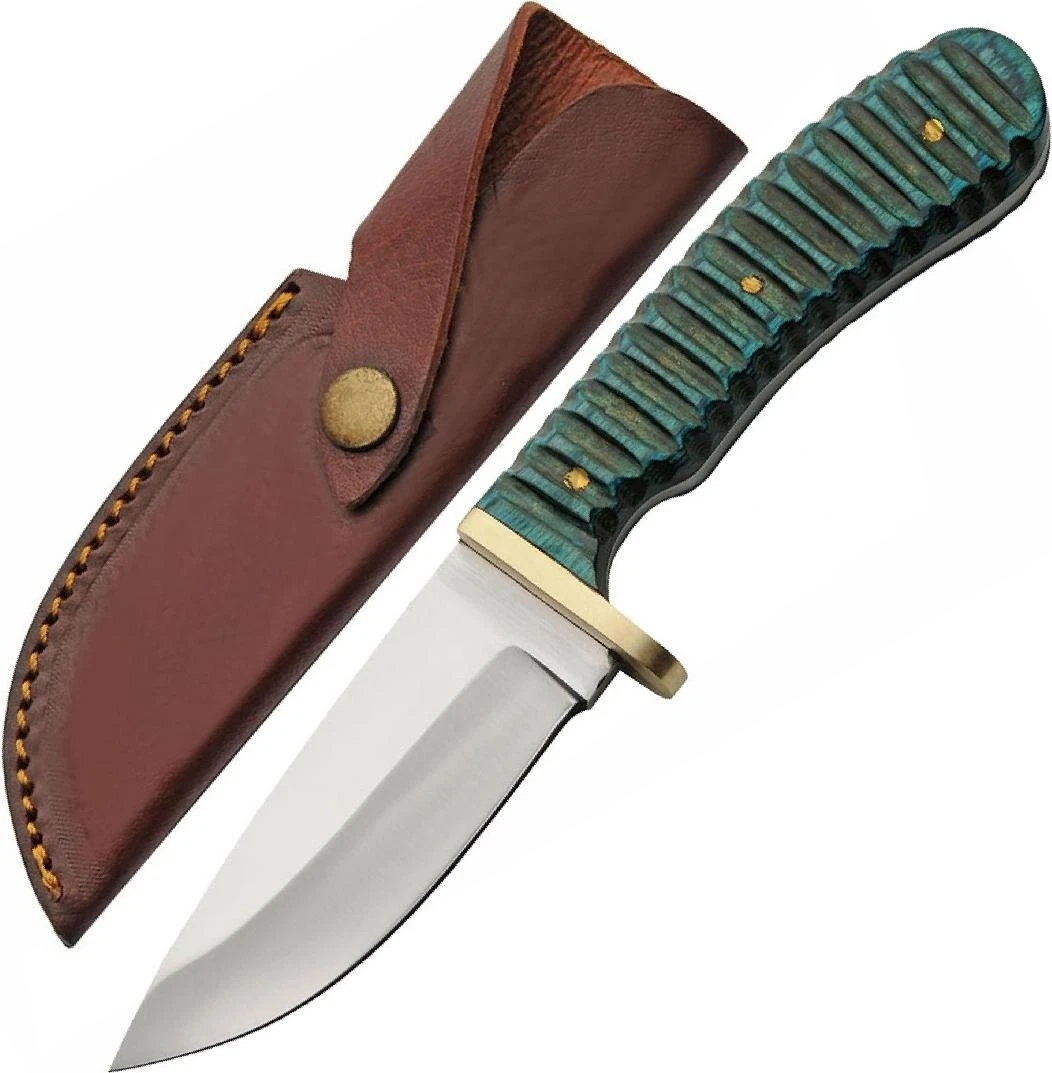
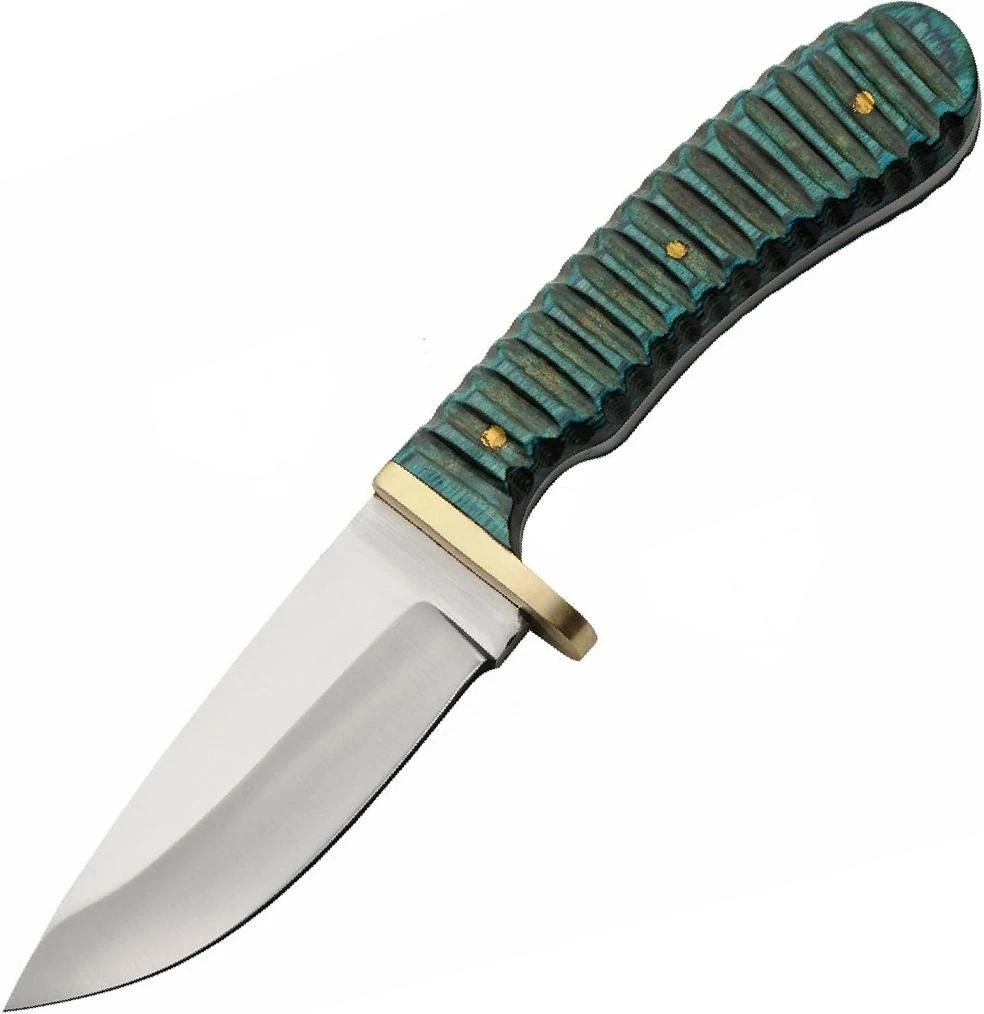
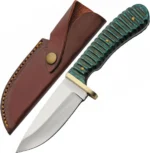
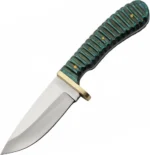
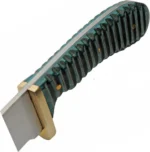
The Teal Handle Fixed Blade Hunting Knife combines a broad, satin-finish blade with an eye-catching ribbed handle and a traditional brown sheath. Its contrasting teal-and-black grip, gold-colored guard, and smooth blade profile create a distinctive outdoor knife design that balances classic hunting-inspired styling with a more contemporary appearance.
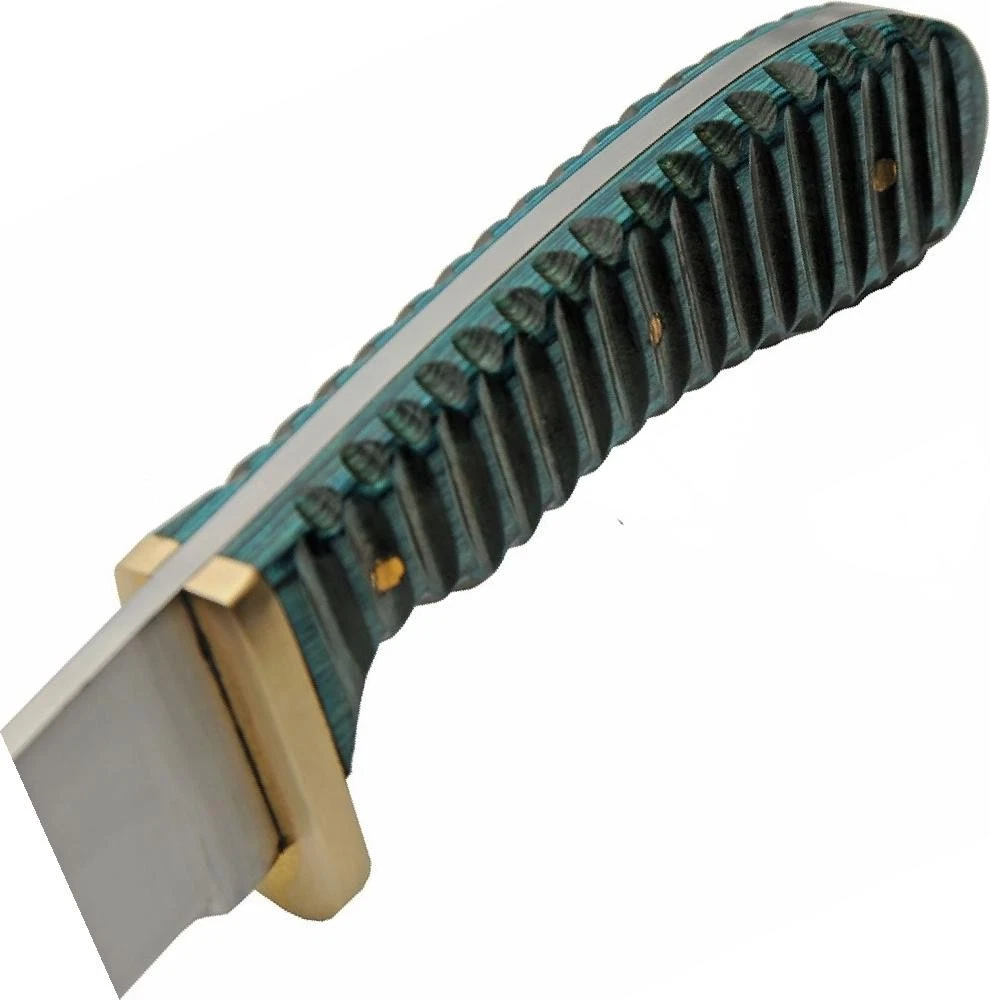
Unlike knives with plain wooden or black handles, this model immediately stands out because of its deep teal coloring and textured grip surface. The handle features closely spaced diagonal grooves, darker accents, and small gold-colored fittings. These details give the knife a recognizable appearance while complementing the polished metalwork near the blade.
The knife has a fixed-blade configuration, meaning the blade does not fold into the handle. Its broad cutting profile narrows gradually toward a pointed tip, while the lower edge follows a continuous curve. A visible bevel runs along the blade, creating a contrast between its different polished surfaces.
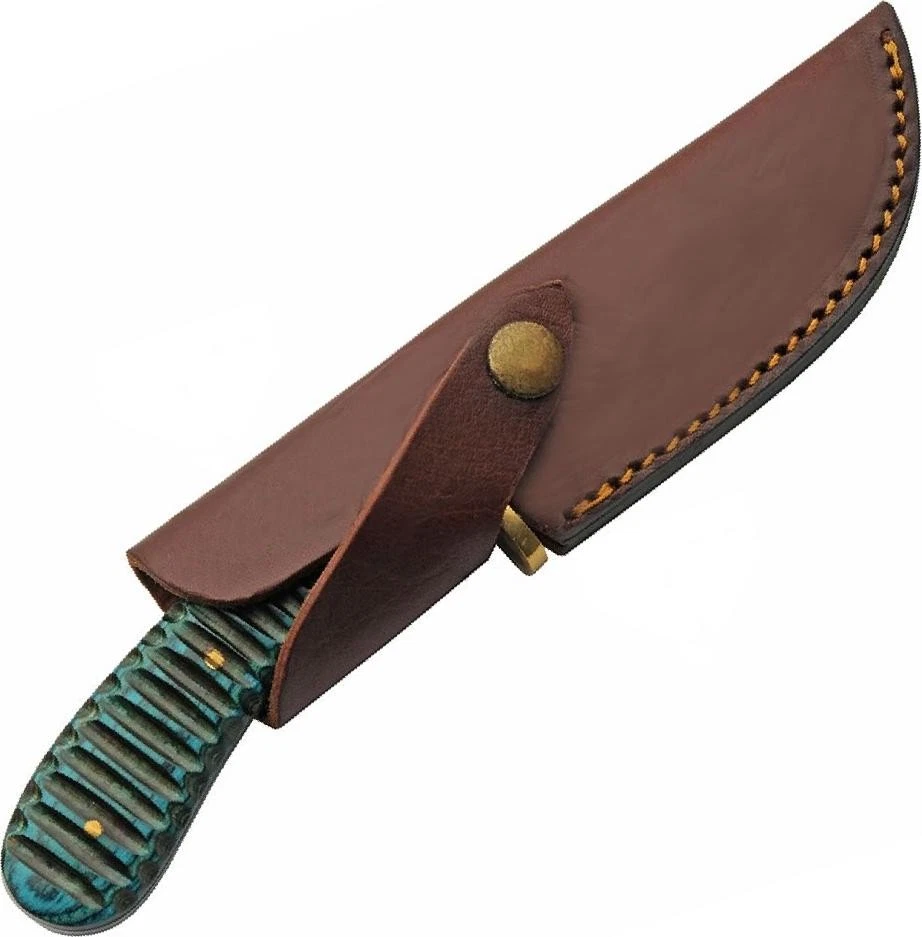
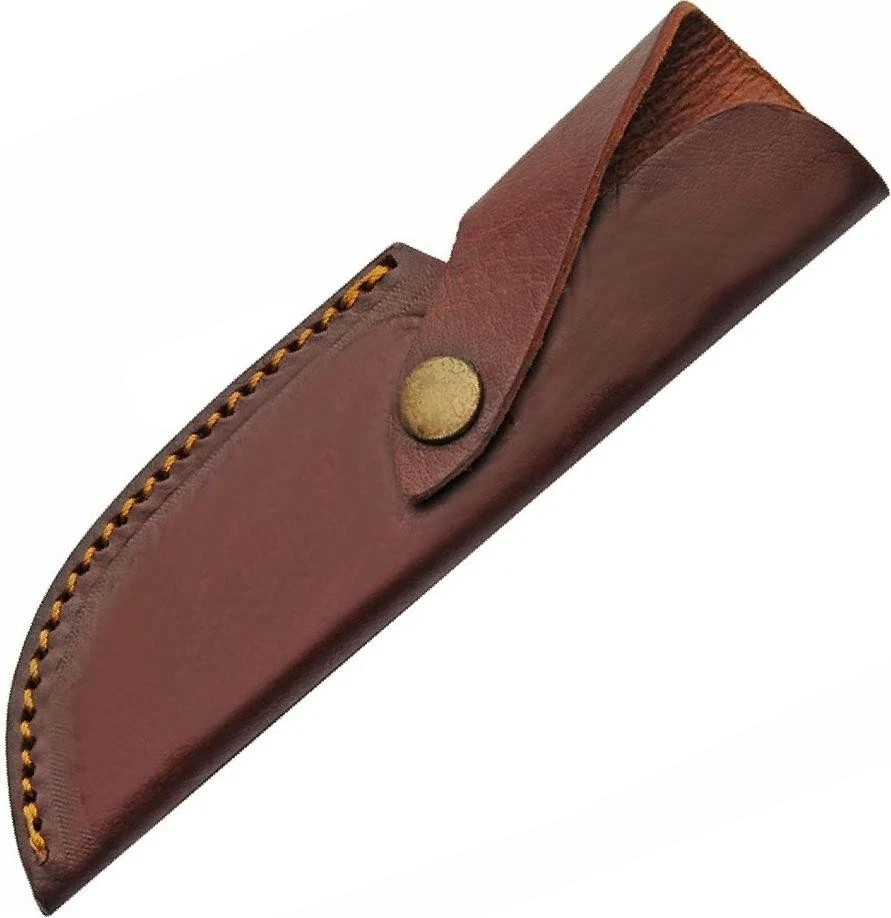
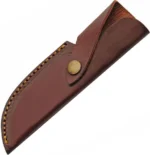
A brown sheath with decorative stitching and a snap-button retaining strap is shown alongside the knife. This accessory adds to its traditional outdoor character and provides a complementary presentation.
Designed in the style of a hunting and outdoor utility knife, this model may appeal to collectors, camping enthusiasts, and customers who appreciate fixed-blade cutlery with distinctive handle designs.
Its exact steel grade, hardness, dimensions, handle composition, and manufacturing specifications require supplier confirmation. The description focuses on the features visible in the supplied photograph rather than making unsupported performance claims.
Distinctive Teal and Black Ribbed Handle
The most recognizable feature of this knife is its textured teal handle.
The grip has an unusual combination of greenish-blue tones, darker black accents, and visible wood-grain-like lines. Its surface includes a series of closely spaced grooves running diagonally across the handle.
These grooves create a ridged appearance that differs from the smooth surface commonly found on traditional hunting knives.
The handle’s coloring varies across its length. Some areas appear brighter teal, while others contain deeper blue-green and charcoal tones.
This variation gives the grip a layered visual effect.
The darker grooves create contrast and make the raised portions more noticeable.
Three small, gold-colored circular fittings are visible along the side of the handle.
They coordinate with the gold-colored guard near the blade and add another decorative element to the design.
The handle also has a slightly curved profile, with a wider rear section and a narrower area closer to the guard.
Its overall shape is consistent with a contoured outdoor knife handle.
Although the grooves may help provide tactile positioning, actual grip security and comfort depend on the material, dimensions, and surface finish.
These properties cannot be established from the photograph alone.
Broad Satin-Finish Blade
The knife features a substantial-looking blade with a smooth silver-gray finish.
Its broad profile provides a strong visual contrast against the darker handle.
The blade is widest toward its rear section and gradually narrows toward the point.
A continuous curved cutting edge runs along the lower portion.
The upper edge begins relatively straight before curving down toward the tip.
This produces a broad hunting-style blade profile.
A large bevel is visible across the blade face.
The bevel creates subtle changes in reflection, giving the metal a dimensional appearance.
The blade has no visible serrations.
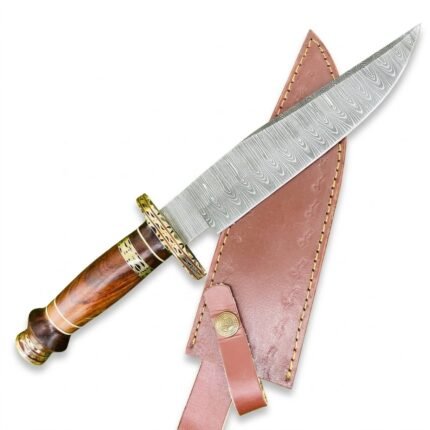
It also does not display the decorative layered pattern associated with many Damascus-style knives.
Instead, the surface appears relatively uniform, with a satin or brushed-metal finish.
This clean appearance makes the blade suitable for a product listing emphasizing classic steel styling rather than decorative patterning.
However, the image cannot establish whether the blade is stainless steel, carbon steel, or another alloy.
The exact material should be identified from manufacturer documentation.
The blade’s hardness, heat treatment, thickness, and sharpness also remain unverified.
Fixed Blade Construction
The knife has a non-folding design.
The blade extends directly from the handle without any visible pivot, hinge, or folding mechanism.
This identifies it as a fixed-blade knife.
Fixed-blade knives are commonly available in hunting, camping, bushcraft, and general outdoor equipment categories.
Their designs range from compact cutting tools to larger field knives.
This model features a broad blade and a relatively substantial-looking handle.
Its profile is consistent with traditional hunting-style cutlery.
The connection between the blade and handle is partially concealed by the gold-colored guard.
Therefore, the photograph does not confirm whether the knife has a full tang, hidden tang, or another internal construction.
The visible pins also do not establish the internal tang configuration.
Customers interested in the construction should request this information from the manufacturer.
Tang design, blade steel, handle attachment, and finishing quality are important considerations when evaluating a fixed-blade knife for practical use.
Gold-Colored Finger Guard
A small guard is visible between the blade and handle.
Its warm golden finish contrasts with the silver blade and teal grip.
The guard projects outward beneath the handle near the blade, creating a distinct boundary between the gripping area and the cutting section.
This design resembles the guards commonly found on traditional hunting knives.
The guard adds a classic decorative touch and helps define the transition between the blade and handle.
Its shape is simple and slightly curved.
The finish appears smooth, with a metallic sheen.
Although the color resembles brass, the actual metal has not been confirmed.
It could be brass, another metal alloy, or a material with a brass-colored finish.
The product should therefore be described as having a gold-colored guard rather than a verified solid-brass guard.
The guard’s dimensions and construction also require confirmation.
Its visible presence should not be interpreted as proof of specific safety or durability performance.
Contoured Handle Shape
The handle has a gently curved outline with subtle changes in width.
Near the guard, it begins with a comparatively narrow section.
Moving toward the rear, the grip becomes slightly wider.
The back end has a rounded profile and a small outward curve.
These details contribute to the knife’s traditional outdoor appearance.
The finger-facing side also contains shallow contours that visually follow the shape of the handle.
The ribbed surface extends across much of the visible grip.
This creates a consistent textured design from the front toward the rear.
The combination of surface grooves and handle contours may appeal to buyers who prefer a visually detailed grip.
However, ergonomic suitability cannot be confirmed without knowing the handle measurements and testing the physical product.
Comfort depends on individual hand size, handle thickness, balance, and material finish.
The handle’s weight and overall construction are also unknown.
For accurate product specifications, the manufacturer should provide the handle length and any available grip measurements.
Teal Handle Material and Appearance
The handle has a pronounced wood-grain-like appearance.
Its dark and teal-colored lines resemble the patterns found in some dyed wooden or laminated handle materials.
However, the appearance alone does not establish the actual composition.
Knife manufacturers use different materials to create textured and colored handles.
These may include natural wood, stabilized wood, layered composites, or synthetic materials.
Some can produce very similar visual results.
For this knife, the exact handle material needs to be confirmed.
The listing therefore describes the grip as teal-and-black and ribbed, without claiming that it is genuine wood, stabilized wood, or a specific engineered material.
The surface appears to have a slightly glossy finish in some areas.
Darker lines follow the grooves and the edges of the grip.
The gold-colored pins create small points of contrast.
These features make the handle distinctive even without a verified material designation.
Customers who specifically require a natural wood or synthetic handle should consult the supplier’s material specifications before ordering.
Decorative Handle Fittings
Three circular fittings are visible on the side of the handle.
Their gold-like finish coordinates with the guard.
The fittings are distributed along the grip rather than concentrated near one end.
This creates a consistent decorative arrangement.
On many fixed-blade knives, pins or rivets are used as part of the handle construction.
However, the presence of visible fittings does not establish how this particular handle is assembled internally.
The fittings may be structural, decorative, or both.
Their material is also unknown.
They should not be described as solid brass until confirmed.
The contrast between the teal grip and gold-colored fittings is one of the most attractive visual details of the knife.
The warm metallic color softens the darker tones of the handle.
At the same time, it provides a visual connection to the guard.
This creates a coordinated appearance across the grip and blade junction.
Smooth Pointed Blade Design
The blade tapers toward a clearly defined point.
Its upper and lower edges converge near the tip.
The curved cutting edge is uninterrupted by visible serrations or hooks.
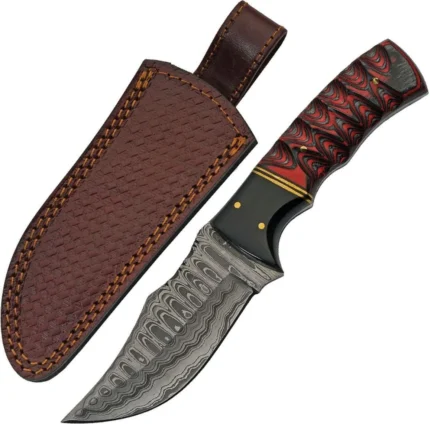
This distinguishes the model from serrated outdoor knives and gut-hook hunting knives.
The point and broad blade shape are consistent with a conventional hunting-style knife.
Its profile also resembles some general-purpose outdoor fixed-blade designs.
The image does not show the blade from every angle.
Therefore, the exact cross-sectional geometry cannot be established.
The visible bevel indicates a sharpened-edge design, but factory sharpness cannot be verified visually.
The blade tip should be handled carefully regardless of its intended use.
Customers should not assume a particular penetration, slicing, or cutting performance based on appearance alone.
Such characteristics depend on verified material and manufacturing specifications.
Traditional Outdoor Knife Styling
Although the handle has a modern teal color, the overall product maintains a traditional outdoor appearance.
The broad blade, curved grip, metal-colored guard, and brown sheath are familiar elements of classic hunting cutlery.
The contrast between these components creates a balanced visual presentation.
The silver blade provides a neutral metallic surface.
The teal-and-black handle introduces color and texture.
The guard adds a warm gold-colored accent.
The brown sheath completes the design with an earthy tone.
Together, these features make the knife visually suitable for an outdoor-themed product collection.
It may appeal to customers who enjoy traditional knife profiles but prefer handles with more distinctive coloring.
The model also provides an alternative to standard black-handled fixed-blade knives.
Its combination of colors is particularly noticeable against a white background.
For online retail presentation, clear product photography can help buyers appreciate the contrast between the different components.
Matching Brown Knife Sheath
The uploaded image includes a brown knife sheath positioned beside the blade.
The sheath has a leather-like surface and a warm reddish-brown finish.
Visible stitching follows the outer edge.
The stitching appears in a lighter brown or tan color, creating contrast with the surrounding surface.
A retaining strap extends across the upper part of the sheath.
This strap includes a circular gold-colored snap button.
The flap is positioned near the opening where the knife handle would sit when stored.
The sheath follows the general shape of the blade and narrows toward its lower end.
Its appearance is consistent with a conventional hunting knife sheath.
Although it resembles genuine leather, the photograph does not confirm the material composition.
The manufacturer should establish whether it is genuine leather, bonded leather, synthetic leather, or another material.
The sheath is shown with the knife, but the final retail package contents should be confirmed before promising that it is included with every order.
Decorative Sheath Stitching
The sheath has a simple design with visible perimeter stitching.
Its lighter-colored thread contrasts with the darker brown body.
The stitching runs along the curved edge toward the pointed bottom.
This gives the sheath a finished appearance.
The upper part includes a flap that curves over the opening.
A circular snap-button fitting provides a visible closure point.
The combination of stitching and a snap closure resembles traditional knife-carrying accessories.
However, the photograph does not show the sheath’s reverse side.
It is therefore not possible to confirm the presence, size, or position of a belt loop.
The actual retention performance of the closure is also unknown.
Customers should confirm the sheath’s design and suitability before using it for transport.
For storage, the blade should be completely covered and secured in an appropriate protective sheath.
Suitable Product Categories
This knife can be organized within several relevant e-commerce categories.
Its primary classification is a fixed-blade hunting-style knife.
This categorization is supported by its blade shape, guard, handle profile, and accompanying sheath.
It can also appear in an outdoor knife collection.
The traditional design may interest customers browsing camping-related cutlery or collectible fixed-blade models.
A retailer may choose to include the product under a general hunting knife category and a more specific fixed-blade subcategory.
The classification should focus on the product’s design rather than unsupported claims about specialized performance.
For example, the image does not show a gut-hook feature.
It should not be placed in a gut-hook knife subcategory.
Similarly, the blade has no visible Damascus pattern.
It should not be listed as Damascus steel without supporting material information.
Accurate category selection improves customer navigation and reduces the likelihood of misleading product descriptions.
A Distinctive Knife for Collectors
Knife collectors often appreciate individual design characteristics.
Some prefer unusual handle colors.
Others focus on blade shapes, decorative fittings, or traditional sheath designs.
This model combines several noticeable visual elements.
The teal-and-black ribbed grip is particularly distinctive.
Its diagonal grooves create a structured texture across the handle.
The small gold-colored fittings provide decorative contrast.
The broad blade has a comparatively simple satin appearance.
The brown sheath adds a traditional finish to the presentation.
These features may appeal to collectors seeking a visually unusual fixed-blade knife.
The product could be displayed as part of an outdoor cutlery collection when stored securely.
However, appearance alone does not establish collectible value.
The maker, production method, rarity, materials, condition, and market demand can all affect value.
The photograph does not confirm that the knife is handmade, custom forged, limited edition, or produced by a particular manufacturer.
Such claims should only be added after verification.
Considerations for Camping and Outdoor Use
Fixed-blade knives are often associated with outdoor activities.
However, not every hunting-style knife is intended for the same practical tasks.
A knife suitable for general light-duty cutting may not be appropriate for more demanding outdoor work.
The necessary performance characteristics depend on the intended application.
For this model, the blade steel and construction quality have not been verified.
Its edge geometry, hardness, and thickness are also unknown.
Consequently, the product should not be advertised as tested for heavy chopping, batoning, prying, or other demanding applications.
Customers planning practical outdoor use should request technical details from the manufacturer.
These specifications help establish whether the knife is suitable for their requirements.
The shape of the blade alone is insufficient to determine its durability.
The handle should also be evaluated for comfort and security before use.
Customers should follow applicable laws and safe handling practices.
Blade Material and Steel Specifications
The blade displays a uniform, steel-colored finish.
It does not show distinctive pattern-welded layers.
The surface appears satin-polished or lightly brushed.
This appearance is common across different blade materials.
Stainless steel and carbon steel can both have similar-looking finishes.
Therefore, the photograph does not establish the alloy.
The exact steel grade should be obtained from the supplier.
Important specifications include blade composition, hardness, heat treatment, thickness, and finish.
These details influence maintenance requirements and comparisons between different knife models.
Without confirmation, it would be inaccurate to claim that the blade is made from 440C, D2, 1095, 420 stainless steel, or any other specific grade.
Likewise, corrosion resistance and edge retention cannot be reliably stated from appearance alone.
A trustworthy product listing should clearly distinguish verified technical information from visual observations.
This helps customers make informed purchasing decisions.
Handle Construction Details
The handle has a contoured, grooved surface.
Its gold-colored fittings appear evenly distributed.
The grip is attached behind a metallic-looking guard.
However, the photograph does not reveal the internal handle construction.
The steel tang may extend through all or part of the grip, but this cannot be established from the image.
Some fixed-blade knives have full-tang construction.
Others use hidden or partial tangs.
Each construction method has different design characteristics.
The knife should not be advertised as full tang unless the supplier confirms the feature.
Similarly, the fittings should not automatically be described as structural rivets.
The manufacturer should identify the actual handle material and assembly method.
This information is especially important for customers who intend to use the knife rather than collect it.
Product Specifications at a Glance
The following attributes are identifiable from the uploaded image.
Product Type: Fixed-blade hunting-style knife
Blade Profile: Broad curved blade with a pointed tip
Blade Finish: Satin silver-gray appearance
Cutting Edge: Continuous plain-edge profile
Handle Color: Teal, blue-green, and black
Handle Design: Ribbed and contoured
Handle Fittings: Three visible gold-colored circular pins
Guard: Gold-colored metallic-looking finger guard
Sheath Color: Brown
Sheath Appearance: Leather-like with contrast stitching
Sheath Closure: Snap-button retaining strap
Primary Style: Traditional hunting-inspired outdoor cutlery
The following information must be confirmed with the supplier:
- Exact blade steel and hardness
- Blade length and overall knife length
- Blade thickness and weight
- Handle material and construction
- Tang configuration
- Guard and pin materials
- Sheath material
- Country of manufacture
- Package contents and warranty
These details should be added to the final product specifications once reliable information is available.
Cleaning the Blade
Routine cleaning is important for maintaining a knife’s appearance.
After appropriate use, remove visible dirt and residue.
Wipe the blade with a soft cloth.
If cleaning with water is suitable for the confirmed blade material, dry it thoroughly afterward.
Avoid leaving moisture on the metal surface for extended periods.
The correct cleaning products depend on steel composition and blade finish.
Because these details are not currently known, strong chemicals and abrasive cleaning methods should be avoided.
Some blade materials require additional corrosion protection.
Follow the manufacturer’s guidance when the steel type has been confirmed.
For long-term storage, the blade should be clean and dry.
Inspect its surface periodically for signs of staining, corrosion, or damage.
Do not assume that a silver-colored blade is completely resistant to rust.
Caring for the Ribbed Handle
The handle’s grooves may collect surface dirt during handling.
Cleaning should be appropriate for the actual material.
Use a soft cloth or another gentle cleaning method recommended by the manufacturer.
Avoid prolonged soaking.
Do not expose the handle to aggressive chemicals.
The teal-colored surface may require different care depending on whether it is wood, composite, or another material.
For example, some natural materials respond differently to moisture and temperature changes than synthetic materials.
Until the supplier confirms the composition, avoid applying oils or conditioners designed for a specific type of wood.
Inspect the visible fittings periodically.
If a fitting becomes loose or the handle shows damage, the knife should not be used until the problem has been assessed.
Store the knife away from excessive heat and persistent moisture.
Maintaining the Brown Sheath
The sheath should be kept clean and dry.
Its surface should be inspected for visible cracking, damage, or wear.
Check the stitched edges and retaining strap periodically.
The snap-button closure should also be examined for proper operation.
If the material is genuine leather, suitable leather-care products may help maintain its condition.
If it is synthetic, different care methods may be required.
Do not apply leather conditioners unless the sheath’s material is confirmed.
Avoid prolonged storage in damp environments.
A sheath that becomes loose, damaged, or unable to cover the blade properly should be replaced.
For extended storage, follow the manufacturer’s recommendations regarding whether the blade should remain inside its sheath.
Safe Knife Handling
The blade has a pointed tip and a visible cutting edge.
It should always be treated as a potentially sharp tool.
Keep fingers clear of the edge during handling.
Do not test sharpness against your skin.
Use an appropriate protective sheath when the knife is not in use.
Store the product securely and away from children.
Before practical use, inspect the knife for damage.
Pay attention to the handle, guard, visible fittings, and blade attachment.
Do not use the knife if any component is loose.
Avoid using it for applications outside the manufacturer’s intended specifications.
Transport and carry requirements vary by jurisdiction.
Customers should check local knife laws before carrying, transporting, or importing the product.
Product Photography and Online Presentation
The teal handle is the strongest visual selling point of this model.
For an e-commerce website, it is helpful to show this feature clearly.
The supplied image already presents the knife and sheath together on a light background.
This makes the color contrast easy to see.
Additional photographs could help customers understand the product more completely.
Useful views include the opposite side of the knife, a close-up of the guard, a detailed view of the handle grooves, and a photograph showing the blade inside the sheath.
A measurement photograph would also be useful.
Such images can reduce uncertainty about scale and dimensions.
Close-up photography should show the finish without excessive color editing.
The teal coloring should remain representative of the actual product.
Accurate images are particularly important because the handle’s material and surface texture are central to the design.
Why Customers May Choose This Design
This knife offers a different visual character from many conventional fixed-blade models.
Its teal-and-black handle is unusual and immediately recognizable.
The ribbed surface adds visual texture.
The gold-colored guard and fittings introduce warm metallic accents.
The broad satin-finish blade has a clean appearance.
The brown sheath complements the outdoor styling.
Customers interested in traditional hunting knives may appreciate the recognizable blade profile.
Collectors may be drawn to the distinctive handle coloration and coordinated fittings.
Outdoor enthusiasts considering the product for practical use should review the verified technical specifications before purchasing.
The design itself offers several attractive visible features, but actual performance depends on material and construction details.
Choosing Between Similar Fixed-Blade Knives
When comparing hunting-style knives, consider both appearance and confirmed specifications.
A decorative handle may be attractive, but its material affects maintenance requirements.
A broad blade can have a distinctive appearance, but its cutting characteristics depend on geometry and steel quality.
A metal guard may be visually appealing, but its construction should also be checked.
The sheath should fit the knife properly and protect the blade.
Customers should look for clear measurements, accurate material descriptions, and reliable product photographs.
Two knives can look similar while using very different materials.
For this reason, comparisons should not rely exclusively on appearance.
The manufacturer’s specifications are the most reliable starting point for technical evaluation.
A Practical Approach to Knife Care
Good care begins with using the product only for appropriate purposes.
Keep the cutting surface clean.
Avoid unnecessary exposure to moisture.
Use care when handling the pointed tip.
Store the knife in a secure location.
Inspect the handle and guard before use.
Follow the manufacturer’s instructions for sharpening and maintenance.
If the knife develops visible corrosion, loose fittings, or other damage, stop using it until the issue has been assessed.
The exact maintenance routine should reflect the confirmed blade and handle materials.
These simple considerations can help preserve the appearance of the knife while supporting responsible ownership.
A Distinctive Addition to an Outdoor Knife Collection
The Teal Handle Fixed Blade Hunting Knife brings together several design elements that make it different from ordinary fixed-blade models.
Its broad silver-colored blade provides a classic hunting-style profile.
The textured teal grip adds a striking modern accent.
The gold-colored guard and pins create decorative contrast.
The brown stitched sheath gives the product a traditional outdoor presentation.
This combination may appeal to knife enthusiasts who appreciate distinctive handles, clean blade finishes, and coordinated accessories.
The knife can be considered for collection or for outdoor applications consistent with its verified specifications.
Its final technical description should be completed using the supplier’s confirmed measurements and materials.
Explore the Teal Handle Fixed Blade Hunting Knife for its recognizable ribbed grip, satin-finish blade, and classic brown-sheath styling.






Reviews
There are no reviews yet.