

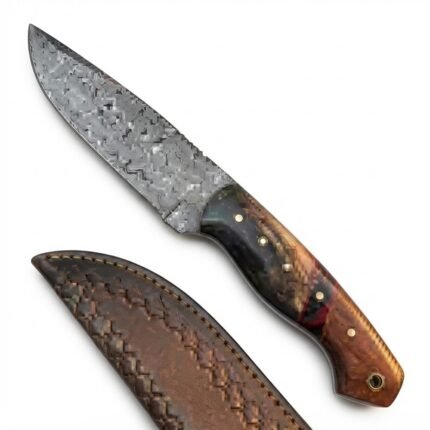
Black and Cream Handle Damascus Pattern Hunting Knife
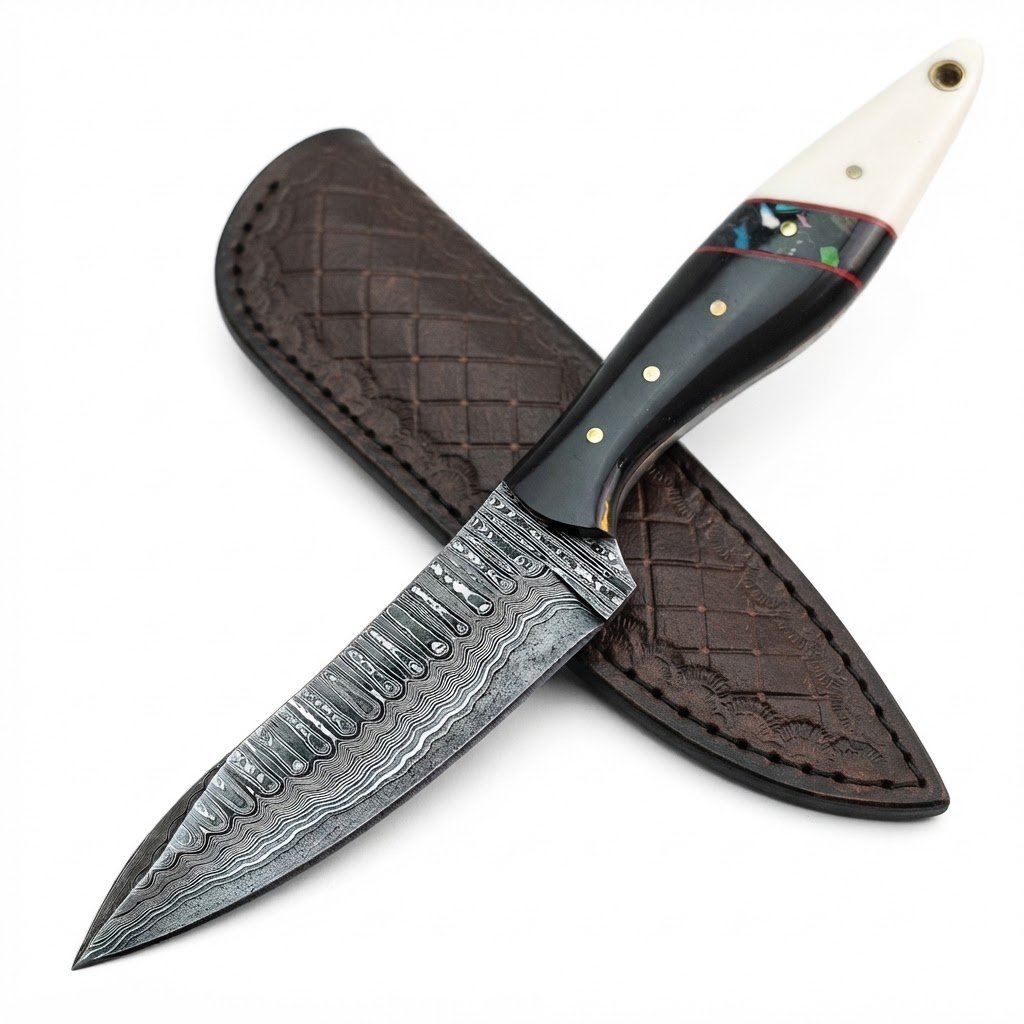
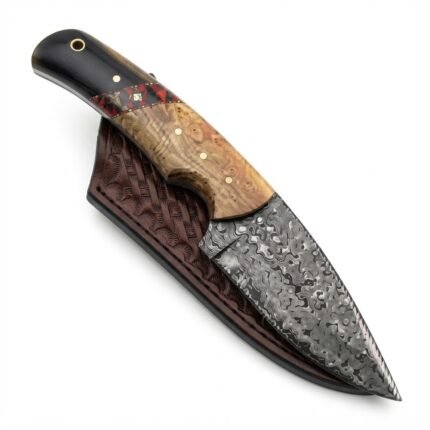
The Black and Cream Handle Damascus Pattern Hunting Knife brings together a striking patterned blade, a carefully styled two-tone handle, and a dark brown decorative sheath. Its pointed fixed-blade design reflects the appearance of traditional outdoor knives, while the contrasting black and cream handle adds a distinctive finishing touch.
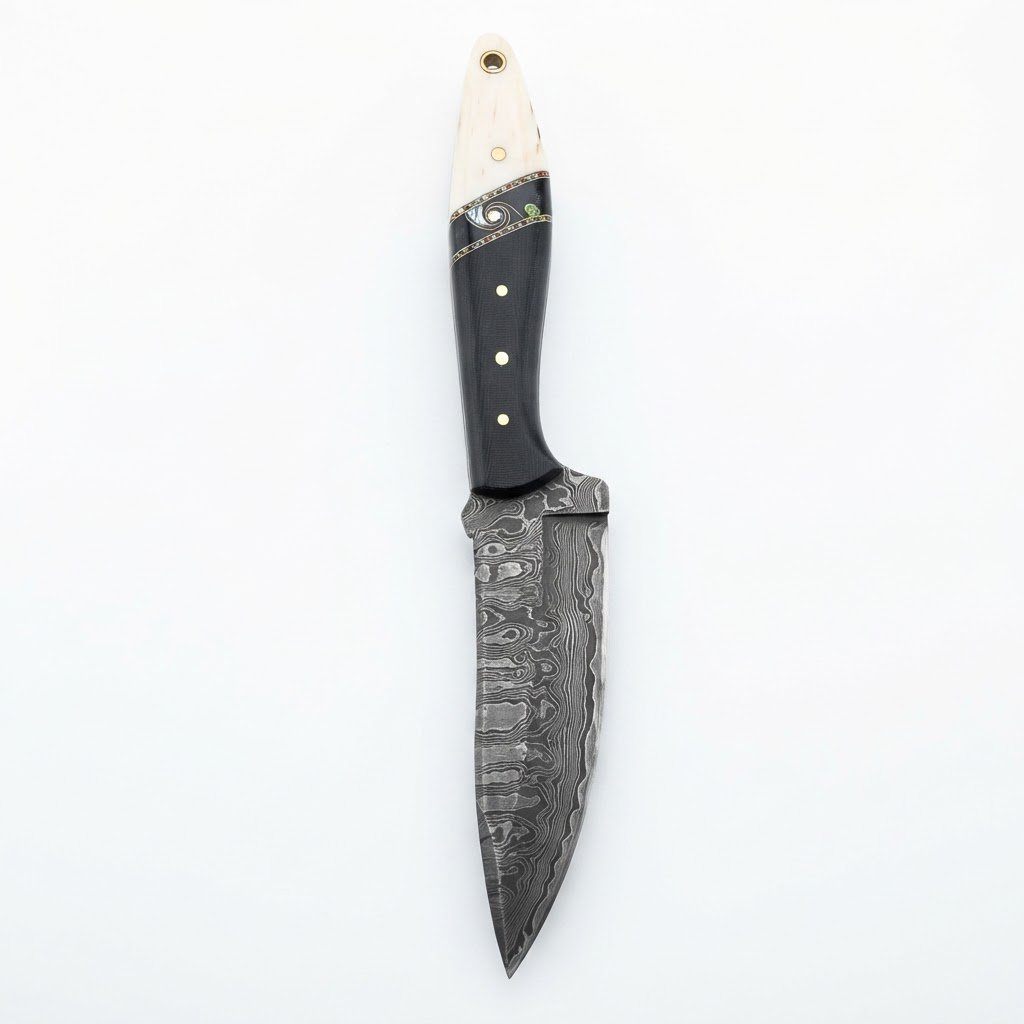
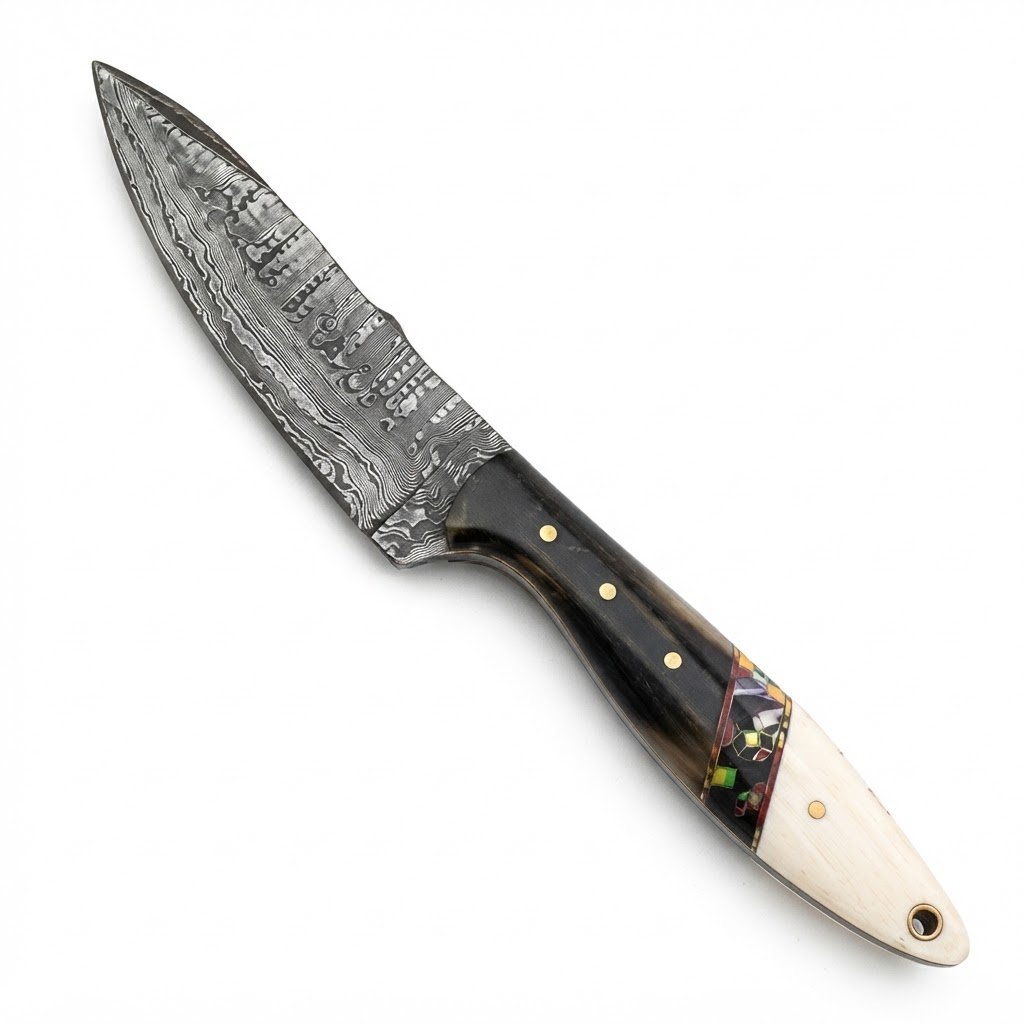
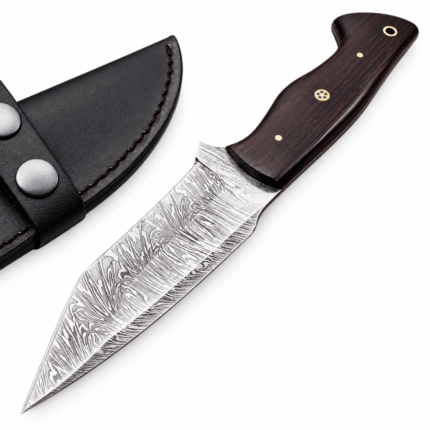
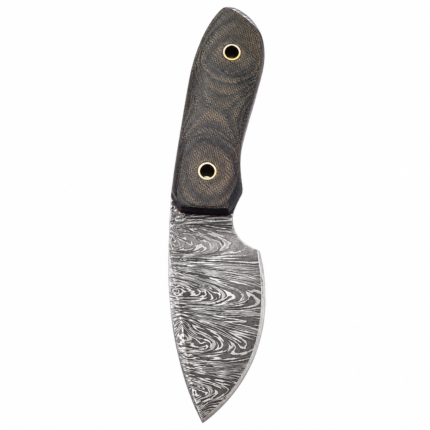
The first feature that attracts attention is the silver-gray blade. Its surface displays intricate Damascus-style markings, including flowing lines, elongated shapes, and repeating curved patterns. These details extend across the visible blade, creating an appearance that differs from an ordinary polished knife.
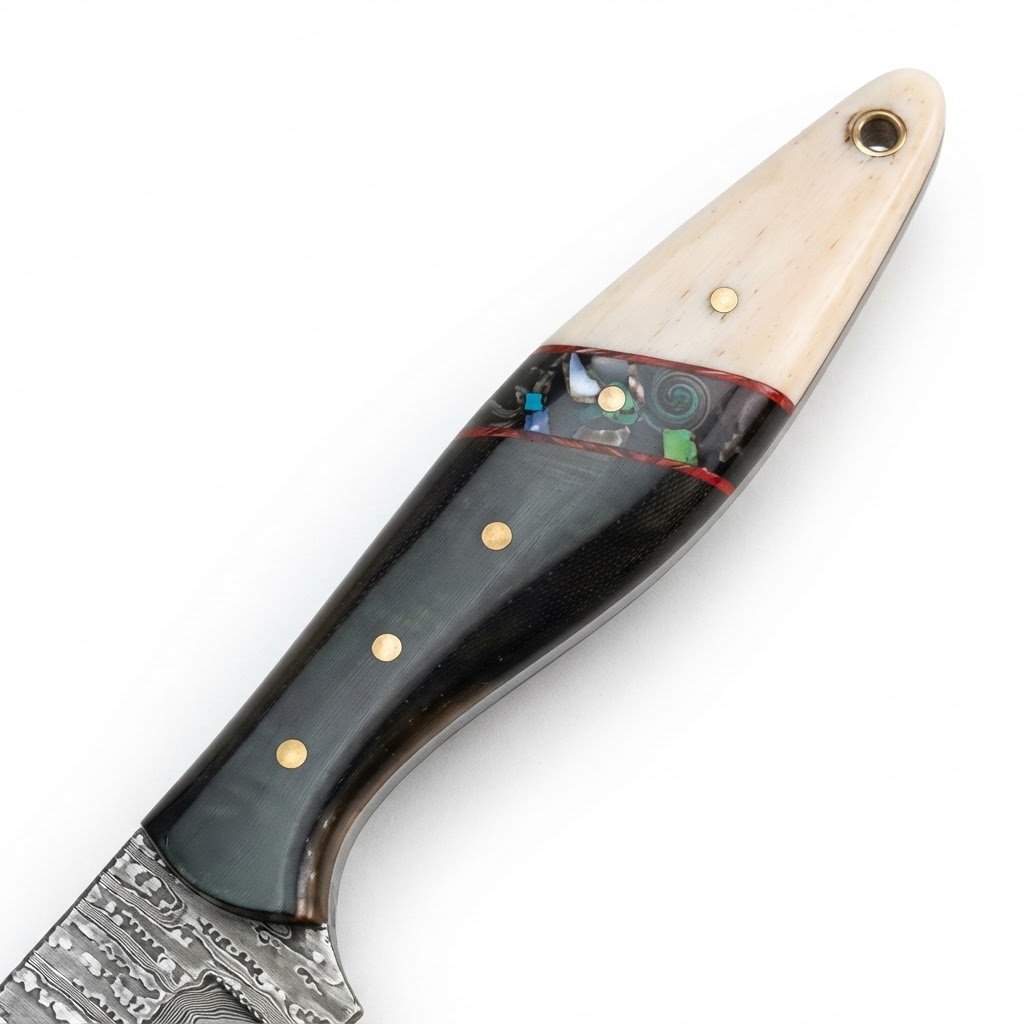
The handle offers another point of interest. A smooth-looking black central section is decorated with small gold-colored pins, followed by a multicolored insert and a cream-colored rear section. A metal-lined opening near the end completes the handle design.
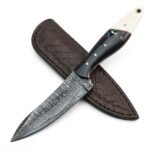
Alongside the knife is a dark brown sheath with an embossed grid pattern, decorative border impressions, and visible stitching. Together, the knife and sheath present an attractive combination for collectors and customers interested in traditional hunting-style cutlery.
Distinctive Damascus Pattern Blade Design
One of the defining characteristics of this knife is its decorative blade pattern.
The silver-gray blade features contrasting dark markings that resemble the layered appearance commonly associated with Damascus-style knives. These markings vary throughout the surface, creating a combination of flowing lines, irregular shapes, and fine linear details.
Near the handle, the pattern appears closely spaced, with repeated elongated shapes running across the blade. Toward the tip, the markings become more flowing and follow the narrowing profile of the metal.
This variation produces a distinctive visual finish.
Customers who appreciate decorative cutlery often pay particular attention to blade patterns because they contribute to the overall character of a knife.
Unlike a completely plain blade, this design offers an intricate surface appearance that complements the contrasting handle.
The pattern is visible across much of the blade rather than being restricted to a small decorative section.
Although the surface resembles traditional Damascus steel, its exact manufacturing method cannot be determined from the photograph.
Authentic pattern-welded Damascus steel and other decorative blade finishes can sometimes look similar in photographs.
For this reason, the knife is described as having a Damascus-pattern blade until the steel composition and production method are confirmed.
Pointed Fixed Blade Hunting Knife Profile
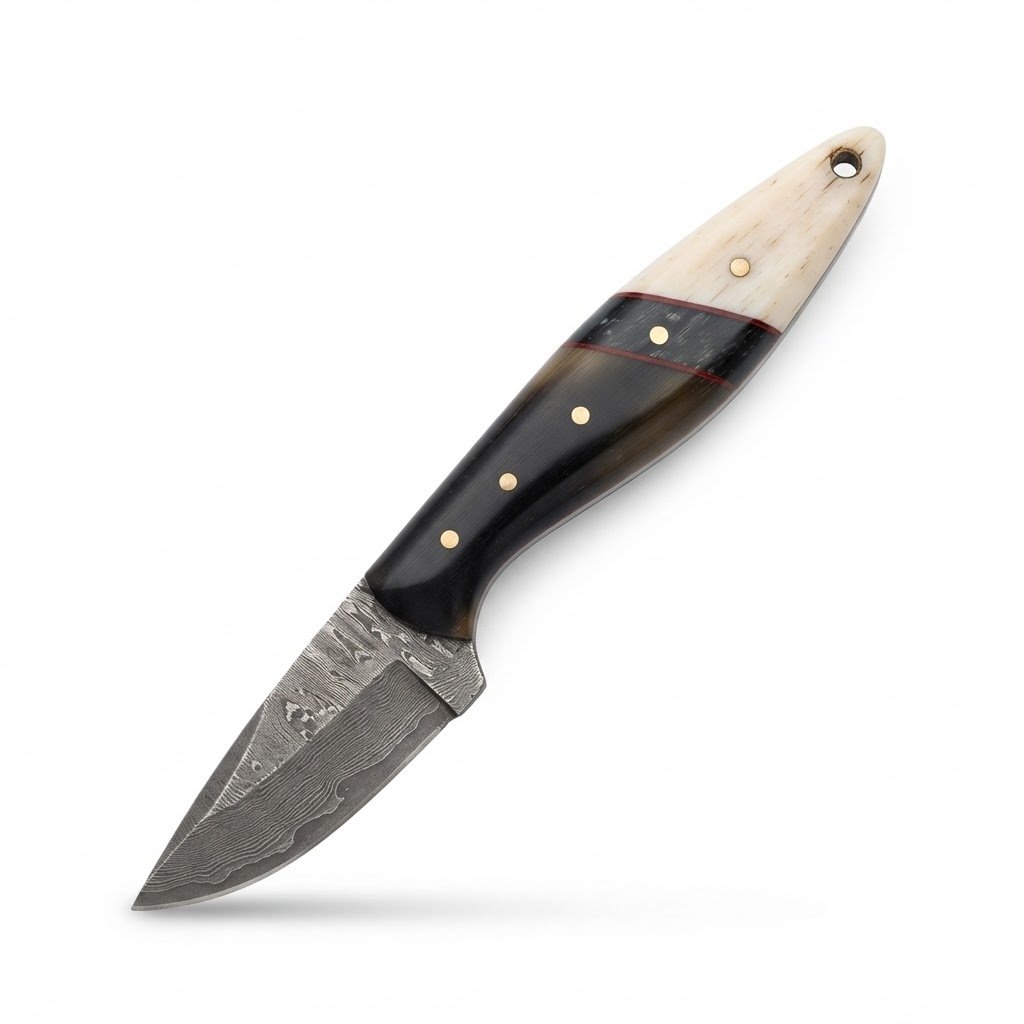
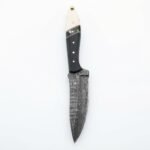
The blade has a pointed profile with a gently curved cutting edge.
It begins with a comparatively broad section near the handle and gradually narrows toward the tip.
The lower cutting edge follows a continuous curve, while the upper portion of the blade slopes toward the pointed end.
This shape gives the knife the appearance of a traditional hunting-style cutting tool.
A fixed blade remains extended rather than folding into the handle.
The photograph shows a continuous, exposed blade without a folding pivot or opening mechanism.
This construction distinguishes the product from pocket knives and folding hunting knives.
The blade appears to have a plain cutting edge rather than visible serrations.
Its recognizable profile may appeal to customers who prefer traditional fixed-blade knife designs.
However, actual cutting performance depends on characteristics that are not visible, including steel composition, edge geometry, hardness, thickness, and heat treatment.
These specifications should be verified before making claims about cutting performance or demanding outdoor use.
Black and Cream Handle with Decorative Details
The handle is one of the most visually distinctive components of the knife.
Its main section has a dark black appearance and a smooth, gently curved surface.
Several small gold-colored circular pins are visible along the grip.
The rear section is cream-colored, providing a strong contrast with the black central portion.
Between these sections is a narrow multicolored decorative insert.
This insert displays a dark background with smaller green, blue, and reddish areas.
Thin red-toned separator lines appear around the decorative section.
The combination creates a layered visual appearance without making the handle overly complicated.
The black portion provides the main visual foundation, while the cream-colored section brightens the rear of the handle.
The gold-colored pins add small metallic accents.
The design is suitable for customers who prefer knife handles with contrasting decorative elements rather than a uniform single-color appearance.
The exact handle materials remain unverified.
The photograph does not establish whether the black section is made from synthetic material, horn, wood, composite, or another substance.
Likewise, the cream-colored section should not be advertised as genuine bone or ivory without manufacturer documentation.
Contoured Handle Shape
The handle has a gradually curved outline rather than a completely straight profile.
Near the blade, the lower section forms a noticeable inward contour.
The main grip then extends toward the rear with a smooth-looking surface.
Toward the cream-colored section, the handle becomes slightly wider and ends in a rounded, tapered shape.
This design gives the knife a traditional hunting-style silhouette.
The gold-colored pins are distributed along the handle, contributing to its decorative appearance.
The rear includes a small circular opening lined with gold-colored metal.
This resembles a lanyard hole commonly found on outdoor knives.
The image does not show a lanyard attached, and the opening’s dimensions are unknown.
It should therefore be described as a metal-lined lanyard-style opening rather than an included attachment system.
Although the handle has an ergonomic-looking shape, actual comfort and grip security cannot be determined from photographs alone.
Those qualities depend on its dimensions, material, surface texture, and how it fits the user’s hand.
Decorative Multicolored Handle Insert
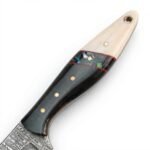
The handle incorporates a narrow decorative section between the black grip and cream-colored rear.
This segment appears primarily dark, with small areas of blue, green, and reddish color.
The irregular distribution of color gives the insert a distinctive appearance.
Thin reddish lines separate it from the adjoining handle sections.
This small detail adds an additional layer of visual interest.
It also helps connect the black and cream portions of the grip.
The colors stand out without overpowering the overall design.
The material of this insert is not confirmed.
It may be a manufactured decorative composite or another material, but a photograph cannot establish its composition.
A responsible product listing should avoid describing it as genuine turquoise, natural stone, or a particular type of resin without verification.
The safest accurate description is a multicolored decorative handle insert.
Cream Colored Handle End and Metal-Lined Opening
The rear of the handle features a cream-colored section with a smooth-looking finish.
This section has a rounded profile that tapers toward the end.
A small gold-colored pin is visible in the material.
Near the upper tip of the handle is a circular metal-lined opening.
The opening has a dark center surrounded by a gold-colored rim.
This detail complements the other metallic fittings.
The cream color contrasts with the black main grip and silver-gray blade.
From a design perspective, this contrast is one of the knife’s strongest visual features.
The photograph does not provide enough information to determine whether the cream-colored section is natural or synthetic.
Its surface should be described by appearance rather than an assumed material.
This ensures that customers receive an accurate description of the product shown.
Gold Colored Handle Pins and Fittings
The handle features several small circular pins with a gold-colored appearance.
These are positioned along the black and cream sections.
The rear opening also has a gold-colored lining.
Together, these fittings give the handle a coordinated visual finish.
Metal pins are common in fixed-blade knife construction and may serve structural or decorative purposes.
However, the photograph does not reveal the internal construction.
The exact metal alloy is also unknown.
It would therefore be inaccurate to claim that the pins are solid brass without confirmation.
The visible details can accurately be described as gold-colored handle pins and a metal-lined rear opening.
Their appearance adds contrast to the darker portions of the handle.
Dark Brown Embossed Knife Sheath
The accompanying dark brown sheath is another prominent visual feature.
It has a tapered body that follows the general outline of a pointed knife blade.
The front surface features a grid-like embossed design.
Additional decorative impressions appear near the edges.
Dark stitching runs along the visible perimeter.
The sheath has a traditional leather-like appearance and a slightly textured surface.
Its dark brown color complements the black handle while contrasting with the silver-gray blade.
The embossed grid pattern gives the cover more character than a completely plain sheath.
The visible stitching also adds definition to its outer shape.
The photograph shows the knife positioned diagonally across the sheath, allowing both pieces to be seen together.
The material has not been independently identified as genuine leather.
Therefore, the sheath should be described as a brown embossed sheath unless the manufacturer confirms its composition.
Likewise, the supplier should verify that the sheath is included with the purchased knife.
Embossed Grid and Decorative Border
The sheath features several different surface details.
Its central area includes a repeating embossed pattern resembling a grid of squares.
Near the edges, smaller decorative impressions create a bordered appearance.
These details are particularly visible along the lower section.
The surrounding stitching follows the sheath’s tapered shape.
Together, the decorative embossing and stitching create a traditional accessory appearance.
The sheath’s design complements the patterned blade without repeating the same surface treatment.
The blade features flowing metallic lines, while the sheath uses geometric embossing.
This contrast gives the overall product presentation additional visual variety.
A matching sheath can be an important consideration for customers comparing fixed-blade knives.
However, details such as belt loops, internal lining, retention strength, and exact dimensions are not visible in the photograph.
These features should be confirmed through additional images or technical specifications.
Traditional Hunting Knife Styling
The knife combines several features commonly associated with traditional hunting-style cutlery.
These include a fixed-blade configuration, pointed tip, curved cutting edge, contoured handle, and shaped sheath.
The decorative blade surface creates a recognizable Damascus-style appearance.
The black and cream handle provides strong color contrast.
Small metallic fittings contribute to the traditional styling.
The dark brown sheath adds a complementary accessory.
Together, these details create a distinctive overall design.
The knife may appeal to customers who enjoy outdoor-themed collections and decorative cutlery.
Its appearance is also relevant to buyers interested in fixed-blade hunting knives.
However, specific applications should be considered only after reviewing the manufacturer’s confirmed technical information.
The photograph alone does not establish whether the knife is suitable for heavy-duty cutting, food preparation, or other demanding tasks.
Fixed Blade Construction and Tang Information
A fixed-blade knife has a blade that remains extended and does not fold into the handle.
This is the most obvious structural characteristic of the pictured product.
However, the internal tang construction cannot be identified from the image.
The tang is the section of blade material extending into the handle.
Different knives use full-tang, hidden-tang, and partial-tang construction.
These arrangements can influence balance, assembly, and suitability for different uses.
Although the photograph shows several handle pins, they do not prove that the knife has full-tang construction.
The exact tang type should be obtained from the supplier.
The same applies to the attachment methods used for the decorative handle sections.
Accurate technical specifications are preferable to assumptions based solely on external appearance.
Blade Material and Damascus Pattern Considerations
Steel grade is an important characteristic of any knife.
Different types of steel have different properties.
Factors such as corrosion resistance, toughness, edge retention, and ease of sharpening depend on the steel and its treatment.
The appearance of a Damascus-style pattern does not establish the exact material.
Some blades use pattern-welded steel, while others feature decorative surface patterns produced through different methods.
Without reliable product documentation, it is not possible to identify the specific production process.
The blade in the photograph has visible contrasting metal patterns.
That appearance is confirmed.
Its steel composition, layer count, hardness, and forging method are not.
The seller should obtain this information directly from the manufacturer before including detailed technical claims.
This is particularly important because customers may use steel specifications when comparing products.
Intended Buyers and Product Appeal
This knife may interest collectors of traditional fixed-blade cutlery.
Its patterned blade creates visual interest, while the two-tone handle offers a recognizable design.
The small multicolored insert introduces additional decorative detail.
The gold-colored pins provide metallic accents.
The embossed brown sheath complements the knife’s appearance.
These characteristics may appeal to customers who enjoy collecting different handle styles, blade patterns, and traditional outdoor knife designs.
The knife can also be considered by customers interested in hunting-style fixed-blade products.
However, purchasing decisions for functional outdoor use should be based on verified dimensions, blade material, edge construction, and manufacturer guidance.
Its visual styling alone cannot establish suitability for a particular task.
Blade Finish and Appearance
The blade has a predominantly silver-gray finish.
Darker markings create visible contrast across its surface.
Near the base, the pattern includes repeated elongated shapes.
Toward the tip, the markings become narrower and more fluid.
The metal surface also has areas of lighter reflection.
This contrast gives the blade an intricate decorative appearance.
The pattern complements the knife’s pointed profile.
A plain blade can look visually simple, while the pictured finish introduces more detailed surface artwork.
For customers interested in decorative knives, the blade appearance may be a central reason for choosing this design.
The pattern should nevertheless be described accurately without implying an unverified manufacturing process.
Handle Color Combination and Visual Balance
The handle’s black central section contrasts with the cream-colored rear.
A small decorative insert separates these two areas.
The gold-colored pins provide additional visual accents.
The overall color combination is balanced by the silver-gray blade.
The dark brown sheath introduces a warm neutral tone.
The result is a knife with several distinct finishes.
The handle has a more elaborate appearance than a basic single-color outdoor knife.
Customers interested in traditional knife styling may appreciate this combination.
The image clearly shows the visible colors, but material names and production techniques require verification.
Understanding Product Dimensions
The image does not include a ruler or another reliable measurement reference.
Therefore, exact measurements cannot be calculated.
Before publishing the final specification table, the manufacturer should supply the overall length, blade length, handle length, blade thickness, blade width, and product weight.
These measurements help buyers understand the product’s size.
They also support comparisons between different hunting-style knives.
Dimensions should preferably be presented in both inches and millimeters for international customers.
The sheath’s overall length and width may also be useful.
Without confirmed measurements, it is better to leave those fields unspecified rather than publish approximate figures as facts.
Product Specifications
Product Type: Fixed-Blade Hunting-Style Knife
Blade Profile: Pointed, Tapered Blade
Blade Edge Appearance: Plain Edge
Blade Color: Silver-Gray with Dark Patterning
Blade Finish: Damascus-Style Pattern
Handle Color: Black and Cream
Handle Detail: Multicolored Decorative Insert
Handle Shape: Curved and Contoured
Visible Fittings: Gold-Colored Pins
Rear Opening: Metal-Lined Lanyard-Style Hole
Pictured Sheath: Dark Brown Embossed Sheath
Sheath Design: Grid Pattern with Decorative Border
Visible Stitching: Dark Perimeter Stitching
Blade Steel: Not Verified
Blade Hardness: Not Verified
Pattern-Welded Construction: Not Verified
Handle Material: Not Verified
Sheath Material: Not Verified
Tang Type: Not Verified
Blade Length: Not Verified
Overall Length: Not Verified
Blade Thickness: Not Verified
Knife Weight: Not Verified
Country of Manufacture: Not Verified
Sheath Included in Sale: Requires Supplier Confirmation
General Knife Care and Maintenance
Proper care is important for any fixed-blade knife.
The exact maintenance requirements depend on the steel composition and surface finish.
Since those details are not confirmed, follow the manufacturer’s instructions.
As a general precaution, keep the blade clean and dry.
Remove dirt and moisture after appropriate use.
Avoid leaving the knife in damp storage conditions.
Use a soft cloth when cleaning the blade surface.
Aggressive abrasives can alter decorative finishes, so avoid abrasive polishing unless recommended for the specific blade material.
Some steel types require protective oil to reduce corrosion.
The correct product and application method should be determined from the manufacturer’s care instructions.
Inspect the blade regularly for signs of damage or corrosion.
Store the knife securely when it is not in use.
Caring for the Decorative Handle
The handle contains several sections with different visible finishes.
These materials may have different cleaning requirements.
Avoid prolonged soaking.
Remove surface dirt gently with a soft cloth.
Do not expose the handle unnecessarily to harsh chemicals or excessive heat.
The cream-colored section and multicolored insert should be treated carefully until their materials are known.
Inspect the visible pins periodically.
If any part of the handle becomes loose or damaged, avoid using the knife until it has been assessed.
Material-specific maintenance guidance should come from the manufacturer.
Cleaning and Storing the Sheath
The sheath features a dark brown embossed surface and visible stitching.
Keep it clean and dry.
Remove loose dust gently.
Avoid using aggressive cleaning products that could affect the finish.
The appropriate conditioning method depends on its actual material.
Since genuine leather construction is not verified, leather conditioner should not automatically be recommended.
Inspect the stitching and edges for visible damage.
A sheath that no longer fits or protects the blade properly should not be used.
For longer-term storage, follow manufacturer guidance concerning moisture and blade protection.
Safe Storage Practices
A fixed blade should always be handled carefully.
Keep the cutting edge away from fingers and other body parts.
Use a suitable protective sheath when the knife is not in use.
Ensure the sheath fits correctly before inserting the blade.
Store the knife somewhere secure and inaccessible to children.
Avoid placing an uncovered blade among loose tools or household objects.
Check applicable local laws before transporting or carrying a fixed-blade knife.
Storage, handling, and transportation requirements may differ depending on the location.
Responsible ownership is an important part of maintaining any sharp cutting tool.
Product Presentation for Collectors
The combination of a patterned blade and contrasting handle makes this model visually distinctive.
The silver-gray blade is the most prominent feature.
Its dark flowing markings create an intricate surface design.
The black and cream handle introduces color contrast.
The small decorative insert adds additional visual detail.
The dark brown sheath provides a matching accessory.
Together, these elements create an attractive composition for customers who collect fixed-blade knives.
The product may also appeal to people interested in traditional outdoor cutlery designs.
However, the image does not establish whether it is handmade, limited edition, individually numbered, or produced by a particular craftsman.
Such claims require independent confirmation.
Product Photography Recommendations
The main image provides a clear view of the knife and sheath together.
Additional photographs could help customers examine important details.
A close-up image of the blade would show the Damascus-style pattern more clearly.
A separate image of the handle would highlight the black grip, multicolored insert, and cream-colored rear.
A reverse-side view could reveal additional construction details.
Photographs of the sheath’s front and back could clarify its shape and attachment features.
A measurement photograph would also be useful.
All product photographs should accurately represent the actual item being sold.
Explore the Black and Cream Handle Damascus Pattern Hunting Knife
The Black and Cream Handle Damascus Pattern Hunting Knife combines traditional hunting-style proportions with decorative blade artwork and a distinctive handle design.
Its silver-gray patterned blade, black-and-cream grip, gold-colored fittings, and brown embossed sheath create a coordinated appearance.
For customers interested in decorative outdoor cutlery and fixed-blade knife collections, this design offers several attractive visual features.
Explore its patterned blade, contrasting handle details, and traditional styling when selecting your next fixed-blade knife.







Reviews
There are no reviews yet.