






Black Handle Fixed Blade Knife
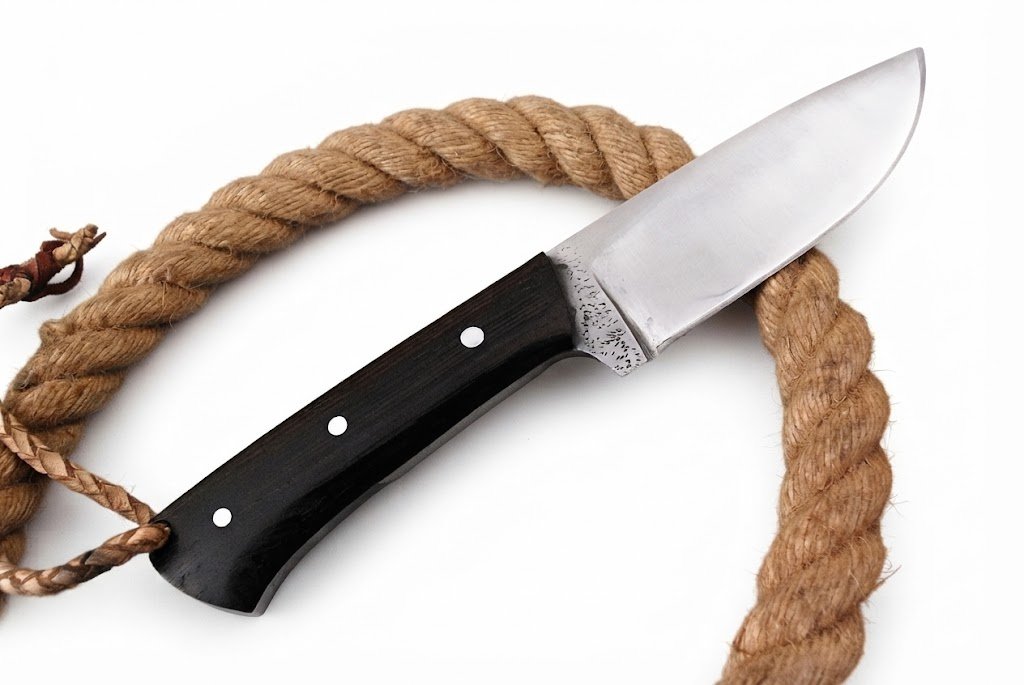
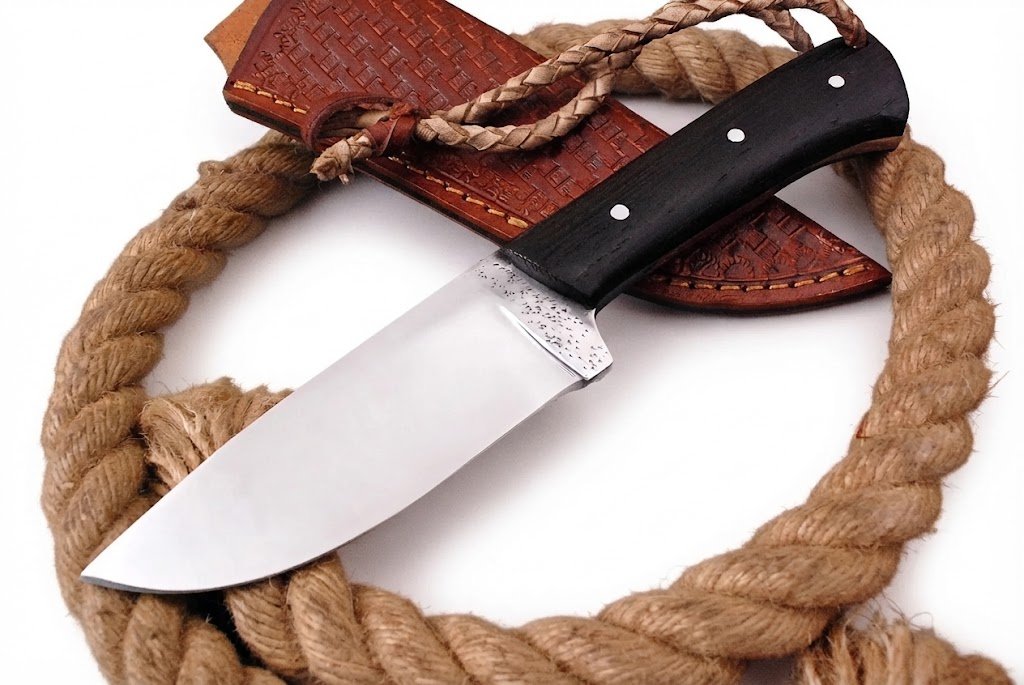
This black handle fixed blade knife pairs a bright, polished-looking blade with a dark handle and simple silver-tone fittings. A braided tan lanyard extends from the handle’s rear, while a reddish-brown sheath with an embossed pattern is pictured underneath. The combination gives the knife a traditional outdoor appearance with a strong contrast between the reflective blade and the darker grip.
The design is relatively understated. Three round pin heads break up the black handle, and a small textured area near the blade’s base adds detail without covering the main blade face. The sheath introduces a warmer colour and a more decorative surface, creating a balanced presentation.
The photograph clearly shows these visual features. It does not establish the steel grade, exact handle material, dimensions, hardness, or manufacturing method. Those specifications remain separate from the appearance described here and should be confirmed when selecting the knife for a particular purpose.
A Bright Blade Finish
The broad silver-coloured blade is the most eye-catching part of this knife. Its face reflects the lighting strongly, with soft bands of brightness running across the surface. This creates a clean, polished appearance that contrasts with the fine dark markings of the handle.
Most of the blade face appears plain rather than covered in a repeating decorative pattern. That gives the shape itself a prominent role in the design. The long outline, curved edge, and pointed end remain easy to distinguish against the white background.
Customers who prefer a simpler blade appearance may find this finish appealing. It offers a different visual character from a heavily patterned or dark-coated blade, particularly when displayed beside the detailed brown sheath.
The visible shine describes the finish in this photograph. It does not establish stainless steel construction, corrosion resistance, a protective coating, or the exact polishing process used during production.
A Broad Profile and Curved Edge
The blade maintains noticeable width through much of its length before narrowing towards the tip. Its lower outline follows a gradual curve, while the upper outline leads towards the point with a less pronounced sweep.
This gives the knife a broad, flowing profile rather than a narrow needle-like appearance. Near the handle, the blade’s base forms a distinct transition into the main face. The edge outline appears continuous in the visible view, with no serrations shown.
The combination of a broad blade and a curved edge is visually consistent with an outdoor-style cutting tool. However, the photograph does not confirm a specific role such as skinning, carving, chopping, or food preparation.
For a customer choosing by shape, the image provides a useful starting point. Blade length, thickness, grind geometry, and the manufacturer’s intended applications would provide the information needed to judge practical suitability more accurately.
Texture Near the Blade’s Base
A small section immediately in front of the handle has dark, irregular marks against a silver background. This textured-looking area is clearly different from the smoother, brighter blade face.
Its placement draws attention to the transition between the handle and blade. Rather than spreading decoration across the entire knife, the design concentrates this detail near the base, leaving the broad forward section visually uncomplicated.
The texture may resemble a hammered or stippled finish, but the manufacturing method cannot be identified from the image. It should not be used as proof that the knife is hand-forged or that particular marks were created during forging.
What is visible is a deliberate contrast in appearance: dark, scattered markings near the handle and a reflective surface across the main blade. This small detail adds character while preserving the knife’s otherwise restrained styling.
A Dark Handle with Subtle Surface Detail
The handle appears black or very dark charcoal, with fine lengthwise lines visible under the lighting. These markings give it more depth than a completely featureless black surface, while remaining subtle enough to keep the overall appearance simple.
The material has a grain-like look, but the photograph does not confirm wood, horn, resin, or a composite. A named material such as ebony, pakkawood, or Micarta would require separate verification.
Its dark colour creates a clear boundary between the grip and the polished-looking blade. This makes the knife’s proportions easy to read and gives the silver-tone pins a contrasting background.
For customers who prefer neutral colours, the handle is one of the design’s strongest features. It coordinates naturally with the silver blade and brown accessories without relying on bright inserts, large logos, or elaborate metal decoration.
A Gently Shaped Grip
The handle has a curved outer profile with a broader, rounded rear end. Its underside follows a gentle contour towards the front, rather than using a series of deep finger grooves.
The photographed edges appear rounded, and the light catches a smooth-looking curve along the lower side. These details suggest a shaped handle surface, although the precise thickness and cross-section are not shown.
This relatively simple outline may appeal to customers who prefer less visually aggressive grip designs. It also leaves much of the dark surface uninterrupted, allowing the fine grain-like markings to remain visible.
Actual comfort cannot be determined from the outline alone. Usable handle length, thickness, surface finish, and hand size all affect fit. Customers planning regular use should compare those measurements with a knife they already find comfortable rather than relying only on the photograph.
Three Silver-Tone Pin Heads
Three circular silver-tone pin heads are visible along the photographed side of the handle. They are spaced along its length and provide small points of brightness against the dark background.
The pin closest to the blade appears larger in this view than the one nearest the rear. Together, the fittings introduce a simple progression along the handle without making it look crowded.
Their colour also connects the handle visually to the blade. This keeps the design consistent: the same silver-and-black contrast appears both across the knife as a whole and within the handle itself.
The photograph does not identify the fittings’ alloy or reveal their internal fastening method. They should therefore be described by their visible appearance rather than labelled as stainless steel or another specific metal. Likewise, the pin arrangement alone does not verify full-tang construction.
The Braided Tan Lanyard
A braided tan lanyard is shown attached at the rear of the handle. It forms a loop above the knife and extends into two decorative ends with darker brown wrapped or knotted details.
The braid adds a softer texture beside the smooth-looking handle and reflective blade. Its light brown colour also links the knife to the warmer tones of the sheath.
This is a visibly different element from the thick rope arranged behind the product. The thin braid is attached to the handle; the larger rope serves as a photographic prop and should not be treated as an included accessory.
The lanyard’s exact material, length, and strength have not been established. Its inclusion in the delivered package should also be confirmed. The photograph supports describing the attachment and braided appearance, without promising a particular load capacity or retention function.
The Brown Sheath Pictured Underneath
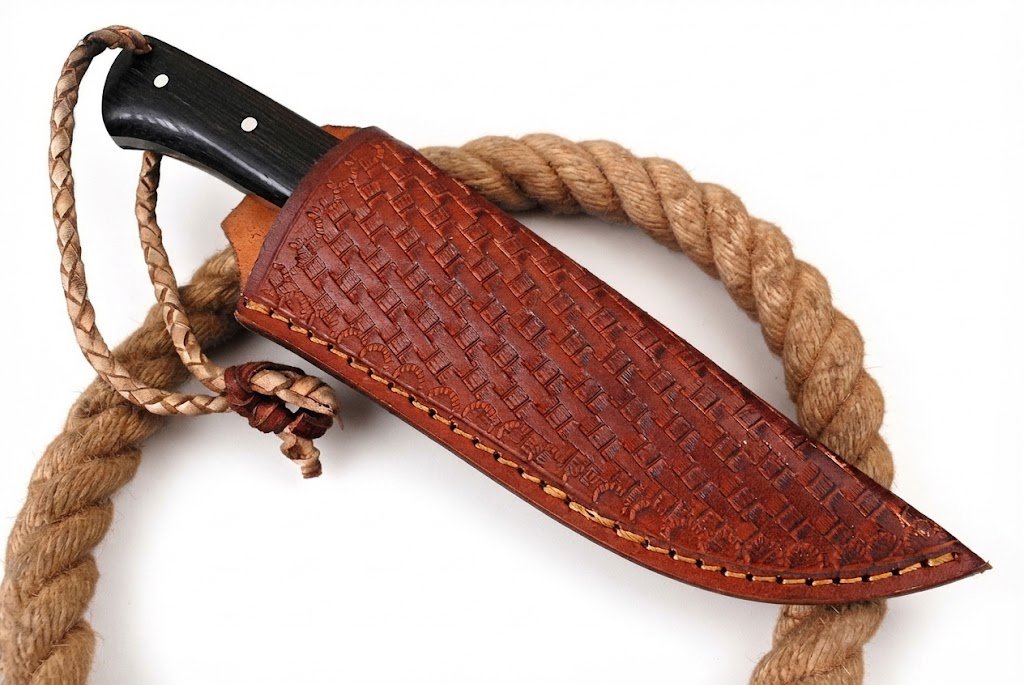
The knife rests over a reddish-brown sheath with a shaped outline and contrasting perimeter stitching. Much of its visible face carries a repeating interlocking pattern resembling basketweave tooling.
This patterned surface gives the sheath a decorative role in the presentation. The warmer brown tone provides a clear contrast to the black handle, while the tan stitching coordinates with the lanyard.
A second decorative border appears near parts of the sheath’s edge, adding curved impressions around the more geometric central pattern. These details create visual depth without requiring a large emblem or printed design.
The surface looks leather-like, but genuine leather, its grade, thickness, and lining are not confirmed. The knife also covers part of the sheath, so the photograph does not show every construction detail. The material and package inclusion should be verified separately.
Stitching and Sheath Shape
The visible stitching follows the sheath’s outer contour, forming a lighter line against the brown surface. Individual stitches can be seen along the lower edge and around the curved end.
The sheath is wider near the area beneath the handle and narrows towards its pointed end. Its shape appears intended to accommodate the pictured blade, but a photograph cannot demonstrate the fit or how securely the knife is retained.
The reverse side is not shown. Belt loops, clips, straps, internal construction, and mounting arrangements therefore remain unverified. Customers should not assume horizontal carry, vertical carry, or compatibility with a particular belt width.
For a buyer who intends to use the sheath, a reverse-side photograph and a description of the retention system would be helpful. These details explain practical compatibility more reliably than the decorative front view alone.
A Coordinated Traditional Appearance
The design brings together three main colours: black, silver, and reddish-brown. The handle provides the darkest area, the blade introduces brightness, and the sheath adds warmth.
The tan lanyard and stitching act as smaller connecting details. They keep the accessories visually related without making every component the same colour or texture.
This combination may appeal to customers who favour traditional-looking knife presentations. The blade remains relatively plain, the handle has restrained detailing, and the sheath carries most of the decorative pattern.
The result is a design that can be appreciated from a distance for its colour contrast and more closely for its pins, braid, surface markings, and embossed sheath. Lighting and screen settings may affect how these colours appear, so the supplied photograph is best treated as a visual reference rather than an exact colour standard.
Considering It for a Collection
For customers interested in knife design, this piece offers a combination of simple metalwork appearance and more decorative accessories. The reflective blade provides a broad, uncluttered surface, while the sheath introduces texture and pattern.
It may appeal to someone assembling a collection around black handles, polished-looking blades, or brown sheath designs. The braided lanyard adds another recognisable detail without changing the main silhouette.
The photographic arrangement also makes the contrast between components easy to see. Buyers can compare the knife’s restrained styling with more heavily patterned examples and decide which approach better suits their preferences.
No maker, production history, country of manufacture, limited edition, or collectible value has been verified. Its appeal here rests on the visible design. Those interested in provenance should request supporting information rather than infer it from the traditional styling.
Assessing Practical Suitability
A fixed-blade knife is a cutting tool, but its suitability for particular work depends on specifications that are not visible in the photograph. A bright finish and substantial-looking profile do not establish performance.
Before choosing this knife for regular use, confirm the steel grade, blade thickness, heat treatment information, and intended applications. These details help explain what the manufacturer designed the knife to do.
Handle construction is equally relevant. The photograph shows the outer grip and fittings, but not the full internal assembly. Dimensions and weight would also help a buyer assess whether the knife suits their preferred size and handling style.
This listing therefore makes no promises about edge retention, corrosion resistance, impact strength, or demanding outdoor use. Customers seeking a working knife should base that decision on verified product specifications as well as its appearance.
Measurements That Help with Comparison
Overall length is the first useful measurement because it establishes the knife’s size from tip to handle end. Blade length and usable handle length then explain how that total is divided.
Blade thickness provides information that is difficult to judge from the angled front view. Handle thickness and total weight would complete a more practical picture of the product.
These measurements are especially helpful when comparing the knife with an existing storage case, display arrangement, or familiar knife. Without them, the photograph can create a misleading impression of scale.
The sheath also needs its own dimensions if belt compatibility or storage fit matters. The size of the pictured rope should not be used as a measuring reference, as its diameter is unknown and it sits at a different position in the arrangement.
Package Contents and Available Options
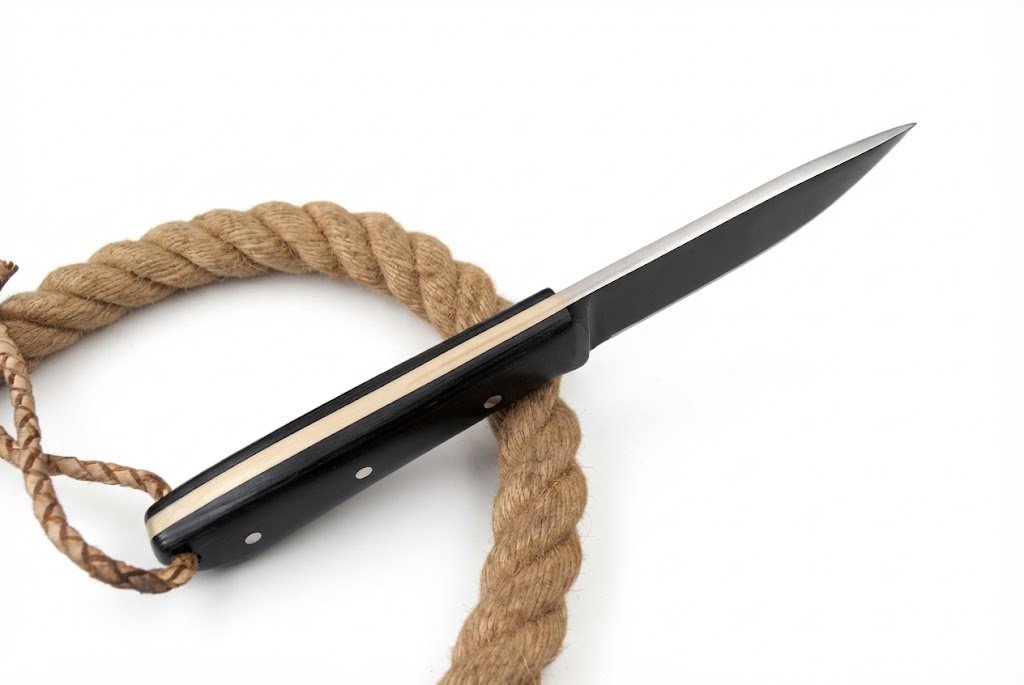
The image shows one knife, a brown sheath, an attached braided lanyard, and a thick rope used in the presentation. Only the seller’s confirmed package description can establish which items are supplied.
The sheath and lanyard should be listed explicitly if they are included. Gift boxes, maintenance products, display stands, and certificates are not shown and should not be assumed.
No alternative handle colours, blade finishes, sizes, or sheath patterns have been verified. The photographed version is the only appearance described in this listing.
Personalisation is also unconfirmed. Customers interested in engraving, initials, custom packaging, or a different lanyard should request availability and pricing before ordering. A plain blade surface does not automatically mean engraving is offered or suitable.
Care Information and Choosing Your Knife
Care requirements depend on the actual blade, handle, sheath, and lanyard materials. The manufacturer’s instructions should guide cleaning, drying, storage, sharpening, and any surface treatment.
Because those materials are not verified, this listing does not prescribe a particular oil, polish, conditioner, or washing method. Obtaining the correct instructions is especially useful for preserving the blade’s reflective appearance and the sheath’s decorative surface.
This black handle fixed blade knife offers a straightforward visual identity: a bright blade, dark contoured grip, three silver-tone pins, and a braided tan accent. The pictured brown sheath adds warmth and detail to the arrangement.
Explore the product’s visible features, confirm the measurements and package contents, and choose it when its appearance and verified specifications suit your needs.







Reviews
There are no reviews yet.