







Black Micarta Style Hunting Knife with Polished Fixed Blade
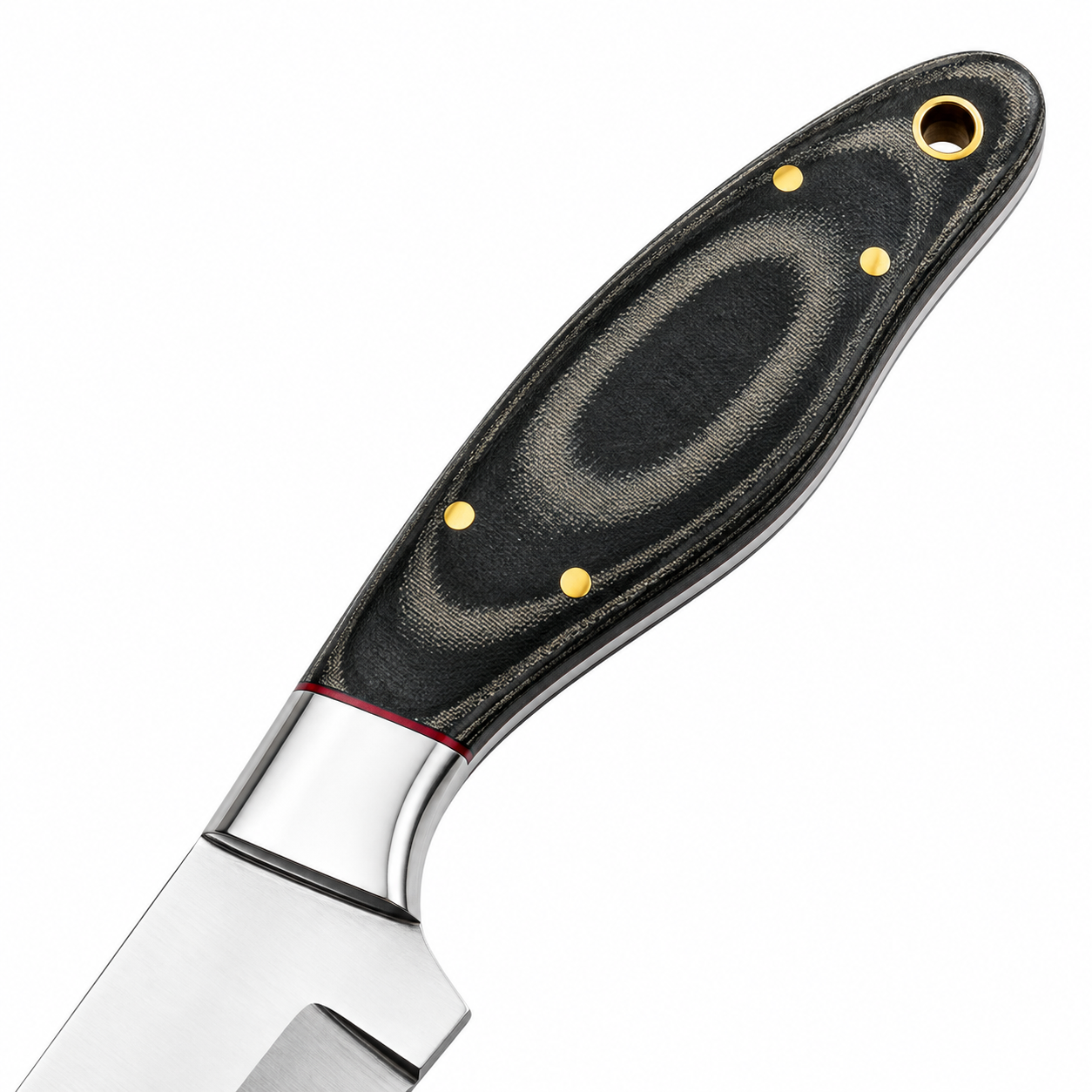
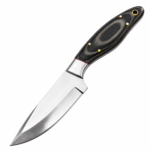
The Black Micarta Style Hunting Knife features a broad polished silver-colored blade, a contoured black patterned handle, and a distinctive metal bolster. Its traditional fixed-blade design is complemented by decorative gold-colored pins, a narrow red spacer, and a metal-lined lanyard hole.
Designed with attention to visual detail, this hunting-style knife combines a classic blade profile with a modern handle appearance. Its silver, black, gray, red, and gold color combination makes it a distinctive option for adult knife collectors and outdoor equipment enthusiasts.
Black Micarta Style Hunting Knife Design and Features
The Black Micarta Style Hunting Knife has a broad, drop-point-style blade with a smooth metallic finish. Its black handle displays layered-looking gray patterns, while the polished bolster creates a clean transition between the handle and blade.
Polished Blade and Patterned Handle
The knife features a curved cutting edge, a pointed tip, and a contoured handle. Gold-colored pins and a lanyard-style opening complete the handle design. Exact steel grade, handle material, dimensions, and construction specifications should be confirmed with the manufacturer.
Distinctive Fixed Blade Hunting Knife Design
The first feature that draws attention to this knife is its broad blade profile.
The blade is noticeably wider near the handle and gradually narrows toward a pronounced point. Its upper contour follows a gently sloping line, giving the knife a shape associated with traditional drop-point-style hunting knives.
Unlike highly decorative knives with complex surface patterns, this model has a relatively clean and understated blade finish.
The silver-colored surface contrasts with the black handle, giving the knife a familiar but refined appearance.
Its design places visual emphasis on the natural relationship between blade shape and handle proportions.
The blade and handle appear permanently connected, with no folding hinge visible.
This establishes the product as a fixed-blade-style knife rather than a pocket or folding knife.
The exact internal construction is not visible, so full-tang or hidden-tang specifications should only be added after manufacturer confirmation.
For customers comparing different hunting-style knives, the combination of a broad blade and contoured patterned handle makes this design readily recognizable.
Polished Silver-Colored Blade
The blade features a clean silver-colored metallic surface with fine, linear finishing marks.
These marks create a satin-like appearance rather than an entirely mirror-polished surface.
The finish reflects light in a controlled way, emphasizing the blade’s broad profile and long cutting edge.
A defined bevel is visible along the blade, contributing to its distinctive shape.
The knife has a pointed tip and a curved cutting edge.
These features are characteristic of many traditional fixed-blade designs.
However, the image does not provide sufficient information to establish the precise steel composition, edge angle, or production method.
Although stainless steel and carbon steel are common materials in the knife industry, neither should be specified without confirmation.
The visible surface can accurately be described as a polished metallic blade with a satin-like finish.
Its actual corrosion resistance, edge retention, and hardness depend on the steel grade and heat treatment used by the manufacturer.
These technical details should be confirmed before any performance guarantees are made.
Broad Drop-Point-Style Blade Profile
The blade has a broad outline with a gradually tapering tip.
Its spine slopes toward the front, while the cutting edge follows a smooth curved line.
This creates a silhouette commonly associated with drop-point-style hunting knives.
The wide blade area provides a substantial visual presence.
The tip has a clearly defined point, and the main body has a smooth transition from the handle.
A curved cutting edge is a familiar element in many general-purpose hunting and outdoor knife designs.
Nevertheless, an image alone cannot demonstrate suitability for specialized cutting applications.
Actual functionality depends on the blade’s dimensions, material properties, geometry, and edge condition.
The manufacturer should provide these details when customers require a knife for specific outdoor tasks.
From a design perspective, the blade offers a classic appearance without excessive ornamentation.
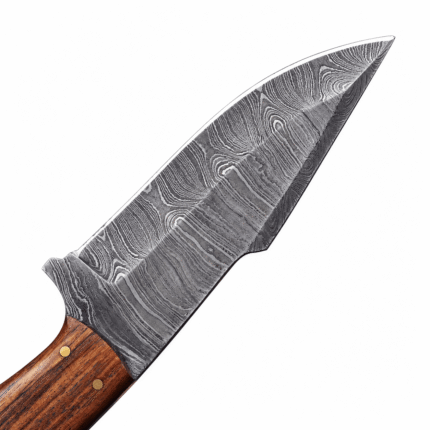
This makes it visually different from highly patterned Damascus-style knives or aggressively angular survival knife designs.
Black Micarta-Style Patterned Handle
The handle is one of the most distinctive parts of the knife.
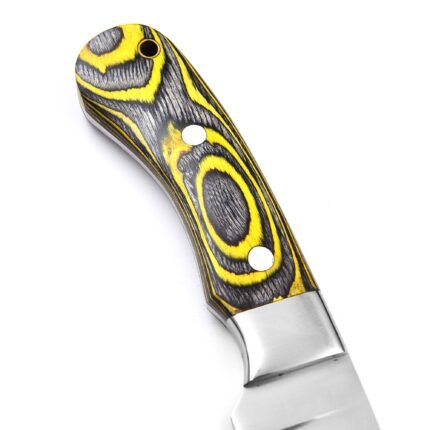
Its surface has a predominantly black appearance with gray curved lines that form layered, oval-shaped patterns.
These markings resemble the visual texture of certain composite knife handles.
The layered pattern creates depth and makes the handle more visually interesting than a plain black grip.
The handle gradually widens toward its center before narrowing toward the bolster.
Its outer edges are rounded, producing a smooth contoured silhouette.
The dark finish coordinates with the polished blade and metallic fittings.
Although the handle looks similar to some Micarta-style materials, its composition cannot be determined from the photograph.
It may be manufactured using a synthetic composite or another handle material.
For accurate product specifications, the supplier should confirm the material.
Until confirmation is available, the most appropriate description is a black patterned Micarta-style handle.
This identifies the visual design without making an unsupported material claim.
Contoured Handle Profile
The handle has a gently curved shape with a rounded rear section.
Its outline follows the overall flow of the knife.
The broad central section provides a recognizable grip profile, while the narrower area near the bolster creates a clear visual transition toward the blade.
Several metallic-colored details are visible across the handle.
The combination of a contoured shape and decorative fasteners contributes to the product’s traditional knife appearance.
Actual ergonomic performance cannot be confirmed through photography.
A comfortable grip depends on factors such as handle dimensions, surface texture, user hand size, and weight distribution.
The surface appears relatively smooth, but its true friction and texture require physical examination.
Therefore, the product should not be advertised as having a guaranteed non-slip or ergonomically tested grip without supporting information.
Customers comparing different knife handle designs should review the actual handle length, thickness, and material before purchasing.
Gold-Colored Handle Pins
Four small gold-colored circular pins are visible on the handle surface.
Their warm metallic color contrasts with the black and gray grip.
The pins are arranged across the handle and contribute to the overall decorative appearance.
These components may be part of the handle’s fastening system, but the image does not establish their construction or function.
The finish resembles brass, although the exact material cannot be confirmed.
They are therefore described as gold-colored handle pins rather than solid brass rivets.
Their understated appearance complements the silver-colored bolster without overwhelming the handle design.
The combination of dark patterned material and gold-colored accents gives the knife a distinctive visual character.
Polished Metal Bolster
A broad silver-colored bolster separates the blade from the handle.
The fitting has a smooth, reflective appearance and follows the curved transition between these components.
Its polished surface is noticeably brighter than the black handle.
This visual contrast draws attention to the connection between blade and grip.
The bolster’s shape contributes to the overall silhouette of the knife.
It creates a defined metallic section directly behind the blade.
The actual material of the fitting is not verified.
It could be manufactured from stainless steel or another metal alloy.
The image also does not establish whether the bolster is a separate component or part of the blade assembly.
For this reason, the product description identifies it simply as a polished silver-colored metal bolster.
Red Handle Spacer Detail
A narrow red accent is visible between the black handle and the metal bolster.
This detail introduces a third prominent color to the knife’s design.
The red line contrasts with the dark grip and polished metallic surface.
Although small, it adds a distinctive finishing detail.
Decorative spacers are commonly incorporated into knife handles to create a more defined transition between materials.
In this knife, the red accent performs that visual role.
Its exact material is not known.
The image does not confirm whether it is made from fiber, resin, plastic, or another decorative material.
Therefore, describing it as a red spacer or accent is more accurate than assigning a specific composition.
The contrast between black, red, silver, and gold gives the knife a coordinated visual appearance.
Gold-Ringed Lanyard Hole
A circular opening is visible near the rear of the handle.
The opening has a gold-colored metallic border.
Its position and appearance are consistent with a lanyard-style hole commonly found on fixed-blade knives.
The metal-colored ring visually coordinates with the other gold-colored pins.
This creates continuity across the handle.
The hole also adds a recognizable traditional knife detail.
Its exact internal diameter has not been measured.
Compatibility with specific cords or lanyard accessories should therefore be confirmed before being advertised.
The opening is best described as a gold-ringed lanyard-style hole.
No cord or lanyard is shown in the uploaded image.
Fixed Blade Construction and Design
Fixed-blade knives differ from folding knives because the blade remains extended rather than rotating into the handle.
The uploaded knife clearly features a fixed-blade configuration.
Its blade extends directly from the metal bolster and handle assembly.
No folding pivot or locking mechanism is visible.
This design category is widely represented in traditional hunting, camping, utility, and collectible knives.
However, fixed-blade appearance does not automatically establish a particular internal construction method.
The photograph does not show whether the blade steel extends through the entire handle.
As a result, the knife should not be described as full tang without manufacturer confirmation.
Similarly, claims regarding reinforced construction, impact resistance, or heavy-duty performance require verified specifications.
The accurate classification is a fixed-blade hunting-style knife with a broad polished blade and contoured black patterned handle.
Understanding the Blade Finish
A blade’s finish plays an important role in its appearance.
Some knives feature dark coatings, while others have bright metallic or patterned surfaces.
The photographed knife uses a bright silver-colored finish.
Fine directional marks are visible across the blade.
This gives the surface a brushed or satin-like appearance.
The finish complements the polished bolster and contrasting black handle.
Unlike knives with highly decorative layered patterns, this blade has a comparatively uniform metallic appearance.
That simplicity allows the handle’s gray concentric pattern to become a central design feature.
The image does not show a manufacturer marking, steel-grade stamp, or certification.
Therefore, no brand, country of origin, hardness rating, or premium alloy should be inferred.
These technical details should be provided separately by the manufacturer.
Traditional Outdoor Knife Styling
The knife’s appearance reflects several familiar elements of traditional outdoor cutlery.
It features a fixed blade, pointed tip, contoured handle, and substantial-looking metallic bolster.
These details are common in hunting-style knife designs.
The broad blade shape gives the product a recognizable outdoor aesthetic.
The handle provides a modern decorative contrast through its layered-looking black and gray pattern.
Gold-colored pins and a red accent add visual character.
The result is a design that combines traditional knife proportions with contemporary decorative styling.
Adult collectors interested in different blade shapes may appreciate this particular combination.
The knife can also be considered by customers comparing outdoor-inspired fixed-blade designs.
Its exact suitability for camping, hunting, or general utility work depends on specifications that remain unverified.
A Distinctive Addition to Knife Collections
Adult knife collectors often value differences in shape, finish, and handle construction.
This knife offers several recognizable visual details.
The broad blade has a smooth, silver-colored finish.
Its pointed profile distinguishes it from blunt-ended or cleaver-style blades.
The handle features a dark patterned surface rather than a plain finish.
The gold-colored circular pins create small contrasting highlights.
The red spacer provides an additional color accent.
The polished bolster completes the transition between handle and blade.
These details make the product visually distinctive within a collection of traditional fixed-blade knives.
The uploaded image does not establish whether the knife is handmade, a limited edition, or produced using a specialized forging process.
Such claims should only be added when supported by supplier documentation.
Comparing Fixed Blade Hunting Knives
When comparing hunting-style knives, customers should consider more than appearance.
Blade geometry is one important factor.
Some models have narrow blades with relatively straight edges.
Others have broader blades with pronounced curvature.
This knife belongs to the broad-blade category.
Its profile has a gently sloping upper edge and a curved cutting edge.
Handle design is another consideration.
The pictured knife has a black patterned handle with rounded contours and visible decorative pins.
Other hunting knives may use natural wood, bone, metal, or synthetic handle materials.
Each material has different characteristics.
Weight, dimensions, durability, and maintenance requirements depend on the actual materials and construction.
The photograph alone cannot establish these specifications.
A reliable comparison should include confirmed blade length, overall length, thickness, weight, handle composition, and steel grade.
These details help customers determine whether a particular knife meets their requirements.
Understanding Knife Steel Grades
The material used to manufacture a blade influences its characteristics.
Different steel grades have different combinations of hardness, corrosion resistance, toughness, and wear resistance.
Blade performance also depends on heat treatment and edge geometry.
A polished surface cannot reliably identify the steel grade.
The photographed blade has a bright metallic appearance.
However, this does not prove that it is made from stainless steel, carbon steel, D2 steel, or any other specific alloy.
The steel composition should be confirmed through manufacturer documentation.
Customers who require technical specifications should request the steel grade and hardness rating.
Actual blade thickness and edge geometry are also useful details.
Without this information, precise performance claims would be speculative.
The product listing should focus on the visible blade design until verified specifications become available.
Understanding Composite-Style Handles
Knife handles can be manufactured from different natural and synthetic materials.
These include wood, reinforced composites, resin-based materials, and other engineered products.
Some composite materials display layered patterns that resemble the texture visible on this knife.
However, similar visual effects can be produced using different manufacturing methods.
The photographed handle has a black base with gray oval and curved markings.
This appearance supports the term Micarta-style.
It does not establish genuine Micarta composition.
The actual material should be confirmed with the supplier.
Accurate material information is important because different handle materials have different care requirements.
For example, a treatment suitable for natural wood may not be appropriate for a synthetic composite.
Customers should follow material-specific care guidance once the handle composition has been identified.
Product Appearance and Color Combination
The knife features a restrained but distinctive color scheme.
The blade is predominantly silver.
The handle is primarily black with gray patterned detailing.
The bolster has a bright silver-colored finish.
Gold-colored pins appear across the handle.
A gold-ringed circular hole is visible at the rear.
A narrow red accent separates the handle from the bolster.
Together, these elements create an attractive balance of dark and metallic tones.
The black handle provides visual depth, while the silver blade creates a clear contrast.
The gold-colored details add warmth.
The red accent introduces a small but noticeable finishing touch.
This coordinated color combination may appeal to customers who prefer traditional knife shapes with decorative handle details.
Blade Cleaning and Routine Care
Regular cleaning is an important part of maintaining a knife’s appearance.
After handling, the blade should be wiped with a clean, soft cloth.
Remove visible moisture and residue before storage.
Avoid unnecessary exposure to damp environments.
The appropriate cleaning method depends on the actual blade steel and finish.
Certain steels require additional corrosion-prevention care.
Others may have different maintenance needs.
Because the steel grade is not confirmed, the manufacturer should provide specific cleaning recommendations.
Avoid using aggressive abrasive products that may alter the surface finish.
Harsh chemicals can also affect decorative components or metallic fittings.
Where cleaning products are necessary, select those approved for the confirmed materials.
Routine visual inspection can help identify changes in the blade surface.
Maintaining the Patterned Handle
The black patterned handle should be treated according to its actual material composition.
For routine surface cleaning, a soft cloth can remove loose dust and dirt.
Avoid prolonged exposure to excessive moisture until the manufacturer confirms the handle’s water-resistance characteristics.
Do not automatically apply wood oils, leather conditioners, or harsh cleaning agents.
These products may be unsuitable for composite or resin-based materials.
The gold-colored pins and silver-colored bolster can be wiped gently.
The red accent should also be cleaned carefully.
Avoid abrasive scrubbing that could damage decorative surfaces.
If the handle develops visible cracks, loose fittings, or other signs of damage, it should be inspected before further use.
Appropriate care helps preserve the appearance of the knife over time.
Responsible Storage and Handling
Fixed-blade knives require careful storage.
An exposed blade should not be left where accidental contact may occur.
Keep the knife away from children and unauthorized users.
A properly fitted protective sheath or suitable storage case should be used when appropriate.
No sheath is visible in the uploaded photograph.
Therefore, a sheath should not be described as an included accessory unless the supplier confirms it.
Before carrying or transporting a fixed-blade knife, check the applicable laws in the relevant jurisdiction.
Knife possession and public-carry rules vary by location.
Customers should also follow manufacturer guidance for storage and maintenance.
Proper handling and storage are important regardless of whether the knife is purchased for collecting or an approved practical purpose.
Product Photography and Display
The knife’s silver blade and dark handle create a strong contrast against a light background.
The uploaded image clearly displays the broad blade profile and the patterned handle.
The gold-colored pins and red accent are also visible.
These details help customers identify the product visually.
For a more complete product listing, additional photographs would be useful.
A second image showing the opposite side of the knife could reveal details not visible in the current photograph.
A close-up of the bolster and handle would help customers examine the decorative fittings.
An image showing the blade spine could provide a better understanding of its thickness.
A measurement reference would also help communicate the knife’s actual dimensions.
These additional photographs should represent the real product accurately.
Important Specifications to Confirm
The uploaded photograph establishes the knife’s general appearance, but several technical specifications remain unknown.
Product Type: Fixed-blade hunting-style knife
Blade Shape: Broad drop-point-style profile
Blade Appearance: Polished silver-colored metallic finish
Blade Edge: Curved cutting edge
Handle Color: Black with gray concentric patterns
Handle Design: Contoured Micarta-style appearance
Bolster: Polished silver-colored metal fitting
Decorative Pins: Four visible gold-colored circular pins
Accent Detail: Narrow red spacer
Rear Handle Feature: Gold-ringed lanyard-style hole
Steel Grade: Not verified
Blade Hardness: Not verified
Handle Material: Not verified
Overall Length: Not verified
Blade Length: Not verified
Blade Thickness: Not verified
Weight: Not verified
Tang Construction: Not verified
Sheath Inclusion: Not verified
These unknown fields should be completed using the supplier’s specifications rather than estimates from the image.
Choosing a Knife Based on Verified Information
When purchasing a fixed-blade knife, accurate information is as important as appearance.
A photograph can show blade shape, color, handle design, and visible components.
However, it cannot independently demonstrate steel quality or manufacturing consistency.
Technical specifications should come from reliable supplier documentation.
For buyers comparing multiple knives, useful information includes material composition, hardness, dimensional measurements, and intended applications.
The manufacturer’s care recommendations should also be considered.
Customers should avoid relying on unverified claims regarding exceptional sharpness, impact resistance, or other performance characteristics.
This knife has an appealing fixed-blade design, but its mechanical properties have not been independently tested.
Its listing therefore emphasizes the features directly observable in the image.
Why Choose This Black Micarta Style Handle Hunting Knife?
The Black Micarta Style Handle Hunting Knife offers a combination of traditional blade geometry and distinctive decorative styling.
Its broad silver-colored blade creates a clean metallic appearance.
The black contoured handle features layered-looking gray patterns that give the product a recognizable visual identity.
Gold-colored pins complement the dark grip.
A polished silver-colored bolster separates the handle from the blade.
The narrow red accent introduces an additional decorative detail.
A gold-ringed opening near the rear of the handle completes the design.
These features distinguish the knife from models with plain handles or heavily decorated blades.
For adult collectors and customers interested in traditional outdoor knife styles, the product presents an attractive combination of shape, finish, and color.
Final Overview
The Black Micarta Style Handle Hunting Knife is a fixed-blade hunting-style knife featuring a broad polished blade, black patterned handle, silver-colored bolster, red accent, and gold-colored decorative fittings.
Its clean blade profile contrasts with the layered-looking handle design.
The combination creates a distinctive appearance that fits naturally within a collection of traditional fixed-blade knives.
Before purchasing for a specific practical application, review the manufacturer’s verified material, dimensional, and construction specifications.
Explore this distinctive hunting knife design as part of your fixed-blade knife collection.






Reviews
There are no reviews yet.