






Black Turquoise Inlay Hunting Knife – Distinctive Fixed Blade Design
The Black Turquoise Inlay Hunting Knife combines a distinctive curved blade profile with a black handle, turquoise-colored decorative inlay, and polished metal accents. Its hunting-inspired design makes it a visually appealing addition to a collection of outdoor knives, decorative cutlery, or fixed-blade tools.
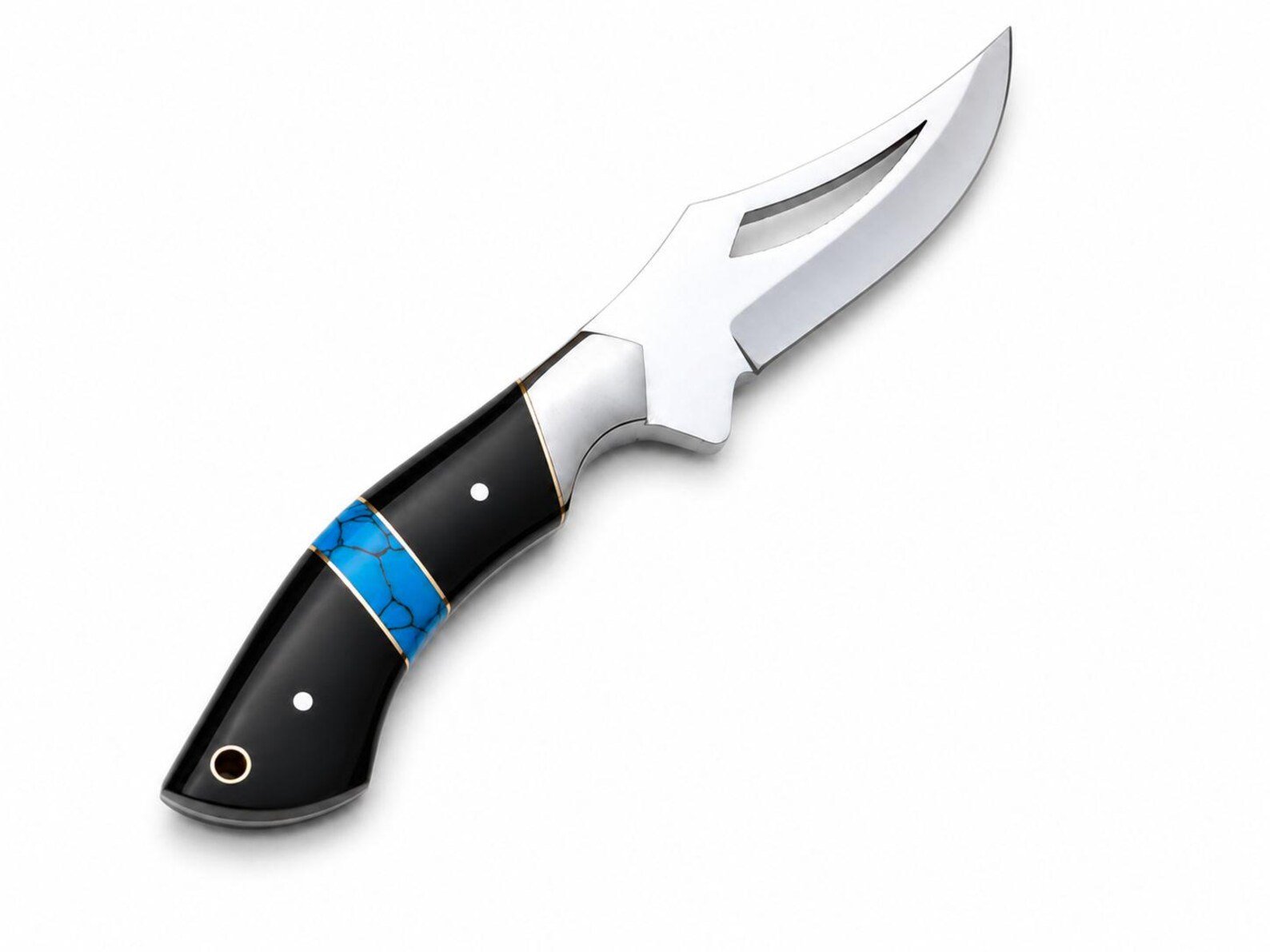
The knife features a bright silver-colored blade with a gently curved cutting edge and a sharply rising tip. An elongated opening near the upper section of the blade creates a recognizable design feature, while the polished surface adds a clean, reflective appearance.
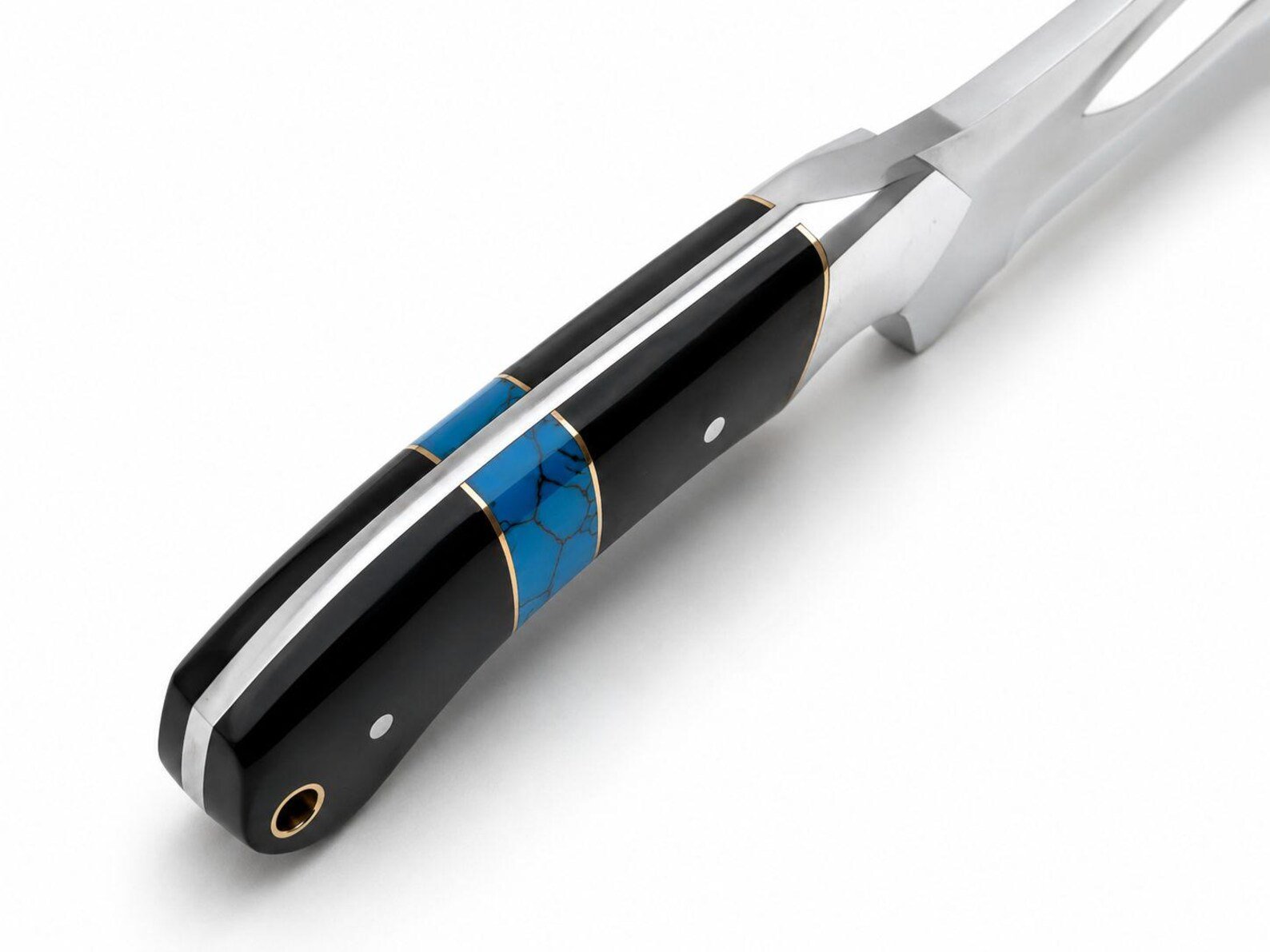
The handle combines black sections with a striking blue inlay positioned around the middle. Thin gold-colored dividing lines frame the blue accent, creating a clear visual contrast.
A smooth silver-colored bolster connects the handle to the blade. The handle also features small circular metallic pins and a rounded lanyard hole near its base.
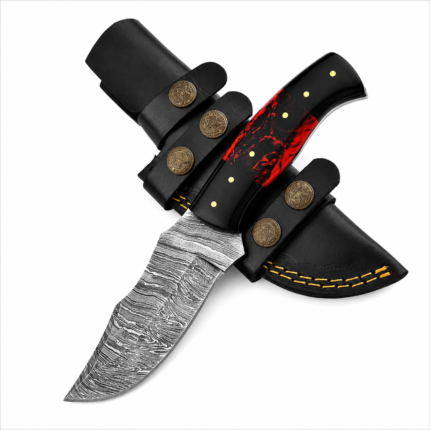
Included in the photograph is a brown, leather-style sheath with visible stitching along its curved edge. Its shape follows the general profile of the knife blade.
With its decorative details and distinctive construction, this fixed-blade knife is suited to customers interested in hunting-style knife designs, outdoor accessories, and collectible cutlery.
Distinctive Curved Blade Profile
One of the defining characteristics of the Black Turquoise Inlay Hunting Knife is its curved blade shape.
Unlike knives with straight or symmetrical blade profiles, this design features an upward-sweeping tip and a gently curved cutting edge.
The blade has a polished silver-colored surface, giving it a bright appearance against the darker handle.
The upper portion includes an elongated opening that follows the direction of the blade. This detail gives the knife an unusual appearance compared with conventional fixed-blade hunting knives.
The opening should be treated as a visible design feature. Its mechanical purpose, if any, has not been established.
A small angular transition is also visible where the blade meets the bolster.
These details contribute to the knife’s recognizable silhouette.
The exact blade length, thickness, cutting geometry, and edge hardness have not been provided.
Therefore, specific cutting-performance claims should be confirmed through manufacturer specifications rather than inferred from its appearance.
Black Handle with Turquoise-Colored Inlay
The handle is one of the most visually distinctive parts of this hunting-style knife.
It features a predominantly black finish divided by a vivid turquoise-blue decorative section.
The turquoise-colored area contains dark lines that resemble the veining commonly associated with turquoise stone.
This creates a contrasting appearance against the surrounding black handle sections.
Thin gold-colored borders separate the blue inlay from the black material, producing a layered decorative effect.
The handle’s curved outline provides a distinctive shape, with a broader section toward the end.
Several small circular silver-colored pins are visible across the black handle.
A gold-colored ring surrounds the opening at the handle’s base.
This hole may be suitable for attaching a lanyard, subject to its actual construction and manufacturer recommendations.
Although the blue decorative section resembles turquoise, the photograph does not confirm whether it is natural stone, synthetic turquoise, resin, or another composite material.
Similarly, the black handle material cannot be accurately identified from its appearance alone.
These material details should be verified with the manufacturer before being included in technical product specifications.
Polished Metal Bolster
The Black Turquoise Inlay Hunting Knife features a substantial silver-colored bolster near the blade.
This section provides a visible transition between the decorative handle and the polished blade.
The bolster has a smooth, reflective surface with a slightly contoured shape.
A curved recess is visible where the bolster meets the underside of the blade.
The metal-colored section creates a balanced visual transition between the bright blade and black handle.
The combination of polished metal, black handle sections, blue inlay, and gold-colored detailing gives the knife a distinctive appearance.
The exact bolster alloy and attachment method remain unverified.
Brown Leather-Style Sheath
The uploaded photograph also shows a brown sheath positioned alongside the knife.
The sheath has a warm reddish-brown finish and visible stitching along its outer edge.
Its curved shape generally follows the profile of the blade.
The material has a leather-like texture, complementing the knife’s traditional hunting-inspired appearance.
The stitching runs along the side and lower edge of the sheath, creating a defined border.
The photograph shows the exterior of the sheath but does not establish its internal lining, thickness, or exact material composition.
The sheath appears to be designed for this knife, although its fit and retention should be confirmed using the actual product.
A suitable sheath helps cover a fixed blade when it is not in use.
For safe storage, the knife should be fully seated in a properly fitted sheath, with the cutting edge protected from accidental contact.
Whether the sheath is genuine leather, synthetic leather, or another material must be confirmed with the supplier.
Hunting-Inspired Design
Hunting knives are available in many shapes, handle styles, and blade configurations.
Some feature relatively simple designs focused on everyday field applications.
Others include decorative elements intended to appeal to knife collectors and outdoor enthusiasts.
This model combines a hunting-style blade profile with several decorative details.
The curved blade, black handle, blue inlay, polished bolster, and brown sheath form a coordinated visual design.
The knife may appeal to customers who prefer distinctive fixed-blade knife styles rather than plain handle finishes.
Its appearance can also complement a collection containing traditional hunting knives and outdoor accessories.
However, its suitability for particular field applications depends on verified blade materials, construction quality, and manufacturer guidance.
The product should not be described as suitable for demanding survival applications or heavy-duty use without supporting specifications.
Decorative Turquoise-Inspired Finish
Turquoise-colored detailing is often associated with Southwestern-inspired and decorative cutlery designs.
The bright blue color introduces an attractive contrast against the black handle and silver-colored blade.
In this product, the blue accent forms a band across the handle rather than covering the entire grip.
The darker veining within the blue section creates a stone-like appearance.
Gold-colored borders help separate the decorative section from the black handle.
This combination makes the handle visually distinctive while preserving a relatively restrained overall design.
Customers who appreciate decorative knives may find the color combination particularly appealing.
The turquoise-inspired section is best described as a decorative inlay until its actual composition has been confirmed.
Claims about genuine gemstone content, natural origin, or special manufacturing techniques should only be published with supplier documentation.
Curved Handle Shape and Visible Details
The handle has an elongated, slightly curved profile.
Its upper surface follows a gradual contour, while the underside curves inward near the bolster and toward the lower section.
This gives the handle a recognizable outline.
The handle also includes visible metallic pins, which contribute to its traditional knife-handle appearance.
A round opening near the end has a gold-colored border.
Such openings are commonly used for lanyard attachments, although actual compatibility should be verified.
The photograph does not establish whether the knife uses full-tang, partial-tang, or another internal construction.
The visible pins and bolster should not be treated as proof of a particular tang design.
Actual comfort, balance, grip security, and durability also require physical inspection or manufacturer testing.
For buyers comparing fixed-blade knives, those specifications may be important alongside the appearance.
Suitable for Knife Collectors
The Black Turquoise Inlay Hunting Knife may be particularly appealing to collectors who appreciate unusual blade profiles and decorative handle combinations.
Its polished curved blade distinguishes it from many conventional straight-backed designs.
The turquoise-colored band provides a strong visual focal point.
The black handle sections and metallic accents add contrast without requiring printed graphics or elaborate branding.
The brown sheath completes the traditional-inspired presentation.
For enthusiasts who collect hunting-style knives, this product offers an appearance that combines decorative and functional design elements.
It may also interest customers who appreciate fixed-blade cutlery with stone-inspired handle accents.
Collectors should confirm the manufacturer’s name, material specifications, and production details if authenticity or provenance is important.
No specific brand, maker, production origin, or limited-edition status is established by the photograph.
An Addition to Outdoor Knife Collections
Outdoor equipment enthusiasts often prefer tools that match their personal style and intended activities.
Some choose practical, minimalist knives.
Others appreciate decorative models featuring polished blades, colored inlays, and traditional sheaths.
This knife fits the latter visual category.
Its black-and-blue handle makes it recognizable, while the silver-colored curved blade gives it a distinctive hunting-inspired silhouette.
The matching brown sheath provides an additional element for storage and presentation.
Customers considering the knife for outdoor use should first confirm its intended applications and technical specifications.
The photograph does not provide evidence of corrosion resistance, edge retention, toughness, or impact performance.
These qualities depend on materials, manufacturing methods, and testing.
Before purchasing a knife for regular field use, buyers should compare verified specifications rather than relying only on its appearance.
Understanding Blade Materials
Blade material is an important consideration when selecting any fixed-blade knife.
Different steel alloys have different characteristics, including hardness, toughness, corrosion resistance, and sharpening requirements.
Some manufacturers use stainless steel grades, while others use carbon steel or additional treatments.
The knife in the photograph has a silver-colored, polished blade.
However, its appearance does not establish the exact steel grade.
The photographed blade should not automatically be identified as Damascus steel, stainless steel, or high-carbon steel.
Likewise, its manufacturing process cannot be determined from the image.
Before publishing technical specifications, the supplier should confirm the steel composition, hardness rating, blade thickness, and finish.
These details help customers make informed comparisons between knife models.
They also allow more accurate maintenance recommendations.
General Knife Care and Maintenance
Proper maintenance can help preserve the appearance of a knife and its decorative components.
After appropriate use, the blade should be cleaned according to the manufacturer’s instructions.
For many fixed-blade knives, careful hand cleaning with a soft cloth and mild cleaning products is preferable to harsh abrasive treatment.
The blade and handle should be dried thoroughly before storage.
Extended exposure to moisture should be avoided unless the product’s materials and corrosion resistance have been verified.
The decorative inlay should not be exposed to aggressive cleaning chemicals without confirming material compatibility.
The same applies to the black handle sections and metallic accents.
If the sheath is genuine leather, its care requirements may differ from those of synthetic materials.
The knife should be stored securely, away from children and unauthorized users.
Any sharpening should follow the manufacturer’s recommended blade geometry.
Avoid modifying the blade or handle without appropriate professional guidance.
Choosing a Fixed-Blade Hunting Knife
When selecting a hunting-style knife, several characteristics are worth considering.
The first is blade size.
A knife should have dimensions appropriate for its intended lawful use.
The second is blade material.
Steel composition influences maintenance requirements and potential performance characteristics.
Handle construction is another important consideration.
Buyers should evaluate the handle material, grip size, and overall shape.
A properly fitted sheath is also important for safe storage and transport.
In addition to these practical considerations, some customers value appearance.
This knife combines a curved polished blade with a black handle and turquoise-colored accent.
Its gold-colored details and brown sheath create a coordinated aesthetic.
Before purchasing, customers should confirm overall length, blade length, total weight, blade steel, handle composition, and included accessories.
Product Appearance and Visible Specifications
The uploaded photograph confirms several distinguishing details.
The knife has a fixed-blade configuration with a curved upward-pointing tip.
The blade is silver-colored with a polished appearance and an elongated opening near its upper portion.
The handle has black sections separated by a turquoise-blue decorative inlay.
A silver-colored bolster connects the handle to the blade.
Metallic pins and a gold-colored lanyard opening are visible.
A brown stitched sheath is shown alongside the knife.
These details provide a useful starting point for an accurate product listing.
However, certain specifications remain unknown, including the exact measurements, materials, country of manufacture, and packaging details.
The listing should be updated when the supplier provides this information.
A Distinctive Design for Cutlery Enthusiasts
The Black Turquoise Inlay Hunting Knife combines a curved silver-colored blade, polished metal bolster, decorative black handle, turquoise-inspired inlay, and brown stitched sheath.
Its unusual blade opening and contrasting handle colors give it a recognizable appearance.
The coordinated details make it an interesting option for customers who appreciate traditional hunting-style knives with decorative accents.
Whether considered for a collection, display, or manufacturer-approved outdoor applications, buyers should review the confirmed materials and dimensions before purchasing.
Explore this black-and-turquoise fixed-blade knife for its distinctive design and traditional-inspired presentation.






Reviews
There are no reviews yet.