

Blue Resin Handle Fixed Blade Knife – Distinctive Outdoor Knife with Brown Sheath
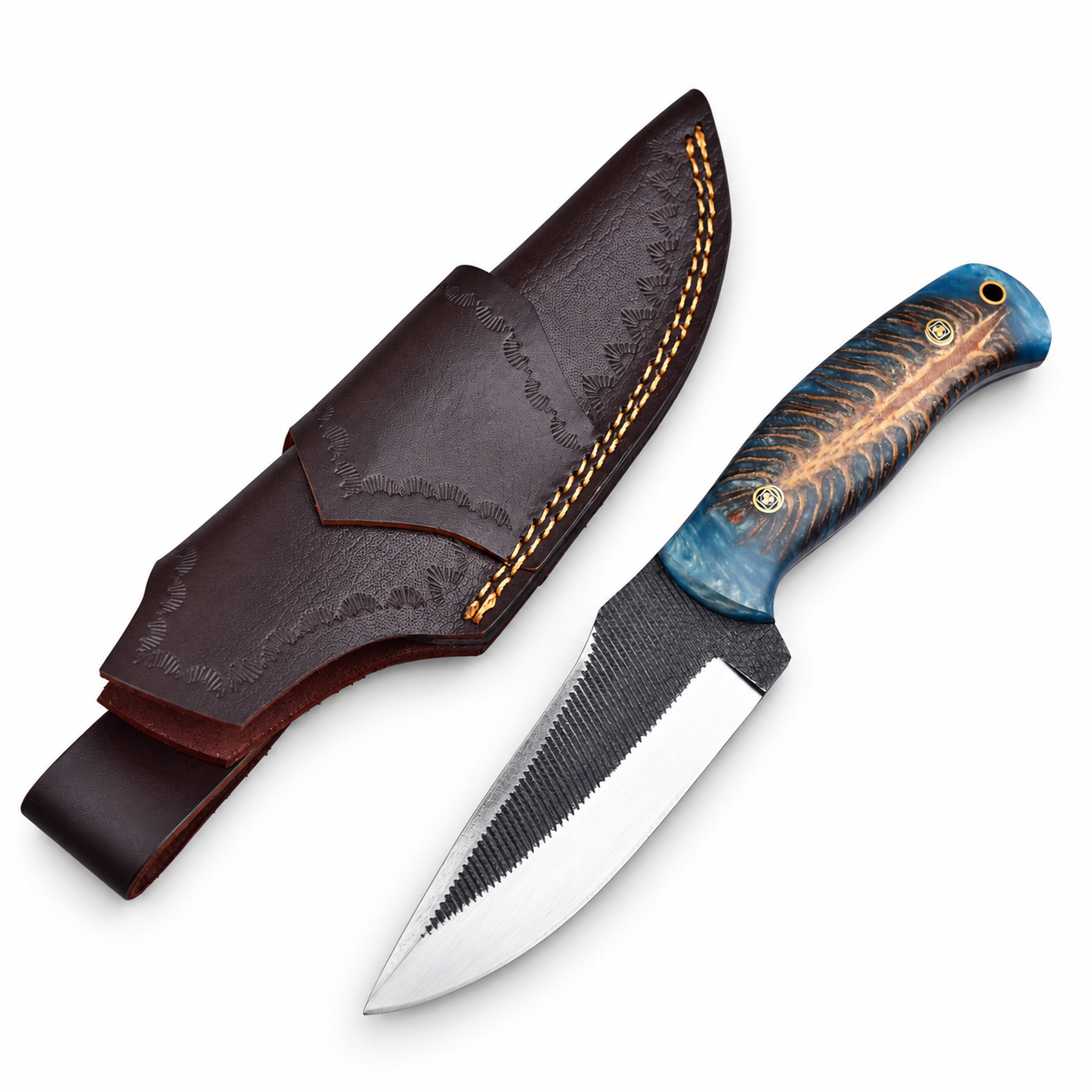
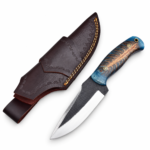
The Blue Resin Handle Fixed Blade Knife brings together a dark textured blade, a polished silver cutting edge, and an eye-catching blue-and-brown patterned handle. Its contrasting finish and contoured shape give this knife an appearance that stands apart from conventional outdoor cutting tools.
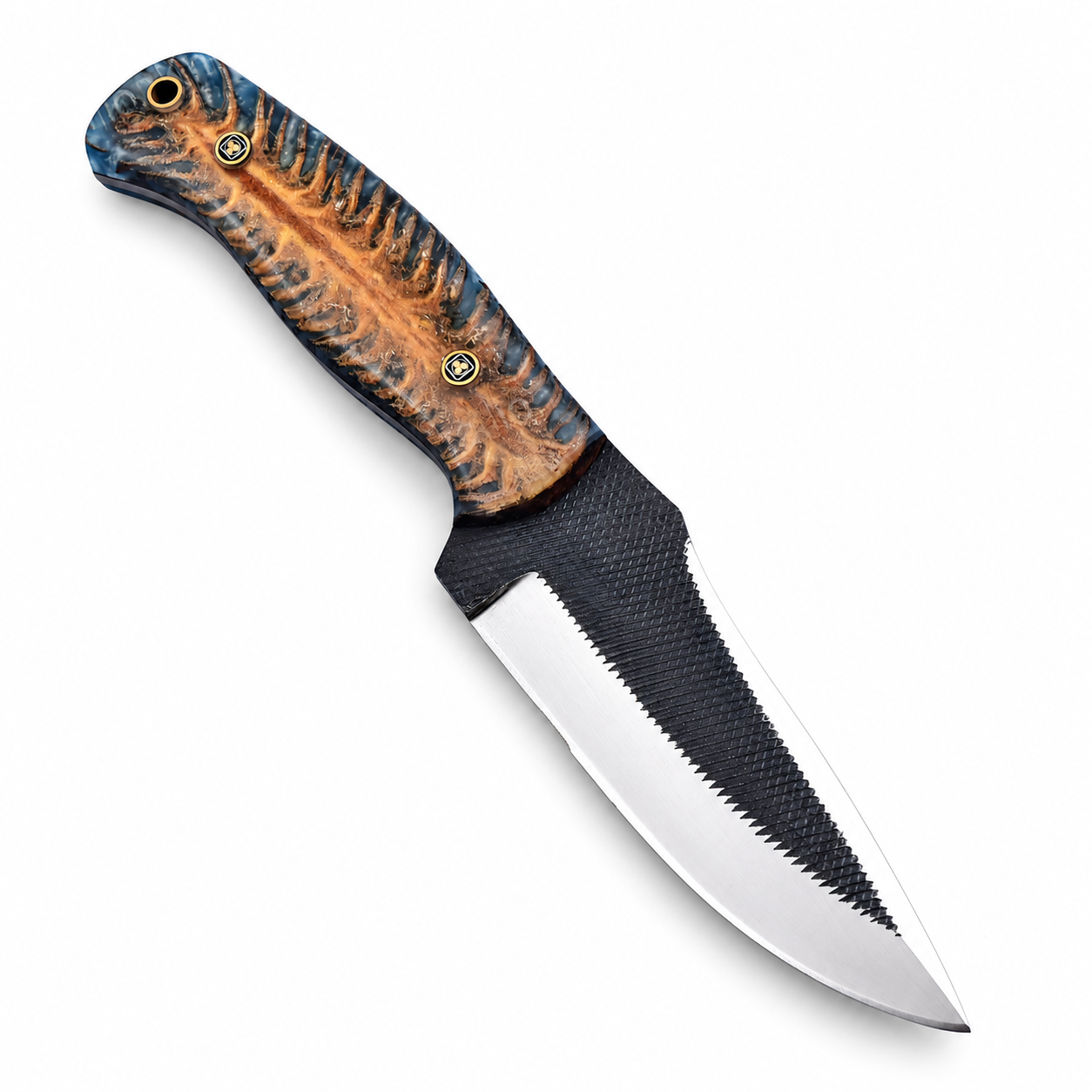
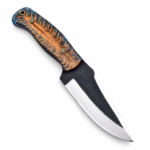
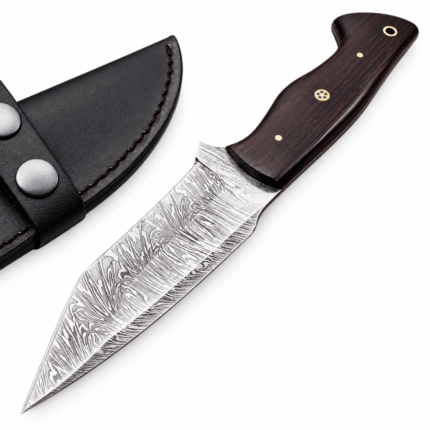
The knife features a pointed blade with a gently curved edge and a broad shoulder near the handle. The blade’s dark upper section contrasts with its brighter lower cutting surface, creating a distinctive two-tone design.
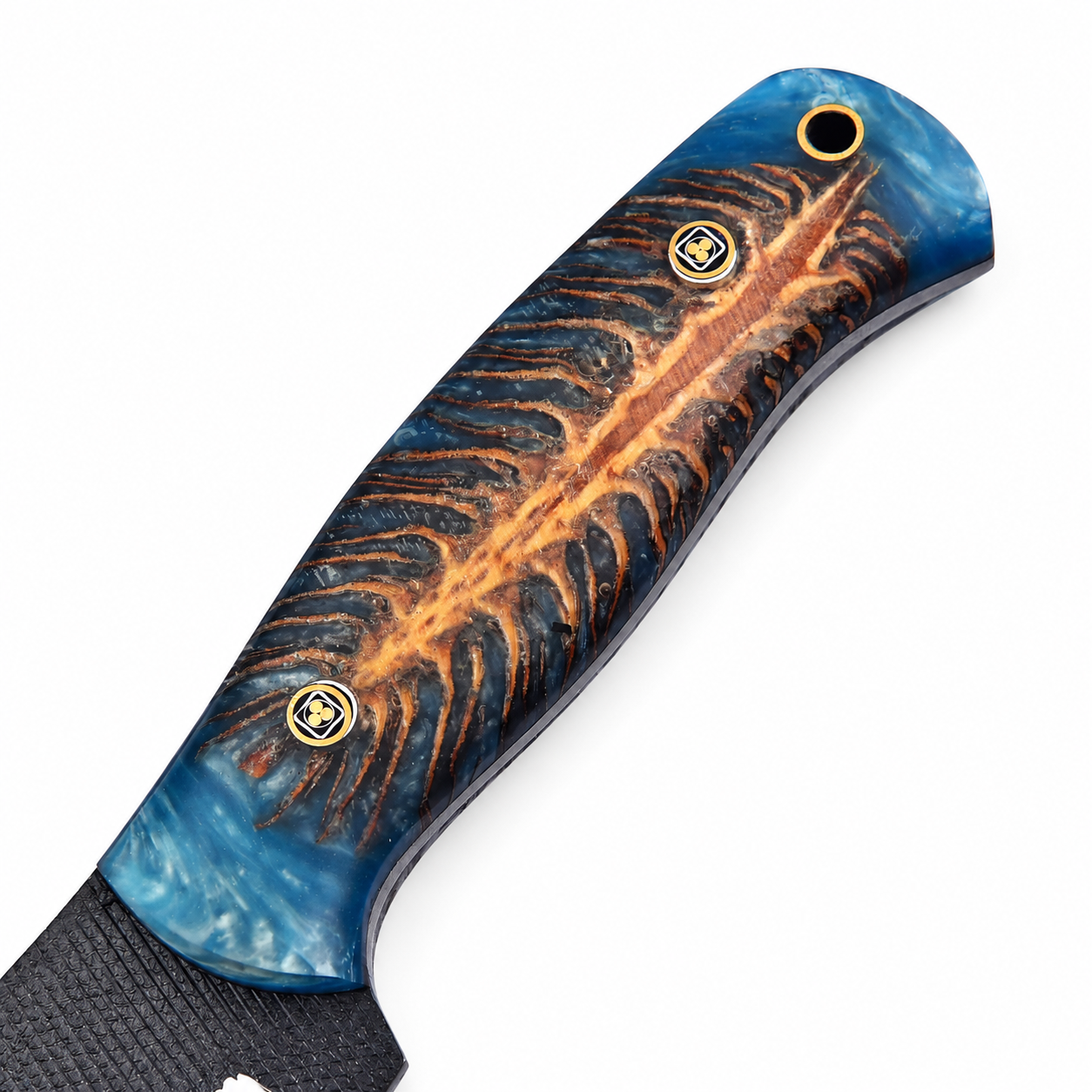
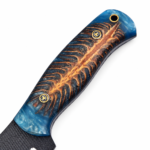
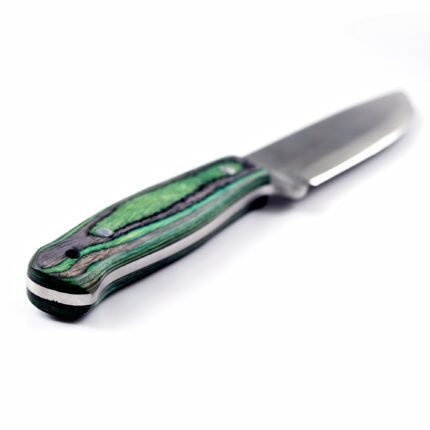
The handle features deep blue sections combined with warm brown, wood-grain-like markings. Its sculpted profile includes visible decorative fasteners and a metallic-looking lanyard opening near the end.
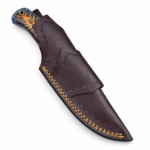
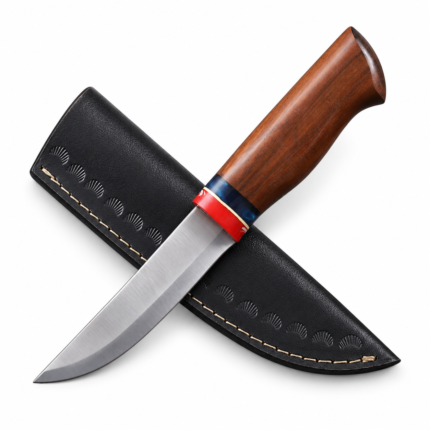
A matching dark brown sheath with orange stitching and embossed decorative details is shown alongside the knife.
This combination of materials and colors makes the design appealing to outdoor knife enthusiasts, collectors, and customers interested in specialty cutlery.
Distinctive Two-Tone Blade Design
One of the most noticeable characteristics of this knife is its contrasting blade finish.
The upper portion of the blade has a dark gray-to-black textured appearance. Fine, closely spaced markings run across part of the blade surface, creating a distinctive visual effect.
The lower section features a bright, silver-colored cutting edge that extends toward the pointed tip.
This combination produces a clear contrast between the darker blade body and the lighter edge.
The result is a visually striking blade that differs from traditional fully polished steel knives.
A darker blade finish can be attractive to customers who prefer understated outdoor equipment, while the polished edge provides visual definition.
The exact finishing technique has not been confirmed. It may involve a surface treatment, textured metal finish, or another manufacturing process.
The photograph does not establish the steel grade, whether the blade was forged, or whether the dark surface provides any specific corrosion resistance.
Compact Fixed Blade Construction
The Blue Resin Handle Fixed Blade Knife has a traditional fixed-blade configuration.
Unlike a folding knife, its blade remains in an extended position and does not use a visible folding mechanism.
The blade has a gently curved cutting edge and a pointed tip.
Its overall silhouette resembles the style commonly found in outdoor utility knives and specialty hunting knives.
The shape provides a recognizable appearance without unnecessary decorative projections along the blade.
Its fixed-blade arrangement is a central design characteristic.
However, the photograph does not reveal the knife’s internal tang construction or the full extent of the blade steel inside the handle.
For that reason, claims such as full tang, hidden tang, or reinforced construction should only be added once the supplier provides the relevant specifications.
Attractive Blue and Brown Patterned Handle
The handle is the most visually distinctive feature of this knife.
It combines rich blue coloring with darker lines and warm brown patterns that resemble natural wood grain.
The colors create a layered appearance, with the blue tones concentrated around the upper and lower portions of the handle.
The brown lines flow through the middle, creating a striking contrast.
The handle is shaped with gentle finger contours and a slightly widened rear section.
This sculpted profile gives it a more detailed appearance than a simple straight handle.
Small circular fittings are visible along the handle, while a brass-colored ring surrounds the lanyard opening near its end.
These details contribute to the overall decorative character.
Although the handle resembles a colored resin-and-wood composite, its exact material cannot be identified from the image alone.
It should not be advertised as stabilized wood, epoxy resin, Micarta, or another specific material until confirmed.
Sculpted Grip Profile
The knife’s handle features a gently curved shape with a slightly flared end.
This profile is commonly seen in outdoor knife designs where the user needs a clearly defined gripping area.
The visible contours create a sculpted form and provide separation between the center of the handle and its ends.
The handle also appears wider toward the rear, giving the knife a distinctive silhouette.
Its smooth-looking surface contrasts with the textured metal blade.
The appearance suggests attention to handle shaping, although comfort, grip security, and slip resistance cannot be determined from a product photograph.
These characteristics depend on the handle’s actual dimensions, surface finish, and material.
Customers should review verified measurements before choosing the knife for a particular grip preference.
Decorative Handle Fasteners
The handle features two visible decorative circular fittings along its side.
These fittings have a metallic gold-and-silver appearance and include patterned central details.
Their placement adds visual character without overwhelming the handle’s blue-and-brown design.
A larger metal-colored ring is also visible near the rear end of the handle.
This creates a finished appearance around the handle opening.
The fittings contribute to the knife’s distinctive presentation.
Their precise materials, installation methods, and structural functions are not confirmed.
For accurate product specifications, the manufacturer should identify the handle fastening system and any additional decorative components.
Pointed Blade with Curved Cutting Edge
The blade features a pronounced tip and a slightly curved cutting edge.
This configuration is associated with many compact and medium-sized fixed-blade utility knives.
The curved profile gives the blade a clean, flowing shape.
The transition from the wider blade section to the pointed end is gradual, producing a balanced-looking silhouette.
A brighter metal surface runs along the visible cutting edge.
This contrast helps distinguish the cutting section from the darker blade body.
The knife may be considered by buyers comparing general-purpose outdoor knife designs.
Actual suitability for particular cutting tasks depends on steel composition, blade thickness, edge geometry, heat treatment, and the manufacturer’s intended-use guidance.
These specifications have not yet been verified.
Dark Textured Blade Surface
The blade’s darker area features a dense, fine-textured pattern.
The markings create visual depth across the upper surface, while the lower cutting edge remains brighter and smoother.
This contrast distinguishes the knife from conventional mirror-polished blades.
The textured appearance may interest customers who appreciate rustic or forged-style finishes.
It also complements the handle’s darker blue sections.
However, a textured blade finish does not necessarily indicate a particular manufacturing method.
It cannot confirm whether the surface was forged, etched, coated, or treated using another process.
For this reason, the product is described by its visible appearance rather than by an unverified manufacturing technique.
Brown Sheath with Contrasting Stitching
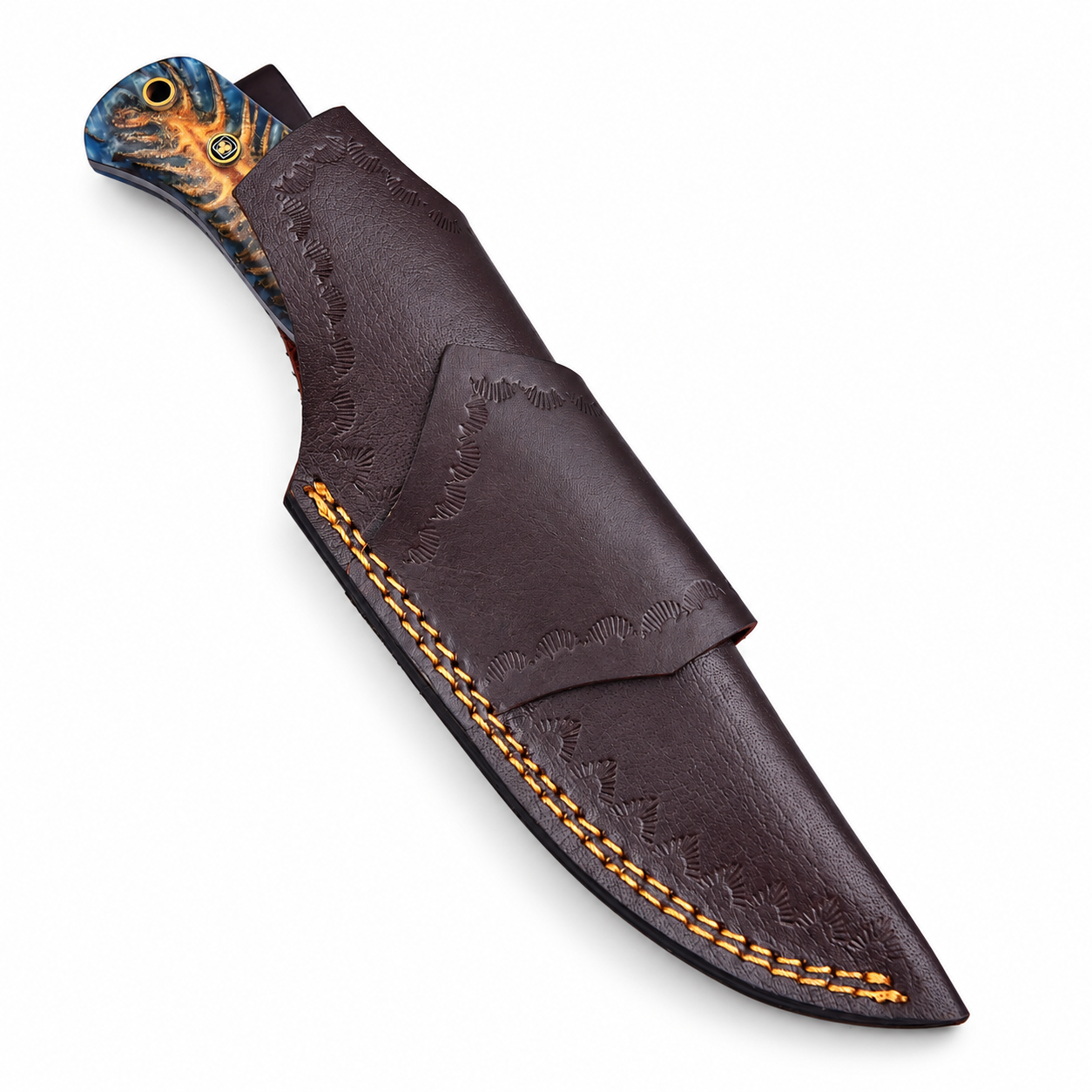
The uploaded image also shows a dark brown protective sheath.
It has an elongated shape corresponding to the knife’s general blade profile.
Orange-colored stitching runs along its curved edge.
Decorative embossed patterns are visible on the exterior surface.
A broad flap overlaps part of the sheath, creating a layered design.
The sheath has a traditional appearance that contrasts attractively with the knife’s modern blue handle.
It also features a darker brown finish around the edges.
This accessory completes the product’s visual presentation.
The sheath resembles leather, but genuine leather construction has not been confirmed.
Its specific closure arrangement, belt attachment configuration, and retention performance should also be verified.
Suitable for Specialty Knife Collections
The Blue Resin Handle Fixed Blade Knife may be especially interesting to collectors who appreciate unusual handle colors and contrasting blade finishes.
Its deep blue handle sections create a noticeable difference from traditional wooden handles.
The brown patterning introduces a natural-looking element.
The dark blade provides a restrained contrast, while the polished cutting edge adds brightness.
The brown sheath complements the overall design.
Collectors often compare knives according to appearance, blade profile, handle detailing, decorative features, and manufacturing specifications.
This model provides several distinctive visual characteristics.
For collectors interested in specific steel compositions or manufacturing processes, supplier documentation remains important.
Outdoor Equipment Styling
The knife has the appearance of a traditional outdoor cutting tool with several modern decorative details.
Its fixed-blade design, pointed blade, contoured handle, and accompanying sheath are features commonly seen in outdoor cutlery.
Such knives are often displayed in hunting, camping, and general outdoor equipment categories.
The knife’s visual styling may appeal to buyers interested in these activities.
However, appearance alone does not establish its performance in the field.
Before purchasing a knife for specialized outdoor use, customers should confirm the blade dimensions, steel grade, edge geometry, handle construction, and recommended applications.
A knife should only be used within the limitations specified by its manufacturer.
Visual Balance Between Blade and Handle
The contrast between the dark blade and colorful handle is one of the defining characteristics of this design.
The blade has a subdued black-and-gray appearance.
The bright cutting edge introduces a second metallic tone.
The handle adds vibrant blue coloring, dark layered markings, and warm brown accents.
Together, these elements create a visually coordinated design.
The handle’s curved profile also complements the gradual shape of the blade.
This combination gives the knife a distinctive presentation for product photography, collector displays, and specialty retail catalogs.
A Distinctive Gift Option for Collectors
Specialty knives are sometimes selected as gifts for collectors and outdoor equipment enthusiasts.
This model’s unusual handle coloring and textured blade finish may make it appealing to recipients who appreciate decorative cutlery.
The contrasting sheath also adds to its presentation.
Its appearance differs from conventional plain black or natural wood-handled knives.
Customers considering the knife as a gift should confirm the product’s actual specifications, packaging, and applicable local rules before purchasing.
Knife sales, possession, and transportation may be subject to age restrictions and local regulations.
Any gift presentation or customization service should be confirmed with the seller.
Knife Storage and Safety
Fixed-blade knives should be stored securely whenever they are not being used.
The cutting edge remains exposed when the blade is outside its sheath.
For this reason, the knife should only be placed inside a properly fitted protective sheath.
Make sure the sheath fully covers the blade and retains it securely.
Keep the knife away from children and unauthorized users.
Avoid leaving the knife uncovered on work surfaces or inside bags.
Do not handle the sharpened edge directly.
Store the knife in a dry, secure area away from moisture and unnecessary contact with other metal objects.
If the sheath becomes damaged or no longer fits properly, replace or repair it before use.
General Blade Care
Appropriate blade maintenance depends on the actual steel grade and surface finish.
Clean the blade according to the manufacturer’s instructions after use.
Dry the metal thoroughly before storage.
Avoid prolonged exposure to water or humid environments.
If the steel requires protective treatment, use a suitable product recommended for that specific material.
Do not apply aggressive chemical cleaners or abrasive compounds to the dark surface without confirming that they are compatible.
These products could alter the visible finish.
Any sharpening should follow the manufacturer’s recommended procedure and account for the blade’s actual edge geometry.
Handle Maintenance
The colorful handle is an important part of the product’s appearance.
Its maintenance requirements depend on the actual material.
For routine cleaning, a soft cloth is generally preferable to abrasive cleaning tools.
Avoid exposing the handle to excessive heat, strong solvents, or prolonged moisture unless the manufacturer confirms that its material can tolerate those conditions.
If the handle contains stabilized wood or another composite material, different care procedures may apply.
Because its composition is not verified, no specific oil, wax, or conditioning treatment should be recommended as mandatory.
Proper maintenance helps preserve the visual appearance of decorative handles.
Sheath Care
The dark brown sheath should be kept clean and dry.
Avoid storing a wet blade inside the sheath.
Moisture trapped around a blade can contribute to corrosion, depending on the steel.
If the sheath is genuine leather, it may require appropriate leather-care products.
If it is synthetic, different cleaning products may be preferable.
The manufacturer should confirm the sheath material before conditioning products are applied.
Check the visible stitching and attachment areas regularly.
Any damage affecting the sheath’s protective function should be addressed before further use.
Product Specifications
Product Type: Fixed-blade outdoor-style knife
Blade Shape: Pointed blade with curved cutting edge
Blade Appearance: Black textured surface with silver cutting edge
Handle Appearance: Blue-and-brown layered wood-grain-like pattern
Handle Shape: Contoured with slightly flared rear
Handle Details: Decorative circular fittings and metal-colored lanyard opening
Sheath Appearance: Dark brown with orange stitching and embossed detailing
Blade Steel Grade: Not verified
Handle Material: Not verified
Sheath Material: Not verified
Blade Length: To be confirmed
Overall Length: To be confirmed
Blade Thickness: To be confirmed
Tang Construction: To be confirmed
Blade Hardness: To be confirmed
Manufacturing Method: To be confirmed
Country of Origin: To be confirmed
Choosing a Fixed Blade Knife
When comparing fixed-blade knives, customers should consider more than their visual appearance.
Blade length, overall weight, and cutting-edge geometry influence the type of tasks a knife may be appropriate for.
Steel composition is also important because different steels have different maintenance requirements and performance characteristics.
Handle size and shape affect comfort and control.
Sheath construction influences how the knife can be stored and transported.
Customers interested in a particular outdoor application should request verified specifications and manufacturer guidance before purchasing.
This model provides a distinctive visual design, while its technical characteristics still require confirmation.
Final Thoughts
The Blue Resin Handle Fixed Blade Knife combines a dark textured blade, a silver-colored cutting edge, an eye-catching blue-and-brown handle, and a matching dark brown sheath.
Its contrasting colors and decorative construction details make it an interesting option for customers exploring specialty fixed-blade knives.
Browse this distinctive design and confirm its materials, dimensions, and intended applications before placing an order.







Reviews
There are no reviews yet.