



Copper Pattern Hunting Knife with Stag-Style Handle
The Copper Pattern Hunting Knife combines a distinctive dark patterned blade with a natural-looking stag-style handle, creating an attractive fixed-blade knife for outdoor enthusiasts, knife collectors, and buyers who appreciate traditional hunting knife designs.
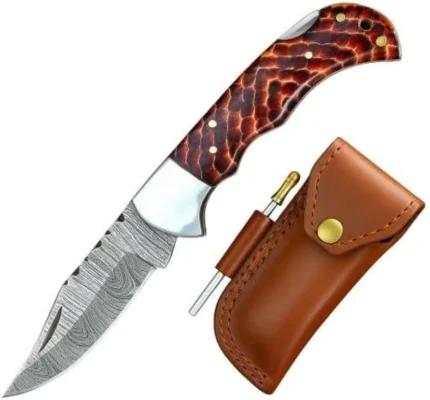
Its most recognizable feature is the combination of dark gray blade patterns and flowing copper-colored lines. These decorative details form irregular layers across the blade surface, creating an appearance similar to copper-accented Damascus steel.
The handle features a striking mixture of cream, brown, and black tones with an antler-like texture. A broad silver-colored bolster separates the handle from the blade, giving the knife a visually balanced appearance.
Designed in a compact hunting-knife style, this model combines traditional outdoor knife proportions with a decorative finish. Its distinctive appearance makes it an interesting addition to collections of fixed-blade knives and outdoor equipment.
Distinctive Copper-Pattern Blade Design
The blade is the centerpiece of this knife’s appearance.
It features a dark surface with irregular copper-colored lines running along its length. These flowing patterns create contrast against the darker metal and make the knife visually different from conventional polished-blade hunting knives.
The pattern resembles the layered appearance associated with Damascus-style and copper-accented steel.
However, visual similarities do not establish the blade’s actual metallurgy. Its steel grade, manufacturing process, copper composition, and number of layers must be confirmed by the supplier.
The blade has a pointed tip and a gently curved cutting-edge profile.
Its compact proportions resemble those commonly found on small hunting and outdoor utility knives.
The surface shows alternating decorative regions, with darker gray areas, copper-colored flowing lines, and lighter metallic highlights.
These details provide a distinctive appearance while maintaining a recognizable fixed-blade profile.
For customers who enjoy collecting knives with unusual surface patterns, the combination of metallic colors is an appealing design feature.
Compact Fixed-Blade Construction
The Copper Pattern Hunting Knife has a fixed-blade configuration.
Unlike a folding pocket knife, the blade is positioned in a permanent open arrangement relative to the handle.
Fixed-blade knives are widely represented in outdoor, hunting, and camping equipment collections.
Their construction eliminates the folding pivot and locking mechanism found in folding knives.
This model features a compact pointed blade and a curved handle, giving it the appearance of a traditional small hunting knife.
Its blade shape resembles a modified drop-point profile, although precise blade classification depends on the manufacturer’s geometry specifications.
The blade appears relatively broad near its junction with the handle and gradually narrows toward its point.
A gently curved cutting edge follows the lower section of the blade.
The precise blade thickness, cutting-edge length, total length, and weight cannot be determined from the photograph.
These specifications should be supplied before the product is advertised for particular outdoor cutting tasks.
Stag-Style Handle Appearance
The handle is one of the knife’s strongest visual features.
It has an antler-inspired appearance featuring cream, dark brown, and black coloration.
Its textured surface displays irregular markings that resemble natural stag antler.
The combination of colors gives the handle a rustic character commonly associated with traditional hunting knives.
Several small gold-colored pins are visible along the handle.
A circular opening near the rear provides a visible lanyard attachment point.
The handle also has a gently curved shape with a wider rear section.
This profile creates a recognizable hunting-knife silhouette and visually complements the pointed blade.
Although the handle resembles genuine stag horn or antler, the material cannot be verified from the image.
It may be natural antler, imitation antler, bone, resin, or another decorative material.
The exact construction must be confirmed with the manufacturer before using material-specific claims.
For website product descriptions, the term “stag-style handle” accurately communicates the visible appearance without making an unsupported material claim.
Silver-Colored Bolster Detail
A substantial silver-colored bolster is visible between the blade and handle.
Its smooth metallic appearance contrasts with the textured antler-style handle and patterned blade.
The bolster follows a curved shape that complements the knife’s overall design.
It creates a visually defined transition between the handle and blade.
This design element is common in traditional fixed-blade hunting knives.
Its presence adds another decorative contrast to the product, bringing together three visually different surfaces: the patterned blade, the smooth metallic bolster, and the textured handle.
The bolster’s exact material is not confirmed.
It should not automatically be described as stainless steel, nickel silver, or another particular alloy.
The manufacturer’s specifications should establish its material and attachment method.
Traditional Hunting Knife Styling
The Copper Pattern Hunting Knife has a recognizable traditional outdoor knife appearance.
Its curved stag-style handle, compact blade, and polished bolster are visual elements commonly associated with hunting-knife collections.
These details create a classic aesthetic.
At the same time, the copper-colored blade pattern adds a contemporary decorative element.
This combination makes the knife suitable for buyers interested in traditional outdoor equipment with distinctive visual styling.
The dark blade surface provides contrast against the lighter handle.
The metallic bolster separates the two components without adding unnecessary decoration.
Its overall shape is relatively simple, allowing the handle texture and blade pattern to remain the main visual features.
A Knife for Outdoor Equipment Collections
Small fixed-blade knives are commonly included in outdoor equipment collections.
Depending on verified product specifications, designs of this type may be considered for ordinary campsite preparation, lightweight outdoor utility tasks, and other appropriate cutting activities.
The pointed blade shape is visually consistent with general outdoor cutting knives.
However, the actual suitability of this particular model depends on blade construction, edge geometry, material composition, and manufacturer guidance.
The image does not establish whether the knife is intended for demanding fieldwork, heavy cutting, or specialized hunting applications.
For that reason, no unverified claims are made about its toughness, cutting performance, or suitability for processing game.
Customers should choose knives according to their intended applications and the manufacturer’s stated capabilities.
Decorative Damascus-Style Patterns
Patterned blades have long attracted attention from knife enthusiasts because of their distinctive appearance.
Some Damascus-pattern blades are produced using layered steels, while others use different manufacturing or finishing techniques.
Copper-accented designs may involve additional materials or decorative treatments.
The uploaded knife features dark patterns with flowing copper-colored lines.
These markings form an irregular, layered appearance across the blade.
The visual effect is particularly noticeable along the central portion of the knife.
The patterns also create contrast near the cutting edge and toward the blade’s base.
Because the manufacturing process has not been verified, the product is described by its visible copper-pattern appearance rather than being presented as certified copper Damascus steel.
If supplier documentation confirms the blade composition, the description can be updated with the relevant steel types and manufacturing details.
Handle Shape and Visual Comfort
The handle has a contoured, curved profile.
Its rear section rises slightly, creating a traditional hunting-knife appearance.
The natural-looking texture and color variation give it a rustic finish.
Its shape resembles the ergonomic contours found on various outdoor knives.
Nevertheless, comfort, grip security, and balance cannot be established from product photography alone.
These characteristics depend on the knife’s dimensions, weight, surface finish, and the individual user’s hand size.
The silver-colored bolster provides a visual transition near the front of the handle.
The rear lanyard opening is another recognizable feature.
Together, these details give the handle an established outdoor-knife style.
Suitable for Knife Collectors
Collectors often look for knives with distinctive combinations of blade pattern, handle finish, and overall shape.
This model brings several recognizable design elements together.
Its copper-colored blade detailing creates an unusual visual effect.
The stag-style handle introduces natural-looking colors and texture.
The smooth silver-colored bolster adds contrast.
For collectors interested in fixed-blade knife designs, these features make the product visually distinctive.
It may also appeal to buyers who enjoy displaying knives with rustic or traditional styling.
However, no claim is made that this knife is a limited edition, antique, rare collectible, or custom handmade item.
Such descriptions would require supporting documentation from the manufacturer.
A Distinctive Gift Option
The knife’s combination of decorative finishes may appeal to adult recipients who appreciate knife craftsmanship, outdoor equipment, or traditional knife collections.
Its dark patterned blade and antler-style handle provide a distinctive appearance.
These visual characteristics can make it an interesting product for a knife enthusiast.
However, the uploaded photograph does not show gift packaging, a presentation box, or a protective sheath.
These accessories should not be advertised as included without supplier confirmation.
Before purchasing it as a gift, review the manufacturer’s product specifications and the recipient’s local laws.
Responsible storage and handling are important for all fixed-blade knives.
Understanding Blade Materials
Knife steel can vary significantly between manufacturers.
Different alloys have different characteristics related to corrosion resistance, edge retention, sharpening, and maintenance.
The photographed blade resembles a decorative patterned steel knife.
However, its precise alloy is unknown.
The visible pattern does not establish whether the blade is made from 1095, 15N20, D2, VG10, or any other specific steel.
Similarly, the image cannot verify blade hardness or heat-treatment quality.
Customers interested in technical performance should review manufacturer-provided specifications.
These details are especially important when comparing hunting-style knives for regular outdoor use.
Before publishing technical claims, obtain written confirmation of the blade’s steel grade, hardness, thickness, and finishing method.
Understanding the Handle Material
The handle has a distinctive antler-like texture.
Its cream-and-brown appearance resembles natural stag horn.
Natural antler, bone, and decorative synthetic materials can sometimes look similar in product photographs.
Therefore, the exact material remains unconfirmed.
If genuine antler is used, the seller should confirm its origin and any applicable material documentation.
If a synthetic alternative is used, the product should be accurately described as an imitation stag or antler-style handle.
This distinction helps customers understand what they are purchasing.
The visible gold-colored pins and rear lanyard opening can be described without assuming the handle’s internal construction.
General Knife Care
Proper maintenance helps preserve the appearance of decorative knives.
The exact care requirements depend on the blade steel, surface treatment, and handle material.
As a general precaution, clean the knife carefully after appropriate use.
Use a soft cloth and mild cleaning products compatible with the manufacturer’s recommendations.
Avoid prolonged exposure to moisture.
Dry the blade and handle thoroughly before storage.
Do not leave the knife submerged in water.
Harsh abrasive cleaners may damage decorative finishes and should be avoided unless specifically approved by the manufacturer.
If the knife contains carbon steel, additional corrosion-prevention measures may be required.
The correct protective treatment should be selected according to the manufacturer’s guidance.
Protecting the Decorative Blade Finish
The dark blade and copper-colored detailing are important parts of this knife’s appearance.
Avoid unnecessary contact with rough or abrasive surfaces.
Do not use harsh polishing compounds unless they are recommended for the blade’s exact construction.
Abrasive cleaning can potentially change the appearance of specialty finishes.
After cleaning, inspect the knife for moisture or residue.
Store it in a dry environment.
If the manufacturer supplies a protective sheath, use it according to the included instructions.
A sheath should fit securely without exposing the cutting edge.
Do not assume the knife includes a sheath based on other similar products.
Safe Storage and Handling
Fixed-blade knives require appropriate storage because their blades do not fold into the handle.
Keep the knife protected when it is not in use.
Use a suitable sheath, blade cover, or secure storage arrangement.
Keep it away from children and unauthorized users.
When handling the knife, avoid direct contact with the cutting edge.
Use only for appropriate tasks supported by the manufacturer’s specifications.
Never use a knife as a pry bar, screwdriver, or other substitute tool.
Inspect the blade and handle connection periodically.
Stop using the product if any cracks, looseness, or damage are detected.
Follow applicable regulations concerning knife ownership, transportation, and use.
Product Specifications Requiring Confirmation
A complete technical product listing should include manufacturer-verified dimensions and materials.
For this model, the most important outstanding details are blade length, overall length, blade thickness, product weight, and exact steel grade.
The supplier should also confirm whether the blade is genuine copper Damascus steel or simply features a copper-pattern finish.
The handle material should be identified as genuine antler, synthetic imitation, or another confirmed material.
Tang construction and bolster material should also be documented.
Additional details may include sharpening recommendations, packaging, protective accessories, and warranty terms.
Providing this information helps customers compare the knife accurately with other hunting-style models.
Why Choose This Knife Design?
The Copper Pattern Hunting Knife stands out through its combination of traditional styling and unusual blade decoration.
The dark blade features flowing copper-colored patterns.
Its antler-style handle displays cream, brown, and black tones.
The polished bolster introduces a contrasting metallic finish.
Gold-colored handle pins and a rear lanyard hole complete the visible design.
These elements create a recognizable fixed-blade knife with a rustic outdoor appearance.
For collectors and outdoor enthusiasts interested in distinctive knife designs, this model offers an attractive combination of patterned metal and natural-looking handle styling.
Explore the Copper Pattern Hunting Knife and review its confirmed specifications to decide whether this compact, stag-style design is the right addition to your collection.






Reviews
There are no reviews yet.