


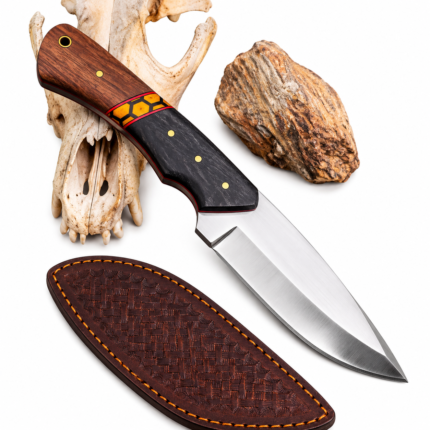
A Cream Handle Fixed Blade Knife with Contrasting Details
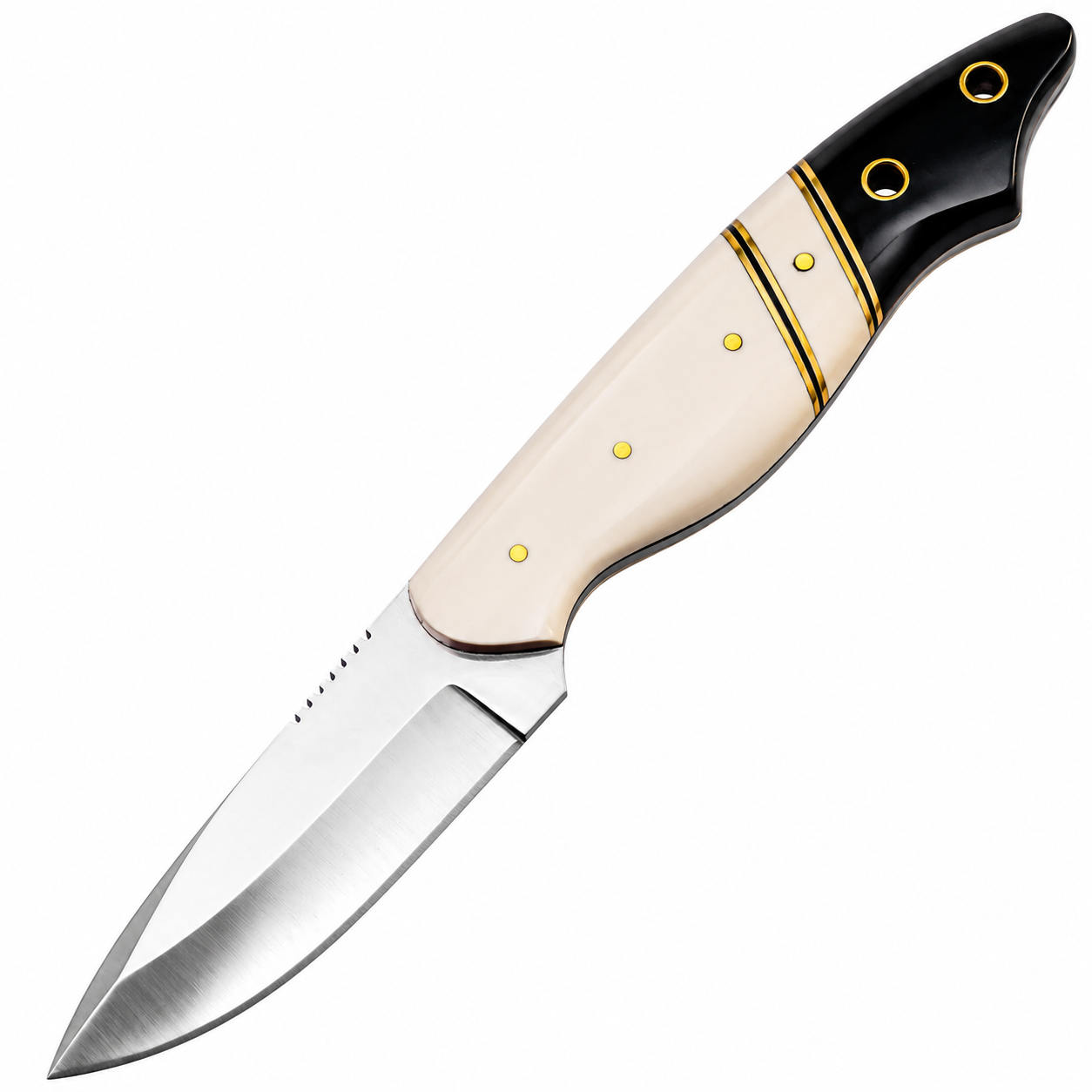
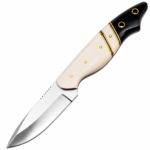
This cream handle fixed blade knife combines a clean silver-tone blade with a distinctive cream, black, and gold-tone grip. The pale front handle section creates a strong contrast with the glossy black rear, while narrow decorative bands provide a precise transition between the two colors.
The blade has a continuous plain edge, a curved belly, and a pointed tip. Its broad lower bevel catches the light differently from the upper face, making the blade’s shape easy to distinguish. A short row of notches appears along the spine near the handle, adding another visible detail to an otherwise uncluttered blade.
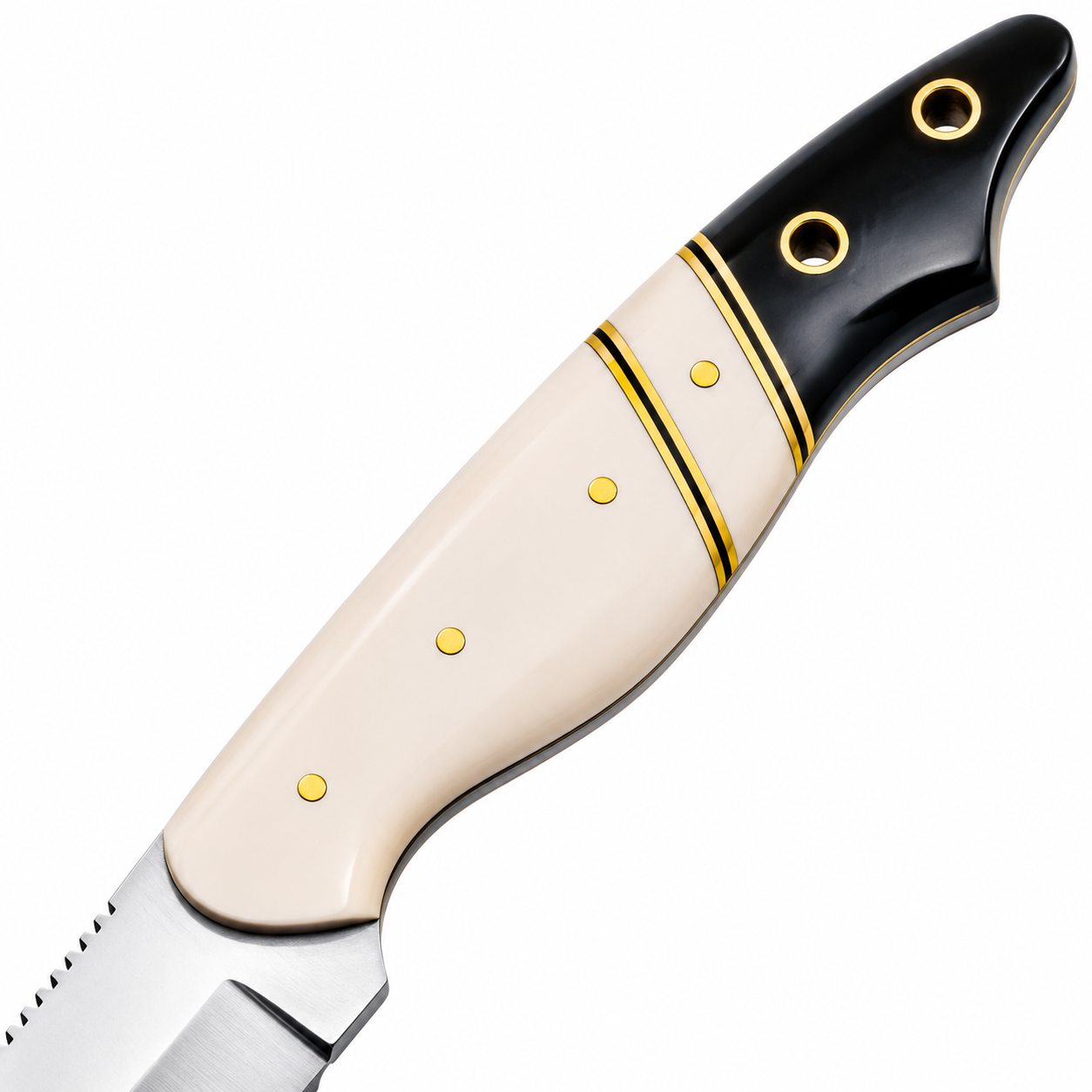
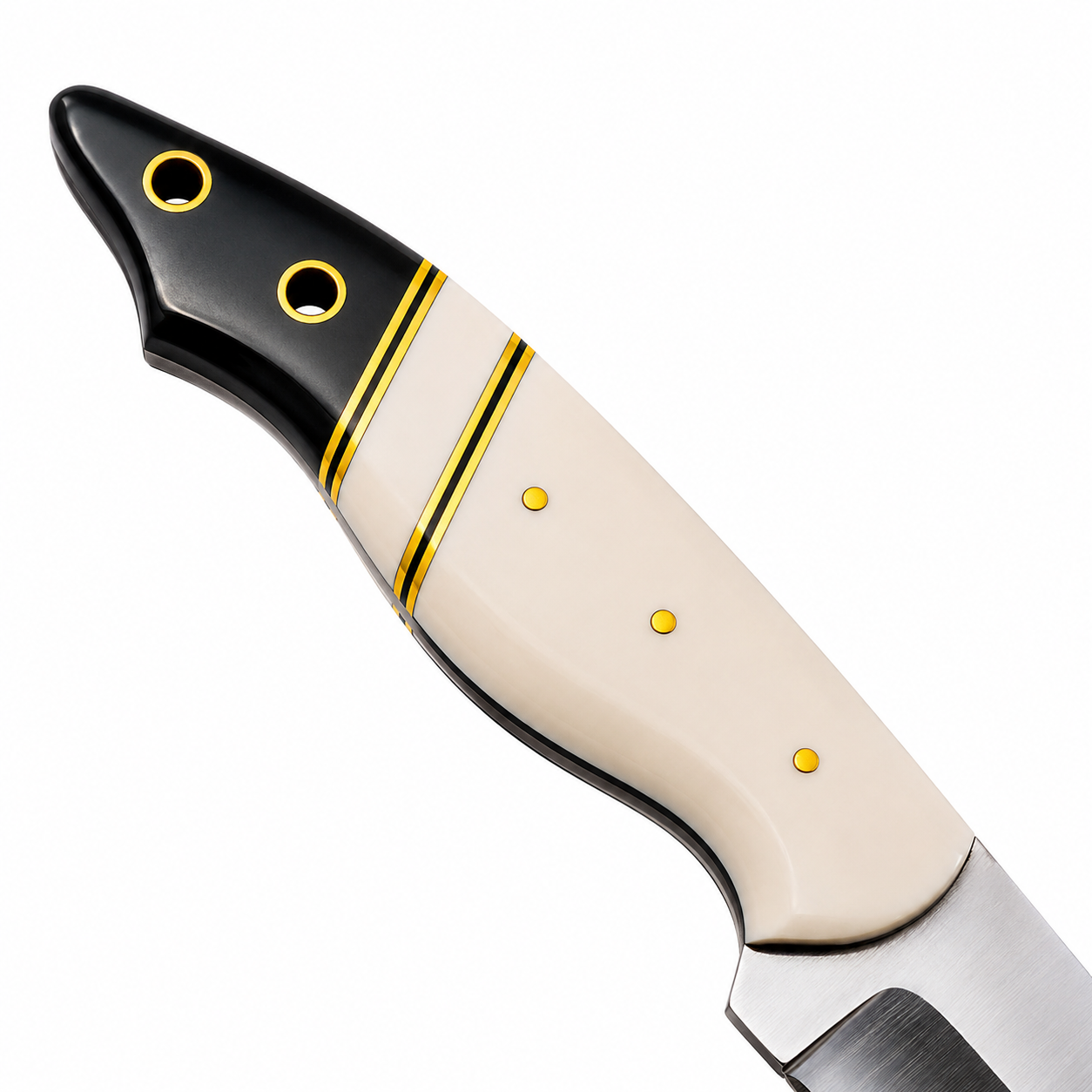
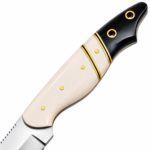
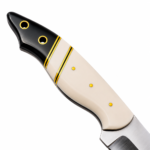
The handle carries most of the decorative interest. Four small gold-tone pins sit within the cream-colored sections, and two larger lined openings appear in the black rear section. These repeated circular details connect visually with the narrow gold-tone bands.
For buyers who prefer contrasting handle colors and a plain blade, this design offers a clear combination of both. It has the appearance of a general outdoor-style fixed blade, although its suitability for particular tasks depends on specifications that still require confirmation.
A Plain Blade with a Curved Belly
The blade is broader near the handle and gradually narrows toward its point. Its cutting edge follows a smooth curve, with a pronounced belly in the forward section.
This shape gives the knife a different profile from a straight-edged utility blade or a long, narrow fillet knife. The curved section creates a changing contact point during a slicing movement, which is a general characteristic buyers often consider when comparing knife shapes.
The edge is visibly non-serrated. There are no teeth interrupting the lower cutting line, and no gut hook appears in the upper blade outline. Customers looking for a straightforward plain-edge design can identify those features directly from the photograph.
The image does not show cutting performance. Sharpness, edge retention, resistance to chipping, and ease of sharpening depend on the blade’s actual material and geometry. Those properties should be supported by specifications rather than inferred from the shape.
What the photograph does establish is a continuous edge with a curved front section and a narrow point. These are useful starting points when comparing the knife with other fixed-blade designs.
Defined Bevel and Silver-Tone Finish
A broad bevel extends along the lower part of the blade. Its fine directional surface marks give it a brushed appearance, while the upper blade face appears brighter and more reflective.
The transition between these surfaces creates a strong visual line. Near the handle, the bevel ends in a clearly defined shoulder, leaving an unsharpened-looking section at the blade’s base.
A narrow angled surface is also visible near the upper front of the blade. The photograph does not establish whether this is sharpened, so the knife is not described as double-edged.
The plain silver-gray finish keeps the blade visually restrained. No Damascus-style pattern, large printed logo, colored coating, or decorative engraving is visible on the photographed side.
Silver color alone does not establish stainless steel. The alloy, heat treatment, and any protective surface treatment remain unverified. Describing the finish separately from the material allows customers to understand what is visible without being given an unsupported technical claim.
Short Spine Notches Near the Handle
A short row of small notches runs along the spine close to the handle. Their position distinguishes this area from the smooth upper blade farther forward.
These notches are commonly described as spine jimping. Here, the term identifies their visible form and location; it does not establish a tested grip benefit or a particular intended hand position.
For buyers examining the knife closely, this detail is worth noting because some fixed blades have a completely smooth spine. Others use longer or more pronounced notched sections. This knife shows a relatively short group near the blade-to-handle junction.
The photograph does not provide the depth, spacing, or surface feel of the notches. Those details would affect how they feel during handling.
Visually, the notched section adds texture without covering a large part of the blade. It gives the front of the handle a clear neighboring detail while preserving the clean appearance of the main blade face.
A Cream-Colored Grip with Subtle Tonal Variation
The largest handle section is a warm cream color. It has gentle tonal variation rather than a strongly patterned surface, giving it a quieter appearance than a striped or brightly marbled grip.
This pale section extends from the blade junction through most of the handle. Its smooth-looking face provides a clear background for the small gold-tone pins.
The color is best described as cream rather than pure white. In the image, slightly warmer areas appear around portions of the grip, particularly near the decorative bands and edges.
The material itself is not confirmed. A cream-colored handle should not automatically be described as bone, ivory, resin, or another substance. Likewise, the photograph cannot establish whether any variation is natural, manufactured, or influenced by lighting.
For customers choosing by appearance, the relevant features are its light tone, restrained surface detail, and contrast with the black rear section. These are the qualities that give the knife its recognizable color scheme.
Glossy Black Rear Section
The rear of the handle changes to a deep black finish. Reflections along its surface and edges give it a glossy appearance in the photograph.
This darker section follows the handle’s shaped outline and ends in a rounded, slightly extended tip. Its lower edge curves inward before meeting the rear end, creating a more sculpted profile than a simple rectangular grip.
The black area balances the long cream section. It creates a distinct visual endpoint and gives the gold-tone rings around the two openings a strong contrasting background.
Its composition remains unknown. The appearance does not prove horn, ebony, resin, or another material, and it should not be marketed under one of those names without confirmation.
The rear section is especially relevant for buyers who prefer a mixed-color handle. Instead of an accent limited to a narrow stripe, this knife uses a substantial dark area at the end of the grip.
Gold-Tone Bands That Define the Handle Sections
Two decorative band groups cross the handle near the transition between cream and black. Each combines narrow gold-tone lines with a dark line between them.
These groups frame a shorter cream-colored section, making the handle’s arrangement more detailed than a single division between two colors. The spacing creates a small intermediate panel before the grip reaches the black rear.
The bands provide visual structure. They divide the handle into recognizable sections and connect the warm metallic accents to the pins and lined openings elsewhere on the knife.
Their gold-tone appearance does not confirm brass or gold content. They are described by visible color and placement rather than assumed composition.
For someone looking at several similar fixed blades, this arrangement is an important identifying feature. The paired bands, small cream panel, and black rear section should all be considered when checking whether another listing shows the same product.
Four Pins and Two Lined Handle Openings
Four small circular gold-tone pins are visible on the photographed side. Three sit along the larger cream grip section, while the fourth appears in the shorter cream panel between the decorative band groups.
Their simple shape keeps the front handle relatively uncluttered. The pins add repeated points of color without introducing a large emblem or complex decorative insert.
Two larger circular openings are visible in the black rear section. Both have gold-tone linings, making them stand out clearly against the darker surface.
The rear-most opening resembles a lanyard attachment point, but the intended function of both openings has not been confirmed. They are therefore described as lined handle openings rather than promised as a particular attachment system.
No cord, strap, or fitting is pictured. If you intend to attach an accessory, confirm the opening diameter and the manufacturer’s intended use first.
Contoured Handle with a Defined Front Recess
The handle is shaped along its lower edge, with a pronounced inward curve near the blade. This creates a clear front recess before the grip widens into its main cream-colored section.
Farther back, the outline changes again as it approaches the black section. The resulting shape has several distinct curves rather than straight, parallel sides.
This contour is useful to consider when comparing grip preferences. Some buyers favor a straight handle that allows different hand positions. Others prefer a shaped grip with a more obvious front reference point.
The photograph does not prove comfort, balance, or resistance to slipping. Those qualities depend on handle thickness, edge rounding, surface feel, weight distribution, and the user’s hand size.
A metallic-looking strip is visible around parts of the handle perimeter. Although it provides a construction clue, the full internal structure is not established by this single view. A full-tang claim should be confirmed separately.
A Coordinated Cream, Black, and Gold-Tone Palette
The handle uses a limited set of colors, but each has a clear role. Cream forms the main grip, black defines the rear section, and gold-tone details connect the separate areas.
The silver blade adds a cooler finish without introducing another strong color. This keeps the overall appearance organized even though the handle contains several decorative elements.
Compared with a fully patterned handle, this design places more emphasis on color blocks and fine borders. Compared with an all-black handle, it offers a much stronger contrast between the front and rear.
That may appeal to buyers who enjoy decorative cutlery but prefer clear shapes to busy surface patterns. The handle can be recognized by its arrangement as much as by its individual materials.
Lighting and screen settings may affect how warm the cream appears and how bright the metallic details look. The photograph is a useful guide to the palette, but it is not a precise color standard.
Understanding the Fixed-Blade Format
The knife is shown with the blade permanently extended from the handle. No folding pivot, opening mechanism, or folding joint is visible.
This format differs from a pocket knife that closes into its grip. A fixed blade needs storage that accommodates the full exposed blade, so overall dimensions and a suitable protective cover are practical considerations.
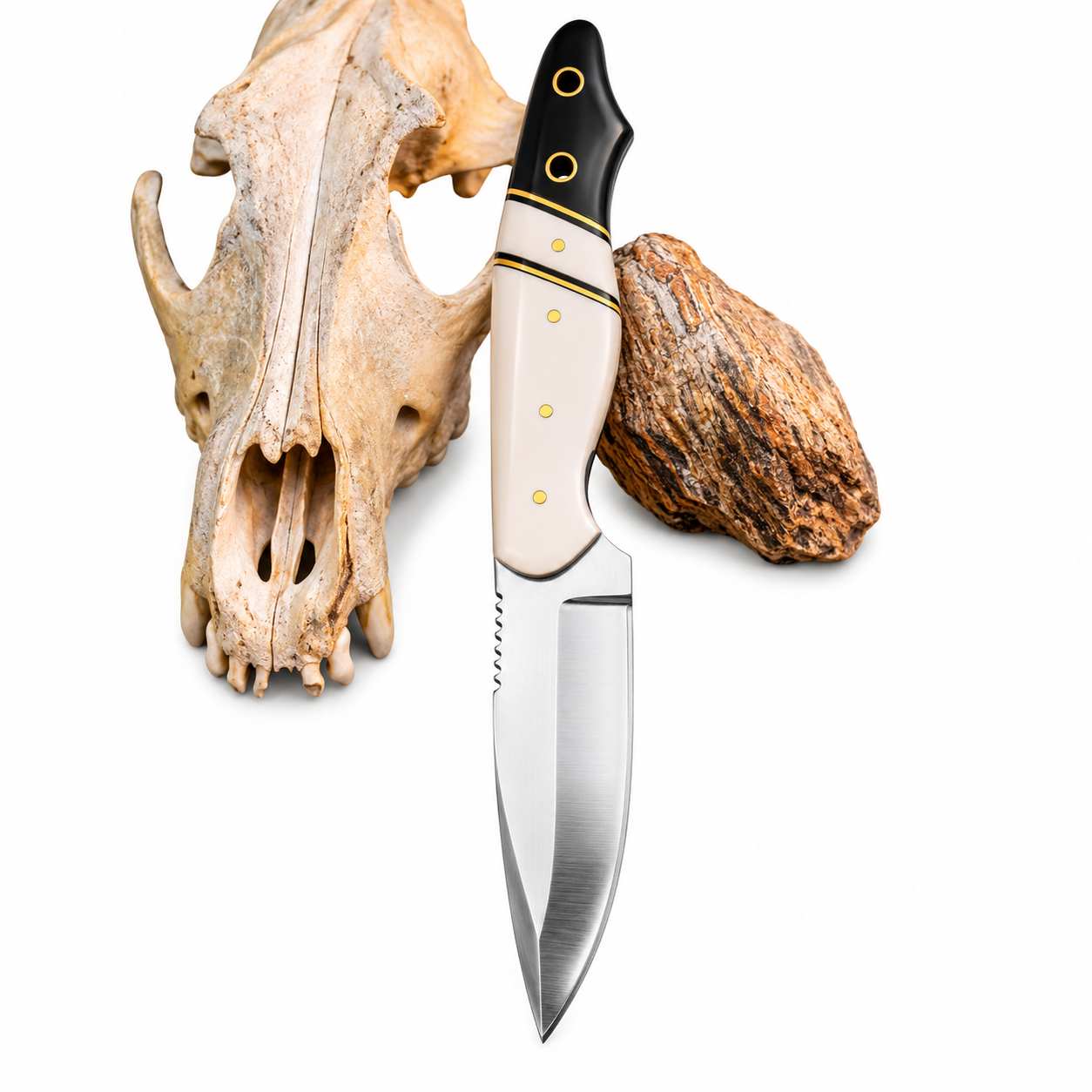
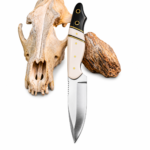
No sheath is shown in the uploaded image. This listing therefore does not promise a leather sheath, belt attachment, pouch, or presentation box.
If a sheath is offered separately, it should be matched to the knife’s blade width, thickness, length, and handle junction. A cover that accommodates the overall length may still be unsuitable if its shape or retention does not match.
For buyers building an outdoor kit, the knife and its storage arrangement should be assessed together. The current image provides a clear view of the knife itself, but package contents need separate confirmation.
Choosing the Right Size and Handling Profile
The photograph has no ruler or familiar scale reference, so exact dimensions cannot be estimated reliably. Blade length, handle length, thickness, and weight remain unknown.
Start by comparing the knife’s measurements with a fixed blade you already know. This gives a more useful sense of scale than a close-up photograph, which can make small and large products look similar.
Cutting length and overall length serve different purposes. Cutting length helps you assess the blade, while overall length helps you plan storage and compare the complete knife.
Handle length and thickness are equally important. The front recess and shaped rear may look suitable, but their fit depends on your hand and preferred grip.
Weight and balance also need confirmation. The knife should not be described as lightweight, heavy-duty, or perfectly balanced without evidence. A clear specification sheet will help determine whether the design suits your intended use.
Intended Use and Buyer Suitability
The broad plain blade and shaped handle place this product visually within the general outdoor-style fixed-blade category. It may interest shoppers comparing utility knives, outdoor cutlery, or decorative fixed blades.
Specific applications should follow the actual specifications. Blade alloy, hardness, edge geometry, and construction determine whether a knife is suitable for a particular type of work.
The image alone does not establish professional skinning performance, bushcraft capability, heavy chopping suitability, or survival-tool durability. Those descriptions would go beyond what is verified.
For a buyer prioritizing appearance, the cream-and-black grip and repeated gold-tone details provide a clear reason to consider this design. For a buyer prioritizing regular working use, the next step is to verify the technical details.
Keeping those two considerations separate makes comparison easier. You can appreciate the visual design while still checking that the knife’s construction supports the tasks you have in mind.
Considering the Knife for a Collection or Gift
The contrasting handle gives this knife a distinctive appearance among plain-handled fixed blades. Its pale front section, black rear, paired bands, and circular fittings create several details that a collector may enjoy examining.
The blade itself remains visually restrained. This balance may appeal to someone who likes decorative handles paired with a plain silver-tone blade rather than decoration across every surface.
As a gift, the knife is most relevant when the recipient’s preferences are already known. Consider the size and style of knives they use or collect, as well as whether they prefer simple or more decorative handles.
Engraving, personalization, gift packaging, and warranty coverage have not been verified. They should not be assumed from the product’s presentation.
The photographed side carries no visible brand mark. This listing therefore does not assign a maker, model, or country of origin to the knife.
Material and Care Information
A useful care guide depends on knowing the materials. The blade alloy, cream handle composition, black handle composition, and metallic fittings have not been identified.
For that reason, material-specific cleaning, polishing, and oiling instructions are not included as product facts. Advice appropriate for one handle material may not suit another.
Water resistance, dishwasher compatibility, and corrosion resistance are also unverified. A smooth handle and a clean silver blade do not establish those properties.
Sharpening information should come from the seller or manufacturer. The photograph shows a defined bevel, but it does not reveal the recommended angle or maintenance method.
Before purchasing for frequent use, request written care instructions alongside the material specifications. This helps you understand the upkeep required and compare it fairly with other knives.
Details to Confirm Before Ordering
The most useful missing specifications are blade material, blade length, overall length, spine thickness, handle dimensions, weight, and construction type.
For this particular design, it is also worth confirming the composition of the cream and black sections, the intended function of the two rear openings, and whether the decorative arrangement appears on both sides.
A reverse-side image could clarify the pin layout and handle finish. A spine view would help show thickness and the relationship between the blade and handle scales. A photograph beside a ruler would establish scale more clearly.
Package contents should be listed individually. The supplied image shows one knife, so a sheath, lanyard, maintenance accessory, or gift box should be treated as unconfirmed.
If ordering multiple pieces, ask whether the cream tone and surface variation differ between units. That matters when the handle’s appearance is a central part of the purchase.
Explore the Contrast and Choose the Right Fit
This cream handle fixed blade knife stands out through its pale grip, glossy black rear section, gold-tone bands, and lined openings. Its plain silver-tone blade, curved edge, and short spine notches complete the visible design.
It offers a recognizable alternative to uniform black or brown handles while keeping the blade appearance straightforward. The decorative details are concentrated in the grip, allowing the blade profile and handle arrangement to remain easy to assess.
Review the photographs, confirm the specifications and package contents, and choose this design if its size, materials, and intended use match what you need.






Reviews
There are no reviews yet.