




Damascus Pattern Full Tang Knife Blank – A Distinctive Base for Custom Knife Projects
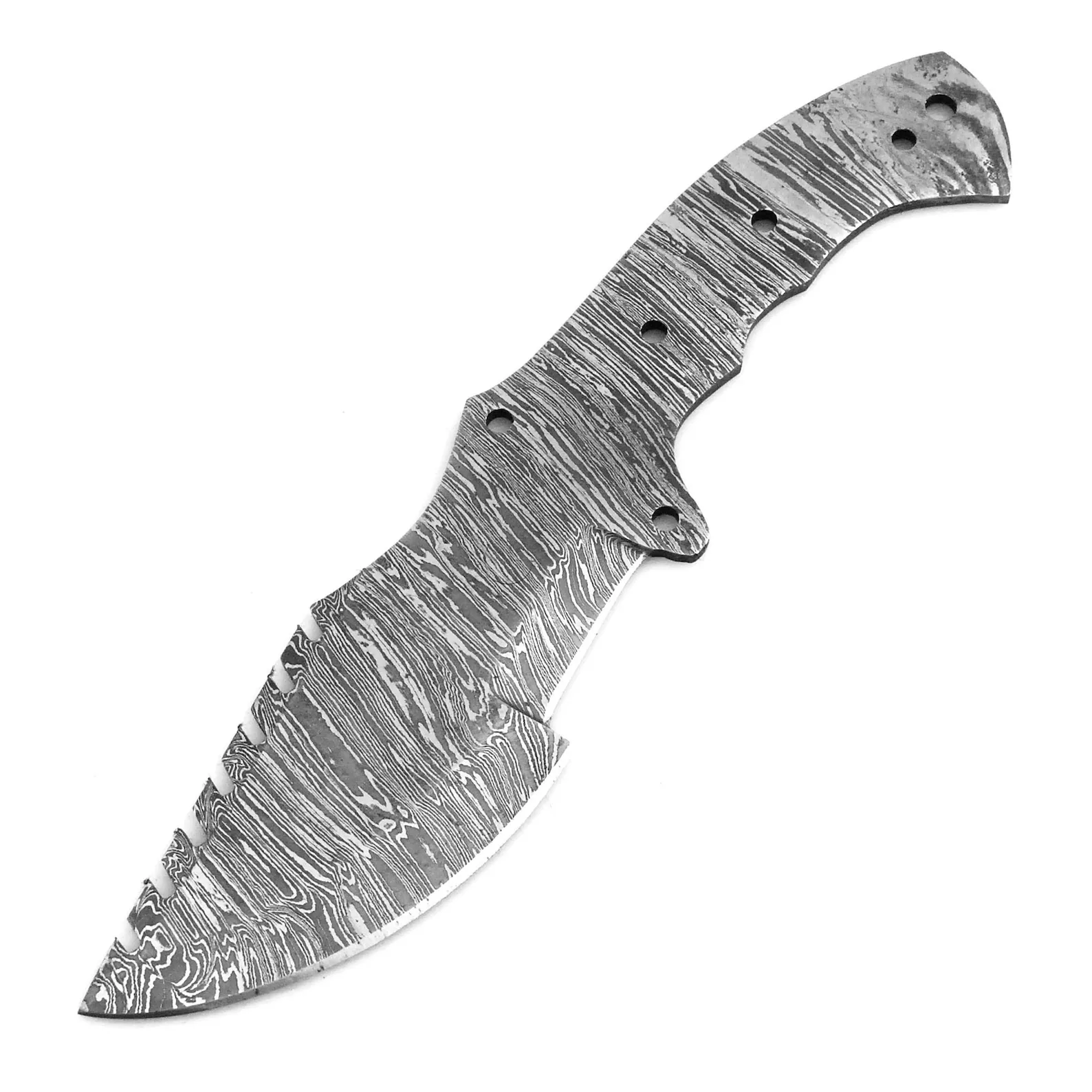
The Damascus Pattern Full Tang Knife Blank combines a broad, curved blade profile with an exposed metal handle section, making it an interesting option for custom knife projects and collectors interested in unfinished knife designs.
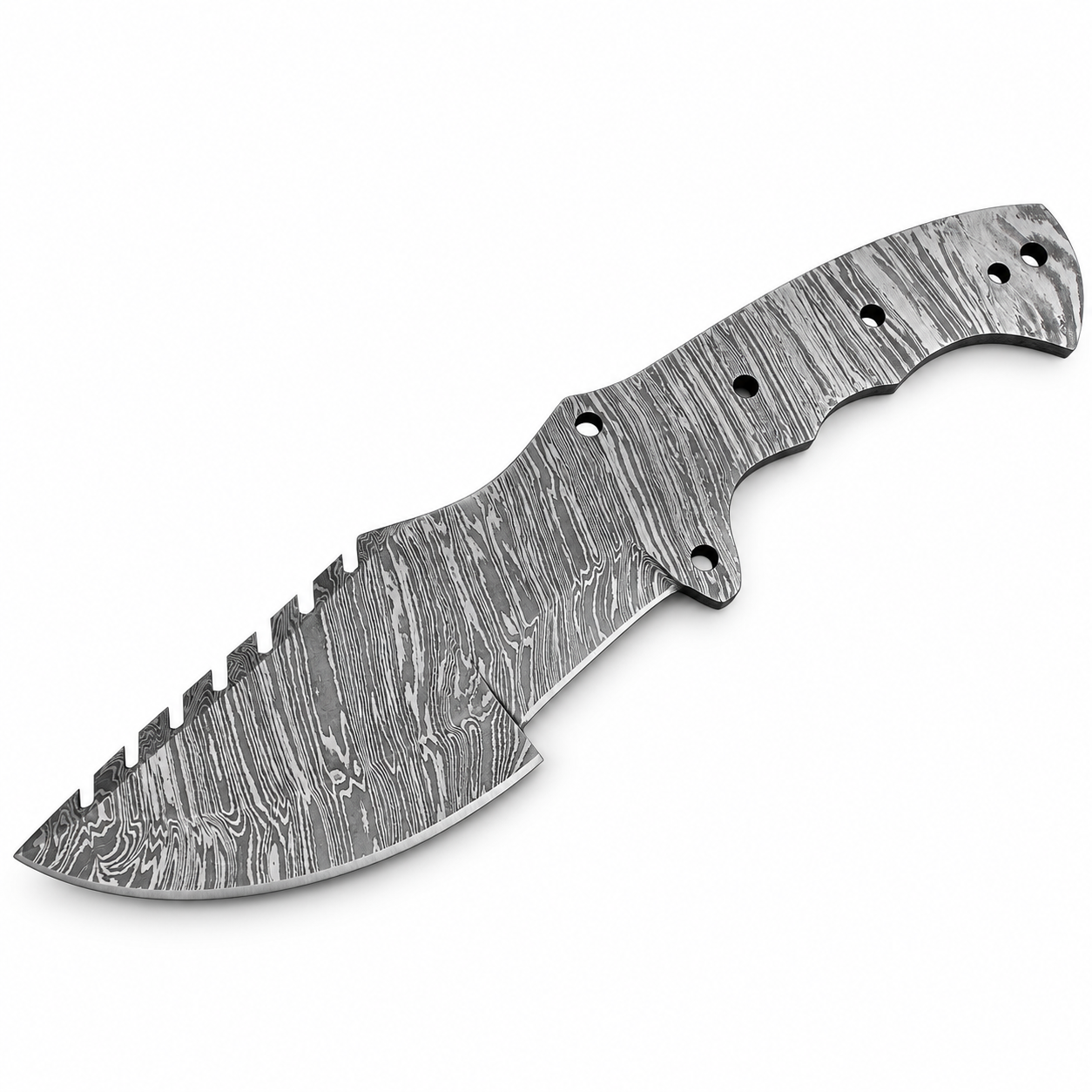
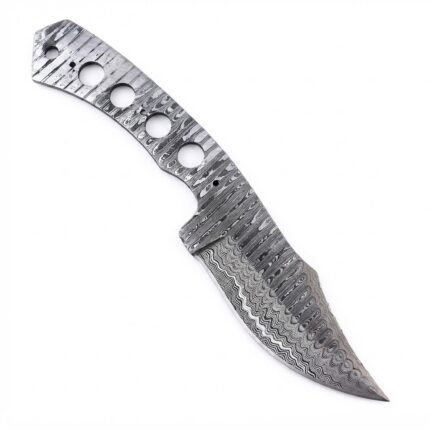
With its flowing gray-and-silver blade pattern, visible mounting holes, notched spine, and contoured handle shape, this knife blank offers a distinctive appearance before any handle scales or decorative grip materials are added.
The product is shown as a single metal piece, with the blade and handle area following one continuous outline. This design gives the blank an immediately recognizable profile and allows the visible metal pattern to continue into the handle area.
Unlike a finished knife with wooden, resin, or composite handle scales, this item shows its metal tang and mounting points directly. That unfinished appearance is an important part of its identity.
Knife-making enthusiasts often look for blanks with recognizable blade shapes and suitable areas for adding their own handle components. This model offers a broad blade silhouette and a finger-contoured handle outline that can be considered when planning a custom knife project.
The exact steel composition and manufacturing process must be verified before describing the item as genuine pattern-welded Damascus steel.
Distinctive Damascus-Style Blade Pattern
The blade displays a detailed pattern of narrow, irregular lines running across its metal surface.
These lines create a layered, flowing appearance associated with Damascus-style knife designs. The pattern extends from the main cutting blade into the unfinished handle section, giving the entire visible metal surface a coordinated appearance.
Different areas of the blade show slightly different concentrations of lines. Some sections have closely spaced, almost parallel markings, while others display more curved and irregular shapes.
This visual variety is one of the main attractions of the product.
The silver-gray finish creates a classic metal appearance without bright colors or separate decorative coatings.
The pattern is particularly noticeable around the broader part of the blade, where the available surface area allows the lines to become more prominent.
Although it resembles Damascus steel, the photograph cannot confirm whether the pattern comes from authentic layered steel, an etched finish, or another production method.
Customers seeking a particular steel construction should review supplier documentation before making a purchase.
Full Tang-Style Handle Construction
One of the most recognizable features of this Damascus Pattern Full Tang Knife Blank is the exposed metal handle.
The handle area forms a continuous shape with the rest of the blade, rather than showing a narrow hidden tang intended to fit inside a solid handle block.
This design resembles the full tang construction commonly used in custom fixed-blade knives.
The metal handle section has a gently curved upper edge, a shaped lower edge, and a slightly widened rear end.
Several circular holes are distributed across the handle and its transition toward the blade.
These visible openings may be used as mounting positions in a compatible handle design, depending on their actual dimensions and the manufacturer’s intended construction.
Their diameter, spacing, and structural purpose have not been confirmed.
Knife makers should measure the blank before selecting pins, fasteners, liners, or scales.
Six Visible Handle and Mounting Holes
The image shows six openings across the handle and tang area.
These openings vary in position and apparent size, giving the blank a distinctive unfinished appearance.
Several holes are positioned through the main handle area, while another appears close to the blade-to-handle transition.
The rear section includes openings near the end of the handle.
The presence of multiple openings may be relevant to individuals planning decorative or functional handle assemblies.
However, the number of holes alone does not confirm compatibility with standard pin sets or a specific assembly method.
Accurate measurement is necessary before ordering mounting hardware.
If the manufacturer provides a technical drawing, it should be used to confirm hole dimensions and center-to-center spacing.
Wide Blade with a Curved Cutting Profile
The knife blank features a broad blade that tapers toward a defined point.
Its cutting edge follows a smooth curve, while the upper edge incorporates a series of notches along part of the spine.
The overall silhouette resembles a hunting-style fixed-blade knife, with more blade width than a narrow fillet knife or small utility blade.
The curved edge gives the product a recognizable outline, while the pointed end creates a clear distinction between the blade and the handle.
The image shows a bright edge line along the lower curve of the blade. This suggests an edge bevel, but it does not establish the level of sharpness or whether additional finishing is needed.
Blade thickness, edge geometry, hardness, and material composition are all important to real-world performance and should be checked with the supplier.
Notched Sawback-Style Blade Spine
A notable visual feature is the row of cutouts along the blade’s upper edge.
These are positioned on the spine and extend across part of its length.
The cutouts give the blade a rugged appearance and differentiate it from smooth-spine knife blanks.
This design may be described as a sawback-style notched spine for product identification.
However, the notches should not be marketed as a functioning saw without testing or manufacturer specifications confirming that purpose.
Notched spines can vary considerably in shape and intended use.
On this product, their appearance is clear, but their practical function remains unverified.
Finger-Contoured Metal Handle
The unfinished handle section has a curved lower profile with several recesses.
These recesses resemble finger grooves and contribute to the knife’s distinctive shape.
Instead of following a completely straight handle outline, the metal gradually curves inward and outward along the grip area.
The rear end is slightly flared, creating a recognizable finishing shape.
Such contours may influence how handle scales are designed for the knife blank.
Anyone planning to complete the handle should consider the existing curves when selecting materials.
A finished handle must be assessed for comfort, secure assembly, and safe control before practical use.
The photograph alone cannot establish grip comfort or ergonomic performance.
An Interesting Option for Custom Knife Projects
Knife blanks provide a starting point for people interested in creating their own finished knife designs.
A blank with an exposed handle area can be considered for a project involving appropriately fitted grip components.
The Damascus Pattern Full Tang Knife Blank may appeal to enthusiasts who want a patterned metal blade and the visual freedom to select their own handle finish.
Wood, resin, and composite materials are common categories used for knife handles generally, although compatibility with this exact blank has not been verified.
Selecting a suitable material depends on the tang dimensions, mounting-hole positions, intended use, and the experience of the person assembling the product.
The finished appearance will also depend on the chosen handle design.
This blank’s prominent blade pattern can be paired visually with understated or decorative handle finishes.
The image does not show any included handle scales, screws, rivets, sheath, or other accessories.
Appealing to Knife Collectors
Collectors often appreciate knives and knife components for their blade shapes, finishing details, and unusual construction features.
This unfinished blank stands out because its patterned metal surface extends across both the blade and exposed handle area.
The broad cutting profile and multiple mounting holes reinforce its recognizable construction.
The notched upper edge adds another visual detail.
For collectors interested in comparing different blade styles, it provides an example of a wide fixed-blade design with an unfinished handle.
Its appearance can also be appreciated without assuming a particular steel grade or forging process.
Buyers who collect authentic pattern-welded steel should request confirmation of the manufacturing process.
The visual pattern alone is not sufficient evidence of authenticity.
A Traditional Metal Finish
The entire piece has a restrained silver-and-dark-gray appearance.
There are no visible brightly colored handle sections or attached guards.
The surface pattern provides most of the ornamentation.
Fine lines flow along the length of the blade and continue toward the rear of the handle.
This creates a relatively consistent visual identity throughout the product.
The lack of fitted handle scales also makes the shape of the metal more apparent.
Customers can see the location of the mounting holes and the full outline without anything covering them.
For an unfinished product listing, these details are particularly important.
Key Visible Design Features
The following details can be identified from the uploaded photograph:
-
Broad blade with a curved cutting-edge profile
-
Silver-gray Damascus-style patterned metal surface
-
Continuous, exposed full tang-style handle section
-
Six visible circular openings
-
Finger-contoured lower handle outline
-
A series of notches along part of the blade spine
-
Slightly widened rear handle section
-
No installed handle scales or sheath visible
These visual details make it possible to identify the product accurately while avoiding unsupported technical claims.
Understanding the Unfinished Design
The absence of handle scales is one of the main differences between this blank and a finished hunting knife.
An unfinished handle leaves the metal tang exposed and makes attachment points visible.
This does not automatically mean that all manufacturing stages are incomplete.
Some knife blanks may already have finished blade profiles, while others need additional processing.
The photograph cannot confirm whether this item requires heat treatment, sharpening, polishing, or other work.
These details must come from the supplier.
Customers should not assume that the product is ready for immediate practical use merely because the blade is visibly shaped.
Likewise, it should not be marketed as heat-treated or sharpened unless verified.
Choosing a Suitable Knife Blank
When comparing knife blanks, buyers should consider more than the visible pattern.
Blade steel is particularly important because different materials have different maintenance and performance characteristics.
Exact blade thickness and overall dimensions also affect the nature of a finished knife.
Tang hole spacing determines whether particular handle components will fit.
Buyers should review the manufacturer’s specifications and ensure that the blank matches their intended project.
Its broad blade shape, exposed metal handle, and distinctive surface pattern make this model recognizable, but technical measurements are still necessary for an informed purchase.
The quality of the finished knife will depend on the blade itself, the chosen handle components, correct assembly, and appropriate inspection.
Care and Storage Before Assembly
An unfinished knife blank should be stored carefully to protect its metal surface.
Keep the product clean and dry.
Avoid prolonged exposure to moisture, particularly when the steel’s corrosion resistance is unknown.
If the blade material requires corrosion protection, follow the manufacturer’s recommended maintenance procedure.
Avoid harsh abrasive cleaners that could damage the decorative surface pattern.
The knife blank should be stored securely with the cutting edge protected.
Do not leave the exposed blade accessible to children or unauthorized users.
Handle the blank carefully even if its final edge condition has not been confirmed.
Specifications That Require Supplier Confirmation
Before purchasing or listing this Damascus Pattern Full Tang Knife Blank as a finished retail product, customers should be provided with reliable specifications.
The blade steel grade is currently unknown.
The image does not establish whether the product uses authentic pattern-welded Damascus steel.
Overall length, blade length, blade thickness, and weight are also unverified.
Hardness ratings, heat treatment, cutting-edge condition, and the purpose of the spine notches have not been confirmed.
Likewise, the exact diameters of the mounting holes and the spacing between them require measurement.
These details are important for buyers considering the blank for an actual knife-making project.
Publishing verified specifications will give customers a clearer understanding of the product and reduce the possibility of ordering incompatible materials.
Why Choose This Damascus Pattern Full Tang Knife Blank?
The Damascus Pattern Full Tang Knife Blank brings several distinctive visual features together in a single unfinished blade design.
Its broad curved blade, exposed tang, finger-contoured handle, and notched spine make it easy to distinguish from simpler smooth-spine knife blanks.
The flowing patterned surface adds visual interest across the entire piece.
Multiple mounting holes make the intended handle area visible, while the absence of fitted scales leaves room for a separately planned handle design.
It is a product worth considering for collectors and experienced knife-making enthusiasts who appreciate patterned metalwork and unfinished fixed-blade designs.
Explore the Damascus Pattern Full Tang Knife Blank and review its verified technical specifications to see whether it is suitable for your intended collection or knife project.







Reviews
There are no reviews yet.