





A textured full tang knife blank for your next project
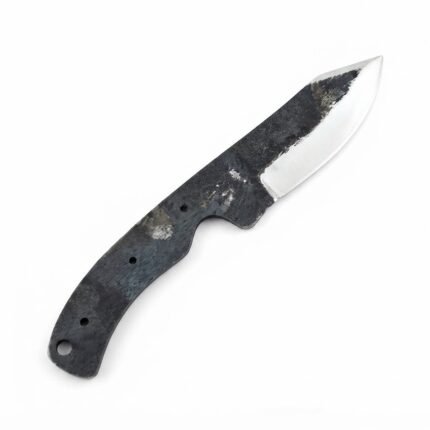
This textured full tang knife blank provides a shaped starting point for a custom knife handle project. It combines a dark, irregularly textured surface with a bright silver-coloured bevel, creating a strong contrast between the upper blade face and the cutting-edge area. The exposed tang continues through the entire handle outline, with no handle scales attached.
The profile includes a pointed blade, a curved cutting edge, and a contoured handle section. Two smaller holes appear along the tang, with a larger opening near the rounded rear end. These visible details make it possible to assess the general layout before choosing compatible handle materials and fittings.
For makers who want a blade blank with an established silhouette, this design offers a clear starting point. Its exact steel, dimensions, heat-treatment status, and remaining finishing requirements must be confirmed before planning the build.
A component for a custom knife project
A knife blank is a component rather than a complete knife with a finished grip. Here, the blade and exposed handle section are already shaped, and a broad bevel is visible. The absence of attached scales leaves the handle’s final appearance open to your project choices.
That distinction matters when ordering. This product is best considered by customers looking for a blank to assess and complete, rather than someone expecting a finished knife with a fitted handle and carrying sheath. No separate handle pieces, fasteners, or accessories appear in the photograph.
The visible preparation may reduce some initial shaping work compared with starting from an unprofiled piece of material. However, the photograph does not establish how much additional work is required. Confirm the supplied condition with the seller before selecting tools, materials, or a project schedule.
Full tang profile with an exposed handle section
The metal outline extends from the blade through the full length and width of the handle section. This visible configuration supports describing the blank as full tang. With no scales covering it, the tang’s shape and hole positions can be inspected directly in the supplied image.
For a handle project, that exposed outline provides an important reference. It shows where the grip narrows, where the front recess begins, and how the rear section curves. These features will influence the outline of any handle scales selected for the blank.
Full tang describes the configuration, not a tested strength rating. Overall performance still depends on the material, heat treatment, dimensions, workmanship, and completed assembly. None of those characteristics should be inferred from the profile alone.
Dark texture with a rustic appearance
Much of the blank has a charcoal-black surface covered in irregular markings. Small lighter areas break up the dark finish, giving the blade face and tang a mottled appearance. The texture continues across both sections, creating visual consistency from the blade toward the handle end.
This surface gives the blank a rustic character. It may appeal to makers who prefer visible texture over a uniformly polished appearance, particularly when planning a handle that complements darker tones. The contrast is already prominent before any scales or decorative fittings are added.
The photograph does not establish how this texture was produced. It should not be treated as proof of hand forging, hammering, a particular coating, or a corrosion-resistant treatment. “Textured” describes what is visible without attributing an unverified manufacturing process.
A bright bevel that defines the blade
A broad, bright bevel runs along the lower part of the blade. Fine directional marks are visible across this area, contrasting with the irregular dark surface above it. The boundary between the two finishes follows the blade’s shape and becomes especially noticeable around the curved forward section.
This contrasting finish makes the blade geometry easier to see in the photograph. It separates the cutting-edge area from the upper face and gives the blank a more defined appearance than an entirely dark surface would provide.
A visible bevel does not confirm final sharpness or readiness for use. The image cannot establish the edge angle, grind symmetry, remaining edge thickness, or finishing stage. Customers should ask whether additional grinding, sharpening, or other preparation is required before the blank becomes a completed knife.
Pointed blade with a curved cutting edge
The blade narrows toward a pointed tip, while the cutting edge rises in a broad curve toward the front. Its upper outline is comparatively straight through much of the visible length. Together, these features create a recognisable fixed-blade profile without serrations or a hooked cutting section.
The curved edge is an important part of the overall design. Makers comparing blanks can use the photograph to judge whether this silhouette fits the appearance they want for their project. It also helps distinguish this blank from straighter utility profiles or wider cleaver-style shapes.
There is no measurement reference in the image, so the blade’s actual size cannot be calculated reliably. Check the blade length, maximum width, and thickness before choosing it for a particular application or comparing it with another model.
A contoured grip outline
The tang has a shaped lower edge rather than a simple rectangular outline. A pronounced recess sits behind the blade, followed by a longer inward curve through the grip area. The rear section then widens and rounds off, giving the handle a defined beginning and end.
These contours establish the basic shape around which a finished handle would be planned. They may be especially relevant to makers who want a curved grip outline already present in the blank, rather than a straight tang that needs a different design approach.
The finished feel will depend on more than this side profile. Scale thickness, edge rounding, surface finish, and the user’s hand size all affect comfort. The image therefore supports describing a contoured tang, but not promising an ergonomic or universally comfortable grip.
Two smaller tang holes
Two smaller circular holes are visible along the handle section. One sits nearer the blade, and the other is positioned farther toward the rear. Their placement provides a useful visual reference when considering the arrangement of a custom handle.
These openings appear suitable for consideration as handle attachment points, but their intended use and exact measurements require confirmation. The photograph does not establish diameter, spacing, tolerances, or compatibility with a particular pin, bolt, or fastening system.
For project planning, request a dimensioned drawing or direct measurements of the supplied blank. Having that information before ordering hardware helps avoid choosing fittings that do not match. The existing holes are visible features, not a guarantee of compatibility with standardised handle kits.
Larger opening near the rear
A larger circular opening appears near the rounded end of the tang. It is clearly separate from the two smaller holes and forms a noticeable part of the rear profile. The photograph shows the opening without a fitted tube, cord, or other attachment.
Its location is consistent with a potential lanyard opening, although the seller should confirm its intended purpose. Diameter and clearance would also need checking before selecting any accessory or deciding how the opening fits into the finished handle design.
Makers may want to preserve access to this feature when planning scales. Whether it remains exposed, is lined with a compatible fitting, or forms part of a particular handle layout depends on the project. No attachment hardware or lanyard is confirmed as included.
Freedom to choose the handle’s appearance
The absence of fitted scales leaves room to choose a handle colour and surface style that suits your project. The blank’s dark upper surface and bright bevel provide a neutral foundation for considering different visual combinations.
A lighter handle could emphasise the contrast with the dark tang, while a darker handle could create a more restrained overall appearance. Those are design possibilities rather than supplied variations. The photograph shows only the bare blank, with no alternative handle options presented.
Actual material selection should follow the blank’s measurements and the requirements of the finished knife. No particular wood, composite, synthetic material, adhesive, or fastening method is verified as compatible. Confirm those details before purchasing additional components for the build.
A starting point for experienced hobbyists and makers
This blank is relevant to hobbyists and makers who want to work from an existing blade profile. It allows attention to be directed toward evaluating the component, planning a handle, and determining what finishing work remains.
Customers with previous handle-making experience may find the exposed tang and visible holes helpful when comparing project options. Someone new to this type of work should first establish the blank’s supplied condition and the equipment or expertise needed to complete it.
The product should not be described as a complete beginner kit. There are no instructions, scales, pins, adhesives, or tools shown. Its suitability for a first project depends on verified information about preparation and finishing, as well as the maker’s own experience.
Plan the finished look before choosing components
A successful visual design starts with the parts already present. Here, the strongest features are the dark texture, the bright bevel, and the curved handle outline. Thinking about those elements together can help when deciding how prominent the finished grip should be.
For example, a simple handle appearance would leave more attention on the blade’s contrasting surfaces. A more decorative handle could become a second focal point. Either direction is a styling choice, subject to the practical compatibility of the materials and fittings involved.
The photograph is useful for considering colour and proportion, but it should be supplemented with accurate measurements. A handle concept that looks balanced in a product image may need adjustment once the actual blank is available.
Measurements that matter for ordering
Before ordering, confirm overall length, blade length, maximum blade width, and material thickness. For the handle section, check the usable length, width at different points, hole diameters, and spacing between hole centres.
These measurements help establish whether the blank fits your planned project and whether available handle stock is large enough. They also support a more meaningful comparison with other blanks than photographs alone, which may be presented at different scales.
Weight can be useful too, particularly when considering the completed knife’s overall feel. None of these figures is available from the supplied image. They should be obtained from the seller rather than estimated from the blank’s appearance or borrowed from a similar Alibaba listing.
Confirm the material and preparation stage
Steel composition and preparation stage are central purchasing details for a knife blank. The photograph does not identify a steel grade, hardness, heat-treatment condition, or manufacturing method. Its dark texture and bright bevel cannot establish those specifications.
Ask whether the blank has been heat treated and what further finishing the supplier expects. Also confirm whether the cutting edge is supplied sharpened or requires additional work. These answers help define the scope of the project before you commit to materials or labour.
A clear product specification is more useful than broad terms such as “premium,” “professional,” or “high quality.” For this blank, the listing focuses on the visible design while leaving performance claims dependent on verified documentation and the completed assembly.
Check suitability for the intended finished knife
The profile has the general appearance of an outdoor-style fixed-blade blank, but appearance alone does not establish suitability for a particular task. A completed knife’s capabilities depend on the blank’s technical specifications and how the project is finished.
Buyers planning a functional knife should match those specifications to their intended use. That includes considering the blade geometry, dimensions, material, and manufacturer’s guidance. The supplied photograph cannot demonstrate edge retention, corrosion resistance, toughness, or cutting performance.
This distinction is especially useful when comparing attractive blanks online. A design can suit your visual preferences while still needing further verification for practical use. Treat the photograph as evidence of shape and appearance, and the specification sheet as the basis for performance-related decisions.
What is shown and what is not included in the image
The photograph shows one bare knife blank against a white background. The blade, exposed tang, two smaller holes, and larger rear opening are all visible. No handle scales or separate fittings are attached.
There is also no sheath, storage case, presentation box, instruction sheet, or accessory pack shown. The image therefore does not support describing the product as a complete kit or claiming that additional components are included in the purchase.
Confirm package contents before placing an order, particularly if you are comparing several suppliers. Similar-looking listings may offer different levels of preparation or different accessories. Knowing exactly what arrives makes budgeting and project planning more straightforward.
Storage and care depend on the confirmed material
The appropriate care routine depends on the blank’s actual composition and surface treatment. A dark finish does not automatically establish rust resistance, and a bright bevel does not identify stainless steel. Material-specific maintenance advice should come from the supplier.
Request storage and care guidance alongside the technical specifications. This is particularly useful if the blank will be kept for some time before the handle project begins, or if the finished knife will be stored in a separate sheath or case.
No particular polish, protective oil, cleaning product, or surface treatment is specified here. Confirming compatibility first helps preserve the appearance you selected and avoids making assumptions about the textured surface or the bright bevel.
Bring your handle design to a defined blade profile
This blank brings together an established outline, contrasting finishes, and an exposed full tang ready to be assessed for a custom handle project. Its curved grip section and visible openings provide useful reference points, while the dark texture gives the design a distinctive starting character.
The main purchasing decision is whether its confirmed dimensions, material, and preparation stage match your plans. Once those details are established, you can judge the blank alongside your preferred handle design and the requirements of the finished piece.
Explore the profile and surface details, review the available specifications, and choose this textured full tang knife blank if it provides the right foundation for your next project.







Reviews
There are no reviews yet.