




Damascus Pattern Full Tang Knife Blanks – 5-Piece Set
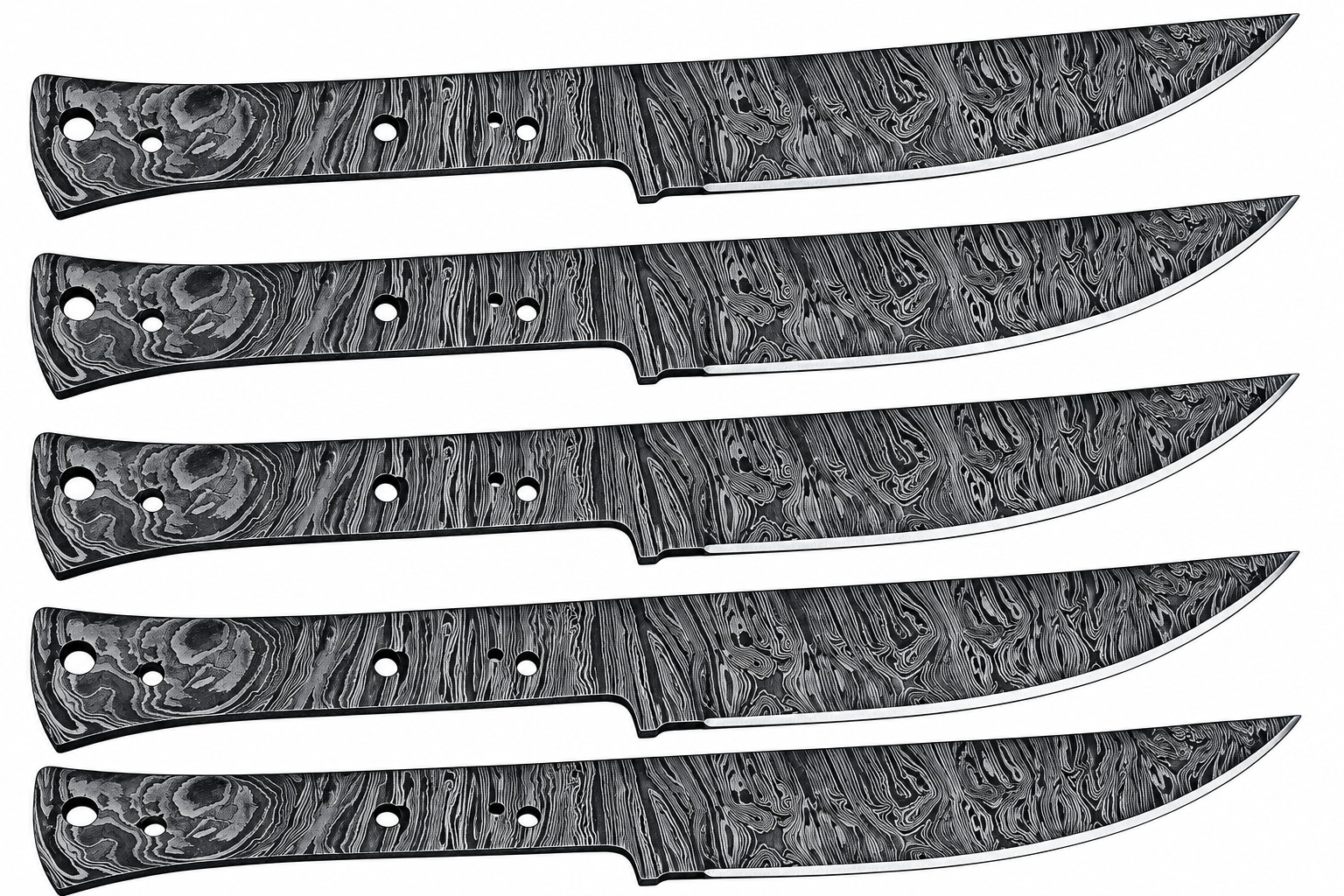
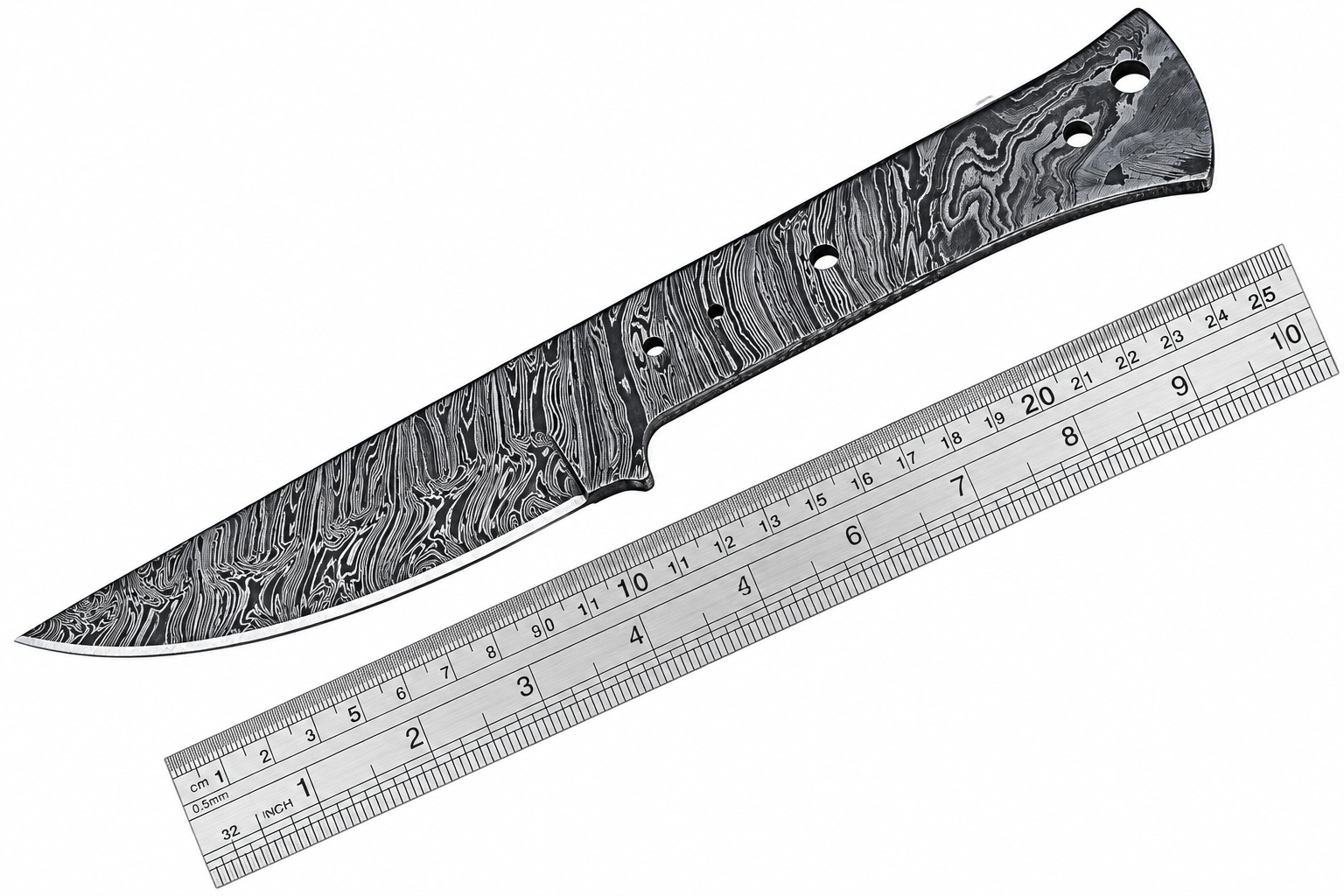
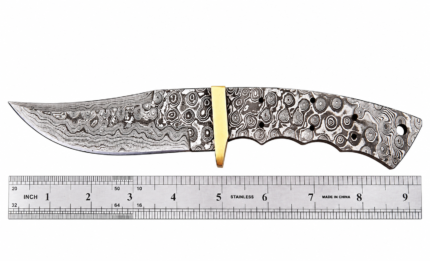
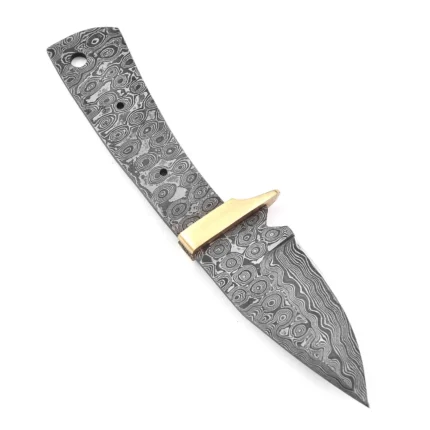
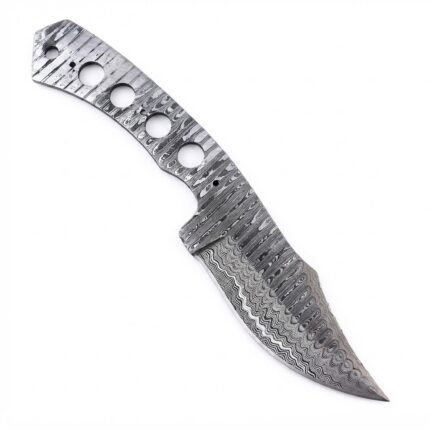
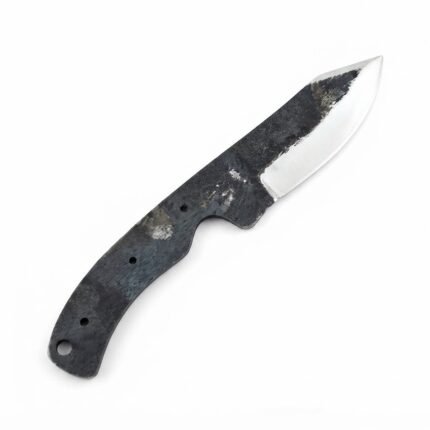
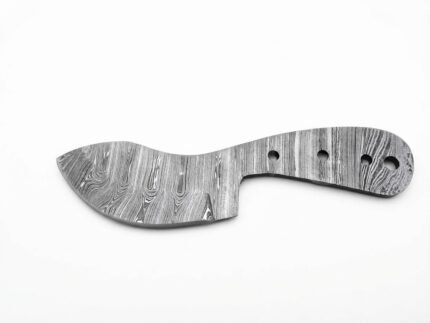
Damascus Pattern Full Tang Knife Blanks are designed for knife-making projects that require an unfinished handle section, a distinctive patterned blade surface, and a consistent fixed-blade profile. The five pieces shown in this set feature matching shapes, dark gray-and-silver layered-looking patterns, curved cutting edges, and multiple pre-drilled holes along the handle tang.
These blanks are intended for people interested in creating their own finished knife handles and exploring custom knife designs. Rather than purchasing a fully assembled knife, a knife maker can select a blank that provides the desired overall silhouette and then plan the remaining finishing and assembly work.
The most noticeable feature of this set is its flowing patterned surface. Fine silver-colored lines run through a darker metal background, forming irregular waves, loops, and wood-grain-like shapes. These details extend across the visible handle tang and blade area.
The photographed set contains five similar knife blanks arranged horizontally on a white background. Each piece has an elongated handle area, a subtle inward contour near the blade shoulder, and a pointed blade profile.
The exact steel grade, hardness, dimensions, manufacturing method, and cutting performance are not established by the photograph. Although the surface resembles Damascus steel, the listing uses the more cautious description Damascus pattern until the material has been verified.
Distinctive Damascus Pattern Blade Appearance
The surface design is the defining visual characteristic of these knife blanks.
Each blank displays an intricate mixture of narrow, curved, and overlapping lines. The contrast between the dark background and lighter pattern creates a decorative appearance that is often associated with Damascus-style metalwork.
The pattern covers the blade face and continues into the handle tang. This produces a consistent visual theme from one end of the blank to the other.
Some areas contain tightly packed parallel lines, while others feature broader swirls and rounded shapes. The uneven arrangement gives the metal surface a more organic appearance than a plain polished blade.
For buyers who value ornamental metal designs, this pattern can be an important reason to choose a particular knife blank.
It also provides an interesting contrast when paired with a separately selected handle material.
The image does not confirm whether the pattern is formed by forge welding, another layered-metal process, surface etching, or decorative finishing. Those manufacturing details should be verified before claiming genuine layered Damascus construction.
Full Tang Knife Blank Design
A prominent characteristic of the Damascus Pattern Full Tang Knife Blanks is the extended metal handle section.
The tang continues from the blade into an area shaped for future handle installation. Unlike a finished knife, this portion remains exposed in the supplied photograph.
The handle section is gently curved, with a wider end and a narrower transition closer to the blade.
This shape creates a recognizable fixed-blade silhouette.
A full tang design refers to a knife construction in which the metal tang extends through the handle area. In this case, the photographed blanks clearly show that extended profile.
The exposed tang provides an area where appropriately fitted handle scales may be installed.
However, the photograph does not show a completed handle, so no particular grip comfort or ergonomics can be established.
Knife makers should confirm the tang measurements before choosing handle materials.
Pre-Drilled Handle Tang Holes
Each visible blank has several openings along the handle area.
These include a larger circular opening near the rear end and smaller openings positioned farther along the tang.
The holes are useful design features for planning handle attachment, although the exact hole diameters and spacing are not provided.
A knife maker may select compatible handle hardware after measuring the blank.
Different handle materials and attachment systems require different dimensions.
It is therefore important not to assume that standard pins, bolts, or other hardware will fit without checking.
The multiple holes also distinguish these blanks from solid, undrilled metal profiles.
Their arrangement gives buyers a visual indication of the intended handle area and potential attachment points.
No handle scales, pins, rivets, screws, adhesives, or installation accessories are visible in the image.
Unless confirmed separately, the listing should describe the package as knife blanks only.
Curved Fixed Blade Profile
The blade section has a long, slightly curved cutting-edge outline ending in a narrow pointed tip.
The upper spine runs toward the tip in a gradual taper, while the lower edge curves outward before meeting the point.
The result is a recognizable fixed-blade profile suitable for consideration in custom knife-making projects.
The photographed blanks appear to have consistent proportions across all five pieces.
The cutting edge contrasts with the patterned blade face through a brighter silver-colored border.
This edge appears to have received some finishing, but its actual sharpness is unknown.
Buyers should confirm the condition of the cutting edge before handling or working with the blank.
The image does not show the thickness of the blade, so its cross-sectional geometry cannot be determined accurately.
The same applies to its flexibility, resistance to wear, and suitability for any particular cutting application.
Those characteristics depend on the verified material and processing history.
Matching Five-Piece Set
One of the main practical benefits of this product is the presentation of five visually matching pieces.
All five share the same broad handle-tang shape and similar blade profiles.
The arrangement makes the set attractive for buyers who prefer a consistent design across multiple knife-making projects.
A matching set can be useful when preparing a small coordinated collection or evaluating different handle finishes on similar blank shapes.
The photographed pieces also offer a clear basis for comparing the visible surface patterns.
Although the shapes appear consistent, slight differences in the pattern can be seen.
These differences may be part of the surface design rather than a manufacturing defect.
The image supports the count of five visible pieces, but it does not establish the supplier’s packaging method or whether all five are always included in a commercial order.
The final package quantity should be confirmed before publishing a specific purchase offer.
Unfinished Handle Section for Custom Projects
The exposed tang is one of the reasons buyers choose knife blanks instead of fully assembled knives.
A completed knife arrives with a handle already selected and attached.
An unfinished blank leaves that visual and material decision open.
Depending on the maker’s preferences and available specifications, different handle materials can be considered.
Examples commonly used in the knife-making industry include wooden scales, composite materials, and other suitable handle components.
These are general possibilities, not confirmed included options for this particular product.
The photograph shows only the patterned metal blanks.
A finished handle may substantially change the overall appearance of the knife.
For example, a darker handle can produce a more subdued look, while a lighter or warmer-toned material can create greater contrast with the patterned surface.
The tang shape and hole positions should guide material selection.
Accurate measurements are essential before any handle-fitting work begins.
Black and Silver Surface Contrast
The combination of black and silver is especially noticeable across the five blanks.
The dark background gives the metal an understated appearance, while the lighter flowing lines add visual complexity.
The bright edge provides a third area of contrast.
Together, these finishes create a more detailed appearance than a uniformly colored blank.
The darker tone extends across the spine and handle-tang region.
The pattern remains visible even where the metal surface narrows.
This makes the unfinished handle area visually connected to the blade rather than appearing like a separate component.
For buyers comparing patterned knife blanks, the consistency of surface design may be an important consideration.
It is worth remembering that photographed colors can vary with lighting, exposure, screen settings, and surface finish.
The actual appearance should be verified using supplier samples or additional photographs.
Knife-Making and Customization Applications
Damascus Pattern Full Tang Knife Blanks are relevant to custom knife-making projects in which buyers want to select the handle design and complete the remaining work separately.
They may be considered by experienced knife makers, collectors of unfinished knife components, and workshops that assemble finished products from sourced blanks.
Their primary appeal lies in the matching blade silhouette and patterned exterior.
A maker may use the same profile across several projects while selecting different handle appearances.
That flexibility can be useful when comparing finished designs.
However, the suitability of these blanks for practical use must be determined from confirmed specifications.
A photographed cutting-edge profile does not prove the metal has received suitable heat treatment.
Likewise, the presence of handle holes does not prove that every attachment method will be appropriate.
Before undertaking a project, buyers should verify materials, processing condition, dimensions, and intended use.
Any workshop activity involving sharp metal should be carried out using appropriate safety procedures and equipment.
Collectors and Workshop Buyers
These patterned blanks may appeal to customers who appreciate knife construction and decorative metalworking.
For collectors, the exposed tang and consistent blade silhouette reveal aspects of the design that are normally hidden beneath the handle of a finished knife.
For workshops, a matching group of blanks allows the appearance of different handle materials to be considered against a similar blade design.
The five-piece arrangement also makes it easier to visualize a coordinated set.
When purchasing for a workshop, however, visual similarity is only one part of evaluating a blank.
The material specification, dimensional tolerance, surface condition, and supplier quality-control information should also be considered.
These factors help determine whether a blank is suitable for a particular finished product.
The photograph alone does not establish production consistency from one order to another.
For repeat purchases, requesting a specification sheet and sample is advisable.
Important Material Information
The blades display a characteristic Damascus-style pattern.
However, the visible pattern should not be treated as proof of a particular steel composition.
Actual Damascus steel may involve multiple metal layers, but some products use decorative surface treatments to create a similar appearance.
Different manufacturing methods can produce designs that look broadly alike in photographs.
The exact steel grade, layer count, hardness, and heat-treatment condition are therefore unverified.
No specific carbon-steel composition, stainless-steel designation, or hardness rating is claimed in this listing.
Buyers requiring particular mechanical or cutting properties should request written technical information from the manufacturer.
This is especially important for commercial projects where the finished knife will be sold with performance specifications.
Reliable product information is more useful than unsupported material descriptions.
Measurements and Dimensional Accuracy
The uploaded image provides a clear side view of the five blanks, but no measuring scale is included.
As a result, the overall length cannot be determined precisely.
The same limitation applies to blade length, tang length, cutting-edge length, thickness, and weight.
The openings along the handle are visible, but their diameters and spacing cannot be measured accurately from this image.
When selecting a blank for a custom project, these measurements are important.
They help buyers determine whether the profile suits their intended design.
They also make it possible to select compatible handle components.
For bulk purchasing, dimensional consistency may be particularly important because small differences can affect the finished assembly.
Buyers should obtain a drawing or detailed measurements from the supplier rather than relying on visual estimates.
Surface Care and Storage
Unfinished knife components should be handled and stored with care.
The steel grade and protective finish are not confirmed, so it is sensible to avoid unnecessary moisture and prolonged exposure to damp conditions.
After ordinary handling, the metal surface can be wiped with a clean, dry cloth.
Avoid using aggressive abrasives on decorative surfaces because these may alter the appearance of the pattern.
Blanks should be kept separated or protected to prevent scratching during storage.
If the supplier provides material-specific maintenance instructions, those recommendations should take priority.
The cutting edges and pointed tips should be treated as potentially sharp even when their finishing condition is unknown.
Use suitable protective packaging and store the blanks securely.
Keep them away from children and unauthorized users.
Wholesale and Supplier Considerations
When purchasing Damascus Pattern Full Tang Knife Blanks through wholesale marketplaces, product details can vary considerably between sellers.
Some suppliers offer individual pieces, while others advertise sets or bulk quantities.
Prices may depend on the steel composition, dimensions, finish, order volume, and customization requirements.
The five pieces shown should not automatically be interpreted as one supplier’s standard wholesale pack.
Buyers should confirm whether a quotation is per blank or per complete set.
They should also check minimum order quantities and whether the displayed price includes any handle components.
Supplier descriptions may include terms such as handmade, forged, layered, hardened, or customized.
Those descriptions should be verified for the exact product being ordered.
A written quotation is especially important when arranging commercial orders.
Why Choose This Patterned Full Tang Knife Blank Set?
The principal attraction of this product is its combination of matching profiles and decorative metal surfaces.
Each blank has an extended handle tang, a curved pointed blade, and several visible holes.
The dark-and-silver pattern gives the set a distinctive finish.
The five-piece presentation may appeal to buyers planning coordinated custom knife projects.
Because the handle sections remain unfinished, the final appearance can be determined by the selected compatible handle components.
The exposed tang also makes the construction layout easy to see.
For buyers who prefer to select their own handles, this is a notable difference from purchasing fully assembled knives.
The design can be appreciated on its own while important specifications remain subject to supplier confirmation.
Final Overview
The Damascus Pattern Full Tang Knife Blanks set contains five matching-looking unfinished knife profiles with flowing silver-and-black patterns, pre-drilled handle tangs, and pointed curved blades.
Its design is relevant to custom knife-making projects, decorative metalwork, and workshops looking for a coordinated blade profile.
Before purchasing, confirm the exact steel composition, thickness, blade length, tang dimensions, hardness, package quantity, and finishing condition.
Explore this five-piece patterned knife blank design as a starting point for your next custom knife collection.







Reviews
There are no reviews yet.