





Rustic Black Full Tang Skinner Knife Blade Blank
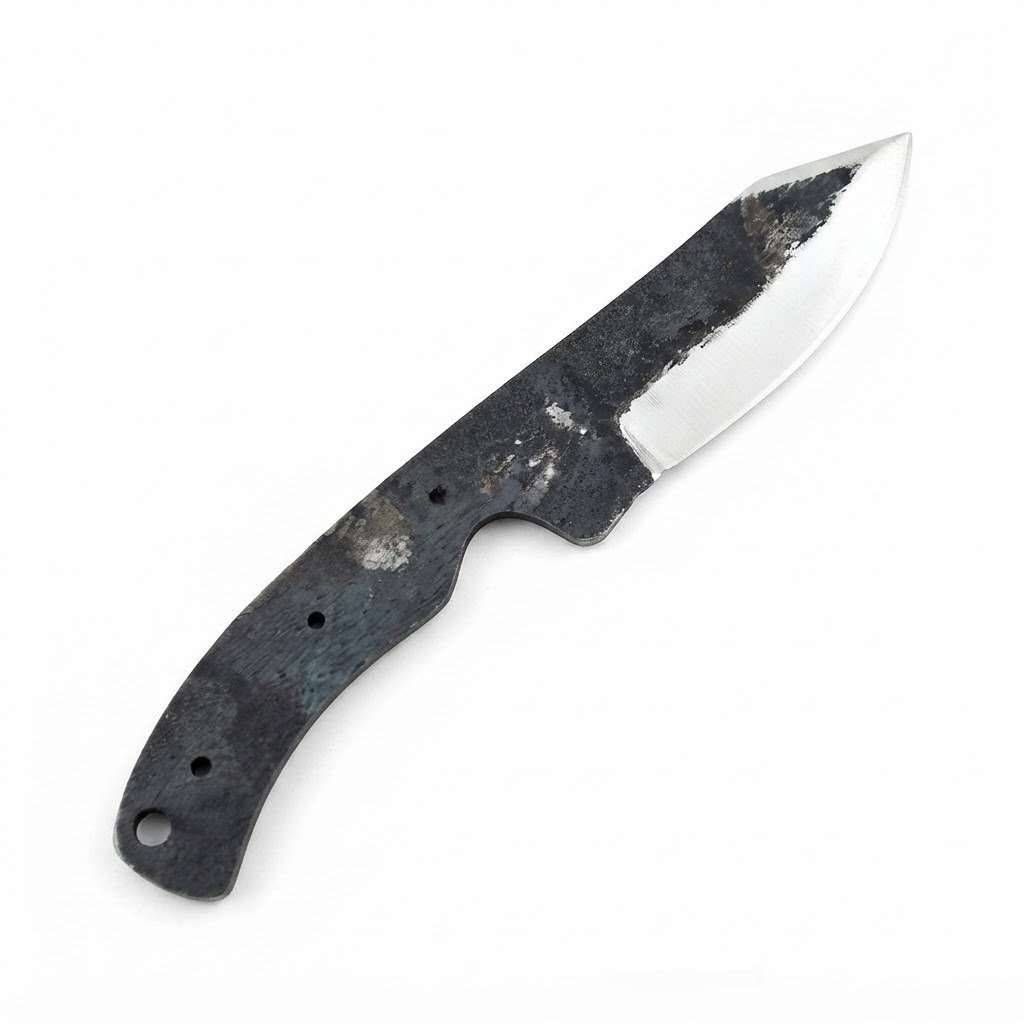
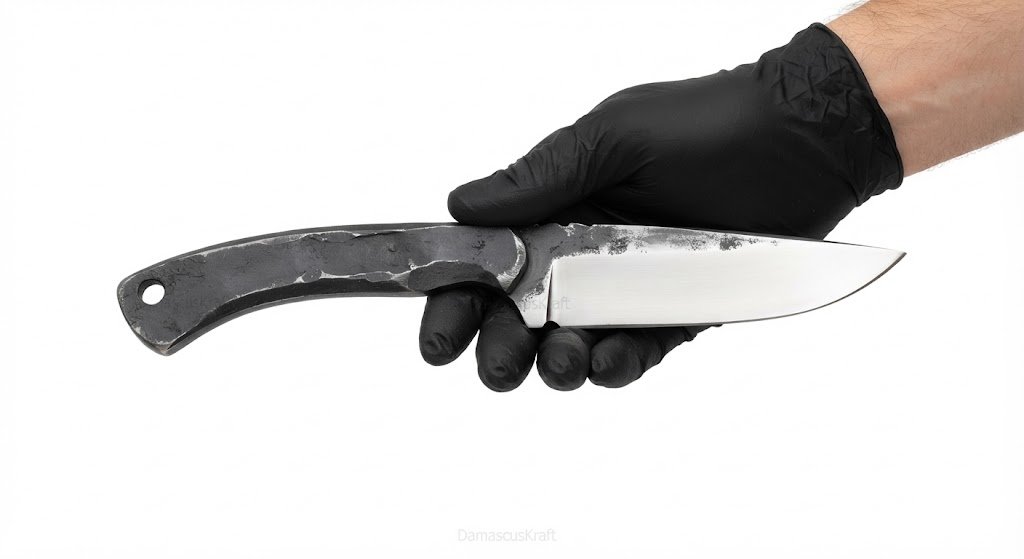
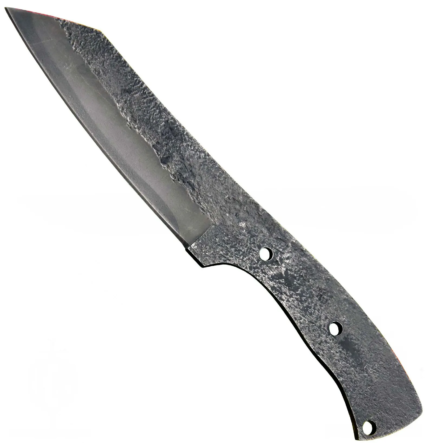
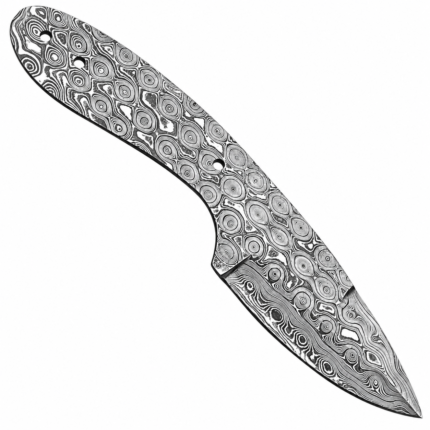
The Rustic Black Skinner Knife Blank is an unfinished fixed-blade knife component featuring a broad cutting profile, a dark mottled metal surface, and a contrasting silver-colored cutting bevel. Its exposed full-length tang and visible mounting holes give it the recognizable appearance of a knife blank intended for custom handle fitting.
The blade features a gently curved cutting edge leading to an upward-positioned pointed tip. This shape resembles traditional hunting and skinning knife designs, making it an interesting option for custom knife enthusiasts, collectors, and buyers seeking unfinished blade components.
Unlike a complete hunting knife, this product does not feature attached handle scales. The exposed tang displays three smaller mounting holes along its length and one larger opening near the rounded rear end.
The dark metal surface has irregular markings and variations in color that create a rustic appearance. A brighter, silver-colored bevel runs along the cutting edge, providing an attractive contrast with the darker blade body.
The exact steel type, manufacturing process, heat treatment, and dimensions have not been established from the image. Customers should confirm these specifications before selecting the product for any particular project.
Distinctive Rustic Black Skinner Knife Blank Design
The Rustic Black Skinner Knife Blank features a practical-looking silhouette inspired by traditional outdoor knife designs.
One of its most noticeable characteristics is the relatively broad blade near the handle, which gradually narrows toward the pointed tip.
The cutting edge has a sweeping curve, while the upper blade profile rises gently toward the front.
This shape gives the blank a distinct appearance compared with narrow utility knives or straight-edged knife blanks.
The blade’s visual proportions suggest a traditional hunting-style design rather than a kitchen or folding knife configuration.
Its dark, textured-looking metal surface is another defining feature.
Instead of a completely uniform black coating, the blade displays subtle gray patches, irregular markings, and lighter areas across the surface.
These details contribute to its rustic visual character.
The wide silver-colored bevel creates a clear separation between the dark main blade face and the cutting section.
Together, these elements produce a design that may appeal to customers interested in unfinished knives with traditional outdoor styling.
Full Tang-Style Construction
The knife blank has an exposed metal handle section that continues directly from the blade.
This uninterrupted profile is consistent with full tang construction.
In a full tang knife design, the metal extends throughout the handle-shaped section rather than ending near the blade’s shoulder.
The photographed product clearly shows the handle tang without any attached grip panels.
Its outline is gently curved and includes a wider rounded section at the rear.
A shaped transition near the base of the blade creates a visible separation between the blade and handle areas.
This configuration is commonly found on fixed-blade knife blanks intended for custom handle projects.
The exposed tang gives buyers an opportunity to examine the visible mounting-hole layout and general handle shape.
However, the photograph cannot establish the tang thickness, exact dimensions, or compatibility with particular handle materials.
These measurements should be confirmed before selecting components.
Dark Mottled Blade Finish
The blackened-looking surface is an important part of the product’s appearance.
The upper blade and exposed handle tang display a dark gray to black finish with irregular lighter patches.
Some areas appear almost charcoal-colored, while others show gray or slightly brownish variations.
This uneven coloration gives the blade a rustic, workshop-inspired appearance.
Customers who prefer traditional metal finishes may find this look especially appealing.
The texture resembles surfaces sometimes associated with forged or unfinished steel.
However, the photograph alone does not prove that the product was hand-forged or treated using a particular blackening process.
It also does not establish that the surface provides corrosion resistance.
The most accurate description is a dark, mottled, blackened-looking metal surface.
This wording reflects the visible appearance without making unsupported manufacturing claims.
The finish may vary under different lighting conditions, so customers should review the product photographs carefully.
Broad Silver Cutting Bevel
The blade has a bright silver-colored bevel along its lower cutting edge.
This section contrasts strongly with the darker upper blade surface.
The bevel appears relatively broad near the center of the blade and continues toward the pointed tip.
Its polished-looking appearance provides a visual indication of the blade’s cutting-edge geometry.
This contrast gives the unfinished blank a partly finished appearance.
The dark metal above the bevel retains its rustic coloring, while the bright lower section reflects more light.
Together, the two finishes create a recognizable two-tone design.
Although the cutting edge is clearly defined, the image does not establish whether the blade has received final sharpening.
It also cannot confirm edge hardness, grinding precision, or cutting performance.
Customers should ask whether the blank is delivered sharpened, partially sharpened, or intended for further finishing.
These details are particularly important when comparing unfinished knife components.
Traditional Skinner-Style Blade Shape
The broad, curved blade resembles the general profile of a traditional skinning knife.
Skinner-style knives are often characterized by a pronounced curved cutting edge and a relatively broad blade section.
The product in the photograph has these visible characteristics.
Its tip is positioned above the main cutting-edge line, creating a gently upswept profile.
The blade also has a noticeably wider section near the transition to the handle.
This shape distinguishes it from narrow spear-point or straight-back knife blanks.
For customers comparing different knife shapes, the profile is one of the most useful features to consider.
Blade geometry affects how a finished knife looks and how it may be suited to different applications.
Nevertheless, suitability for a specific cutting task depends on verified dimensions, material properties, edge geometry, and appropriate finishing.
Those characteristics cannot be fully evaluated from a single image.
The product should therefore be presented as a hunting- or skinner-style knife blank rather than a tested professional skinning tool.
Exposed Handle Tang
The handle section is unfinished and has no fitted scales.
Its dark surface continues from the blade, creating a visually consistent metal component.
The tang has a contoured lower edge and a rounded rear section.
This shape gives the handle area a recognizable outline even without added material.
The upper line gradually transitions toward the wider rear.
Three small circular holes appear along the visible tang.
A larger hole is positioned near the rear end.
The overall configuration resembles knife blanks intended to receive separate handle components.
Potential handle design choices depend on the actual measurements and supplier specifications.
Buyers should not assume that wooden scales, fasteners, adhesives, or finishing accessories are included.
Only the metal knife blank is shown in the photograph.
Handle Mounting Holes
The visible mounting holes are useful identifying features.
Three smaller holes are distributed along the handle tang.
Their placement suggests possible positions for handle hardware in a completed knife assembly.
The larger rear opening resembles a lanyard or attachment hole.
Such openings are commonly incorporated into fixed-blade knife designs.
However, the image does not establish the exact purpose or measurements of each hole.
Before selecting compatible handle components, customers should obtain the hole diameters and spacing.
Fasteners that do not match these dimensions may be unsuitable.
Accurate measurements are especially important when preparing components for a custom design.
The product should not be advertised as compatible with a particular hardware size unless the manufacturer has provided that specification.
Knife Blank for Custom Design Projects
The Rustic Black Skinner Knife Blank may interest customers seeking a starting component for custom knife designs.
Because the handle tang is exposed, the final handle appearance has not been established.
This allows buyers to evaluate the metal profile separately from any decorative grip material.
The combination of a broad blade and gently curved tang provides a traditional fixed-blade silhouette.
Knife enthusiasts may also appreciate the contrast between the dark metal surface and the bright cutting bevel.
For collectors, the unfinished construction makes the item different from a fully assembled knife.
A knife blank can be examined as a separate manufacturing component, showing the relationship between blade shape and handle layout.
However, completing a knife requires appropriate technical knowledge, compatible materials, and suitable equipment.
The exact work required depends on the product’s manufacturing condition.
Whether additional heat treatment, sharpening, surface finishing, or other operations are required must be established with the supplier.
Important Material Considerations
The photograph confirms a metal blade component, but it does not identify its steel grade.
Many different steel alloys can have similar visual appearances.
A dark blade surface is not sufficient evidence that the material is high-carbon steel.
Likewise, a polished silver bevel does not prove that the product is stainless steel.
Customers should request the exact material specification before purchasing.
Steel composition influences a blade’s potential hardness, toughness, corrosion behavior, and maintenance requirements.
Heat treatment also plays an important role in determining whether a blade meets its intended specifications.
An unfinished blade may be sold in different manufacturing conditions.
Some blanks require further processing, while others may already have undergone major finishing stages.
The photograph does not establish which condition applies to this item.
For an accurate product page, steel grade and hardness should be added only when supported by reliable supplier information.
Dimensions and Product Specifications
The exact dimensions cannot be determined from the uploaded image.
There is no ruler or other dependable measurement reference.
The photograph shows the overall shape but does not establish the actual size.
For buyers comparing knife blanks, important measurements include the blade length, overall length, blade width, tang length, and thickness.
The dimensions of the mounting holes are also relevant.
Product weight may be useful when considering the finished knife’s intended design.
Even small differences in thickness or length can affect whether a particular blade blank is appropriate for a customer’s project.
Therefore, the listing should not include estimated measurements presented as confirmed specifications.
A dimensioned drawing or supplier specification sheet would help customers make more informed purchasing decisions.
If this product is offered in multiple sizes, each variation should have its own verified measurements.
Suitable Customers and Product Applications
The Rustic Black Skinner Knife Blank can appeal to several groups of buyers.
Custom knife enthusiasts may be interested in its exposed full-length handle tang.
Collectors may appreciate the rustic dark surface and traditional blade silhouette.
Knife-making businesses may consider the product when researching unfinished components for their product lines.
Craft enthusiasts may also find the blank useful as a reference for understanding fixed-blade construction.
Its visible design is particularly relevant to customers who prefer traditional hunting-style profiles.
However, the product’s actual working capabilities must be evaluated separately from its appearance.
It should not be advertised as suitable for heavy-duty outdoor activities, professional processing, or specialized tasks without verified performance information.
Clear descriptions help customers understand what is included and what remains unfinished.
Care and Maintenance
The appropriate maintenance routine depends on the confirmed blade material and finish.
For general handling, keep the metal surface clean and dry.
Avoid storing the blank in damp conditions.
Moisture and contaminants may contribute to corrosion in susceptible steels.
Because the exact alloy has not been verified, customers should seek guidance from the manufacturer regarding suitable cleaning and protective products.
The dark surface may be affected by abrasive polishing.
Therefore, aggressive cleaning should be avoided unless it is compatible with the confirmed finish.
Use a soft, clean cloth when removing ordinary surface dust.
Any further treatment should follow the supplier’s instructions.
The blade should be stored securely to prevent accidental contact with the pointed tip or cutting edge.
Even an unfinished blade may be sharp.
Keep it away from children and individuals unfamiliar with safe blade handling.
Storage Recommendations
A knife blank should be protected from unnecessary contact with other metal objects.
Loose storage may cause scratching, finish damage, or contact with the cutting bevel.
An appropriate protective blade covering can help reduce these risks.
The product should also be kept in a clean, dry storage environment.
For long-term storage, follow the supplier’s recommendations for the specific steel grade.
If the blank will remain unused for an extended period, inspect its surface occasionally for corrosion or other changes.
Do not assume that the dark finish eliminates the need for maintenance.
When transporting the component, ensure that the blade is securely covered and that applicable local regulations are followed.
Understanding the Unfinished Product
One important purchasing consideration is the difference between a knife blank and a completed knife.
A finished fixed-blade knife normally has an installed handle and may include a sheath.
The product shown here has an exposed metal tang rather than a finished grip.
The image also does not show a sheath or additional hardware.
It should therefore be categorized as an unfinished knife component.
Customers looking for a ready-to-use knife should understand this distinction before ordering.
The blade’s visible finish does not establish whether all manufacturing stages have been completed.
Further work may be required depending on the condition supplied.
Accurate product identification helps prevent confusion and ensures that customers know what to expect.
Customization and Product Variations
This blade blank’s exposed tang makes its handle configuration visually adaptable.
However, any available customization options must be confirmed by the supplier.
Possible variations in knife products can include different handle materials, blade dimensions, finishes, and packaging.
These are general industry possibilities, not confirmed options for this particular item.
If custom manufacturing is offered, buyers should request detailed specifications and quotations.
Minimum order quantities, production lead times, and additional charges may depend on the supplier.
Product listings should distinguish standard available products from made-to-order variations.
This helps maintain accurate customer expectations and prevents unsupported customization promises.
Why Choose This Rustic Hunting-Style Blade Blank?
The primary appeal of the Rustic Black Skinner Knife Blank lies in its distinctive appearance and unfinished full-tang configuration.
Its broad, upswept blade creates a classic hunting-style silhouette.
The dark mottled finish provides a rustic visual character.
The contrasting silver-colored bevel adds definition to the cutting edge.
The exposed tang and mounting holes clearly communicate the product’s unfinished nature.
These visible features make the blank easy to distinguish from polished knife blades and completed hunting knives.
For customers who appreciate traditional knife shapes and unfinished metal components, it is an interesting product to consider.
The final purchase decision should also account for verified steel, dimensions, finishing condition, and supplier specifications.
Final Overview
The Rustic Black Skinner Knife Blank combines a broad hunting-style blade, a dark irregular metal finish, a bright cutting bevel, and an exposed full-length handle tang.
Its visible mounting holes and unfinished configuration make it relevant to custom knife projects and collections.
The product has a distinctive traditional appearance without requiring unsupported claims about manufacturing methods or performance.
Before purchasing, confirm the steel grade, dimensions, heat treatment, and included components.
Explore this rustic knife blade blank as an unfinished component for an appropriate custom knife project or collection.









Reviews
There are no reviews yet.