





Wood Handle Damascus Fillet Knife – Elegant Long Patterned Blade
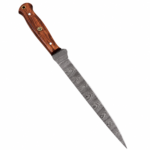
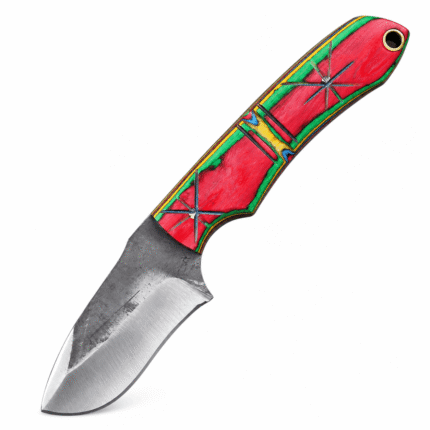
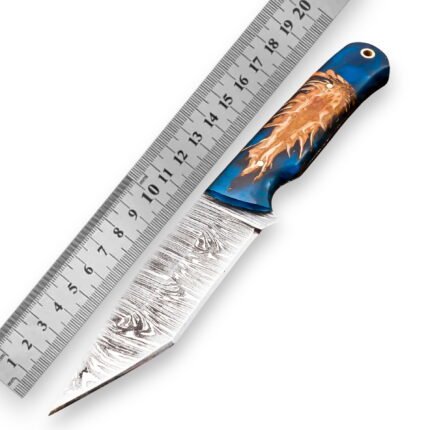
The Wood Handle Damascus Fillet Knife features a long, slender blade with flowing silver-and-charcoal patterns and a distinctive reddish-brown wood-grain-look handle. Its narrow pointed profile and gently curved cutting-edge outline give it the appearance of a traditional filleting or slicing knife, while its decorative metallic finish adds visual character.
The blade displays a series of fine, layered-looking lines that form irregular waves and curved shapes. These patterns are commonly associated with Damascus-style blades. Their arrangement varies across the blade, creating visual interest from the base to the narrow pointed tip.
The handle introduces warmer colors to the design. Its reddish-brown finish has darker streaks resembling natural wood grain. Small silver-colored pins, a circular decorative insert, and a gold-rimmed rear opening complete the appearance.
For adult culinary knife enthusiasts, cutlery collectors, and buyers interested in patterned kitchen blades, this knife presents a combination of familiar knife styling and decorative craftsmanship.
1. Wood Handle Damascus Fillet Knife Overview
The Wood Handle Damascus Fillet Knife has an elongated fixed-blade construction.
The blade remains permanently extended from the handle rather than folding into it.
Its metallic surface is relatively narrow compared with broad chef’s knives or chopping blades.
The blade gradually tapers from its wider rear section toward a fine pointed tip.
The lower cutting-edge side follows a subtle curve, creating a recognizable slicing-style profile.
The handle is elongated and gently contoured, with a rounded rear and slightly narrower front section.
A wood-grain-look finish complements the silver-gray patterned blade.
Visible Product Features
- Long, narrow fixed blade.
- Silver-and-charcoal Damascus-style blade pattern.
- Gradually tapered pointed tip.
- Gently curved cutting-edge profile.
- Reddish-brown wood-grain-look handle.
- Two small silver-colored handle pins.
- Circular gold-and-black ornamental insert.
- Gold-rimmed opening near the handle end.
- Shaped transition between handle and blade.
- Smooth-looking handle surface.
These characteristics are visible in the photograph. Exact blade materials, measurements, flexibility, and construction details require supplier confirmation.
2. Distinctive Damascus-Style Blade Pattern
One of the most noticeable features of this knife is its intricate metallic pattern.
The blade contains numerous fine lines in contrasting shades of silver and dark gray.
These lines create curves, waves, and layered-looking formations.
Some appear nearly parallel to the blade’s length, while others form flowing loops.
As the blade becomes narrower toward the tip, the patterns follow its changing profile.
This creates a continuous decorative appearance across the visible metal surface.
Flowing Silver and Charcoal Details
The silver-colored areas are surrounded by darker gray markings.
These contrasting colors make the patterns easier to distinguish.
Closer to the handle, several curved formations resemble small waves.
Farther along the blade, the lines become more elongated.
The patterns vary without changing the overall appearance of the knife.
Understanding Damascus-Style Patterns
Damascus steel is commonly associated with layered or patterned blade surfaces.
Modern pattern-welded Damascus may be produced by combining different steel alloys.
However, similar patterns can also be created using decorative etching or surface treatments.
The uploaded photograph establishes the visible Damascus-style finish but does not prove that the blade is genuine pattern-welded steel.
Its steel grade, number of layers, hardness, corrosion resistance, and heat-treatment process remain unverified.
Customers seeking a particular blade composition should request confirmed manufacturer specifications.
3. Long Narrow Fillet-Style Blade
The blade’s narrow shape is a defining characteristic of this knife.
Unlike a broad chef’s knife, it has a more slender profile.
The blade becomes progressively narrower toward the front.
Its pointed tip and curved edge resemble designs commonly associated with filleting, slicing, and certain boning knives.
Traditional Fillet Knife Appearance
Fillet knives are commonly designed with narrow blades for food preparation tasks involving fish and other ingredients.
Some fillet knives are flexible, while others are relatively rigid.
The photographed blade resembles this category, but its flexibility cannot be established visually.
It would therefore be inaccurate to advertise a specific level of flexibility without supplier confirmation.
Tapered Pointed Tip
The pointed end forms a prominent part of the knife’s silhouette.
The upper and lower blade outlines gradually converge toward the front.
This creates a narrow, tapered appearance.
However, its exact tip geometry, sharpness, and working characteristics remain unknown.
Blade Dimensions
The photograph provides no measurement reference.
The exact blade length, overall length, thickness, and weight cannot be determined.
These details should be supplied by the manufacturer before the knife is marketed for specific culinary tasks.
4. Wood Handle Damascus Fillet Knife Design
The handle has a reddish-brown appearance with darker irregular markings.
Its surface resembles polished natural wood.
The color ranges from warm orange-brown to deeper reddish tones.
Darker grain-like lines extend along its length, creating a traditional decorative appearance.
The handle has a gently curved outline rather than a completely straight rectangular shape.
Reddish-Brown Wood-Grain Finish
The warm brown coloring contrasts with the cool silver-gray blade.
This creates a classic combination often seen in traditional cutlery.
The darker streaks provide additional visual depth.
Some sections appear relatively smooth, while others have more visible grain-like markings.
These details make the handle visually distinctive.
Material Verification
Although the handle resembles natural hardwood, the photograph does not confirm its composition.
Natural wood, stabilized wood, resin, and various composites can display similar patterns.
For accurate product information, the handle should be described as wood-grain-look until the supplier verifies its material.
The exact wood species, if any, remains unknown.
5. Decorative Silver-Colored Handle Pins
Two small silver-colored circular pins are visible on the handle.
One appears closer to its rear section, while another is positioned nearer the blade.
These metallic details provide subtle contrast against the reddish-brown surface.
Similar components can serve structural functions in some knife designs.
However, their actual role cannot be confirmed from this photograph.
They should therefore be described as visible pins rather than verified structural fasteners.
Coordinated Metallic Details
The silver-colored pins complement the gray blade finish.
They also provide a contrast to the warmer brown handle.
Their simple circular shapes prevent the design from appearing overly elaborate.
The result is a classic handle appearance with several small decorative features.
6. Circular Ornamental Handle Insert
A distinctive circular insert appears along the handle’s visible side.
It has a gold-colored outer border and a dark central pattern.
The internal arrangement contains several small circular openings or dark markings.
This design creates an ornamental focal point.
Decorative Handle Detail
The insert stands out against the wood-grain-looking surface.
Its gold-colored rim complements the rear opening.
Together, these details add visual variety to an otherwise traditional handle.
The photograph does not establish the insert’s material, purpose, or manufacturing method.
It should therefore not be described as a specific alloy or structural component without confirmation.
7. Rear Handle Opening
Near the rounded rear end, the handle contains a circular opening.
The opening has a gold-colored metallic-looking rim.
It resembles a lanyard hole commonly found on various outdoor and utility knives.
However, its exact purpose and dimensions have not been verified.
Practical Considerations
Customers interested in attaching a lanyard should confirm the opening’s size and intended use.
The feature may also be appreciated as part of the handle’s decorative design.
Its gold-colored rim creates a contrast against the reddish-brown surface.
8. A Distinctive Fillet-Style Knife Profile
The Wood Handle Damascus Fillet Knife presents a profile associated with narrow culinary blades.
Its long shape differs from broad chopping knives.
The curved lower edge and narrow pointed front create a recognizable slicing-style silhouette.
For customers comparing kitchen knife designs, blade shape is an important consideration.
Filleting and Slicing Knife Categories
Filleting knives are commonly associated with fish preparation.
Slicing knives are designed in various lengths and profiles for cutting prepared foods.
Boning knives may also have narrow blades, although their dimensions and flexibility vary.
The photographed knife shares certain visual characteristics with these categories.
However, it should not be described as a verified professional fillet knife until its dimensions, flexibility, steel, and intended uses are confirmed.
9. Why Choose a Wood Handle Damascus Fillet Knife?
This knife offers several visually distinctive features.
Its long patterned blade creates a traditional appearance.
The reddish-brown handle introduces warmth and contrast.
The circular ornamental insert adds a small decorative element.
The gold-rimmed rear opening provides another recognizable detail.
Together, these features may appeal to buyers who appreciate traditional knife styling.
Distinctive Blade Pattern
The silver-gray Damascus-style finish adds visual complexity.
Its flowing lines distinguish the blade from plain-finish knives.
Classic Handle Appearance
The reddish-brown wood-grain look provides a familiar traditional style.
This may appeal to customers who prefer warmer handle colors.
Elongated Blade Silhouette
The narrow blade offers a different visual profile from chef’s knives or chopping blades.
It may interest customers looking for traditional fillet-style cutlery.
10. Wood Handle Damascus Fillet Knife for Kitchenware Enthusiasts
Knife enthusiasts often compare products according to blade shape, handle appearance, and material specifications.
This knife has several visible features that make it distinctive.
Its narrow blade, pointed tip, and curved cutting-edge profile are recognizable.
The decorative metallic pattern adds another element of interest.
The handle combines a traditional wood-grain look with small metallic details.
Culinary Knife Collection
The knife may be considered as part of an adult kitchen cutlery collection.
Its appearance contrasts with broader chef-style blades and shorter utility knives.
However, its suitability for actual food preparation depends on verified material composition and manufacturer-approved applications.
Decorative Display
The knife may also be displayed securely as part of a cutlery collection.
Any display should protect the blade against accidental contact.
Because its sharpness cannot be determined from the photograph, it should always be handled as potentially sharp.
11. Understanding Blade Material and Construction
The blade has a visible Damascus-style surface.
Its metallic appearance alone does not establish the actual alloy.
Various blade materials can be finished with patterned surfaces.
Some are genuine pattern-welded steel constructions, while others use decorative treatments.
The specific properties depend on the actual manufacturing process.
Why Blade Specifications Matter
Steel composition can influence corrosion resistance and maintenance requirements.
Heat treatment affects hardness and other properties.
Blade thickness and flexibility can influence suitability for different culinary tasks.
None of these characteristics can be reliably established from the uploaded photograph.
For this reason, buyers should request manufacturer-confirmed specifications.
12. Understanding Handle Construction
The handle resembles wood, but the exact material remains unknown.
Different types of natural wood and decorative composites can have similar appearances.
Their maintenance requirements can vary.
Natural wood may require particular protection from excessive moisture.
Certain stabilized or synthetic materials may have different care instructions.
The correct treatment should be based on the actual material rather than appearance.
Handle Shape and Comfort
The handle has an elongated, gently curved profile.
Its shape creates a traditional appearance.
However, actual ergonomic comfort cannot be evaluated without knowing its dimensions, surface texture, balance, and weight.
Customers should request these measurements where available.
13. Wood Handle Damascus Fillet Knife Care Guide
The correct maintenance procedure depends on the confirmed materials.
The following recommendations are general precautions for kitchen-style fixed-blade knives.
Cleaning the Blade
After handling or food preparation, clean the blade according to the manufacturer’s instructions.
Remove food residue and moisture promptly.
Dry the metal surface using a soft cloth.
Avoid leaving the knife damp for extended periods.
If the blade contains corrosion-prone steel, a compatible protective treatment may be recommended by the manufacturer.
Protecting the Decorative Pattern
Avoid aggressive polishing compounds unless their compatibility has been confirmed.
Some decorative metal finishes can be altered by abrasive cleaning.
Use gentle cleaning methods suited to the verified steel and surface treatment.
Caring for the Handle
Wipe the handle using a soft cloth.
Avoid prolonged moisture exposure, strong chemicals, and extreme heat.
Do not apply specialized wood oils or resin treatments until the material is verified.
Dishwasher Considerations
The photograph does not establish dishwasher compatibility.
Until the manufacturer confirms otherwise, avoid assuming that the knife is dishwasher safe.
Careful hand cleaning is generally a more conservative approach for decorative handled cutlery.
14. Safe Handling and Storage
The knife has a long pointed blade and should be handled carefully.
Treat the cutting edge as potentially sharp.
Keep fingers away from exposed cutting surfaces.
Store the knife securely when not in use.
A compatible blade guard or storage sheath can help cover the edge.
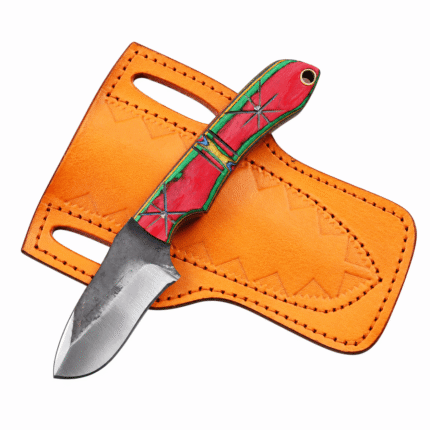
However, no sheath or protective cover is visible in the photograph.
These accessories should not be advertised as included without confirmation.
Keep the knife inaccessible to children.
Follow applicable local laws concerning knife ownership, transportation, and storage.
15. Suitable Customers and Collection Interests
Adult Kitchen Knife Enthusiasts
Customers interested in traditional culinary knife profiles may appreciate the long blade and patterned finish.
Decorative Cutlery Collectors
The flowing metallic pattern and warm-colored handle create an attractive combination.
Fillet-Style Knife Enthusiasts
The narrow tapered blade resembles traditional filleting designs.
Actual flexibility and suitability should be verified before purchasing for a particular culinary task.
Adult Gift Buyers
For an adult who collects decorative knives or kitchen cutlery, this knife may be considered as a gift.
The buyer should confirm packaging, materials, accessories, and intended applications.
16. Product Specifications
| Attribute | Description |
|---|---|
| Product Type | Fixed-blade fillet/slicing-style knife |
| Blade Appearance | Damascus-style patterned finish |
| Blade Color | Silver and charcoal gray |
| Blade Profile | Long, narrow, tapered |
| Blade Tip | Pointed |
| Cutting-Edge Profile | Gently curved |
| Handle Appearance | Reddish-brown wood-grain look |
| Handle Shape | Elongated and gently contoured |
| Decorative Pins | Two silver-colored pins |
| Handle Ornament | Circular gold-and-black insert |
| Rear Opening | Gold-rimmed circular opening |
| Blade Steel | Not verified |
| Genuine Damascus Construction | Not verified |
| Handle Material | Not verified |
| Blade Length | Not provided |
| Overall Length | Not provided |
| Blade Thickness | Not provided |
| Blade Flexibility | Not verified |
| Weight | Not provided |
| Tang Construction | Not verified |
| Included Sheath | Not shown |
17. Important Information Before Ordering
Before purchasing this Wood Handle Damascus Fillet Knife, customers should confirm the actual manufacturer specifications.
The blade steel should be identified.
If genuine pattern-welded Damascus construction is important, the supplier should provide supporting information.
The handle material should also be verified.
Its wood-grain appearance does not establish natural hardwood construction.
For culinary use, the manufacturer should confirm the blade’s dimensions, flexibility, edge condition, food-contact suitability, and intended applications.
Accurate blade length, overall length, thickness, and weight are important for comparing fillet knives.
The seller should also confirm whether protective accessories or custom packaging are included.
If customization is offered, the supplier should specify available options, minimum order quantities, and additional costs.
18. Explore the Wood Handle Damascus Fillet Knife
The Wood Handle Damascus Fillet Knife combines a narrow tapered blade with intricate silver-gray patterns and a rich reddish-brown handle.
Its flowing metallic finish creates decorative interest, while the circular handle ornament and gold-rimmed rear opening provide distinctive details.
The elongated blade profile offers a recognizable fillet- or slicing-style appearance.
For adult cutlery collectors and buyers interested in traditional knife designs, this product offers a distinctive combination of classic styling and patterned metalwork.
Explore this elegant knife and confirm its materials, dimensions, intended applications, and specifications before placing your order.





Reviews
There are no reviews yet.