






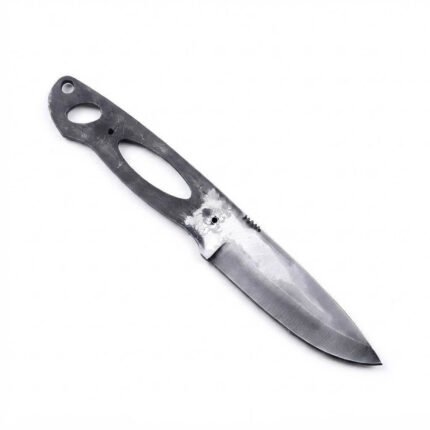
Damascus Gut Hook Skinning Knife – Distinctive Blade Design with Wooden Handle
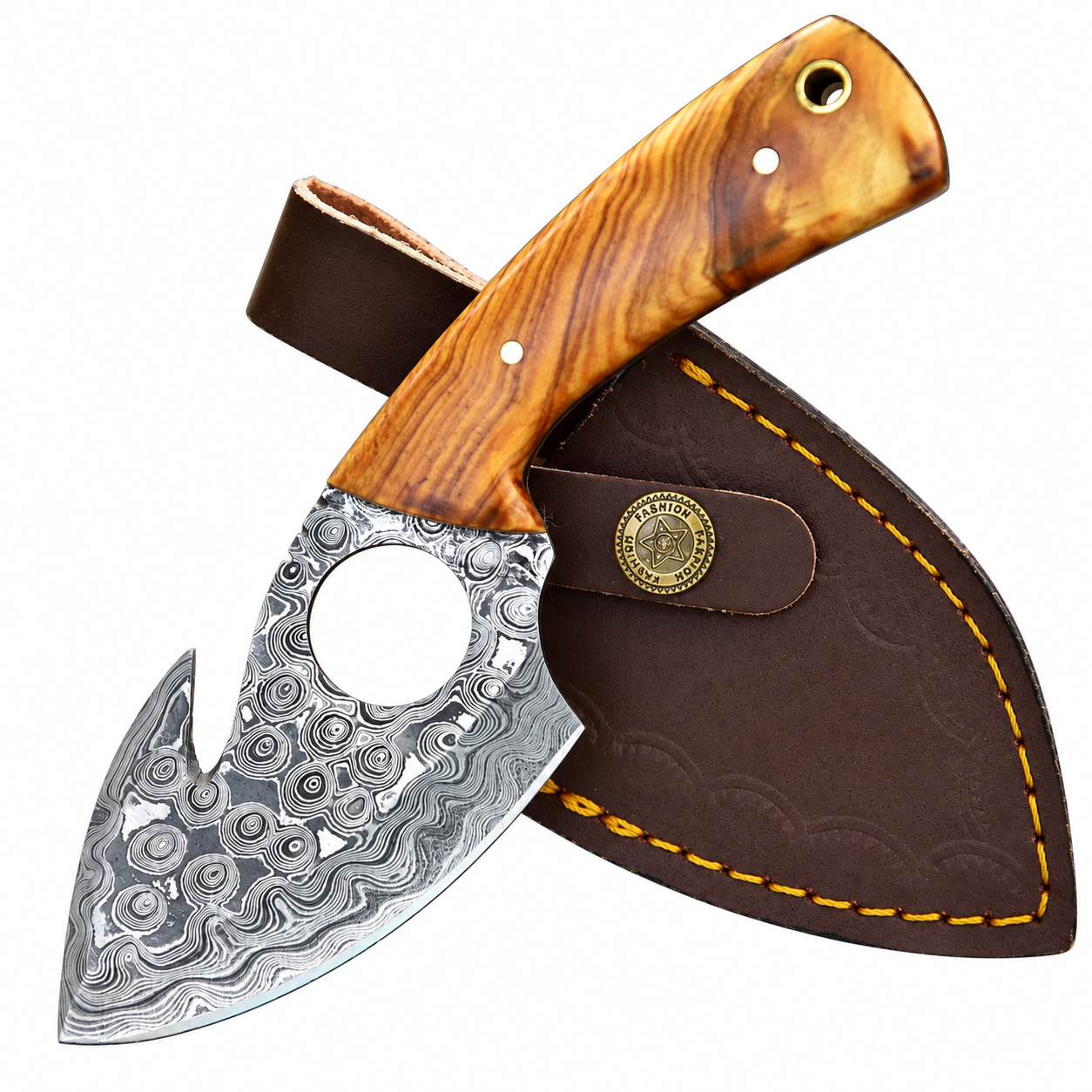
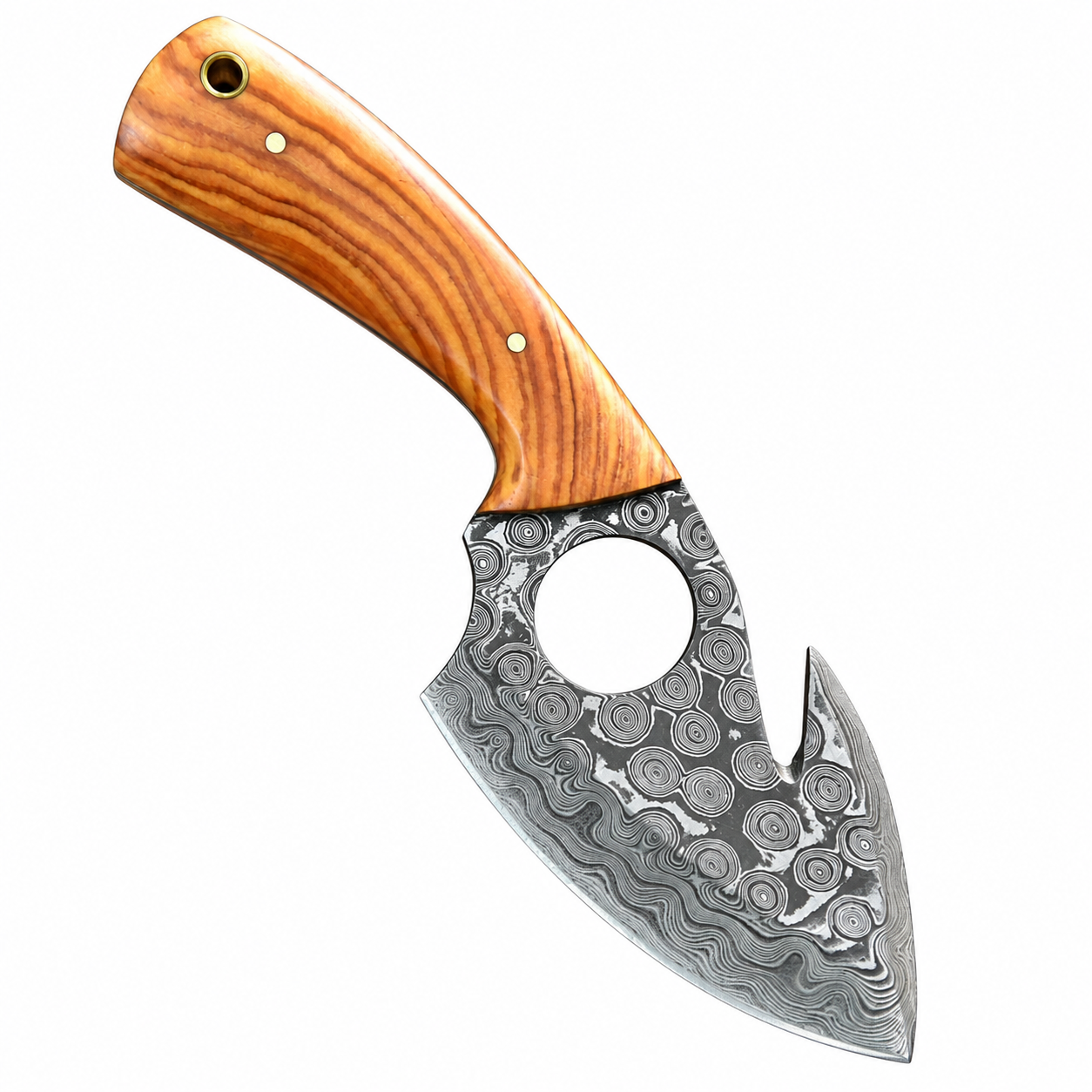
The Damascus Gut Hook Skinning Knife combines an unconventional blade shape with the natural appearance of a wood-grain handle. Featuring a broad patterned blade, a prominent circular finger opening, and a hook-shaped notch along the upper section, this knife stands out from more traditional straight-blade hunting knives.
The combination of curved steel surfaces, contrasting patterns, and warm brown handle tones gives the knife a distinctive appearance. Its unusual profile may appeal to outdoor equipment enthusiasts, knife collectors, and buyers who appreciate specialized knife designs.
Unlike standard hunting knives with narrow blades and simple handle profiles, this model features a wide, curved cutting section and an integrated finger opening. Both elements contribute to its recognizable appearance.
The blade displays a Damascus-style pattern with circular formations resembling overlapping rings. These patterns are surrounded by fine flowing lines that extend toward the pointed tip and curved cutting edge.
A polished-looking edge contrasts with the patterned body of the blade, creating a clear distinction between the cutting profile and the decorative steel surface.
The handle features a light-to-medium brown finish with pronounced natural-looking grain. Its curved shape follows the overall profile of the knife and incorporates small gold-tone circular fittings.
The result is a visually distinctive knife suitable for consideration by collectors and outdoor equipment buyers seeking something different from a conventional hunting knife.
Distinctive Damascus-Style Blade Pattern
One of the most noticeable features of this knife is its intricate blade pattern.
The surface displays numerous rounded formations made up of alternating dark and light rings. Similar designs are commonly associated with patterned steel used in decorative and collectible cutlery.
Rather than featuring a plain polished surface, the blade incorporates detailed contrasting lines across much of its visible area.
These markings form an eye-catching design that becomes especially noticeable around the broad central section of the blade.
The arrangement of circular shapes and flowing lines creates visual depth without requiring additional decoration.
For buyers who appreciate patterned cutlery, the blade’s appearance is one of its defining characteristics.
The contrasting surface also complements the warm brown handle, giving the knife a balanced combination of natural-looking material and ornamental metalwork.
Although the image shows a Damascus-style appearance, the precise manufacturing process and steel composition require confirmation. The pattern alone does not establish whether the blade is made from forge-welded layered steel, another type of patterned steel, or a surface-treated material.
For this reason, the knife should be evaluated according to its verified specifications rather than its appearance alone.
Broad Curved Blade Profile
The knife features a broad blade with a pronounced curved cutting edge.
Its shape differs from the narrow profiles commonly associated with general-purpose pocket knives.
The cutting section extends outward from the handle before sweeping toward a pointed tip. This creates a wide blade face with a continuous curved edge.
A broad cutting profile is commonly found on specialty cutting and skinning knife designs.
The curved shape may be relevant to controlled cutting applications, depending on the actual blade geometry, sharpening angle, material properties, and intended manufacturer specifications.
The broad surface also provides ample space for the distinctive patterned finish, allowing the circular motifs to remain visible across much of the blade.
The edge appears lighter and more polished than the central blade surface.
This difference in finish emphasizes the blade’s outline and highlights its curved geometry.
The point is positioned toward the upper end of the blade, while the cutting edge follows a sweeping curve to the lower section near the handle.
The exact cutting-edge length, overall blade width, and thickness are not available from the photograph.
Customers requiring specific dimensions should consult the confirmed product specifications before purchasing.
Integrated Gut Hook-Style Notch
Near the upper section of the blade is a distinctive hook-shaped opening.
This feature resembles the gut hooks commonly found on certain hunting and field-processing knives.
Gut hook designs are generally associated with specialized outdoor cutting applications, particularly where a recessed cutting feature is useful.
On this knife, the notch is positioned along the upper portion of the broad blade, beneath its projecting pointed section.
Its curved opening creates a noticeable visual separation between the blade’s upper point and the wider body.
The hook also contributes to the unusual silhouette that distinguishes this model from conventional fixed-blade hunting knives.
Although the feature resembles a gut hook, its exact functional purpose, edge sharpness, and performance cannot be established solely from the image.
Buyers should refer to the manufacturer’s instructions and confirmed specifications before using any specialized cutting feature.
Large Circular Finger Hole
Another distinctive part of this design is the large circular opening positioned near the junction of the blade and handle.
The opening is surrounded by the patterned metal surface, giving it a clean and integrated appearance.
Similar finger-hole features appear on certain compact cutting tools and specialty outdoor knives.
A finger opening can influence how a knife is held, but the suitability and safety of any grip depend on the specific design, dimensions, and intended use.
The circular feature is visually prominent and gives the knife a recognizable profile.
It also separates the wooden handle from the forward cutting section without interrupting the overall visual flow of the design.
The circular opening follows the same Damascus-style surface pattern as the surrounding metal.
This continuity contributes to the knife’s cohesive appearance.
The opening’s internal diameter and ergonomic characteristics are not confirmed.
Natural-Looking Brown Wooden Handle
The handle features a smooth, curved profile with an attractive wood-grain appearance.
Its warm orange-brown coloring contrasts with the silver and dark gray blade.
Visible darker grain lines run along the length of the handle, creating a natural-looking decorative finish.
The handle is shaped with a pronounced curve, wider toward its lower end and narrowing near the blade.
This gives it a distinctive appearance compared with conventional straight knife handles.
The image also shows two small gold-tone circular fittings along the handle surface.
These visible fittings contribute to the handle’s overall decorative design.
An additional circular opening with a gold-tone border is positioned near the end of the handle.
This appears consistent with a lanyard-style hole, although its intended use has not been verified.
The handle is suitable for buyers who prefer the appearance of traditional wood-grain finishes rather than brightly colored synthetic designs.
The exact wood species, finishing treatment, moisture resistance, and handle assembly method are not confirmed.
Contrasting Materials and Decorative Details
The knife’s visual appeal comes from the combination of its patterned blade and warm brown handle.
Silver, charcoal gray, brown, and gold-tone details create a balanced color arrangement.
The blade’s flowing Damascus-style lines provide an intricate appearance, while the handle introduces softer natural-looking grain.
The small metal-colored fittings complement the surrounding materials without overpowering the overall design.
This combination makes the knife visually suitable for a product collection featuring decorative outdoor knives, patterned blades, and traditional-looking handle designs.
The contrast between the blade and handle is especially noticeable against a plain background.
Unlike heavily ornamented designs that rely on numerous additional elements, this knife uses its shape and surface patterns as its main visual features.
The broad cutting section, circular opening, hook-shaped notch, and curved handle each contribute to the product’s distinctive appearance.
Fixed-Blade Construction
The knife appears to have a fixed-blade configuration.
A fixed-blade knife differs from a folding knife because the blade is not designed to pivot into the handle during storage.
In the uploaded image, the blade and handle form one continuous external profile, with no visible folding mechanism.
This makes the product visually consistent with the fixed-blade hunting and skinning knife category.
However, the image does not establish whether the knife has full-tang, partial-tang, or another internal construction.
Those details depend on the internal attachment method and cannot be reliably identified from the visible exterior.
The exact blade-to-handle connection, fastener construction, and structural specifications should therefore be confirmed separately.
For accurate e-commerce information, claims about strength, durability, and heavy-duty suitability should be supported by manufacturer data or appropriate product testing.
A Distinctive Addition to a Knife Collection
Collectors often appreciate knives that introduce something different through their blade geometry, decorative finish, or handle design.
This model combines several recognizable design features in one product.
The blade’s circular Damascus-style patterns provide detailed visual interest.
Its broad curved shape differs from standard clip-point and drop-point hunting knives.
The finger opening and hook-shaped notch further distinguish its silhouette.
Meanwhile, the natural-looking handle introduces a traditional visual element that contrasts with the more elaborate blade.
These details may make the knife appealing to collectors who are interested in unusual fixed-blade profiles.
The knife may also suit customers looking for a decorative outdoor accessory or a display piece within a specialty cutlery collection.
Whether the product is appropriate for regular field use depends on confirmed material specifications, edge condition, and manufacturer recommendations.
It is best to avoid assuming that decorative appearance alone establishes cutting performance.
Suitable Buyers and Applications
This knife is primarily relevant to customers interested in hunting-style cutlery, unusual fixed-blade designs, and collectible outdoor equipment.
Its visual characteristics may appeal to buyers who prefer decorative patterned blades over plain steel finishes.
The broad, curved profile places it within the general family of specialty skinning and outdoor knife designs.
The hook-style notch also makes it relevant to customers researching gut hook knife profiles.
Collectors may appreciate its combination of circular patterning, a prominent finger opening, and a curved wooden handle.
For display purposes, its contrasting materials create a visually distinctive composition.
Buyers evaluating it for practical outdoor use should confirm the intended cutting applications and material properties before use.
The image does not establish suitability for heavy cutting, prolonged exposure to moisture, or particular field-processing tasks.
As with any sharp cutting tool, appropriate handling, safe storage, and compliance with applicable local regulations remain important.
Care and Maintenance
Proper care is important for maintaining the appearance and condition of patterned metal blades and wood-handled knives.
The care requirements depend on the blade material and handle finish.
After appropriate use, clean the blade according to the manufacturer’s instructions and dry it thoroughly before storage.
Prolonged moisture exposure can be unsuitable for many carbon-steel blades and some natural wood handles.
If the blade is confirmed to contain corrosion-prone carbon steel, a suitable protective oil may be recommended by the manufacturer.
The wooden handle should generally be protected from prolonged soaking, excessive heat, and harsh cleaning chemicals unless its verified material and finish are specifically designed to tolerate those conditions.
Avoid abrasive cleaning methods that could affect decorative blade patterns or handle finishes.
Store the knife securely with the cutting edge protected.
A compatible sheath or protective case should fit the actual blade shape, including its broad curved edge and hook-style notch.
No sheath is shown in the uploaded photograph, so one should not be advertised as included without separate confirmation.
The knife should be inspected periodically for surface changes, loose fittings, or damage.
Any sharpening or maintenance should follow the manufacturer’s recommended method and the blade’s confirmed steel composition.
Product Appearance and Buying Considerations
When comparing specialized patterned knives, customers should consider more than the outward appearance.
Blade material, overall dimensions, handle construction, weight, cutting-edge finish, and intended use are important factors.
For this product, the visible design provides a clear understanding of its appearance but does not confirm all technical details.
Before purchasing for practical use, buyers should review any available material certificates or manufacturer descriptions.
The steel type should be identified accurately.
If the product is made using forge-welded Damascus steel, that construction can be described once verified.
If the pattern is decorative or produced through another process, the description should reflect that distinction.
Likewise, the handle should only be identified as a specific species of wood when confirmed.
The product’s exact size is particularly important because photographs taken without a measurement reference do not provide a reliable scale.
Buyers should also confirm whether a protective sheath, storage case, or other accessories are included.
For bulk or wholesale purchases, specifications should be consistent across supplied units.
These considerations help customers make an informed purchasing decision based on reliable information rather than assumptions.
Explore a Unique Hunting-Style Knife Design
The Damascus Gut Hook Skinning Knife brings together a broad curved blade, circular finger opening, hook-shaped notch, and wood-grain handle in one distinctive design.
Its silver-and-dark patterned surface contrasts with the warm brown handle and gold-tone fittings, creating an appealing appearance for collectors and enthusiasts of specialized outdoor cutlery.
For customers seeking an unusual knife profile with decorative detailing, this model offers a recognizable alternative to more conventional fixed-blade designs.
Explore this distinctive patterned skinning knife and review its confirmed specifications to determine whether it suits your collection or intended application.







Reviews
There are no reviews yet.