



Damascus Pattern Chef Knife with Two-Tone Handle and Protective Sheath
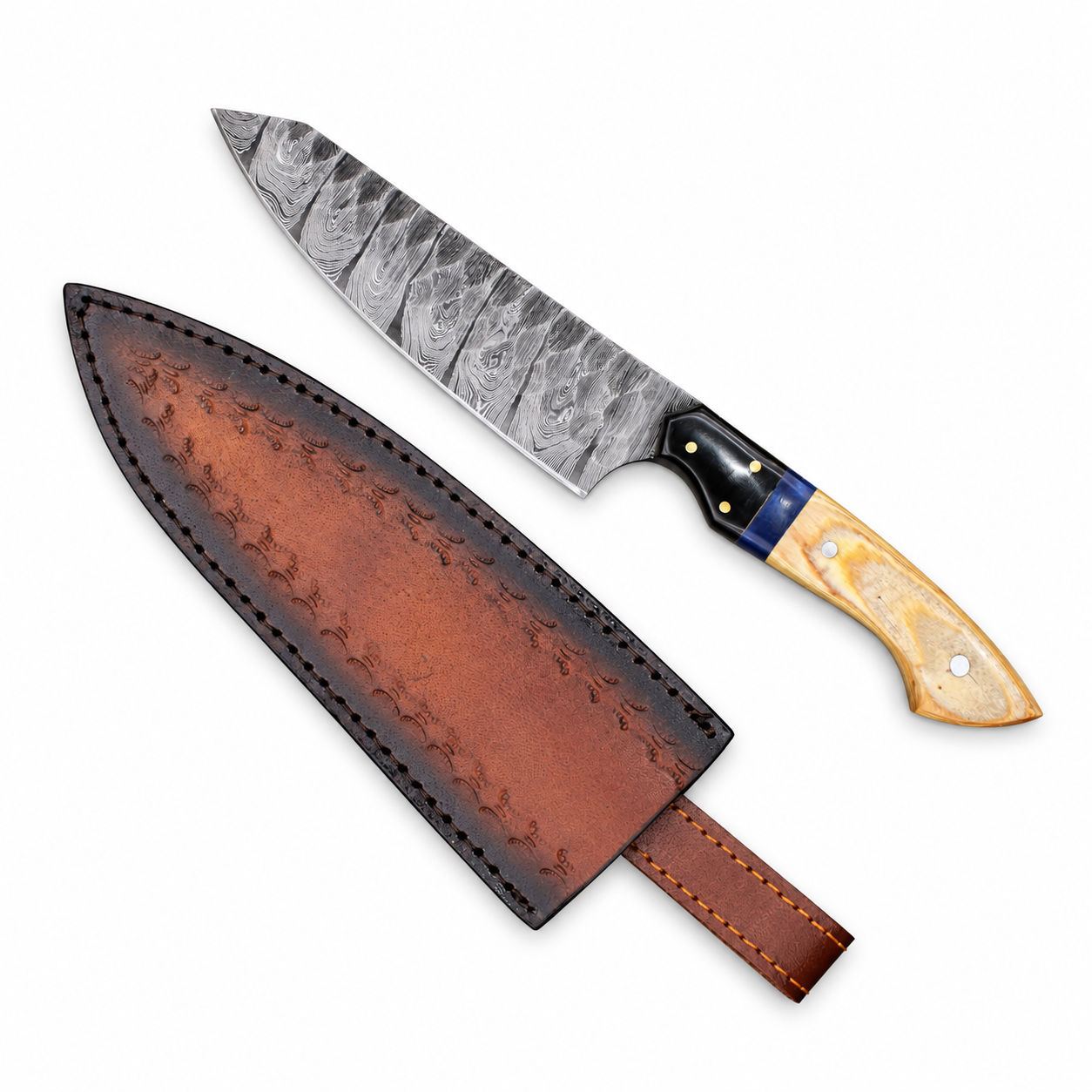
The Damascus Pattern Chef Knife combines a broad, pointed blade with striking flowing patterns, a distinctive two-tone handle, and a traditional brown leather-style sheath. Its design brings together the practical shape of a chef knife and the visual appeal of patterned metalwork, making it an interesting choice for kitchen knife buyers, cooking enthusiasts, and collectors of decorative culinary tools.
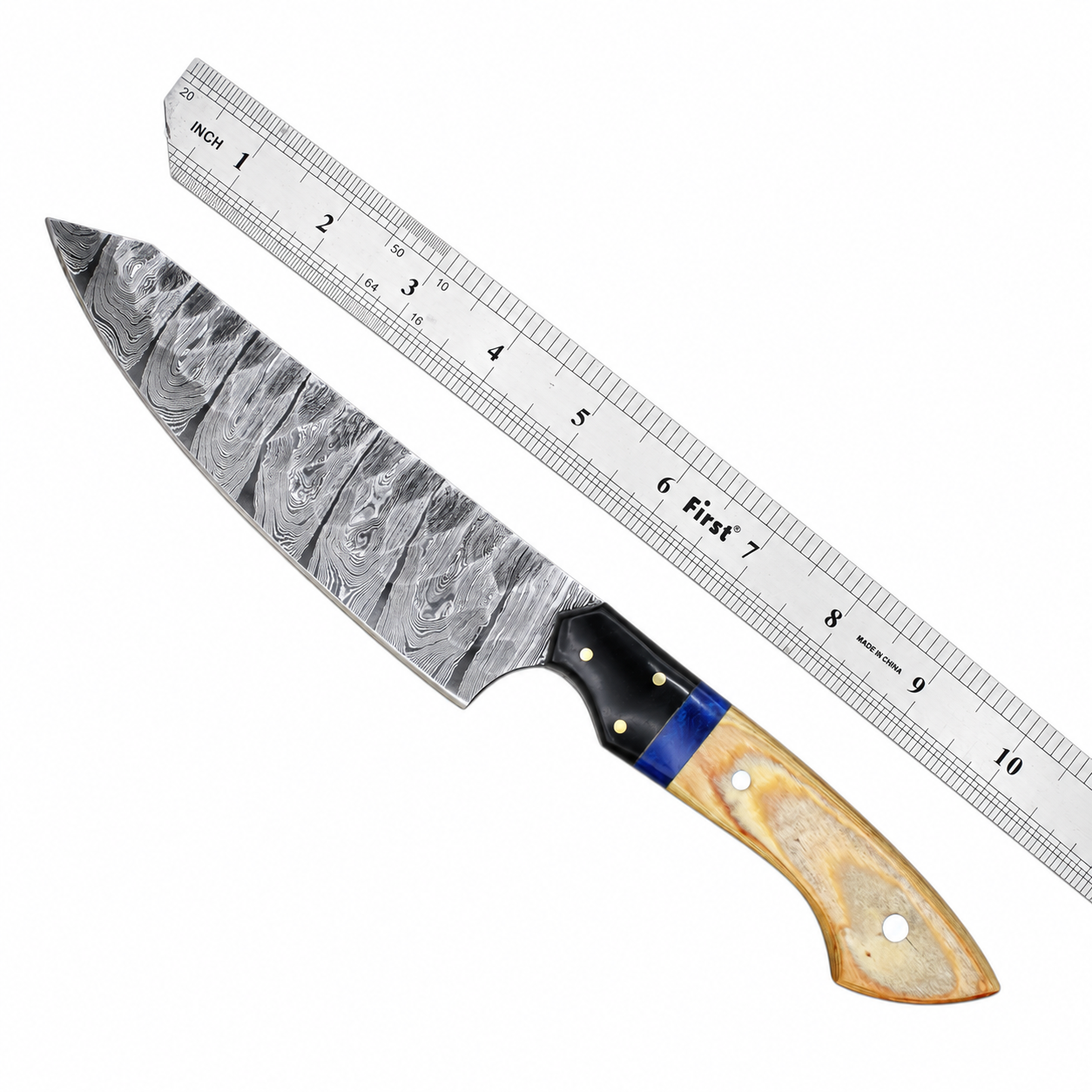
The blade features a combination of silver-gray and darker swirling lines, creating a layered appearance across its surface. Its long cutting edge curves gently toward a pointed tip, giving the knife the familiar silhouette of a multipurpose chef knife. The handle is equally distinctive, combining glossy black detailing, a blue accent band, and a warm cream-colored section with natural-looking marbled patterns.
A separate brown sheath completes the presentation. Its stitched edges, decorative impressions, and extended carrying loop complement the knife’s traditional styling.
The result is a visually distinctive kitchen knife design that can appeal to customers looking for an alternative to conventional plain-blade cutlery.
Distinctive Damascus-Style Blade Pattern
The most noticeable feature of this knife is its patterned blade.
Instead of a plain metallic surface, the blade displays flowing lines that resemble the layered structure often associated with Damascus steel.
The patterns extend across much of the blade, creating a combination of light silver-gray and dark wavy details.
Different sections contain curved, flowing, and closely spaced lines that give the surface a distinctive appearance.
These patterns add depth to the blade’s design and provide an attractive contrast against the darker handle.
Damascus-style blades are popular among customers who appreciate decorative metal finishes and traditional-inspired knife designs.
However, an important distinction should be made between genuine layered Damascus steel and a Damascus-style surface pattern.
The photograph confirms the visible patterned appearance but cannot identify the actual steel construction.
The manufacturer should confirm whether the blade uses layered Damascus steel, patterned stainless steel, or another material and finishing process.
Broad Chef Knife Blade Design
This Damascus Pattern Chef Knife features a broad blade with a gently curved cutting edge and pointed tip.
The blade becomes wider near the handle and tapers toward the front, creating a familiar chef knife profile.
This type of shape is commonly associated with kitchen food preparation tasks such as slicing vegetables, preparing ingredients, and cutting food into smaller portions.
The pointed front section may be useful for controlled work, while the longer cutting edge offers a broad contact area for ordinary kitchen preparation.
The exact performance depends on the blade’s material, geometry, sharpening, and manufacturing quality.
From the image, the knife has a continuous cutting-edge profile and a visibly defined tip.
Its edge angle, sharpness, hardness, thickness, and balance cannot be measured from the photograph.
Customers interested in professional kitchen use should review the manufacturer’s technical specifications before purchasing.
Elegant Black and Cream Handle
The handle contributes significantly to the knife’s overall appearance.
Its front section is glossy black, creating a strong visual contrast with the silver-gray blade.
Small circular gold-colored fittings are visible in this section.
These details add decorative character while giving the handle a coordinated appearance.
A narrow blue band separates the black section from the lighter rear portion.
The blue accent creates a distinctive transition between the two handle colors.
The rear section has a cream, ivory, and golden appearance with natural-looking marbled variations.
The combination produces a warm finish that complements the cooler metallic tones of the blade.
This handle design is particularly suitable for customers who appreciate contrasting colors and decorative details in culinary cutlery.
The exact handle materials are not confirmed. The cream-colored section may have a bone-like or resin-like appearance, but it should not be advertised as genuine bone without supplier verification.
Curved Handle Profile
The handle has a gently curved shape rather than a completely straight design.
Its contour is visible along the lower side, where the profile gradually changes toward the rear.
The end of the handle widens slightly, creating a distinctive finishing shape.
This curved appearance gives the knife an attractive silhouette.
Handle contour is an important consideration when choosing kitchen cutlery because it affects how the knife sits in the hand.
Different users may prefer different handle shapes depending on hand size, cutting technique, and personal comfort.
The design looks shaped for handheld use, but its ergonomic performance cannot be evaluated from a product photograph alone.
Before describing it as non-slip or ergonomically tested, the manufacturer’s specifications should be reviewed.
Brown Leather-Style Protective Sheath
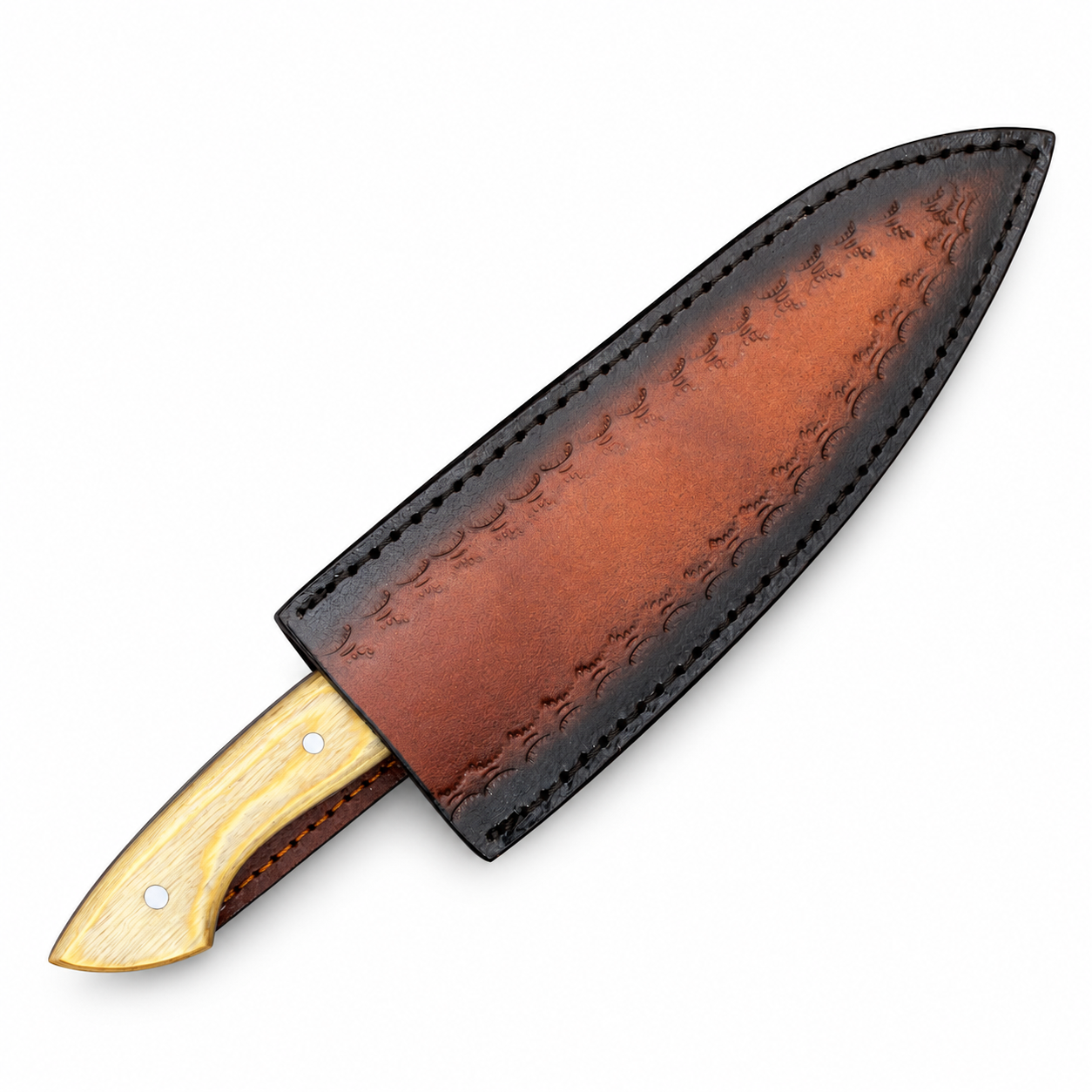
A separate brown sheath is shown alongside the chef knife.
The sheath has a warm reddish-brown center with darker brown edges.
Its outline follows the general shape of the blade, suggesting that it has been designed as a fitted cover.
Visible stitching runs around the outer edge.
Decorative stamped-style details appear across the front surface, giving the cover a traditional finish.
An extended strap or loop is attached near the lower part of the pictured sheath.
This detail may be intended for carrying, attachment, or securing the cover, although its exact function should be confirmed.
A correctly fitted protective sheath can help reduce accidental contact with the blade during storage.
It may also help keep the cutting edge separated from other kitchen accessories.
The image does not establish whether the sheath is made from genuine leather, synthetic leather, or another material.
A Distinctive Addition to Kitchen Cutlery
Kitchen knives are available in many blade shapes, handle styles, and decorative finishes.
Some feature minimalist steel surfaces and plain handles, while others emphasize visual craftsmanship.
This knife falls into the second category because of its patterned blade and contrasting handle sections.
The swirling metal appearance creates an attractive focal point.
The dark front handle, blue band, and golden cream-colored rear section provide additional character.
The brown sheath adds a coordinated storage accessory.
These elements make the knife visually different from standard kitchen cutlery.
For customers who enjoy collecting chef knives or displaying culinary tools, its decorative styling may be especially appealing.
The combination also makes the knife a potential gift option for adult cooking enthusiasts, provided its actual quality and intended use meet the buyer’s expectations.
General Kitchen Preparation
Chef knives are commonly used for several everyday kitchen tasks.
Their broad blades are often selected for preparing vegetables, cutting boneless ingredients, and working with fruits and herbs.
A gently curved cutting edge can support different cutting motions depending on the knife’s geometry.
The pointed tip can also be useful for more controlled ingredient preparation.
This product has the visual shape of a multipurpose chef knife, but its suitability for particular tasks depends on verified construction details.
Before using the knife, customers should confirm that it is manufactured as food-preparation cutlery and that its materials and finish are suitable for food contact.
It should not be used for cutting bones, frozen food, or hard materials unless the manufacturer specifically approves those applications.
Such activities may damage the cutting edge or blade.
For ordinary kitchen use, a stable cutting board and appropriate cutting technique are important.
Decorative Appeal for Knife Enthusiasts
Customers interested in distinctive knife designs may appreciate the combination of traditional and contemporary styling.
The blade’s flowing appearance is reminiscent of layered metalwork.
The black front handle gives the design a clean modern contrast.
The narrow blue accent provides a subtle touch of color.
The rear handle section introduces warm cream and golden tones.
Together, these features create a recognizable visual identity.
Knife enthusiasts often compare products based on appearance, blade shape, handle construction, and material specifications.
This knife provides several visible features that distinguish it from plain stainless-steel chef knives.
For serious collectors, the manufacturer should also provide information about the actual steel grade, production method, and overall dimensions.
These details are important when assessing authenticity and value.
Blade Design and Construction Considerations
The blade appears to have a broad body with a patterned metallic finish.
Its pointed tip and gently curved edge are consistent with a traditional chef knife silhouette.
The blade transitions into the handle through a narrower section.
The photograph does not show the complete internal construction.
Therefore, the knife cannot be confirmed as full tang or partial tang.
The handle fittings visible in the photograph do not establish the actual internal attachment system.
Likewise, the image does not provide information about steel hardness, heat treatment, or long-term edge retention.
These specifications are important for buyers who prioritize cutting performance.
A verified product specification sheet should be used to confirm them.
Until those details are available, the knife is most accurately described by its visible construction and design.
Kitchen Knife Care and Cleaning
Proper care helps maintain the appearance and condition of kitchen knives.
After use, clean the blade using a soft sponge and mild dishwashing detergent, provided the manufacturer confirms the finish is suitable for normal handwashing.
Avoid aggressive abrasive pads that may damage the decorative surface.
Dry the knife thoroughly after cleaning.
Moisture left on certain steel surfaces can contribute to corrosion, particularly if the blade contains materials that require additional maintenance.
The exact corrosion resistance of this knife is not verified.
For that reason, handwashing and immediate drying are sensible precautions.
Avoid prolonged soaking.
Do not place the knife in a dishwasher unless the manufacturer specifically confirms that it is dishwasher safe.
The decorative handle sections may require additional care depending on their actual material.
Protecting the Cutting Edge
The cutting edge should be protected when the knife is not in use.
A correctly fitted sheath may help separate the blade from surrounding objects during storage.
Before inserting the knife, check that the sheath is clean and dry.
Make sure the knife fits securely and that the cutting edge does not contact exposed stitching or other vulnerable areas.
Do not force the blade into a sheath that is too narrow or incorrectly shaped.
If the cover becomes damaged, replace it or use another appropriate protective storage method.
A knife block, suitable blade guard, or dedicated knife storage system may also be used.
The storage method should keep the edge protected and the knife inaccessible to children.
Sharpening and Maintenance
Kitchen knives may require periodic sharpening depending on their steel, edge geometry, and frequency of use.
Using the correct sharpening method is important for preserving the cutting edge.
The appropriate sharpening angle cannot be determined from this image.
Owners should consult the manufacturer’s recommendations before sharpening.
Improper sharpening may remove excessive material or alter the original blade profile.
Use a suitable sharpening system for the confirmed blade material.
Regular inspection is also recommended.
Check the cutting edge for chips, deformation, or unusual wear.
Inspect the handle for looseness or visible damage.
A damaged knife should not be used until it has been evaluated or repaired appropriately.
Caring for the Decorative Handle
The two-tone handle deserves attention because of its contrasting finishes.
The glossy black section may show fingerprints or surface marks after handling.
A soft cloth can help remove ordinary dust and residue.
The blue accent should be cleaned gently.
The cream-colored rear portion should also be protected from aggressive chemicals.
Because the exact handle material is unknown, avoid prolonged exposure to water, strong solvents, and extreme temperatures.
Do not apply wood oil or other conditioning products unless the manufacturer confirms that they are appropriate.
Inspect the visible fittings periodically.
If the handle develops cracks, looseness, or separation around its decorative sections, discontinue use until the product has been assessed.
Suitable for Different Customers
This knife design may appeal to several types of adult customers.
Home cooking enthusiasts may appreciate its recognizable chef knife shape.
Knife collectors may be interested in its patterned blade and contrasting handle.
People who enjoy decorative culinary tools may prefer its traditional-inspired appearance.
Retailers selling kitchen cutlery may also find the design suitable for a decorative chef knife collection.
The accompanying sheath may be particularly interesting to customers who value covered storage.
Practical buyers should evaluate the manufacturer’s specifications before choosing the knife for regular or intensive food preparation.
Its actual performance should be assessed independently of its decorative appearance.
Product Specifications
| Specification | Details |
|---|---|
| Product Type | Chef knife |
| Blade Style | Broad, pointed chef knife blade |
| Blade Appearance | Damascus-style flowing pattern |
| Blade Color | Silver-gray and dark gray |
| Handle Color | Black, blue, cream and golden tones |
| Handle Profile | Slightly curved |
| Handle Details | Decorative circular fittings |
| Handle Material | Not verified |
| Blade Material | Not verified |
| Steel Grade | Not verified |
| Pattern Manufacturing Method | Not verified |
| Sheath | Brown leather-style cover shown |
| Sheath Details | Decorative stamping, stitching and extended loop |
| Sheath Material | Not verified |
| Blade Length | Not verified |
| Overall Length | Not verified |
| Blade Thickness | Not verified |
| Steel Hardness | Not verified |
| Handle Construction | Not verified |
| Food Contact Suitability | Not verified |
| Customization Options | Not verified |
Responsible Handling
Treat this knife as a sharp cutting instrument.
Keep fingers away from the cutting edge and pointed tip.
Use a stable cutting surface during food preparation.
Never attempt to catch a falling knife.
Avoid leaving the knife loose in a sink or drawer.
Store it securely with a properly fitted protective cover or another suitable storage system.
Keep it out of the reach of children.
Do not use the knife for prying, striking, or cutting unsuitable materials.
Follow the manufacturer’s care recommendations and applicable safety guidance.
Why Choose This Damascus Pattern Chef Knife?
This knife offers a distinctive combination of visual details.
The broad patterned blade creates an attractive appearance.
The black, blue, and cream handle sections provide contrast.
The curved handle profile gives the knife a recognizable shape.
The brown leather-style sheath complements the decorative design.
Together, these features produce a chef knife that stands apart from conventional plain-blade cutlery.
Its combination of patterned metalwork and traditional-inspired styling makes it particularly interesting for customers who appreciate visually distinctive kitchen tools.
For buyers seeking reliable cutting performance, confirmed specifications should remain an essential part of the purchasing decision.
Explore This Distinctive Chef Knife Design
The Damascus Pattern Chef Knife combines a flowing silver-gray blade pattern, a contrasting two-tone handle, and a brown leather-style sheath.
Its decorative appearance and familiar chef knife profile make it an interesting addition to a kitchen cutlery collection.
Explore this distinctive chef knife and review the confirmed material and manufacturing specifications to determine whether it meets your culinary needs.






Reviews
There are no reviews yet.