







Damascus Pattern Slicing Knife – Elegant Blade Design with Red Wood-Style Handle
The Damascus Pattern Slicing Knife combines a distinctive patterned blade, a rich reddish-brown handle, and a long, curved cutting profile. Its appearance blends the styling of traditional patterned knives with the clean lines of a modern slicing and carving blade.
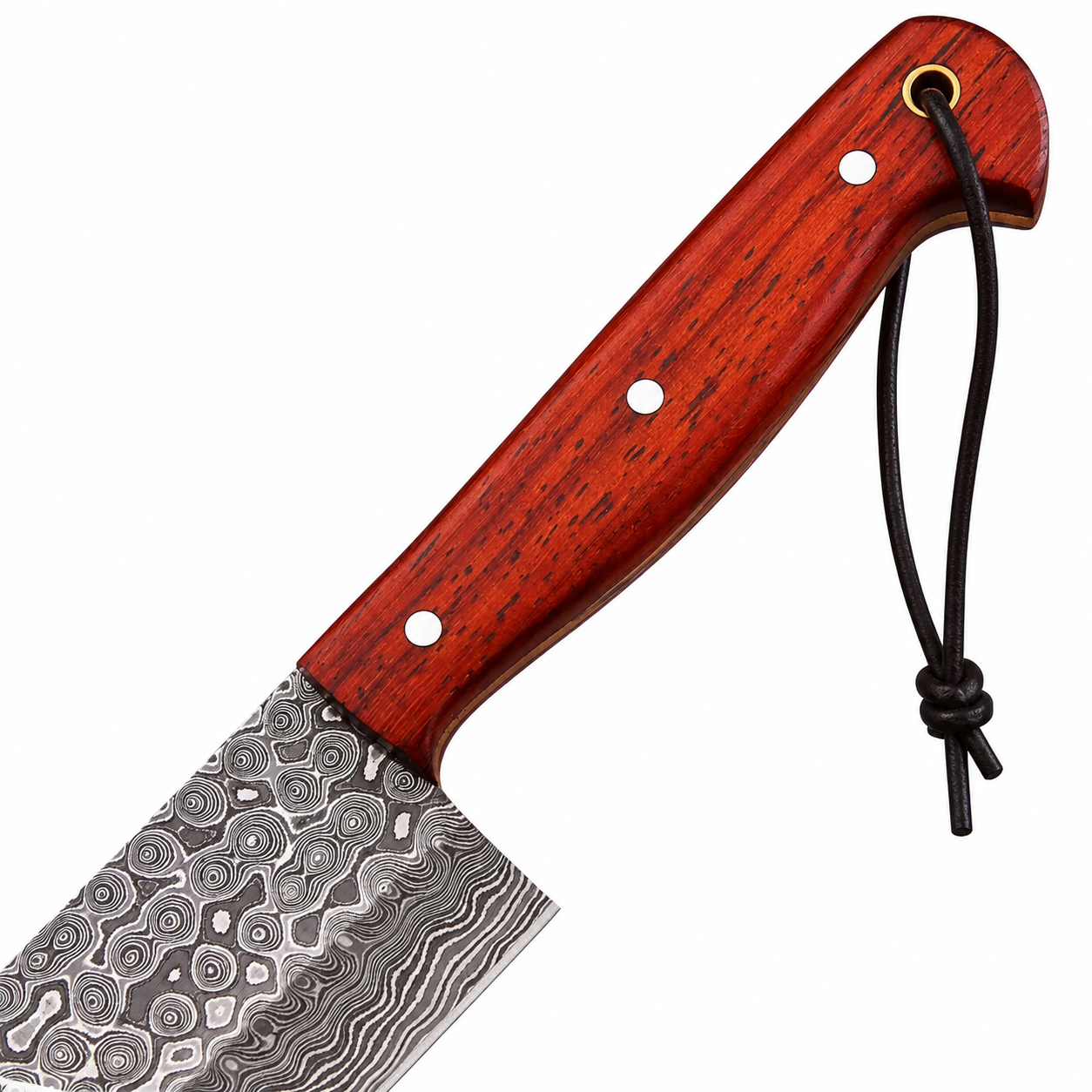
The knife features an extended silver-gray blade decorated with intricate waves, circular formations, and flowing lines. These patterns create a striking contrast across the metal surface, making the blade visually different from a conventional plain-finish kitchen knife.
Its reddish-brown handle displays a wood-grain-like texture, a gently curved profile, and three visible silver-colored fastening pins. A black cord lanyard is attached through a small metallic eyelet at the handle’s rear.
The combination of the patterned blade and warm handle color gives this knife an attractive appearance for kitchen knife enthusiasts and collectors.
While its profile suggests a slicing or carving application, practical food preparation suitability should be confirmed through the manufacturer’s specifications before it is marketed as a food-contact kitchen tool.
Distinctive Damascus-Style Blade Pattern
The most noticeable feature of this knife is its detailed blade pattern.
The visible surface displays multiple flowing lines, ring-like shapes, and irregular layered formations. The patterns extend from near the handle toward the pointed blade tip.
A series of darker gray markings contrasts with lighter silver-colored areas, producing a textured appearance.
Closer to the blade’s center, the pattern includes small circular shapes surrounded by winding lines.
Toward the cutting edge, the markings gradually transition into more elongated formations that follow the blade’s curve.
This intricate design gives the knife a traditional Damascus-inspired appearance.
Genuine Damascus steel is commonly associated with pattern-welded or layered metal construction. However, similar-looking patterns may also be produced through surface treatments.
The visible photograph does not establish the manufacturing method or whether the blade is made from genuine pattern-welded steel.
For this reason, the product is accurately described as having a Damascus-style patterned blade until the material is verified.
The steel composition, hardness, heat treatment, and corrosion resistance should be confirmed separately.
Long, Curved Slicing Blade
This knife features a relatively long and narrow blade that gradually tapers toward a pointed tip.
The cutting edge follows a sweeping curve, creating an elongated cutting profile.
This shape is commonly associated with slicing and carving knives, although the exact intended application depends on the blade’s physical specifications.
The blade appears noticeably longer than the handle, contributing to its streamlined design.
Its pointed end distinguishes it from cleavers and other broad, square-tipped kitchen knives.
The curved cutting edge also gives the knife a different silhouette from straight-edged utility blades.
A suitable slicing knife is generally selected for controlled cuts through appropriate food ingredients or other approved materials.
However, performance depends on several factors, including blade geometry, edge sharpness, thickness, material, and construction quality.
These properties cannot be reliably measured from the product photograph.
Customers should confirm the actual cutting-edge length and intended purpose before purchasing.
Reddish-Brown Wood-Style Handle
The handle features a rich reddish-brown finish with visible dark grain-like markings.
Its warm color provides an attractive contrast against the silver-gray patterned blade.
The surface resembles polished wood, although the exact material may be natural wood, stabilized wood, composite, or another manufactured material.
The photograph alone cannot establish the handle’s composition.
The handle has an elongated shape with gentle contours along its upper and lower edges.
It widens slightly near the rear before tapering into the end section.
This curved appearance gives the knife a traditional yet understated design.
Three circular silver-colored pins are visible along the side of the handle.
These pins add a decorative metallic accent and appear to be associated with the handle’s construction.
The precise handle assembly and tang configuration should be confirmed by the manufacturer.
The smooth-looking surface and natural-style coloring make the handle an important part of the overall visual design.
Decorative Handle Pins
Three visible silver-colored circular pins are positioned along the reddish-brown handle.
The pins are spaced between the blade junction and the rear section.
Their reflective appearance contrasts with the darker grain lines on the handle.
Decorative pins are common on kitchen knives and fixed-blade knives because they provide a recognizable traditional appearance.
Depending on the construction, pins may also form part of the mechanism securing handle scales to a blade tang.
However, the image does not reveal the knife’s internal construction.
It would therefore be inaccurate to claim that this knife has a full tang or a particular fastening method without supplier confirmation.
The visible pins are best described as silver-colored handle pins.
Black Cord Lanyard
Another distinctive feature is the black cord attached to the handle.
The cord passes through a small brass-colored eyelet near the handle’s rear.
It forms a loop with a knot at the end.
The black color creates a strong contrast against the reddish-brown handle.
Lanyards are commonly found on outdoor knives and certain specialty blades.
They can provide an additional handling or attachment option where appropriate.
For kitchen use, however, the cord should be kept away from food-contact surfaces and moving equipment.
Its suitability for a particular application should be assessed before use.
The black lanyard adds a recognizable design detail that distinguishes this knife from many traditional kitchen slicing knives.
A Distinctive Design for Knife Enthusiasts
Knife enthusiasts often appreciate the combination of attractive blade finishes and contrasting handle materials.
This model offers both features.
The patterned blade provides the strongest visual element, while the reddish-brown handle balances the overall design.
The silver-colored pins create small metallic accents.
The black lanyard adds a functional-looking detail without changing the blade’s streamlined silhouette.
Customers interested in collecting patterned fixed-blade knives may find this combination appealing.
The knife can also be considered by people who appreciate traditional blade designs and distinctive decorative finishes.
Collectors should verify the manufacturer, steel composition, and authenticity of any Damascus-related claims.
A patterned surface alone does not prove that a knife has been hand-forged or produced using a particular number of steel layers.
Slicing and Carving Applications
The knife’s elongated blade profile resembles designs commonly used for slicing and carving.
Slicing knives are often selected when longer cutting motions are desirable.
A long blade can be useful for making continuous cuts when its geometry, sharpness, and dimensions are appropriate.
Carving knives are also commonly designed with relatively narrow blades and pointed tips.
These characteristics help distinguish them from general-purpose chef knives.
The model pictured has a pointed tip and an extended curved cutting edge.
These visual characteristics suggest a slicing-oriented design.
However, actual kitchen performance cannot be established without testing or verified technical specifications.
Before using it for food preparation, confirm that the blade materials, surface finish, handle construction, and production process are suitable for food contact.
The lanyard should also be managed appropriately in a kitchen environment.
The Appeal of Patterned Blades
Patterned blades have a long association with decorative craftsmanship and knife collecting.
Their visual character comes from the contrast between different lines, shapes, and shades across the blade surface.
In this knife, the pattern includes several recognizable formations.
Some areas contain circular markings, while others display closely spaced wavy lines.
The combination produces an intricate appearance across the blade.
Rather than featuring a completely uniform metallic surface, the knife displays visual variation from the base to the tip.
This makes the blade particularly noticeable in product photography.
The appearance may appeal to customers who prefer knives with decorative metalwork rather than a standard satin or polished finish.
When buying a patterned knife, it is important to distinguish the visual finish from the underlying material specification.
A decorative pattern does not establish the blade’s hardness, durability, or edge retention.
These characteristics require actual testing or verified manufacturer data.
A Modern Look with Traditional Details
The knife combines several styling elements.
The elongated blade has a relatively contemporary profile.
Its flowing surface markings introduce a more traditional appearance.
The reddish-brown handle adds warmth to the overall design.
The three silver-colored pins are simple, understated details.
The black cord lanyard creates another contrasting element at the rear.
Together, these features produce a knife that is visually different from many plain kitchen blades.
The design may suit customers who appreciate distinctive cutlery and decorative fixed-blade knives.
Its appearance is particularly suitable for product photography that highlights the blade surface and handle texture.
Handle Shape and General Handling Considerations
Handle design is an important consideration when choosing a knife.
The shape influences how the knife is held and how it feels during use.
This model has an elongated handle with gently curved edges.
The design appears to provide space for a conventional hand grip, although actual comfort depends on the user’s hand size and the knife’s dimensions.
The handle’s smooth-looking finish may also affect the way it feels when held.
Grip security cannot be determined from the image.
Customers should evaluate the handle dimensions, surface texture, weight, and balance before selecting the knife for demanding tasks.
A knife intended for frequent food preparation should be comfortable and appropriate for the intended cutting activity.
The manufacturer should confirm whether the handle is suitable for wet kitchen conditions.
Understanding the Blade Material
The term Damascus is often used to describe blades displaying layered or flowing visual patterns.
Modern Damascus blades may be manufactured using pattern-welded steel or other specialized methods.
The properties of the finished knife depend on the actual alloys, heat treatment, blade geometry, and manufacturing quality.
Some commercially available knives feature decorative patterns designed to resemble Damascus steel.
Therefore, the visible pattern should not be used as the sole basis for identifying the blade material.
This listing describes the knife as a Damascus-pattern model because that accurately reflects its visible appearance.
The exact steel grade remains unverified.
If the manufacturer provides documentation confirming genuine Damascus construction, the product specification can be updated accordingly.
Until then, claims about steel-layer counts, hardness ratings, rust resistance, and special forging methods should be avoided.
Caring for the Blade
Proper cleaning and storage are important for maintaining the appearance of patterned knife blades.
After suitable use, gently clean the blade according to the manufacturer’s instructions.
Remove any residue that may remain on the surface.
Dry the blade thoroughly before storing it.
Avoid leaving the knife in prolonged contact with moisture.
The correct cleaning products depend on the blade’s actual steel composition and surface treatment.
Harsh chemicals or abrasive cleaning materials may damage certain finishes.
If the manufacturer confirms that the blade is suitable for food preparation, follow the recommended food-safe cleaning and maintenance procedures.
Do not assume the knife is dishwasher-safe.
Manual cleaning and careful drying are generally preferable for specialty knives unless otherwise specified by the manufacturer.
Maintaining the Handle
The reddish-brown handle is one of the knife’s most noticeable design features.
To preserve its appearance, remove surface dust and residue using appropriate cleaning methods.
Avoid unnecessary exposure to harsh chemicals.
Do not soak the handle in water.
Natural wood and synthetic composite handles may require different maintenance procedures.
If the handle is confirmed to be natural wood, the manufacturer may recommend particular conditioning products.
If it is made from resin or another synthetic material, the care instructions may differ.
The handle pins and rear eyelet should also be kept clean.
The attached cord should be inspected for wear and cleaned or replaced as appropriate.
Proper Knife Storage
Store the knife in a dry location away from children.
Because the blade is fixed and exposed in the photograph, suitable blade protection is important during storage and transportation.
A correctly fitted sheath, protective cover, or knife storage system can help reduce accidental contact with the cutting edge.
No sheath or protective cover is visible in the uploaded image.
Such accessories should not be advertised as included unless confirmed by the supplier.
The knife should not be stored loosely among other utensils where the exposed edge may create a hazard.
For kitchen storage, choose a method appropriate to the knife’s size and design.
Always follow applicable regulations regarding knife possession, transport, and use.
What Makes This Knife Different?
This knife has several recognizable visual characteristics.
The blade’s extended profile distinguishes it from compact pocket knives.
Its intricate gray pattern provides a decorative surface.
The pointed tip and curved edge create a streamlined appearance.
The reddish-brown handle introduces warm color and grain-like texture.
Three visible silver-colored pins complement the overall design.
The black lanyard and brass-colored rear eyelet provide additional details.
These features create a distinctive knife that may appeal to collectors and customers interested in decorative slicing knives.
The combination of a long patterned blade and a red wood-style handle is the central design characteristic of this model.
Product Specifications
| Feature | Details |
|---|---|
| Product type | Fixed-blade slicing/carving-style knife |
| Blade appearance | Damascus-style patterned |
| Blade color | Silver-gray with dark pattern lines |
| Blade profile | Long, curved edge with pointed tip |
| Handle color | Reddish brown |
| Handle appearance | Wood-grain style |
| Handle material | Not verified |
| Handle pins | Three visible silver-colored pins |
| Lanyard | Black cord with knot |
| Lanyard eyelet | Brass-colored |
| Blade steel | Not verified |
| Blade length | Not verified |
| Overall length | Not verified |
| Blade thickness | Not verified |
| Weight | Not verified |
| Food-contact suitability | Not verified |
| Sheath | Not shown |
| Customization | Not verified |
Choosing the Right Slicing Knife
When selecting a slicing knife, buyers should consider more than appearance.
The blade length should be appropriate for the intended task.
The handle should provide suitable control and comfort.
The steel grade and blade geometry should match the intended cutting application.
If the knife is intended for food preparation, the materials and finish should be suitable for food contact.
Buyers should also review care requirements, especially for specialty patterned blades.
A knife that looks attractive in photographs may have different handling characteristics from another model with a similar design.
Comparing verified dimensions and specifications helps customers make informed purchasing decisions.
Final Thoughts
The Damascus Pattern Slicing Knife with Red Wood-Style Handle and Lanyard offers a distinctive combination of flowing blade patterns, warm handle colors, and a long curved blade profile.
Its three silver-colored handle pins, brass-colored eyelet, and black lanyard add recognizable details.
For collectors and enthusiasts interested in decorative fixed-blade knives, this model offers an attractive visual design.
Explore this patterned slicing knife and confirm the materials, dimensions, and intended applications before placing an order.







Reviews
There are no reviews yet.