






Damascus Pattern Kitchen Knives – Five Distinctive Kitchen Blade Designs
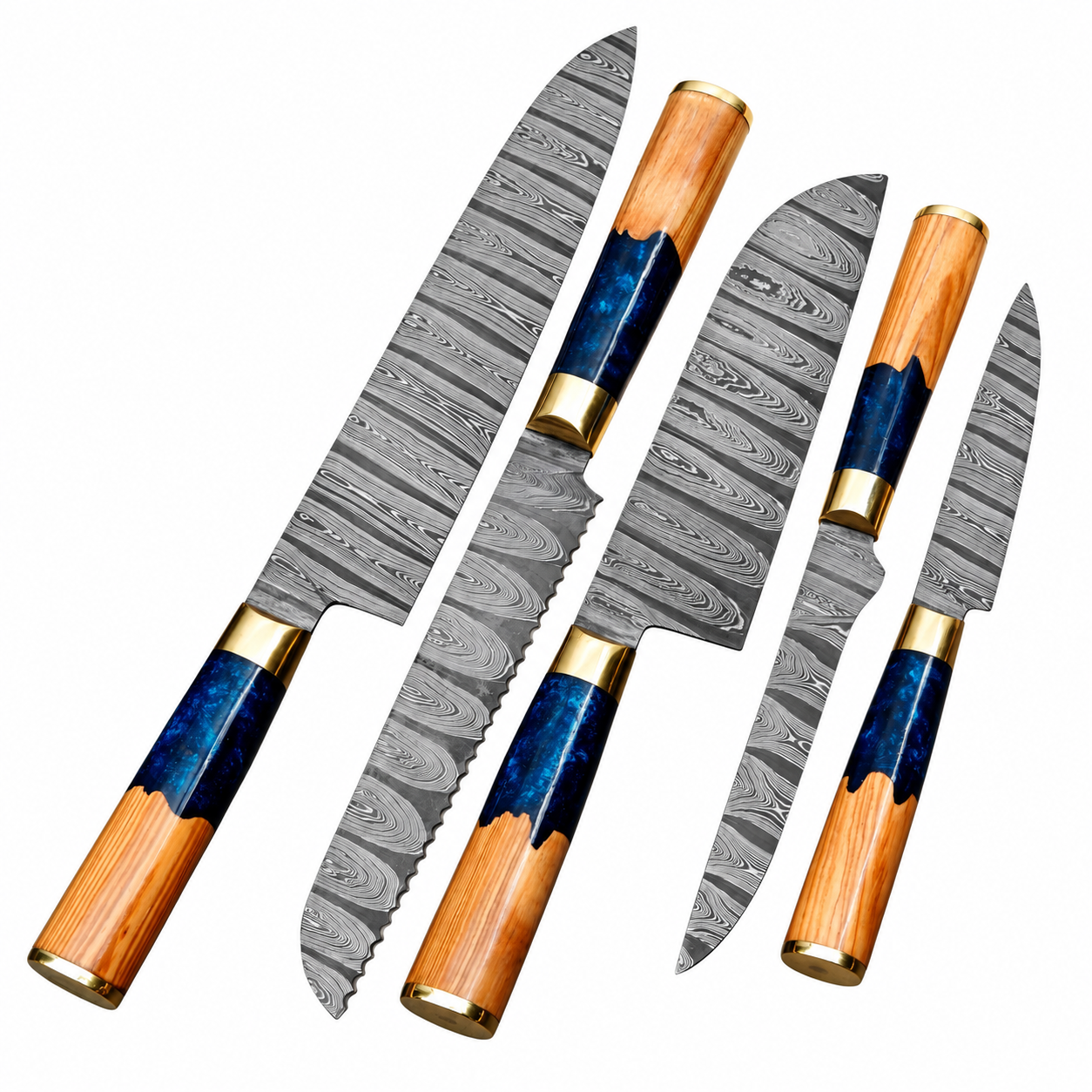
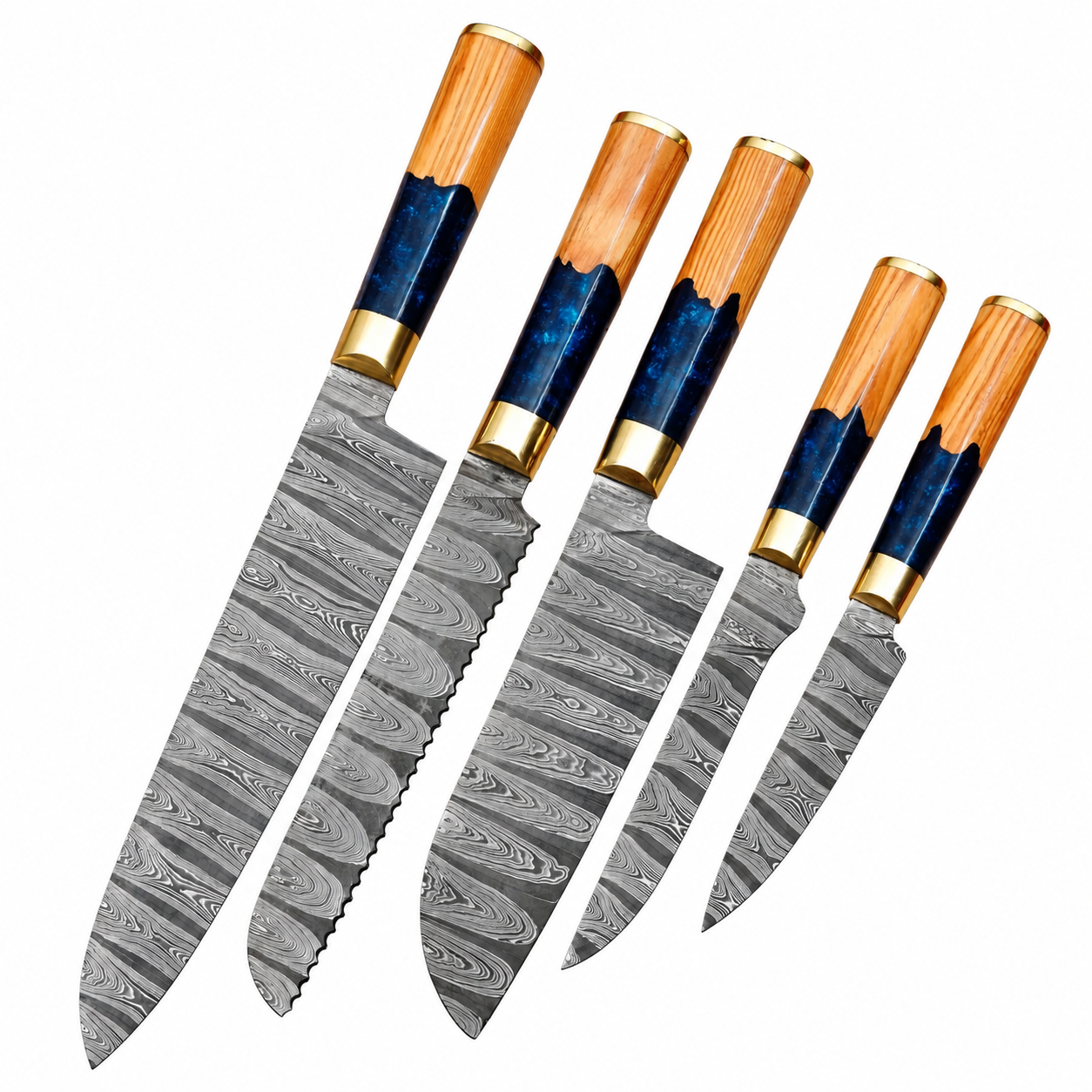
Damascus Pattern Kitchen Knives combine five different kitchen blade profiles with beautifully detailed silver-gray patterns and distinctive two-tone handles. The photographed collection brings together traditional culinary knife shapes with decorative blue, orange-brown, and gold-colored accents, creating a coordinated appearance for kitchen cutlery enthusiasts.
Each knife features a patterned metallic blade with flowing lines and layered-looking details. Although the designs share a consistent appearance, their blade shapes vary to reflect different kitchen cutting applications.
The handles introduce a contrasting finish. Warm orange-brown sections have a visible wood-grain appearance, while the lower sections feature deep-blue coloring with irregular patterns. Gold-tone collars visually connect the handles to the blades, giving the collection a coordinated presentation.
From the broad chef-style blade to the serrated bread-style knife and rectangular vegetable chopping blade, the image showcases several recognizable kitchen cutlery designs.
For home cooks, culinary enthusiasts, and buyers who appreciate decorative kitchen equipment, these knives offer an interesting combination of traditional shapes and visually distinctive finishes.
1. Damascus Pattern Kitchen Knives – Product Overview
The Damascus Pattern Kitchen Knives pictured in this collection include five straight-handled kitchen knives with different blade profiles.
Each knife has a metallic silver-and-gray blade displaying a flowing Damascus-style pattern.
The handles have a consistent cylindrical shape, with orange-brown wood-grain-looking sections and deep-blue decorative areas.
Gold-colored collars are visible where the handles meet the blades.
The handle ends also feature gold-tone caps, giving the knives a coordinated finish.
Although the handles share a similar construction style, the blades differ in length, width, and cutting-edge shape.
These differences allow the collection to present several types of kitchen knife designs within one consistent visual theme.
Visible Product Features
- Five kitchen knives pictured together.
- Silver-gray Damascus-style patterned blades.
- Orange-brown wood-grain-look handle sections.
- Deep-blue decorative handle sections.
- Gold-tone collars and end caps.
- Long chef-style knife profile.
- Serrated bread-style blade.
- Broad rectangular vegetable chopping blade.
- Shorter curved utility-style knife.
- Narrow slicing or utility blade.
- Coordinated handle colors across all five knives.
The exact steel alloys, handle materials, dimensions, and package contents require confirmation from the manufacturer.
2. Distinctive Damascus-Style Blade Patterns
One of the most noticeable features of these Damascus Pattern Kitchen Knives is the flowing metallic pattern across each blade.
The blade surfaces display numerous fine lines in contrasting shades of silver and gray.
Some lines form long waves that run along the blade, while others create curved, layered-looking shapes.
This patterned appearance gives the knives a distinctive visual character compared with ordinary plain-finish kitchen cutlery.
The patterns extend across the visible faces of the blades, including the broader chef-style and chopping designs.
On the narrower blades, the lines follow the contours of the metal and help emphasize their shapes.
Understanding the Damascus Appearance
Damascus steel is commonly associated with patterned metal surfaces.
Modern genuine pattern-welded Damascus steel may be produced by combining different steels to create a layered pattern.
However, Damascus-style appearances can also be produced through decorative surface treatments or etching.
The photograph establishes that the blades have visible Damascus-style patterns, but it does not confirm how these patterns were created.
Their steel composition, hardness, heat treatment, and number of layers remain unverified.
For accurate product information, the blades should be described as Damascus-patterned until the manufacturer confirms genuine Damascus construction.
3. Five Different Kitchen Knife Designs
The photographed collection includes five visibly different blade profiles.
Each follows a recognizable kitchen knife style.
These differences are useful for understanding the types of knives represented in the collection.
Variation 1 – Broad Chef-Style Kitchen Knife
The first knife features a long, broad blade that gradually narrows toward a pointed tip.
Its cutting-edge side follows a gently curved profile.
This general blade shape resembles a traditional chef’s knife.
Chef-style knives are commonly selected for various food preparation tasks, including slicing and chopping vegetables.
The image establishes the blade profile but does not verify the exact dimensions or cutting performance.
The patterned metallic surface extends across the broad blade face.
The orange-brown and blue handle provides a distinctive contrast against the silver-gray metal.
Variation 2 – Serrated Bread-Style Knife
The second knife features a long, narrow blade with a visibly serrated cutting edge.
Small repeating teeth run along one side of the blade.
This design resembles a traditional bread knife.
Serrated kitchen knives are commonly used for foods with firmer outer surfaces and softer interiors, including bread.
The pictured knife has the same two-tone decorative handle as the others.
Its patterned blade also maintains the collection’s coordinated metallic appearance.
The actual sharpness, tooth geometry, and intended manufacturer-approved applications have not been confirmed.
Variation 3 – Rectangular Vegetable Chopping Knife
The third knife has a broad, rectangular-looking blade.
Its upper edge is relatively straight, and the blade ends in a squared-off cutting profile rather than a narrow pointed tip.
This design resembles a vegetable chopping knife or nakiri-style kitchen blade.
Wide, rectangular kitchen blades are commonly associated with vegetable preparation and straight downward cutting techniques.
The photographed knife should not automatically be described as a heavy-duty cleaver because its thickness and intended application are unknown.
Its large blade face prominently displays the flowing Damascus-style pattern.
Variation 4 – Short Curved Utility-Style Knife
The fourth knife has a shorter blade with a gently curved cutting edge.
Its compact profile differs from the longer chef-style and bread-style knives.
This shape resembles a small utility or preparation knife.
Knives of this general style are often associated with more controlled food preparation tasks, depending on their exact dimensions.
The shorter blade creates a visibly different proportion between the handle and cutting section.
The same blue, brown, and gold-colored handle design maintains visual consistency.
Variation 5 – Narrow Slicing and Utility-Style Knife
The fifth knife features a relatively narrow blade with a pointed or tapered-looking end.
Its profile is slimmer than the broad chef-style and rectangular chopping blades.
This design resembles a narrow utility or slicing knife.
The compact blade shape offers another recognizable kitchen knife variation within the photographed collection.
As with the other knives, its actual dimensions and specific intended uses should be confirmed with the manufacturer.
4. Damascus Pattern Kitchen Knives with Two-Tone Handles
The handles are among the most distinctive features of the collection.
Each has a long cylindrical profile that combines two contrasting decorative sections.
The upper portion has a warm orange-brown appearance with narrow, darker grain-like lines.
The lower portion displays deep-blue coloring with irregular variations.
These two surfaces create a strong visual contrast.
The result is a coordinated handle design that stands out against the silver-gray patterned blades.
Orange-Brown Wood-Grain-Look Finish
The rear portions of the handles resemble polished natural wood.
Fine lines run along their length, giving the surface a grain-like appearance.
The coloring ranges from light golden orange to deeper brown tones.
Although these sections look wooden, the photograph does not establish the actual material or wood species.
They may be manufactured from natural wood, stabilized wood, or another decorative material.
For accurate publishing, the handles should be described according to their appearance until their composition is verified.
Deep-Blue Decorative Sections
The blue sections appear near the front portions of the handles.
Their finish includes different shades of dark blue and brighter blue highlights.
Some areas have irregular lighter patterns, creating visual depth.
These sections resemble decorative resin or another composite finish, but the exact material remains unverified.
The combination of warm brown and cool blue tones gives the knives a distinctive appearance.
5. Gold-Tone Collars and Handle End Caps
The Damascus Pattern Kitchen Knives also feature bright gold-colored accents.
A prominent collar is positioned between the blade and handle of each knife.
Additional gold-tone caps are visible at the rear ends.
These details provide another layer of contrast.
The warm metallic color complements the orange-brown handle sections.
It also creates a decorative transition into the silver-gray blades.
Consistent Decorative Construction
Although the blades differ, the handle fittings have a similar appearance across the collection.
This consistency gives the knives a coordinated presentation.
The collars appear smooth and reflective.
Their exact composition cannot be identified from the image.
They should not be advertised as brass or another specific metal unless the manufacturer confirms the material.
6. A Coordinated Collection for Kitchen Enthusiasts
The appeal of these Damascus Pattern Kitchen Knives comes from their combination of different blade shapes and consistent handle styling.
The photograph presents several recognizable kitchen knife categories in one arrangement.
The broad chef-style blade, serrated blade, rectangular chopping blade, and two smaller utility-style blades create visual variety.
At the same time, the shared metallic patterns and handle colors make the knives appear coordinated.
Traditional Kitchen Knife Profiles
The blades resemble familiar culinary knife forms.
This allows the collection to appeal to customers interested in different kitchen blade designs.
However, the photograph does not establish that each knife meets a particular professional cooking specification.
Those claims would require verified measurements, materials, and performance information.
Decorative Presentation
The patterned blades create a more detailed appearance than plain metallic surfaces.
The blue-and-brown handles introduce color, while the gold-tone fittings complete the presentation.
Together, these features make the knives suitable for consideration by buyers who value kitchen equipment aesthetics.
7. Understanding Different Blade Shapes
A kitchen knife’s profile can influence how it is normally used.
Broad chef-style blades are commonly associated with general food preparation.
Serrated blades are familiar in bread preparation.
Rectangular vegetable blades are generally associated with chopping and slicing vegetables.
Smaller utility-style knives are often chosen for tasks requiring a more compact blade.
The five visible knives illustrate several of these familiar categories.
However, intended applications should always be based on the specific manufacturer’s recommendations.
Blade thickness, cutting-edge geometry, balance, and steel composition can affect how a knife performs.
These technical characteristics cannot be confirmed from the uploaded image.
8. Patterned Blades with Distinctive Surface Detail
The blade patterns vary slightly across the collection.
Some display long, flowing lines, while others have tighter curves and more intricate formations.
On the wide rectangular blade, the large patterned surface is particularly noticeable.
The narrower knives show the same general decorative style on a smaller area.
The patterns create visual consistency without requiring each blade to have identical markings.
Metallic Color Contrast
The blades feature predominantly silver and charcoal-gray tones.
These relatively neutral colors balance the brighter handle designs.
The contrast also allows the gold-tone collars to remain visible.
This combination creates a cohesive appearance across all five knives.
Surface Pattern Versus Steel Properties
A decorative blade pattern should not be treated as evidence of strength, corrosion resistance, or edge retention.
Those properties depend on the actual blade material, manufacturing process, and heat treatment.
Customers seeking particular technical specifications should request confirmation from the manufacturer.
9. Damascus Pattern Kitchen Knives for Home Kitchens
The Damascus Pattern Kitchen Knives may appeal to customers interested in equipping a kitchen with several familiar blade styles.
The photographed assortment represents different profiles commonly associated with everyday food preparation.
The shared handle styling provides a coordinated appearance.
For home cooking enthusiasts, blade variety can be useful when selecting kitchen equipment.
However, buyers should first confirm whether the knives are sold together or offered individually.
The image shows five knives but does not establish the retail package quantity.
Kitchen Presentation
The blue-and-brown handles offer a distinctive visual style.
Their bright metallic collars complement the patterned blades.
This may appeal to customers who prefer kitchen tools with decorative finishes.
Home and Commercial Kitchen Considerations
For practical kitchen use, buyers should verify the blade materials, food-contact suitability, dimensions, cleaning requirements, and intended applications.
Professional kitchen suitability should not be assumed from the photograph alone.
10. Damascus Pattern Kitchen Knives Care Guide
The correct maintenance method depends on the actual steel and handle materials.
The following recommendations are general kitchen knife care precautions.
Cleaning the Blades
Clean knives after food preparation using methods suitable for their confirmed materials.
Avoid leaving food residue or moisture on the blades for extended periods.
A soft cloth can be used to dry the visible metal surfaces.
Harsh abrasive products may affect some decorative patterns.
Follow the manufacturer’s cleaning instructions when available.
Hand Washing Considerations
Many decorative kitchen knives are better maintained through careful hand washing.
However, the actual cleaning requirements for these knives have not been confirmed.
Until the manufacturer provides care instructions, avoid assuming they are dishwasher safe.
Extended exposure to high temperatures, detergents, or moisture may affect certain handle materials and decorative finishes.
Handle Maintenance
The handles display wood-grain-like and blue decorative surfaces.
Their materials remain unverified.
Avoid applying specialized wood oils, resin treatments, or metal polishes without confirming compatibility.
Wipe away moisture after cleaning and allow the handles to dry thoroughly.
11. Safe Kitchen Knife Storage
Kitchen knives should be stored securely when not in use.
Appropriate storage methods may include a suitable knife block, protective blade covers, or dedicated knife storage equipment.
The photograph does not show a knife block, storage case, or blade guards.
These accessories should not be described as included without supplier confirmation.
Keep blades protected from accidental contact.
Avoid placing exposed knives loosely in drawers where their edges may contact other utensils.
Store kitchen knives where children cannot access them.
12. Choosing the Right Kitchen Knife Design
Different cooking tasks may call for different blade profiles.
A broader chef-style knife is commonly associated with general preparation.
A serrated knife is often associated with bread and certain foods with resistant outer surfaces.
A rectangular vegetable knife may appeal to people who prefer a broad chopping profile.
Smaller utility-style knives provide alternative blade shapes for preparation tasks.
The photographed collection illustrates these categories, but practical suitability depends on verified blade construction.
Customers should compare dimensions, materials, weight, and intended use before purchasing.
13. Product Specifications
| Attribute | Description |
|---|---|
| Product Type | Kitchen knives |
| Quantity Pictured | Five knives |
| Blade Appearance | Damascus-style patterned finish |
| Blade Color | Silver and charcoal gray |
| Blade Profiles | Chef-style, serrated, rectangular chopper, and two utility-style blades |
| Handle Appearance | Orange-brown wood grain and deep-blue decorative sections |
| Handle Shape | Cylindrical |
| Handle Fittings | Gold-tone collars and end caps |
| Blade Steel | Not verified |
| Handle Materials | Not verified |
| Overall Dimensions | Not provided |
| Blade Lengths | Not provided |
| Blade Thickness | Not provided |
| Weight | Not provided |
| Package Quantity | Not confirmed |
| Storage Accessories | Not shown |
These specifications describe the visible products without introducing unsupported material or performance claims.
14. Important Information Before Ordering
Before purchasing these Damascus Pattern Kitchen Knives, customers should review the confirmed product specifications.
The first consideration is whether all five knives are supplied together.
The image shows a collection but does not establish the seller’s packaging or fulfillment arrangement.
The blade composition should also be verified.
Genuine Damascus steel and decorative Damascus-style finishes are not necessarily the same.
The handle materials should be confirmed, particularly where natural wood or resin construction is advertised.
Buyers should also request accurate blade lengths, overall dimensions, weight, and care instructions.
If the knives are offered with customization, the supplier should specify the available options, minimum order quantities, and additional costs.
15. Explore the Damascus Pattern Kitchen Knives Collection
The Damascus Pattern Kitchen Knives bring together five distinctive kitchen blade shapes with a coordinated decorative design.
Their flowing silver-gray patterns create an attractive metallic appearance, while the blue-and-brown handles introduce color and contrast.
The gold-tone fittings provide a consistent finishing detail across the collection.
From the broad chef-style blade to the serrated bread-style knife and compact utility designs, the photograph presents an interesting selection of kitchen cutlery forms.
For home cooks, kitchenware enthusiasts, and buyers who appreciate decorative culinary tools, these knives offer a distinctive combination of familiar blade profiles and colorful handle styling.
Explore the photographed designs and confirm their materials, dimensions, availability, and package contents before placing your order.








Reviews
There are no reviews yet.