



Orange Black Damascus Pattern Cleaver Knife – Distinctive Design and Traditional Styling
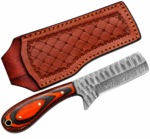
The Orange Black Damascus Pattern Cleaver Knife combines a broad patterned blade with a distinctive orange-and-black handle, creating an attractive design for customers who appreciate decorative kitchen knives and traditional blade craftsmanship.
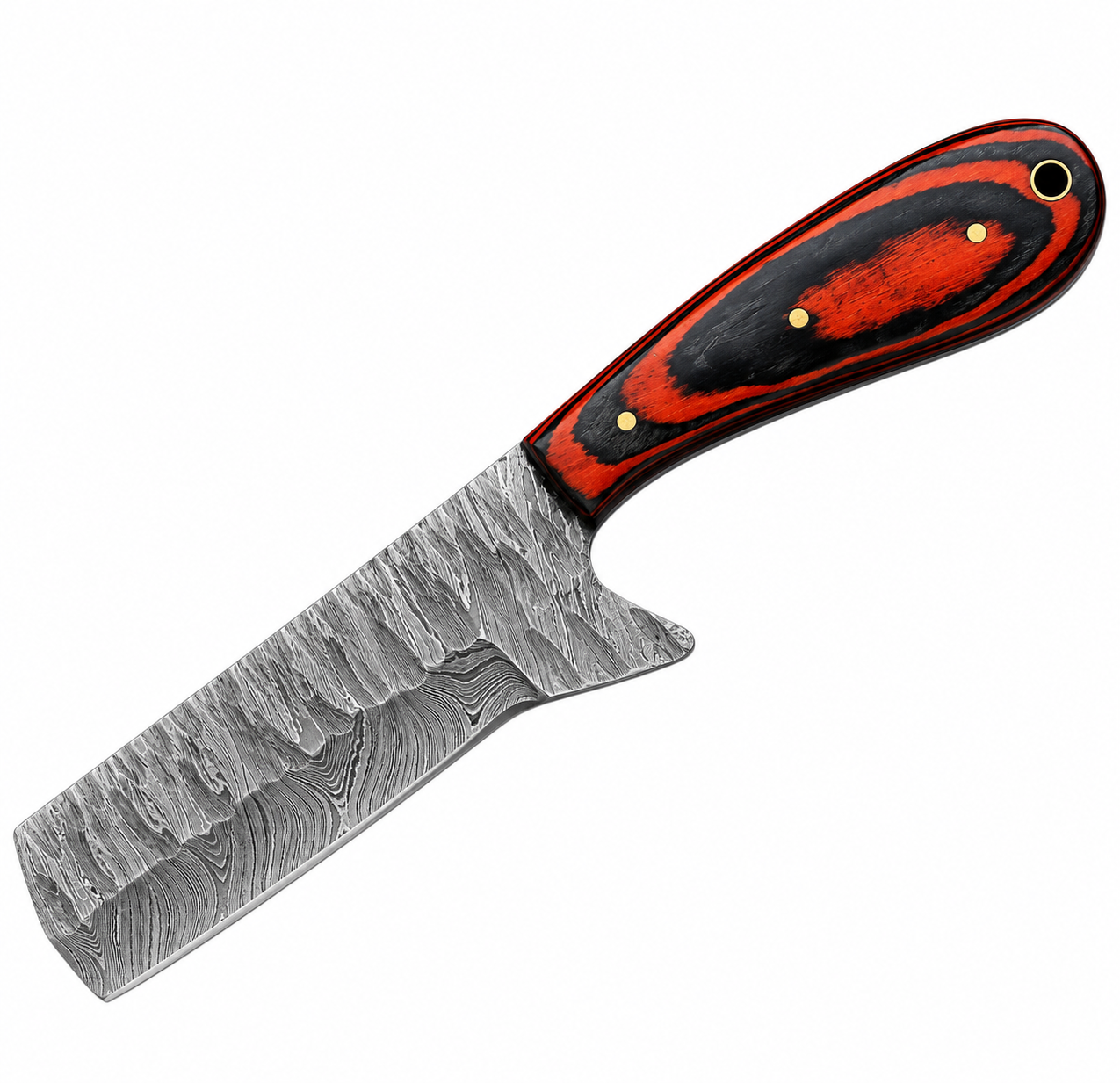
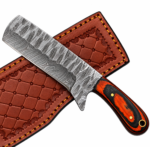
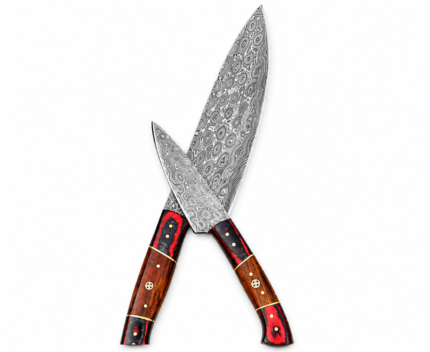
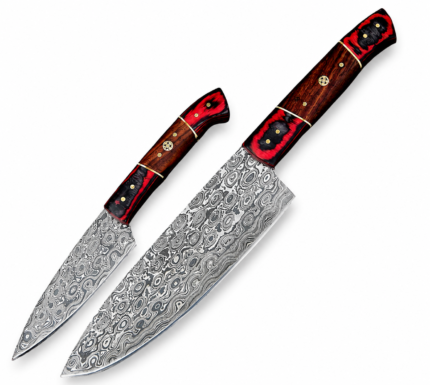
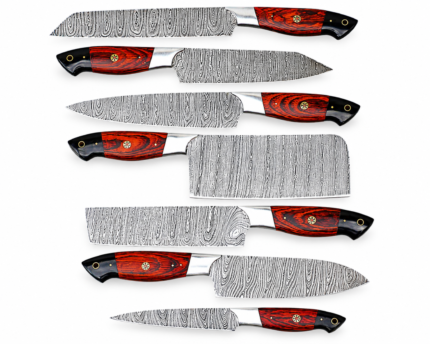
Its wide blade features flowing silver-and-gray lines that resemble the layered patterns commonly associated with Damascus steel. The contrasting colors and intricate surface details create a recognizable appearance, making this knife stand out from ordinary plain-finish cleavers.
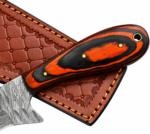
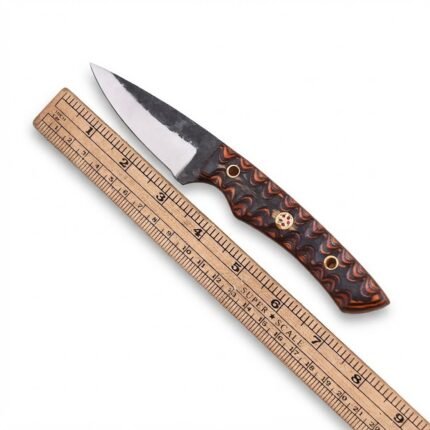
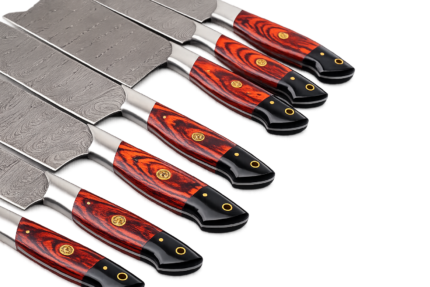
The orange-and-black handle adds another appealing feature. Its bold color combination creates a strong contrast against the metallic blade, while small gold-colored pins and a circular opening near the handle’s end complete the design.
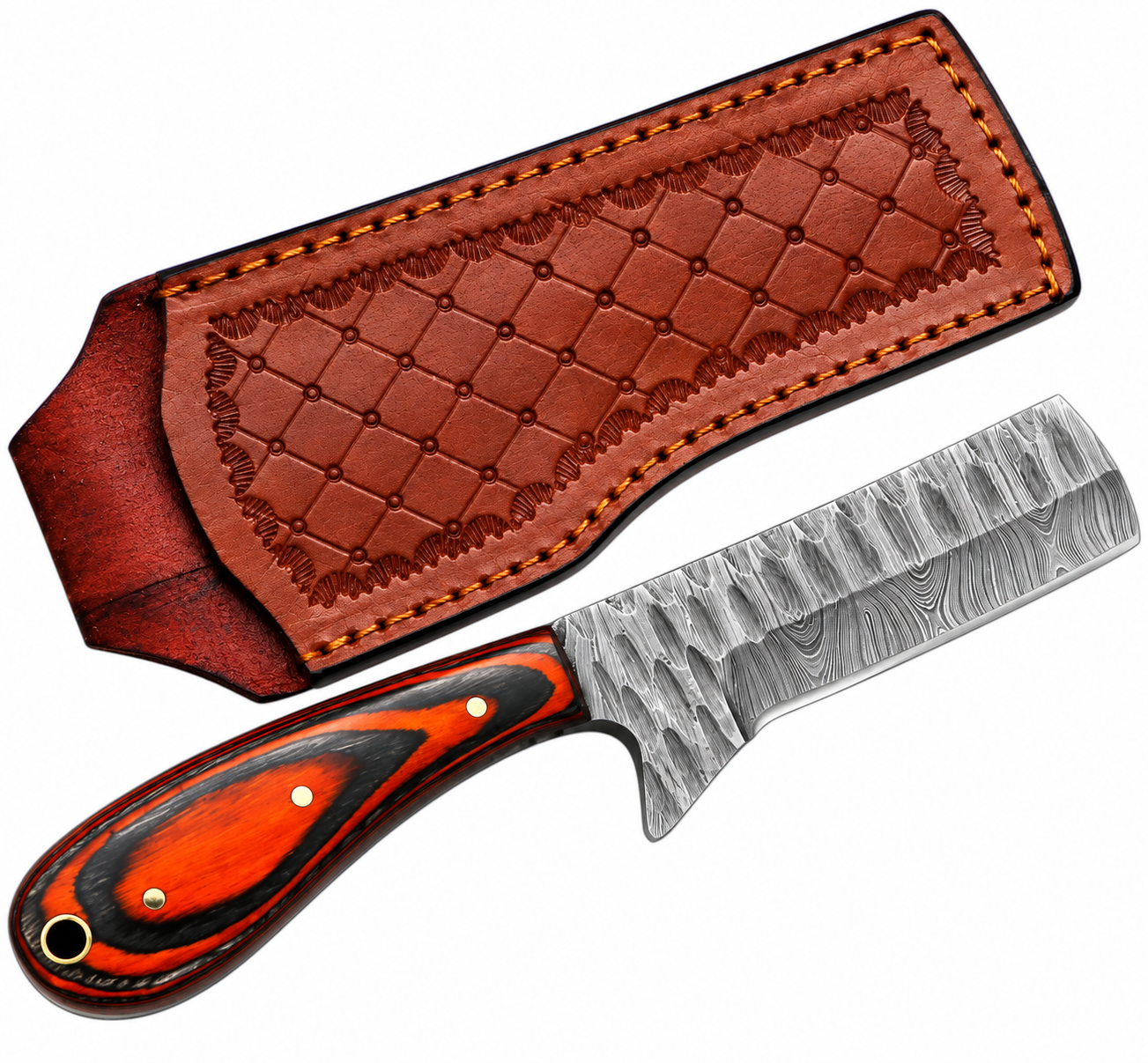
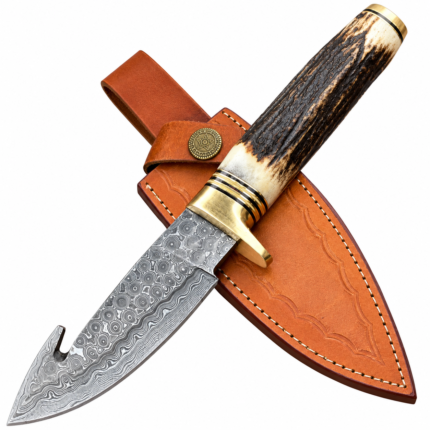
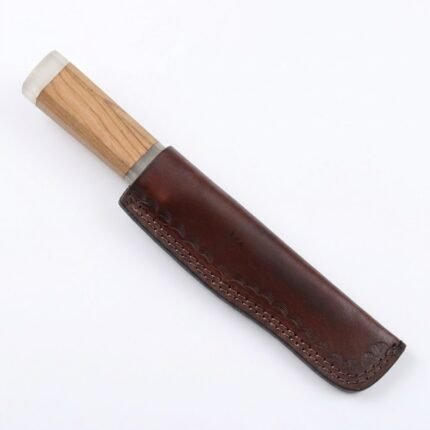
A brown sheath is also displayed behind the knife, featuring detailed embossing, decorative stitching, and dark edging.
The combination of patterned metal, colorful handle styling, and traditional sheath design makes this knife an interesting choice for enthusiasts who appreciate distinctive blade designs.
Damascus-Style Blade with Flowing Patterns
One of the most recognizable features of this knife is its patterned blade.
The surface displays numerous silver-gray lines, irregular curves, and layered-looking formations. These patterns extend across most of the blade, creating a detailed finish that contrasts beautifully with the orange-and-black handle.
Some sections feature closely arranged lines resembling flowing water, while others contain larger swirls and irregular shapes.
The variation gives the blade a decorative appearance often associated with Damascus-pattern knives.
These surface details are especially noticeable near the center and lower portion of the blade.
The blade’s pattern also continues toward the area connecting the cutting portion to the handle, giving the visible metalwork a consistent appearance.
Although its finish resembles traditional Damascus steel, the exact manufacturing method cannot be verified from the photograph.
The blade may be pattern-welded steel or another type of patterned metal. Its steel grade, layer count, hardness, and heat-treatment process require supplier confirmation.
For this reason, the product is accurately described as Damascus-patterned rather than making unsupported claims about its metallurgy.
Broad Cleaver-Style Blade Design
The Orange Black Damascus Pattern Cleaver Knife features a wide blade with a relatively straight cutting-edge profile and a gently curved outer shape.
Unlike narrow utility knives, its broad silhouette creates a visually prominent cutting section.
The blade widens toward its forward end, giving it a distinctive cleaver-inspired appearance.
Its front edge is angled and gently rounded rather than forming a long, narrow point.
This design places the knife within the broad family of cleaver-style cutting tools.
However, blade geometry alone does not establish whether the knife is intended for cutting vegetables, preparing boneless meat, or chopping through bones.
These applications require different blade thicknesses, edge geometries, and steel properties.
The manufacturer’s specifications should therefore be checked before advertising the knife for particular food-preparation tasks.
The broad blade nevertheless gives the product a traditional butcher-knife appearance that may appeal to collectors and customers interested in distinctive kitchen cutlery.
Orange and Black Decorative Handle
The handle features a vivid combination of orange and black tones.
Large dark sections are surrounded by orange areas, forming an irregular, layered-looking pattern.
The orange color is particularly noticeable toward the front and rear portions of the handle.
Dark curved shapes appear through the center, creating an attractive contrast.
This colorful arrangement gives the knife a more contemporary appearance than traditional single-color wooden handles.
The handle’s decorative texture has a woodgrain-like appearance, although the actual material cannot be determined from the image.
It may be made from treated wood, a composite material, resin, or another manufactured handle material.
The supplier should verify its composition before the product is described as stabilized wood, pakkawood, or another specific material.
The orange-and-black finish is one of the main visual features distinguishing this cleaver knife from similar products.
Contoured Handle Profile
The knife’s handle has a gently curved profile designed with visible shaping along its lower edge.
The front section curves inward toward the blade, creating a defined transition between the grip and the metal cutting portion.
The rear section widens into a rounded end.
This shape gives the handle a balanced visual appearance and distinguishes it from simple rectangular or cylindrical handles.
A comfortable handle is an important consideration when selecting any kitchen knife.
However, actual handling comfort depends on factors such as handle dimensions, weight, surface texture, and individual hand size.
These characteristics cannot be established from the photograph alone.
Customers interested in regular food-preparation use should review the manufacturer’s dimensional specifications and grip-material information.
Decorative Gold-Colored Pins
Two small gold-colored circular pins are visible on the orange-and-black handle.
These details create an attractive contrast against the darker central pattern.
The pins are spaced along the length of the handle and contribute to its traditional construction-inspired appearance.
A larger circular metal-lined opening is also visible near the rounded end.
This opening may accommodate a cord or hanging loop, although its intended function should be verified.
The gold-colored details complement the warm orange tones throughout the handle.
Their exact metallic composition is unknown, so they should not be advertised as solid brass without supporting information.
Integrated Blade and Handle Styling
The transition between the blade and handle is visually distinctive.
Rather than displaying a separate, conventional rectangular bolster, the patterned blade appears to continue into a shaped metal section near the grip.
A small downward projection is visible beneath the junction.
This element contributes to the knife’s unusual silhouette.
The patterned metal surrounding the handle transition visually connects the wide blade with the colorful grip.
The design gives the knife a recognizable profile that differs from many conventional kitchen cleavers.
The photograph does not reveal the internal tang structure, so full-tang construction cannot be confirmed.
A clear image of the handle’s opposite side and a supplier specification sheet would help establish its construction more accurately.
Brown Decorative Sheath
A brown sheath is positioned behind the knife in the uploaded image.
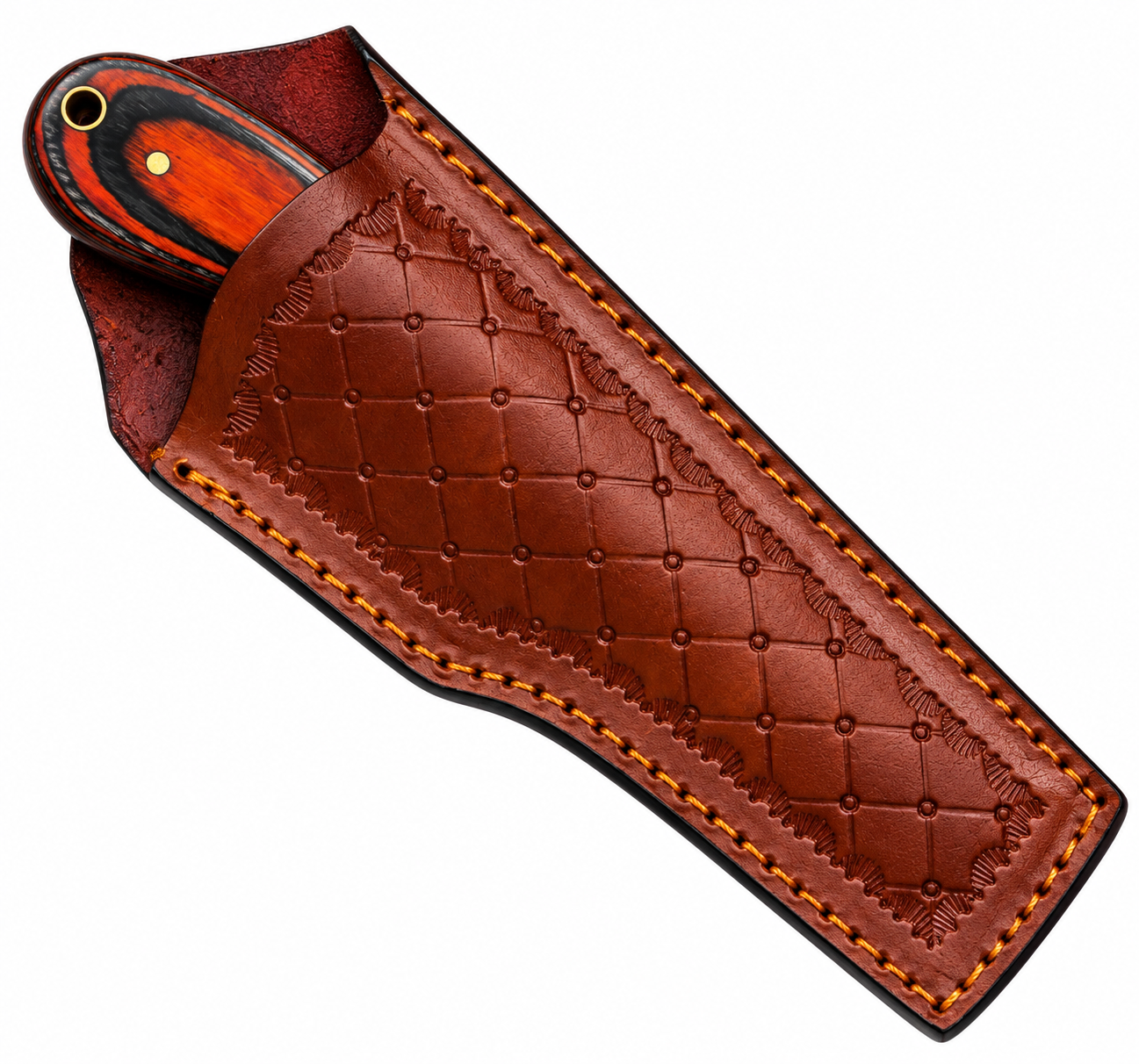
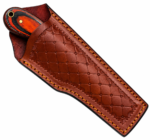
The sheath has a warm reddish-brown appearance with detailed decorative markings across its surface.
A repeated geometric pattern appears within an embossed border.
Small circular impressions are arranged within the central design, creating a quilted visual effect.
The outer edge features bright yellow-gold stitching that contrasts with the brown material.
Dark edging runs around the perimeter, providing another decorative detail.
The sheath’s design complements the orange-and-black knife handle.
Its warm colors create a coordinated appearance that may be attractive to collectors or customers purchasing decorative knife sets.
The material resembles leather, but genuine leather construction cannot be confirmed from the image.
It should be listed as a leather-look sheath until the supplier confirms whether it is genuine leather, synthetic leather, or another material.
The image shows the sheath alongside the knife, but its inclusion in a commercial purchase must also be confirmed.
Traditional Styling with Contemporary Colors
This cleaver-style knife combines traditional blade aesthetics with a more colorful handle design.
Damascus-like metal patterns are associated with classic decorative knife styles.
The orange-and-black handle introduces a contemporary visual element that makes the product distinctive.
The brown embossed sheath reinforces the traditional appearance.
Together, these features create a combination of old-fashioned and modern design influences.
The blade’s intricate lines contrast with the handle’s bold colors.
The sheath provides a more subtle background that helps emphasize both components.
This coordinated presentation is particularly relevant for customers who value appearance when choosing knives for personal collections.
An Interesting Addition to a Knife Collection
The Orange Black Damascus Pattern Cleaver Knife may appeal to collectors interested in decorative cutting tools and unusual blade finishes.
Its broad blade offers more visual space for the patterned metalwork than many smaller utility knives.
The flowing gray-and-silver patterns are prominent across the blade’s surface.
The handle introduces color without obscuring the visible metal detailing.
Gold-colored pins and the circular handle opening provide smaller points of interest.
The accompanying pictured sheath completes the overall presentation.
Collectors often appreciate knives with identifiable design characteristics, and this model has several.
The broad blade shape, orange-and-black handle, and embossed brown sheath distinguish it from conventional monochrome knives.
Actual collectibility and value depend on verified materials, workmanship, condition, rarity, and manufacturer information.
These factors should be evaluated separately from the product’s appearance.
Potential Kitchen and Culinary Interest
Cleaver-style knives are commonly associated with culinary tasks, particularly in food-preparation environments where a broad blade shape may be useful.
Depending on their construction, knives of this general category may be intended for preparing vegetables, portioning boneless meat, or other cutting applications.
However, not every broad-bladed knife is suitable for the same tasks.
A thin-edged kitchen cleaver may be designed for slicing, while a heavy butcher cleaver requires different construction characteristics.
The Orange Black Damascus Pattern Cleaver Knife should not be described as suitable for bone chopping, commercial butchery, or heavy-duty cutting until the manufacturer’s specifications establish those capabilities.
Its exact dimensions, edge geometry, weight, and hardness remain unverified.
These details should be included in the commercial listing before promising particular cutting performance.
Visual Appeal for Kitchen Knife Enthusiasts
Kitchen knife enthusiasts may appreciate the combination of broad blade geometry and patterned metalwork.
The patterned surface provides a visual alternative to conventional polished or satin-finished blades.
Its orange-and-black handle also adds color to a product category often dominated by natural brown and black grips.
The knife’s design can complement a collection of decorative kitchen cutlery.
It may also appeal to customers seeking a visually distinctive gift for an adult cutlery enthusiast.
Before selecting the knife for practical kitchen use, buyers should consider the blade’s actual specifications and the manufacturer’s intended applications.
The appearance alone does not establish food-contact suitability, corrosion resistance, or cutting performance.
Caring for the Patterned Blade
Proper maintenance helps preserve the appearance of decorative metal surfaces.
After use, clean the blade carefully according to the manufacturer’s recommendations.
Avoid prolonged moisture exposure.
The blade should be dried thoroughly before storage.
Strong chemicals and abrasive cleaning products may damage decorative surface finishes.
If the manufacturer recommends a protective oil, use a product appropriate for the blade material and its intended application.
The specific steel composition should be confirmed before selecting specialized cleaning products.
Dishwasher safety is not established and should not be claimed without supplier confirmation.
For a knife intended for kitchen use, manufacturers should provide appropriate food-safe care instructions.
Maintaining the Orange and Black Handle
The handle’s contrasting colors are an important part of the product’s appearance.
To help preserve the visible finish, avoid unnecessary exposure to harsh chemicals and abrasive cleaning materials.
Use a soft cloth for routine cleaning.
The correct treatment will depend on the actual handle material.
Natural wood, stabilized wood, resin, and synthetic composites have different maintenance requirements.
Without confirmed material specifications, it would be inappropriate to recommend a particular wood oil or chemical treatment.
The handle should also be checked periodically for signs of loosening or damage.
A damaged or unstable handle can affect safe handling and should be inspected before continued use.
Caring for the Brown Sheath
The pictured sheath has decorative stitching and an embossed surface.
To maintain its appearance, remove dust with a soft, dry cloth.
Avoid prolonged exposure to moisture.
If the sheath is confirmed to be genuine leather, follow appropriate leather-care guidance supplied by the manufacturer.
If it is synthetic material, cleaning recommendations may differ.
A sheath should be completely dry before being used for storage.
For long-term storage, follow the knife manufacturer’s advice regarding moisture protection and whether the blade should remain inside its sheath.
Important Product Specifications
Before publishing the final commercial listing, the manufacturer should confirm the blade material, construction method, and actual dimensions.
The blade’s length, width, thickness, and total weight are particularly important for customers comparing cleaver-style knives.
The steel composition and hardness should also be stated where available.
The handle material needs confirmation.
Likewise, the sheath’s material and its inclusion in the purchase should be verified.
Other useful details include the product’s country of manufacture, intended use, care instructions, and any available customization options.
Providing accurate specifications helps customers understand exactly what they are purchasing.
A Distinctive Combination of Blade, Handle, and Sheath
The Orange Black Damascus Pattern Cleaver Knife brings together several decorative characteristics in one recognizable design.
Its broad blade features complex silver-and-gray patterns.
The orange-and-black handle introduces a bold color contrast.
Gold-colored pins provide smaller accents that complement the warm handle tones.
The brown embossed sheath adds traditional styling to the overall presentation.
These details create a visually coordinated knife and sheath combination.
Although performance and material specifications require verification, the visible design clearly distinguishes this model from plain cleaver-style knives.
Explore the Orange Black Damascus Pattern Cleaver Knife
The Orange Black Damascus Pattern Cleaver Knife offers a distinctive combination of decorative metalwork, a colorful contoured handle, and a traditionally styled brown sheath.
Its patterned blade and contrasting grip make it an interesting addition to a collection of decorative kitchen knives.
For customers who appreciate unusual cutlery designs, this knife provides a recognizable appearance with several carefully coordinated visual details.
Explore this Damascus-pattern cleaver-style knife and discover a distinctive option for your collection.




Reviews
There are no reviews yet.