



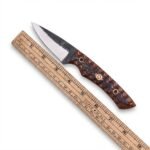


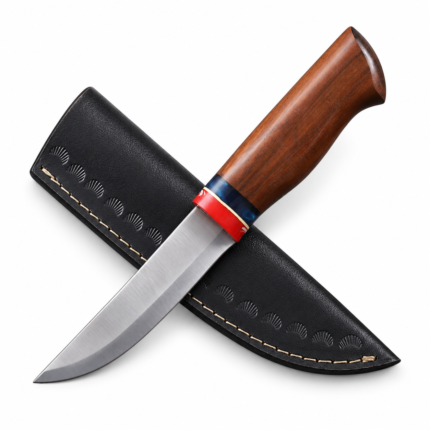
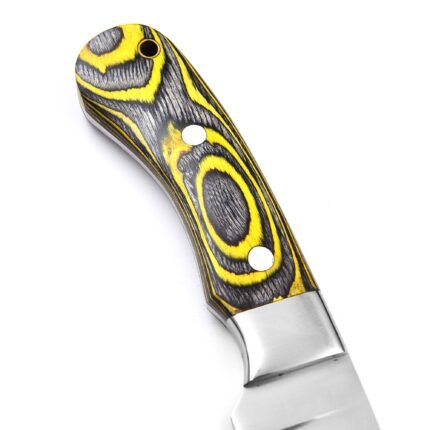
Patterned Handle Skinner Knife – Distinctive Fixed-Blade Design
The patterned handle skinner knife combines a contrasting two-tone blade, decorative brown-and-black grip and matching black sheath in a traditional-inspired fixed-blade design. Its pointed blade profile, detailed handle pattern and coordinated accessories make it an attractive option for adult knife collectors and enthusiasts interested in hunting-style knives.
The blade is immediately noticeable because of its two contrasting finishes. Its upper portion has a dark charcoal appearance with an irregular textured-looking surface, while the lower cutting section is bright silver and comparatively smooth. A slightly uneven boundary separates these two finishes, giving the blade a rugged, forged-inspired appearance.
The handle adds another distinctive element. Its surface displays repeated curved markings in copper-brown and black, creating a carved-looking geometric pattern. Small circular metal fittings and a central mosaic-style decorative pin provide contrast against the darker material.
Positioned behind the knife is a black sheath with visible golden-tan stitching and subtle decorative markings.
Together, these features create a coordinated product design that differs from conventional fixed-blade knives with plain handles and uniform metal finishes.
Distinctive Two-Tone Blade Finish
One of the most recognizable characteristics of the patterned handle skinner knife is its dark-and-silver blade appearance.
The upper portion of the blade features a dark charcoal finish that appears slightly irregular and textured. This surface extends from the handle area toward the narrowing front of the blade.
Below it, a bright silver-colored section follows the cutting-edge outline.
The contrast between these two areas gives the blade a visually defined appearance.
The darker portion looks relatively rugged, while the silver section has a smoother, more polished finish.
This combination resembles the styling often associated with forged-look hunting knives.
However, a dark irregular finish does not establish that a blade was hand-forged, hammer-finished or manufactured from a particular grade of carbon steel.
Different production and finishing techniques can create comparable appearances.
The manufacturer would need to confirm the actual steel, surface treatment and fabrication process.
For the present listing, the blade is described according to its clearly visible contrasting finishes.
This distinction helps customers understand the product’s appearance without relying on unsupported technical claims.
Curved Skinner-Style Blade Profile
The blade has a pointed profile with a broad section near the handle and a tapered front.
Its lower cutting-edge outline follows a long, gentle curve.
The upper edge slopes gradually toward the tip.
This creates a shape resembling certain skinner and general hunting-style fixed blades.
The curved lower edge is an important feature of the knife’s visual design.
It makes the blade different from knives with straight cutting edges or broad cleaver-style profiles.
Skinner-style knives appear in many configurations, and their geometry can vary depending on the intended application.
Although this product resembles a skinning knife, the photograph alone does not establish its suitability for particular field-dressing or outdoor tasks.
Actual performance depends on blade thickness, edge geometry, heat treatment, steel composition and construction.
These specifications have not been verified.
For collectors who are comparing different knife shapes, the broad heel, curved lower edge and tapered point remain useful visible characteristics.
Smooth Silver Cutting Section
The lower portion of the blade has a bright silver finish.
Its relatively smooth surface contrasts with the darker section above.
A clearly defined cutting-edge outline extends toward the pointed tip.
The silver area is broad near the center and narrows toward the front.
This difference in width creates an attractive visual transition.
The brighter metal also helps emphasize the blade’s curvature.
Although the surface appears polished, the image does not prove a particular polishing grade or sharpening condition.
The blade might be sharpened, partially sharpened or supplied with another edge condition.
That information should be confirmed directly by the manufacturer.
Likewise, visible reflectivity cannot establish stainless-steel composition, corrosion resistance or edge retention.
Those technical characteristics should be included only when supported by reliable specifications.
Dark Forged-Look Upper Blade
The upper blade surface has a darker, more irregular appearance.
Its color ranges from charcoal gray to nearly black, depending on the visible section.
The texture resembles the surface of certain forged-looking or rustic-style knives.
Small variations in tone give the surface additional visual depth.
This upper finish also complements the darker markings on the handle.
The relationship between the blade and grip creates a coordinated color theme.
However, the manufacturer has not provided information establishing whether this surface was forged, etched, oxidized, coated or otherwise treated.
It would therefore be inaccurate to advertise the product as hand-forged or blackened high-carbon steel based on appearance alone.
The dark finish remains an important distinguishing feature, regardless of how it was produced.
For adult collectors who enjoy knives with contrasting metal textures, this design provides a noticeable alternative to completely polished blades.
Decorative Brown-and-Black Handle
The handle is one of the most distinctive parts of the patterned handle skinner knife.
It features a warm brown base with dark, repeated curved markings arranged along its length.
The pattern resembles carved wood, layered composite material or another decorative handle surface.
The lighter sections have copper-brown and reddish-brown tones.
Darker areas surround the repeated shapes, creating a strong contrast.
The overall appearance is more decorative than that of a plain wooden or synthetic knife handle.
The repeated markings are especially visible along the upper and lower portions of the grip.
This provides a consistent design from the rear of the handle toward the blade.
Although the material resembles wood, the actual composition cannot be determined from the photograph.
The handle may be natural wood, stabilized wood, laminated composite or another manufactured material.
The exact material must be confirmed before making specific claims about durability, moisture resistance or craftsmanship.
Repeated Carved-Look Handle Pattern
The decorative grip pattern consists of curved, repeated shapes arranged in rows.
Each marking includes darker and lighter areas that create the appearance of depth.
Some shapes resemble small overlapping arches, while others form rounded geometric patterns.
The pattern continues along much of the visible handle surface.
These details give the knife a recognizable appearance that differs from smooth or simply stained handles.
The repeated shapes may have been carved, machined, molded or created by another finishing technique.
The photograph does not establish which method was used.
Therefore, the product should be described as having a carved-looking or patterned finish rather than being guaranteed hand-carved.
From a visual perspective, the markings complement the rustic-looking upper blade.
Both features create surface texture, although they use different designs.
The blade relies on irregular dark metal, while the handle features organized, repeating decorative shapes.
Contoured Fixed-Blade Handle
The handle has a gently contoured profile.
Its width changes slightly along its length, creating a shaped silhouette.
The rear portion is relatively broad, while the section near the blade narrows into a subtle transition.
The handle’s lower outline includes a gentle curve that follows the overall fixed-blade design.
This gives the product a more traditional appearance than knives with completely straight handles.
The decorative markings follow the handle contours and remain visible across much of the surface.
Although its shape resembles ergonomic knife handles, actual comfort cannot be confirmed from a photograph.
Factors such as overall size, thickness, balance, material texture and hand size influence how a knife feels during use.
The listing therefore describes the visible contours without claiming superior grip security or comfort.
Customers who value handle design can still appreciate its recognizable shape and detailed appearance.
Central Mosaic-Style Handle Pin
A decorative circular fitting appears near the central portion of the grip.
The fitting has a gold-colored outer section with several small colored elements inside.
Its appearance resembles a mosaic pin commonly used in decorative knife handles.
The multicolored center creates a subtle focal point against the brown-and-black surface.
Mosaic-style fittings are popular among collectors because they introduce detailed metalwork without requiring large engravings.
The surrounding dark handle makes the decorative fitting particularly noticeable.
However, the image does not establish the composition or manufacturing method of the pin.
Its colored elements may be produced using different metals or decorative materials.
The fitting should therefore be identified as mosaic-style rather than being assigned unverified material specifications.
This small detail contributes to the knife’s overall decorative character.
Two Brass-Colored Handle Openings
Two circular metal-lined openings are visible along the handle.
One is positioned closer to the front section, while the other appears toward the rear.
Their warm gold or brass-colored rims contrast with the darker handle.
The openings resemble hollow pins or decorative handle tubes used on certain fixed-blade designs.
However, their precise intended function has not been verified.
They should not automatically be described as mounting holes, lanyard holes or a particular fastening system without supplier confirmation.
Their visible circular form is nevertheless a distinctive design feature.
Together with the central mosaic-style pin, they create three metallic details along the handle.
The arrangement contributes to the product’s decorative appearance.
The brass-colored tone also complements the warmer copper-brown markings.
Black Leather-Look Sheath
The photograph includes a black sheath positioned behind the knife.
Its elongated shape follows the profile commonly associated with fixed-blade knife covers.
The surface has a dark, slightly textured appearance resembling finished leather.
The sheath is broader near its upper opening and tapers toward a rounded lower section.
A visible attachment loop extends behind its upper portion.
This gives the accessory a traditional outdoor-knife appearance.
The black color coordinates with the dark areas of the blade and handle.
Although the sheath resembles leather, its actual composition is not confirmed.
It could be genuine leather, synthetic leather or another material with a similar surface finish.
The seller should verify the material before making specific claims.
The photograph shows the sheath with the knife, but the manufacturer should also confirm whether both are included in the final retail package.
Decorative Golden-Tan Stitching
A line of contrasting stitches follows the sheath’s outer edge.
The thread appears golden tan against the black surface.
This creates a clearly visible decorative border.
The stitches extend along the sheath’s side and continue around the lower curved section.
The contrasting colors help define the sheath’s shape.
They also complement the warm handle markings and gold-colored fittings.
Traditional-style sheaths frequently use decorative stitching, but the manufacturing method can vary.
The photograph does not establish whether the stitching was completed by hand or machine.
Consequently, the product should not be advertised as hand-stitched without supplier documentation.
The visible stitching nevertheless gives the sheath a finished appearance.
It also makes the accessory more visually interesting than a plain black cover.
Embossed-Look Sheath Details
Subtle decorative impressions appear across the black sheath.
These markings are visible near the upper section and along parts of the lower surface.
They resemble stamped or embossed ornamentation.
The details are understated because they have nearly the same color as the sheath itself.
Under the lighting shown in the photograph, their shapes become visible through variations in texture and reflection.
These decorative elements complement the handle’s repeated pattern.
The exact technique used to create them cannot be confirmed from the image.
They may be stamped, embossed or produced using another surface-finishing method.
For accurate product copy, they are described as embossed-looking details rather than verified handmade decoration.
Belt-Loop-Style Sheath Attachment
A dark attachment section extends from the upper portion of the sheath.
Its appearance resembles a belt loop commonly found on outdoor knife covers.
Such attachments vary in their size, construction and compatibility.
The photograph does not show the sheath being worn or attached to a belt.
Therefore, the exact loop dimensions and intended compatibility remain unknown.
The seller should confirm these details before advertising particular carrying configurations.
The visible attachment nonetheless contributes to the accessory’s traditional appearance.
For customers comparing knife-and-sheath designs, the loop is a relevant detail that should be shown clearly in additional photographs.
A rear view of the sheath would help establish its complete shape and construction.
Traditional Hunting-Style Appearance
The patterned handle skinner knife combines several visual features commonly associated with hunting and outdoor fixed blades.
These include a curved blade, pointed tip, contoured handle and accompanying black sheath.
The two-tone metal finish introduces a rugged-looking design element.
The brown-and-black patterned grip provides warmth and decorative detail.
Together, these characteristics create a recognizable outdoor-inspired appearance.
The knife differs from modern designs featuring bright synthetic handles or completely uniform black blades.
Instead, it combines a relatively traditional silhouette with elaborate grip markings.
This appearance may appeal to adult collectors interested in fixed-blade knives with decorative handles.
However, a hunting-style appearance does not establish suitability for specific hunting or outdoor tasks.
Those claims require verified manufacturer specifications.
An Appealing Option for Adult Knife Collectors
Knife collectors often appreciate distinctive handles, blade finishes and matching accessories.
This product combines all three.
The blade has a contrasting dark-and-silver finish.
The pointed profile provides a traditional skinner-style appearance.
The handle displays repeated decorative shapes and a central mosaic-style fitting.
Two circular metal-lined openings add further detail.
The black sheath completes the presentation with contrasting stitching and subtle embossed-looking markings.
These features make the knife visually different from conventional fixed blades with plain handles.
Adult collectors may appreciate its combination of rustic-looking metal and warm patterned grip styling.
The product may also appeal to buyers seeking a collectible gift for an adult knife enthusiast, subject to applicable regulations.
Any presentation box, stand or additional accessory should only be advertised if confirmed by the seller.
Product Specifications to Confirm
Before publishing a complete technical specification table, the manufacturer should provide accurate measurements.
Important details include overall length, blade length, blade thickness, handle length and total weight.
The exact blade steel should also be identified.
If the supplier claims high-carbon steel or hand-forged construction, those details should be supported by product specifications.
The upper blade finish requires clarification.
It should be established whether the appearance results from forging, etching, coating or another process.
The handle material and decorative patterning method should also be confirmed.
The mosaic-style pin and circular metal fittings may have separate material specifications.
For the sheath, confirm the composition, attachment arrangement and whether it is included in the purchase.
Information about edge condition and manufacturer-recommended applications would also help customers evaluate the product.
Accurate specifications are more useful than assumptions based on visual similarity to other knives.
Care and Maintenance Recommendations
Proper care helps preserve the appearance of decorative fixed-blade knives.
After ordinary permitted use, clean the blade according to the manufacturer’s instructions for its confirmed steel type.
Remove surface moisture and residue before storage.
The darker textured-looking section may require additional attention because irregular surfaces can collect moisture or debris.
Avoid aggressive abrasive cleaners that could alter the metal finish.
If the manufacturer recommends corrosion protection, use a suitable product.
The patterned handle should be maintained according to its actual material.
Until its composition is confirmed, avoid prolonged exposure to strong solvents, extreme temperatures and excessive moisture.
Inspect the visible handle fittings for damage or looseness.
Keep the sheath clean and dry.
If genuine leather is confirmed, use appropriate leather-care products.
For long-term storage, follow the manufacturer’s recommendations regarding whether the knife should remain inside the sheath.
Store the knife securely, away from children and unauthorized users.
Observe applicable laws relating to ownership, transportation and use.
Why Choose This Patterned Handle Skinner Knife?
The patterned handle skinner knife combines a distinctive two-tone blade, a detailed brown-and-black handle and a coordinated black sheath.
The dark upper blade finish contrasts with the brighter silver cutting section.
The curved pointed profile gives the knife a recognizable hunting-style appearance.
The repeated handle markings provide decorative depth, while the mosaic-style pin and brass-colored openings introduce small metallic highlights.
The black sheath adds traditional character through its golden-tan stitching and subtle embossed-looking details.
Together, these elements make the knife visually appealing to adult collectors and customers interested in distinctive fixed-blade designs.
Before purchasing, confirm the actual blade steel, handle material, dimensions, edge condition and included accessories.
Explore the patterned handle skinner knife for its striking finish, decorated grip and classic fixed-blade styling.






Reviews
There are no reviews yet.