





Decorative Filework Hunting Knife – Classic Fixed Blade with Detailed Metal Accents
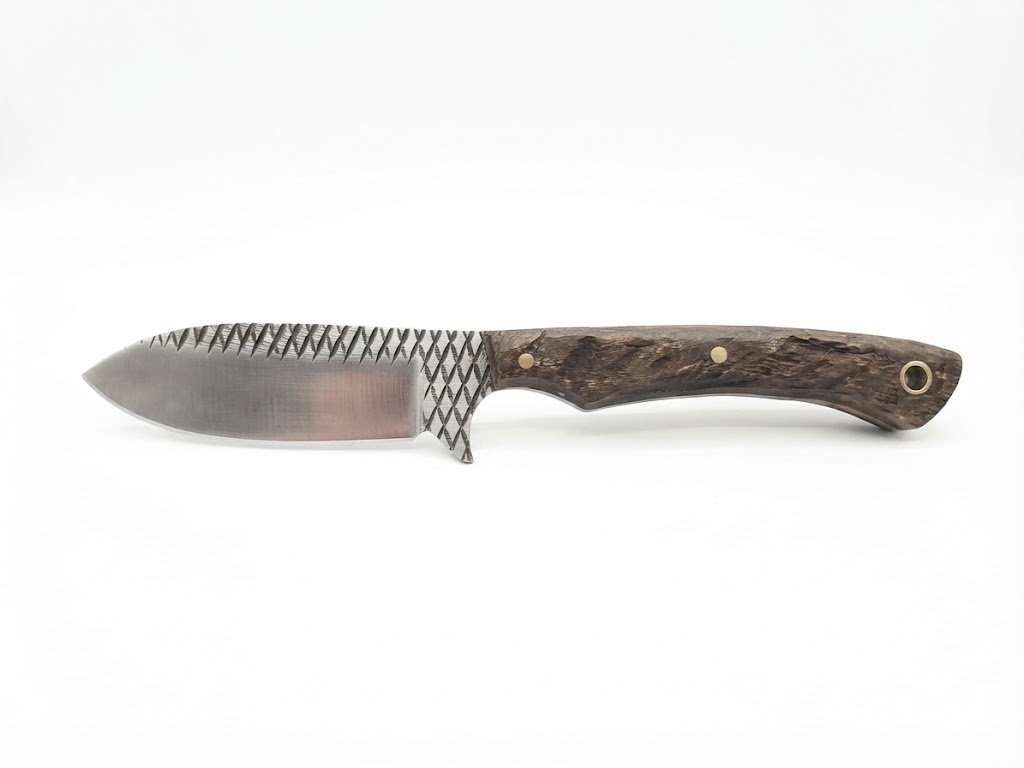
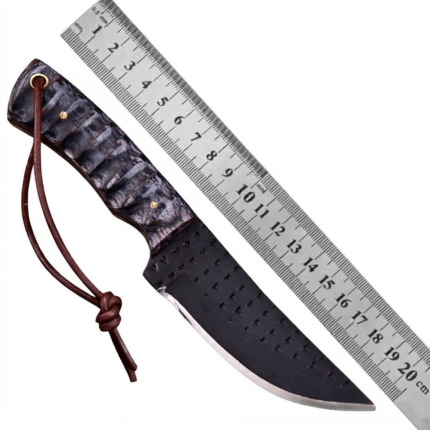
The decorative filework hunting knife combines a traditional fixed-blade shape with distinctive dark markings, a satin-looking silver blade and a warm brown handle. Its compact-looking profile and decorative detailing give it an appealing character for adult knife collectors and enthusiasts of classic outdoor-style knives.
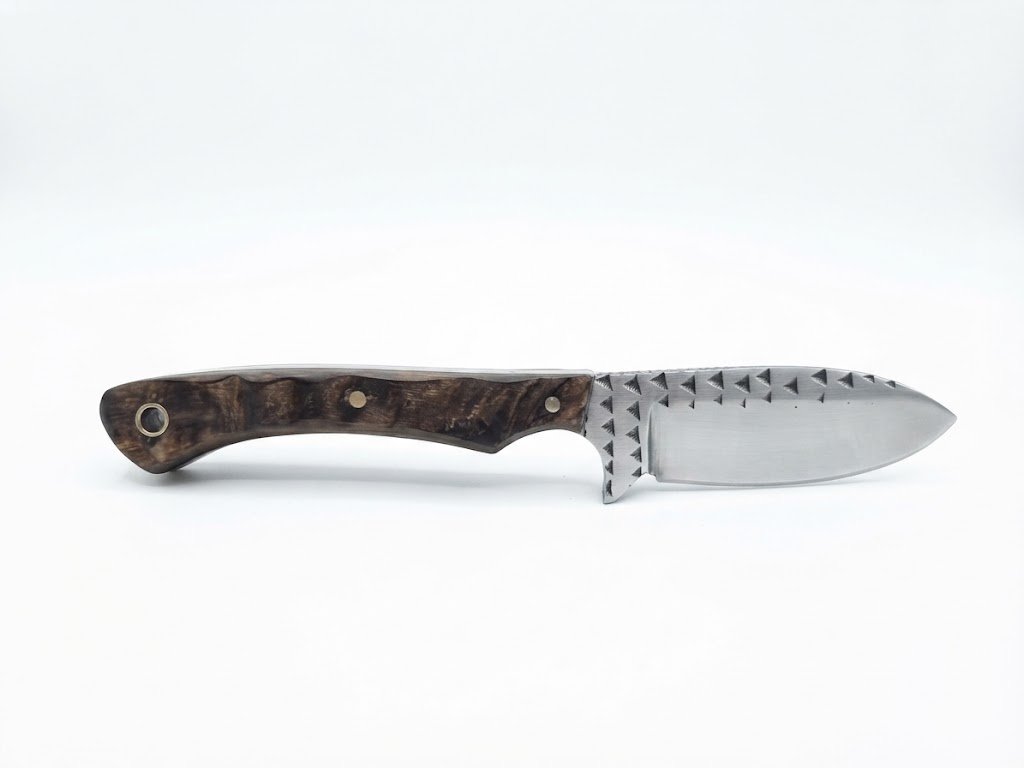
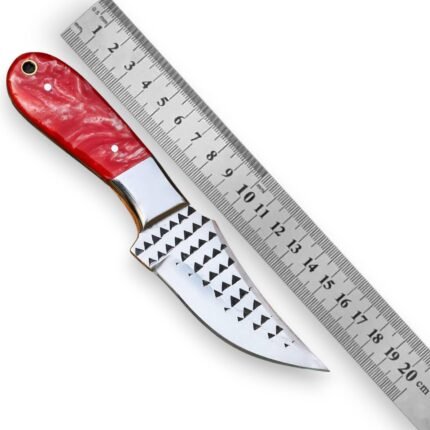
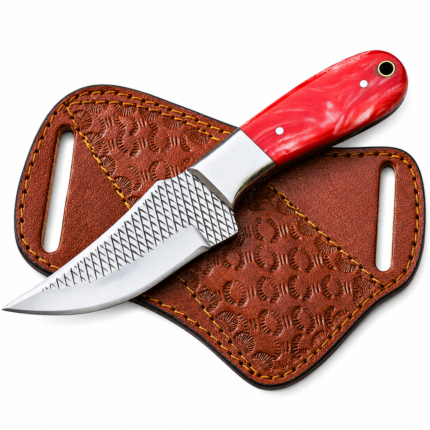
What makes this design especially noticeable is the patterned metalwork near the blade’s upper edge and base. A row of short diagonal marks creates a decorative border along part of the blade, while a larger crosshatched design appears near the transition between the handle and cutting section.
The blade itself has a clean, silver-colored appearance with a broad belly and a gradually tapering point. This simple surface contrasts with the darker decorative marks, allowing them to stand out clearly.
The handle adds another traditional element. Its dark brown, wood-grain-style surface has a gently curved silhouette, two brass-colored fittings and a circular metal-lined opening at the rear.
Together, these elements create a recognizable fixed-blade knife with a combination of understated styling and detailed decoration.
Distinctive Decorative Filework Pattern
The most recognizable feature of the decorative filework hunting knife is the dark patterned section near the upper blade edge.
Short diagonal markings follow part of the blade’s upper outline, creating a repeated series of dark angled strokes.
These markings vary slightly in their spacing and direction, giving the metal a visually textured appearance.
Near the blade-to-handle transition, the decoration becomes more pronounced.
A larger arrangement of intersecting diagonal lines produces a diamond-like crosshatch design.
This section creates a clear contrast with the otherwise smooth blade surface.
The pattern resembles decorative filework commonly associated with handcrafted or custom-inspired knife designs.
However, the photograph does not establish whether the markings were produced using hand filing, engraving, etching, machining or another finishing method.
The listing therefore refers to the visible filework-style appearance without claiming a specific manufacturing technique.
For customers who appreciate subtle decorative details, these markings provide much of the knife’s individual character.
Unlike a heavily engraved blade, the decoration is concentrated around specific areas rather than covering the entire metal surface.
This gives the knife a balanced visual presentation.
Satin-Look Silver Blade
The blade of this decorative filework hunting knife has a relatively clean silver-colored finish.
Its broad surface appears smooth, with soft reflections and a lightly satin-polished appearance.
The main blade face does not display the flowing layers associated with Damascus-style finishes.
Instead, the metal has a simpler appearance that highlights the blade outline and decorative upper markings.
The blade is relatively wide near the handle and gradually narrows toward a pointed end.
Its visible edge follows a gentle curved path, creating the familiar appearance of a drop-point-style outdoor knife.
The silver finish contrasts with both the dark filework-style decoration and the brown handle.
This combination makes the blade easy to distinguish in product photographs.
Although the surface resembles polished steel, the exact alloy cannot be identified from visual evidence.
The knife should not be advertised as stainless steel, high-carbon steel or a particular grade without supplier confirmation.
Similarly, corrosion resistance, edge retention and heat-treatment quality remain unverified.
These specifications should be added only when reliable manufacturer information becomes available.
Classic Drop Point Style Blade Profile
The knife features a broad blade with a gently descending upper profile.
Its point sits toward the end of a gradual taper, creating a recognizable drop-point-inspired silhouette.
The lower blade edge has a noticeable curve, commonly referred to as a blade belly.
This gives the knife a traditional outdoor-style appearance.
Drop-point profiles are commonly found among hunting, utility and fixed-blade collector knives.
However, blade shape alone does not establish suitability for a particular task.
Actual cutting characteristics depend on the steel composition, edge geometry, blade thickness and heat treatment.
The uploaded photograph does not provide those specifications.
From a design perspective, the relatively simple profile complements the decorative filework-style markings.
The broad metal surface gives the knife visual presence, while the gently curved tip contributes to a traditional silhouette.
Customers interested in classic knife styles may appreciate this combination of familiar geometry and decorative details.
Dark Brown Wood-Grain Handle
The handle is another distinctive feature.
Its surface has a dark brown appearance with subtle variations in tone that resemble natural wood grain.
Some areas appear almost black, while others display warmer brown shades.
This variation gives the handle a natural-looking finish rather than a completely uniform color.
The handle also appears slightly irregular in texture, adding visual depth.
It resembles the dark wooden handles frequently seen on traditional hunting knives.
However, its exact material cannot be confirmed from the photograph.
It may be natural hardwood, stabilized wood, a laminated composite or another material with a wood-grain appearance.
For accuracy, this product description uses the term wood-grain-style handle until the supplier confirms its construction.
The darker grip provides a strong visual contrast with the silver-colored blade.
It also complements the black decorative markings near the blade junction.
This creates a cohesive design in which the blade and handle feature distinct but coordinated colors.
Contoured Handle Shape
The decorative filework hunting knife features a gently shaped handle.
Its outline is slightly curved rather than completely straight.
The handle is narrower near the blade and widens subtly toward the middle before tapering toward the rear.
A shallow inward curve along the lower edge gives the grip a defined appearance.
This shape contributes to the knife’s classic outdoor styling.
The rear end is rounded and contains a metal-lined opening.
The overall profile appears relatively slender compared with larger hunting-style fixed blades.
However, exact dimensions are not visible.
The knife should therefore not be described as a particular size, such as a four-inch blade or eight-inch overall length, without measurement.
Handle comfort also cannot be determined from the image.
Factors such as material, thickness, balance, surface finish and hand size influence actual grip characteristics.
The contoured shape is a visible design feature, but it is not sufficient evidence of specific ergonomic performance.
Brass-Colored Handle Fittings
Two small circular fittings are visible on the handle.
Their warm gold or brass-colored appearance contrasts with the dark brown grip.
One fitting is located near the front portion of the handle, while the second is positioned farther toward the rear.
These fittings resemble the pins commonly used in fixed-blade handle assemblies.
Their placement contributes to the traditional appearance of the knife.
The warm metallic color also coordinates with the ring around the rear lanyard opening.
This creates a consistent decorative theme.
Although the fittings look like brass, their exact composition is not established.
They could be brass, another metal or plated components.
The current description therefore identifies them as brass-colored fittings without asserting a specific material.
Their visible function and appearance can be described without making unsupported claims about mechanical strength or construction.
Metal-Lined Lanyard Opening
Near the rear of the handle is a circular opening with a gold-colored metal lining.
Its position and shape resemble a traditional lanyard hole.
Lanyard openings appear on many outdoor-style knife designs, although their exact configurations vary.
The visible opening contributes to the finished appearance of the handle.
Its bright metallic ring stands out against the dark brown surface.
This small feature also complements the two circular handle fittings.
Together, the three metallic details create a coordinated appearance along the handle.
The actual diameter, load capacity and intended compatibility of the opening have not been confirmed.
It should therefore not be advertised as compatible with specific cords or accessories unless measurements are available.
No lanyard is shown in the photograph.
Any cord or attachment accessory should be listed separately unless explicitly included by the supplier.
Traditional Outdoor Knife Styling
The decorative filework hunting knife has a familiar traditional appearance.
Its broad silver-colored blade, dark wood-grain handle and brass-colored fittings create a design associated with classic outdoor knife collections.
The decorative filework-style markings add a distinctive character without overwhelming the simple blade shape.
This makes the knife visually different from modern black-coated tactical designs or brightly colored fixed blades.
Customers who prefer warm, natural-looking handle finishes may find the design particularly appealing.
The overall styling is understated, with much of the decoration concentrated around the blade’s upper edge and transition area.
This combination allows the knife to retain a recognizable fixed-blade profile while introducing more personalized visual details.
Although the knife resembles hunting and outdoor utility designs, actual suitability for those activities depends on verified manufacturing specifications.
The product should not be promoted as suitable for demanding fieldwork solely because of its appearance.
Appealing to Adult Knife Collectors
Knife collectors often appreciate products with unusual decorative details, recognizable blade profiles and traditional handle finishes.
This knife combines several of these characteristics.
The blade features a clear silver-colored surface.
The filework-style border provides a distinctive dark pattern.
The diamond-like markings near the blade base give the design a particularly recognizable feature.
The dark brown handle contributes warmth and character, while small metallic fittings complete the presentation.
Collectors who enjoy comparing knife designs may appreciate the contrast between this relatively simple blade and its concentrated decorative areas.
The product may also appeal to adults interested in traditional-inspired fixed blades as display pieces.
Any display arrangement should use a secure stand or suitable case to prevent accidental contact with the blade.
The photograph does not show a stand, sheath or presentation box.
These items should only be described as included when confirmed by the seller.
Fixed Blade Configuration
The knife has the appearance of a fixed-blade design.
There is no visible folding hinge or pivot mechanism between the blade and handle.
Instead, the blade remains extended outward from the grip.
This configuration produces a continuous silhouette.
Fixed-blade knives are available in many different sizes and construction types.
Some are manufactured for general outdoor use, while others emphasize decorative appearance or collectability.
The intended application of an individual knife should be established through its technical specifications.
The photograph does not reveal the internal tang construction, blade hardness or method used to attach the handle.
These details are important when evaluating manufacturing quality.
Consequently, this listing describes the knife as a decorative hunting-style fixed blade without claiming full-tang construction or heavy-duty performance.
A Balanced Combination of Decoration and Simplicity
One reason the decorative filework hunting knife stands out is its balance between a plain blade surface and concentrated decoration.
The main cutting section is smooth and silver-colored.
The upper blade area introduces narrow dark markings.
The blade base features the more detailed crosshatched pattern.
Meanwhile, the handle has a natural-looking dark brown finish rather than bright decorative colors.
This combination creates visual interest without making the product appear overly ornate.
The design may particularly appeal to customers who enjoy traditional knives with small custom-inspired details.
The dark filework-style pattern also contrasts effectively with the silver blade, making it visible even in a relatively simple product photograph.
The warm handle color helps balance the colder metal tones.
The result is an attractive and recognizable fixed-blade design.
Product Specifications to Confirm
Before publishing a complete technical specification table, several details should be verified with the supplier.
The most important measurements include overall length, blade length, handle length, blade thickness and total weight.
The actual blade steel should also be identified.
If the manufacturer specifies a particular hardness or heat-treatment process, this information can be added after verification.
The handle material should be confirmed as well.
Although its appearance resembles dark wood, the photograph cannot establish whether it is natural hardwood or a synthetic alternative.
The metallic fittings and lanyard-hole liner should also be identified accurately.
The decorative patterning technique is another important specification.
If the markings are hand-filed, etched or machined, that can be stated once confirmed.
The seller should also clarify whether the knife is supplied sharpened and whether a protective sheath is included.
These details help customers understand exactly what they are purchasing.
Accurate specifications are more useful than unverified claims about craftsmanship or durability.
Care and Maintenance Recommendations
Appropriate care helps preserve the appearance of the blade and handle.
The silver-colored blade should be cleaned using methods suitable for its confirmed material.
Ordinary surface residue can generally be removed with a soft cloth.
Dry the blade thoroughly before storing it.
If the steel requires corrosion protection, use an appropriate product recommended by the manufacturer.
Avoid harsh abrasive cleaners that may scratch the satin-looking finish or alter the decorative markings.
The filework-style sections should be checked for accumulated moisture or residue and cleaned carefully.
The handle should also be maintained according to its actual composition.
If it is confirmed to be natural wood, appropriate wood-care products may be useful.
Until the material is verified, avoid prolonged exposure to strong solvents, high temperatures and excessive moisture.
Inspect visible fittings periodically for signs of wear or looseness.
Store the knife securely in a dry place using a properly fitted protective sheath or case.
No sheath is visible in the image, so its inclusion must be confirmed.
Keep the knife inaccessible to children and follow applicable laws concerning knife ownership, transportation and use.
Why Choose This Decorative Filework Hunting Knife?
The decorative filework hunting knife combines a recognizable traditional blade shape with distinctive patterned metal details.
Its broad silver-colored blade has a clean appearance, while the dark upper-edge markings create visual contrast.
The crosshatched section near the blade base introduces another decorative feature.
A dark brown wood-grain-style handle, brass-colored fittings and metal-lined lanyard opening complete the design.
These elements make the product visually different from plain fixed-blade knives.
For adult collectors and customers interested in traditional-inspired outdoor accessories, the design offers several interesting details.
Before purchasing, customers should confirm the actual steel, handle material, dimensions and included accessories.
Explore the decorative filework hunting knife for its classic fixed-blade appearance, distinctive metal patterning and dark wood-grain-style handle.





Reviews
There are no reviews yet.