






Damascus Pattern Axe Head Blank – Distinctive Bearded Design
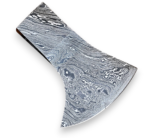
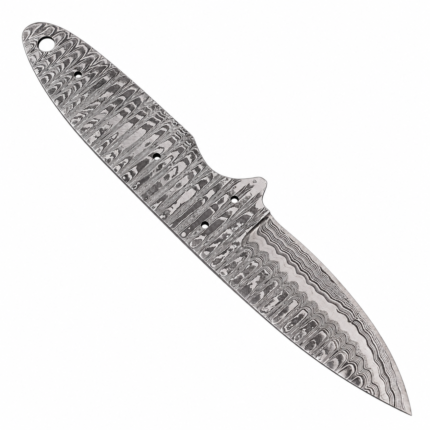
The Damascus Pattern Axe Head Blank features a broad curved cutting profile, intricate silver-and-gray wave patterns, and a traditional bearded-axe-inspired silhouette. Its unfinished, handleless configuration makes it a distinctive metal component for adult collectors, decorative metalwork enthusiasts, and professional buyers interested in axe head blanks.
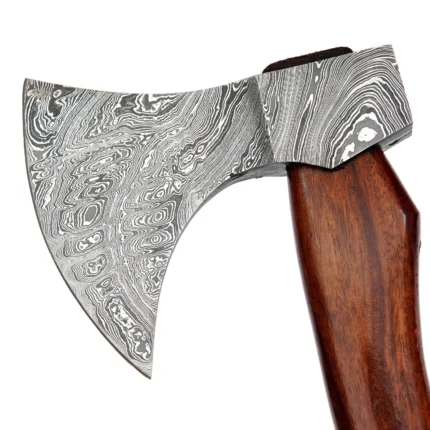
The first detail that stands out is the extensive pattern covering the visible metal surface. Numerous thin silver-colored lines flow across darker gray areas, creating a layered appearance commonly associated with Damascus-style steel.
These patterns follow the curved shape of the blade, producing irregular waves, circular formations, and closely spaced metallic lines.
Unlike a complete axe, this product is shown without a handle. Its narrow rear section transitions into a wider cutting head, which curves downward toward an extended lower point.
This recognizable shape gives the component a traditional Nordic or Viking-inspired appearance.
The design may appeal to customers who appreciate historical-style metalwork, decorative axe components, or distinctive unfinished cutting-tool forms.
Although the surface resembles Damascus steel, the actual metal composition and manufacturing process cannot be verified from the photograph alone.
This description therefore focuses on the clearly visible characteristics while distinguishing decorative appearance from unverified technical specifications.
Distinctive Damascus Pattern Axe Head Blank Design
The Damascus Pattern Axe Head Blank stands out because of its combination of decorative metalwork and an unusual blade outline.
The head has a relatively narrow rear section that gradually expands toward the cutting edge.
Its upper edge follows a gentle curve, while the lower section extends downward into a pronounced bearded-style profile.
This creates a recognizable silhouette similar to certain traditional axe-head designs.
The broad cutting section provides a large visible area for the intricate surface pattern.
Fine silver-colored lines run through darker metal tones, creating a layered appearance.
The overall effect is decorative without relying on colorful coatings, attached ornaments, or engraved logos.
The visible design distinguishes this axe head from ordinary plain-finish components.
For customers comparing decorative axe blanks, its flowing metal pattern and curved lower blade may be the most appealing characteristics.
Intricate Silver and Gray Wave Pattern
One of the most distinctive characteristics of this axe head is its layered-looking metallic surface.
The pattern features numerous thin lines arranged in flowing formations.
Some lines run almost parallel across the narrower rear section, while others bend into irregular curves toward the broader cutting head.
These variations create a visually complex surface.
The contrast between light silver and darker gray areas makes the pattern particularly noticeable.
Several formations resemble tightly arranged waves, while others contain circular or oval shapes.
The design covers nearly the entire visible side of the axe head.
This gives the component a consistent ornamental appearance from the rear section toward the cutting edge.
Because of the pattern’s detailed appearance, the axe head may appeal to adult collectors who appreciate decorative metal finishes.
However, the visible pattern does not independently establish how the steel was produced.
Pattern-welded Damascus steel and other decorative metal finishes may share similar visual characteristics.
The exact manufacturing process must therefore be confirmed before advertising the component as genuine pattern-welded steel.
Traditional Bearded Axe-Inspired Profile
The blade outline resembles a bearded axe head, a style commonly associated with traditional Northern European axe designs.
Its lower cutting section extends noticeably below the narrower rear portion.
This creates an elongated curved shape.
The upper part remains comparatively compact, while the lower section projects downward.
These proportions make the component visually different from conventional rectangular or symmetrical axe heads.
The broad front surface also displays the decorative pattern particularly clearly.
Traditional bearded axe forms have appeared in different historical and modern designs.
However, the photograph cannot establish whether this specific product is a historically accurate reproduction.
It is best described as bearded-style or Viking-inspired.
These terms communicate the visible design without claiming a particular archaeological origin.
For decorative collections, the shape provides an immediately recognizable traditional appearance.
Wide Curved Cutting Edge
The cutting-edge area forms a broad, curved profile along the outer front of the head.
The upper cutting region begins near the broad forward corner and follows the overall shape toward the lower extended portion.
The geometry creates a distinctive sweeping outline.
Its curvature is particularly noticeable compared with ordinary straight-edged blade blanks.
The head’s large surface area allows the silver-and-gray pattern to remain visible alongside the cutting profile.
Although the edge looks defined in the photograph, its actual sharpness cannot be established.
The blade may require additional manufacturer-approved processing before any intended functional application.
The edge thickness, bevel geometry, and final finishing condition are unknown.
Consequently, it would be inaccurate to describe the product as professionally sharpened, ready for chopping, or tested for wood-splitting performance.
These characteristics require manufacturer confirmation.
Handleless Axe Head Configuration
A key feature of this product is its handleless construction.
No wooden, synthetic, or wrapped handle is shown.
The photograph presents the metal head alone.
This distinguishes the component from a complete axe or hatchet sold with an attached grip.
The rear section has a relatively straight-sided, narrowing outline.
However, the image does not show enough information to verify the exact handle-mounting arrangement.
It would therefore be inappropriate to claim compatibility with a specific handle size or mounting method.
Buyers seeking a head for a particular manufactured assembly should obtain accurate measurements and technical documentation.
This may include information about the head’s thickness, weight, mounting construction, and intended use.
For product classification, the most accurate description is an unfinished axe head blank.
Clear identification helps customers understand that a completed handle is not included.
Decorative Layered Metal Appearance
The axe head features a detailed metal pattern that appears to continue across much of the visible surface.
The layered-looking markings create visual movement.
This becomes particularly noticeable where the pattern follows the broad curve of the blade.
Different sections contain distinct arrangements of lines.
The narrower rear portion shows longer flowing formations, while the wider cutting section includes more irregular circular patterns.
These variations give the component a visually textured appearance.
The overall design resembles decorative metalwork associated with premium cutlery and ornamental axe collections.
However, the appearance does not confirm the number of metal layers or the use of any particular forging process.
The product should not be advertised with a specific Damascus layer count without verification.
The visible markings remain a legitimate design feature regardless of the eventual material classification.
A Classic Silver-and-Gray Color Combination
The head uses a restrained metallic color palette.
Its primary tones are light silver, medium gray, and darker charcoal-like areas.
The contrast between these shades creates the layered-looking pattern.
Unlike brightly painted decorative tools, the axe head relies on natural-looking metallic tones for its visual identity.
This gives it a relatively traditional appearance.
The lighter sections highlight the flowing lines, while the darker areas make the pattern more pronounced.
The color combination works particularly well with the broad bearded-style silhouette.
For adult collectors, the silver-and-gray finish may complement other patterned knives, axe heads, and decorative metal objects.
The photograph does not establish whether the surface includes a protective coating.
Its corrosion resistance and maintenance requirements depend on the actual steel and finish.
Nordic and Viking-Inspired Decorative Appeal
Bearded-style axes are frequently associated with historical Northern European tool designs.
Their characteristic extended lower blade makes them recognizable.
The photographed component draws on this general visual tradition.
Its shape combines a narrow rear section with a wider, downward-curving front.
The layered-looking metal pattern adds another decorative characteristic.
Together, these features may appeal to collectors interested in Nordic-inspired objects.
However, an historically inspired appearance should not be confused with verified historical authenticity.
The manufacturer has not provided evidence that this item reproduces a particular historical axe.
For accurate marketing, it should be described as Viking-inspired or bearded-style rather than an authenticated historical replica.
This distinction is useful for customers who appreciate traditional design but also value accurate product information.
Suitable for Decorative Axe Head Collections
Collectors often compare axe heads according to profile, surface finish, proportions, and decorative details.
This component offers several recognizable characteristics.
The broad curved blade gives it a traditional silhouette.
The extended lower section creates its bearded-style appearance.
The flowing silver-and-gray pattern distinguishes the surface from plain steel.
Its handleless presentation allows the entire visible profile to be appreciated.
These details may make the product interesting for adult collectors of unfinished blade components and historically inspired metalwork.
It can also serve as a visual comparison piece alongside other decorative axe-head profiles.
For display purposes, the cutting edge should remain protected.
No display stand, protective case, or sheath is shown.
Such accessories should only be advertised as included if the supplier confirms them.
Unfinished Component Rather Than Complete Axe
Customers should understand the difference between an axe head blank and a finished axe.
A complete axe normally includes an appropriately fitted handle and a head designed and verified for its intended application.
The photographed product shows only the metal head.
Its unfinished configuration means that practical suitability cannot be inferred from appearance.
Likewise, the presence of a cutting-edge profile does not establish that the item is ready for demanding work.
Functional performance depends on the actual steel grade, dimensions, heat treatment, edge geometry, and final manufacturing condition.
These characteristics are not confirmed.
The product should therefore be presented as an axe-head component rather than a guaranteed working axe.
This classification helps reduce confusion for customers browsing decorative axe and metalwork products.
Understanding Damascus-Style Metal Patterns
The term Damascus is often used to describe metallic surfaces featuring distinctive layered-looking markings.
These markings may include waves, curves, rings, and irregular formations.
The uploaded image shows several of these features.
However, not every patterned metal surface is produced using the same process.
Some products use pattern-welded steel manufactured from different metal layers.
Others may achieve a similar decorative appearance through alternative methods.
A photograph cannot verify the underlying alloy, steel layering, manufacturing process, or heat treatment.
For buyers seeking technically defined Damascus steel, manufacturer documentation is important.
Until those details are confirmed, the term Damascus pattern accurately communicates the visible appearance without overstating material authenticity.
General Surface Care and Maintenance
Appropriate care can help preserve the appearance of decorative metal components.
Store the axe head in a clean, dry environment.
Avoid prolonged exposure to moisture.
Because the steel alloy is unverified, no specific corrosion-resistance rating can be assumed.
After handling, gently wipe away fingerprints or visible residue with a soft cloth.
Avoid aggressive abrasive polishing that might affect the surface pattern.
Strong chemical cleaners should not be used without confirming their compatibility with the metal and finish.
If the manufacturer recommends a particular protective treatment, follow those instructions.
Care is especially important for collectors who want to preserve the visual contrast between the light and dark patterned areas.
These recommendations are general precautions rather than guarantees of material performance.
Safe Storage and Handling
Even an unfinished axe head should be treated as a potentially sharp metal component.
The broad cutting edge and extended lower section may present a risk of injury.
Do not assume the edge is blunt because the item is sold without a handle.
Keep the component away from children and unauthorized users.
Use a suitable protective covering or storage arrangement.
Avoid leaving the exposed head on open work surfaces or furniture.
Any professional finishing or assembly work should be undertaken only by qualified specialists following appropriate safety procedures.
The axe head should not be used for chopping, splitting, or other demanding activities unless the manufacturer verifies its intended application and relevant specifications.
Customers should also follow applicable laws governing possession, transport, importation, and use.
Technical Specifications to Confirm
Several important specifications cannot be established from the uploaded photograph.
The overall width, height, blade thickness, and weight remain unknown.
The actual steel alloy and manufacturing method require verification.
The number of metal layers, if applicable, is not established.
The hardness, heat treatment, cutting-edge condition, and surface protection are also unconfirmed.
The handle attachment method and compatibility dimensions cannot be determined from the visible side.
No included handle, sheath, or mounting accessories are shown.
Wholesale buyers should request a specification sheet before ordering.
Accurate dimensions and verified materials are particularly important when comparing visually similar axe head blanks.
Why Choose This Damascus Pattern Axe Head Blank?
The Damascus Pattern Axe Head Blank offers a distinctive combination of flowing silver-and-gray patterns and a traditional bearded-style profile.
Its broad curved blade creates a recognizable silhouette.
The extended lower section adds visual character.
The detailed metallic surface distinguishes it from ordinary plain-finish axe heads.
For adult collectors and specialist buyers interested in unfinished decorative axe components, these features create an appealing presentation.
The exact materials, manufacturing process, and practical capabilities should be confirmed before purchase.
Explore the Damascus Pattern Axe Head Blank if you appreciate traditional axe-head shapes, intricate wave patterns, and Nordic-inspired metalwork.




Reviews
There are no reviews yet.