


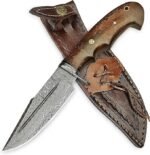



A distinctive fixed-blade knife with traditional styling
This finger groove handle knife combines a richly patterned blade with a brown, grain-look handle and carefully placed decorative details. Its appearance brings together the flowing lines of a Damascus-style finish, the warm tones of the grip, and the darker outline of a long groove along the blade face. The result is a knife with several points of interest, from its shaped handle to its tapered tip.
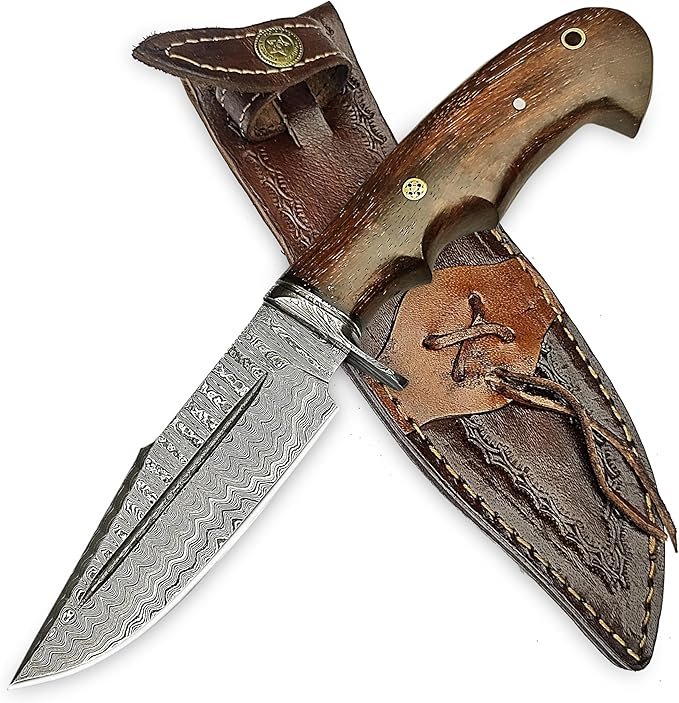
The design will appeal particularly to shoppers who appreciate traditional-looking fixed-blade knives and visible surface detail. Rather than relying on bright colours or large branding, it draws attention through contrasting textures and a recognizable silhouette. The photograph shows one knife against a white background, providing a clear view of the blade, guard, handle contours, and fittings on the visible side.
What defines this finger groove handle knife
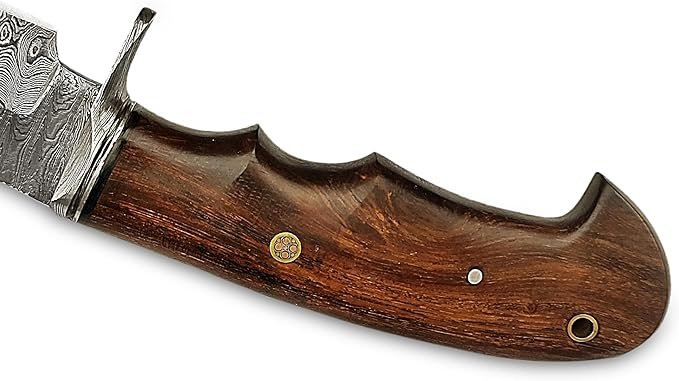
The handle is one of the product’s most recognizable features. Several pronounced recesses run along its underside, forming a finger-groove profile. The upper edge follows a gentler curve, while the rear of the handle broadens into a rounded end. Together, these shapes give the grip a clearly sculpted appearance.
These contours distinguish the knife from designs with straight, uniform handles. They also make handle fit an important consideration when choosing the product. Finger spacing, grip length, and handle thickness all affect how a shaped grip feels in a particular hand.
The image confirms the visible contours but does not establish universal comfort or slip resistance. For buyers who specifically prefer defined finger positions, the shape is a useful feature to examine alongside the actual handle measurements before ordering.
Brown tones and a visible grain-like finish
The handle displays a mixture of medium brown, dark brown, and warmer reddish tones. Lighter streaks run through the surface, producing a wood-grain appearance that contrasts with the silver and charcoal tones of the blade. This warmer colour gives the knife a traditional visual character without making the handle look plain.
The grain-like lines follow the length and curvature of the grip. Around the rounded rear section, the changing tones help reveal the handle’s shape. Near the front, the darker finish creates a clear transition into the patterned metal-looking fittings.
Although the handle looks wooden, the photograph does not verify its material or species. It should not be advertised as walnut, rosewood, pakka wood, or another named material without supplier confirmation. Its confirmed visual qualities are its brown colour, grain-like markings, and contoured profile.
A flowing Damascus-style blade pattern
The blade face carries a dense arrangement of flowing, wavy lines. Some areas appear tightly curved, while others form longer bands that follow the blade’s length. This variation gives the surface a layered appearance and provides the main decorative contrast against the warmer handle.
“Damascus-style” describes the visible pattern accurately without making an unsupported claim about the steel. A photograph cannot establish whether a blade is pattern-welded, surface-etched, printed, or produced using another method. Steel composition, layer count, and manufacturing process require separate confirmation.
For buyers interested in appearance, the pattern offers considerable detail to examine. For buyers seeking a particular metallurgical construction, it is important to obtain the exact material specification. The visual appeal and the underlying steel properties are related purchasing considerations, but one should not be used as proof of the other.
A long groove along the blade face
A narrow, elongated groove runs along much of the visible blade face. Its dark interior creates a strong line within the surrounding patterned surface, drawing the eye from the area near the handle toward the tip. The groove ends before the point rather than continuing through the full blade length.
This feature adds structure to a surface otherwise covered in flowing lines. It creates a clear directional element and helps distinguish this knife from patterned blades with an uninterrupted flat face.
The photograph supports describing it as a blade groove or fuller-like feature. It does not establish its depth, manufacturing method, or effect on weight and rigidity. Those details should be confirmed through specifications rather than inferred from appearance. Its most evident contribution here is visual: a long, contrasting line set within the Damascus-style pattern.
A broad blade that narrows toward the point
The blade begins with a relatively broad section near the handle and narrows toward a defined tip. The lower edge follows a sweeping curve, while the upper outline changes direction toward the point. This gives the knife a hunting-style appearance without requiring an exact model designation.
The relationship between the broad face and tapered end gives the surface pattern room to remain visible across most of the blade. The long groove reinforces that shape, following the blade’s direction while stopping short of its narrowest section.
Blade profile alone does not establish suitability for a specific cutting task. Actual performance also depends on thickness, grind, edge geometry, steel, and heat treatment. Buyers can assess the silhouette from the photograph, then use confirmed specifications to determine whether the product matches their intended practical requirements.
Patterned details at the handle transition
The area between the handle and blade includes patterned, silver-tone fittings. A short guard projects below the handle, creating a visible boundary between the grip and the blade area. The patterned treatment in this section connects visually with the decoration across the blade face.
This transition is an important part of the knife’s overall appearance. The brown handle does not meet a completely plain blade base; instead, the intervening detail carries the patterned theme through the centre of the product.
The image shows the guard’s presence and general shape, but it does not establish the material of each fitting or how the components are joined. It also does not demonstrate protective performance. The accurate description is a short projecting guard with patterned metal-looking details around the front of the handle.
A decorative pin adds a small focal point
A circular decorative pin is visible near the middle of the handle. It has a light outer border and a small patterned centre, giving it a mosaic-style appearance. Against the darker brown grip, this small detail stands out without dominating the design.
Another smaller, plain round pin is visible closer to the rear of the handle. The difference between the two fittings adds variety while keeping the overall treatment restrained. Neither is presented as a large logo or written badge.
These visible fittings contribute to the knife’s appearance, but their presence does not confirm the internal construction. The photograph alone cannot establish the full fastening arrangement or tang design. For shoppers comparing decorative features, however, the contrast between the plain pin and patterned circular detail is a useful distinguishing characteristic.
A lined hole near the handle end
Near the rounded rear of the handle, the image shows a circular hole with a light, gold-tone lining. Its position and form are consistent with a lanyard hole. The contrasting rim makes it easy to identify against the brown surface.
This opening adds another visible detail to the handle and may be relevant to buyers who prefer knives with a rear attachment point. No cord or lanyard is shown, so an accessory should not be assumed to be included.
If you intend to use the opening with a particular cord or fitting, check its internal diameter and the seller’s guidance. The photograph does not provide a measurement or establish compatibility. It confirms only the presence of the lined opening on the visible side of the handle.
A coordinated mixture of patterns and plain areas
The knife brings together several different visual treatments without introducing a large colour range. The blade has dense flowing lines, the handle has broader grain-like streaks, and the decorative pin contains a small circular pattern. These details appear at different scales, allowing each to remain recognizable.
The plain pin and the open lanyard hole provide simpler shapes within the more detailed handle. Similarly, the long blade groove creates a clear line through the patterned blade face. Those quieter elements prevent every part of the design from having the same texture.
For a buyer choosing primarily by appearance, this mixture gives the knife more to offer than a single decorative surface. It can be appreciated as a complete object, with the handle and fittings contributing alongside the blade rather than serving only as a background.
A fixed-blade format with no visible folding mechanism
The product is shown as a fixed-blade knife. There is no visible pivot, folding joint, release button, or locking mechanism. The blade extends directly from the handle assembly, giving the knife a continuous overall profile.
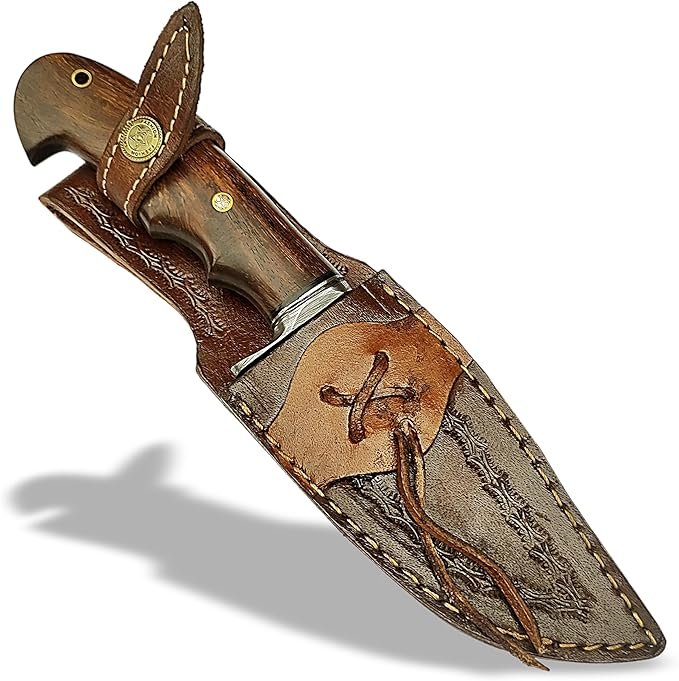
That format is relevant when comparing storage options and package contents. A fixed blade remains exposed unless it is placed in a suitable cover or sheath. The supplied photograph does not show either accessory, so their inclusion needs to be established separately.
The visible format should not be confused with proof of full-tang construction. A fixed blade can use different internal arrangements, and a single side view does not reveal enough to confirm one. Buyers who require a particular tang construction should request a specification or additional photographs that clearly document it.
For collectors who appreciate patterned blades
This knife may interest adult collectors who enjoy decorative blade finishes and traditional-looking handles. The flowing pattern, long blade groove, and brown contoured grip give it several distinguishing details that can be compared with other pieces in a collection.
Its appeal is especially clear when viewed from the side shown in the photograph. That angle reveals the patterned blade face, the decorative handle pin, and the finger-groove outline together. These features provide a coherent design theme rather than a collection of unrelated embellishments.
A collecting decision may depend on appearance, verified materials, documented manufacture, or a combination of those factors. This image supports an assessment of the appearance. Any claim of hand forging, limited production, regional origin, or special craftsmanship would require additional evidence for the actual item being offered.
Evaluating it for practical use
The knife’s shape resembles products commonly presented in hunting and outdoor knife categories. That resemblance is useful for understanding its general style, but it is not enough to confirm performance in the field. The product should be evaluated against the tasks you actually expect it to perform.
Before selecting it for practical use, check the blade material, dimensions, edge condition, handle construction, and manufacturer’s stated purpose. Those details provide a stronger basis for a purchasing decision than a patterned finish or a substantial-looking silhouette.
This description therefore makes no promise about heavy-duty work, edge retention, corrosion resistance, or demanding outdoor conditions. If practical performance is your priority, use the visible design as a starting point and the confirmed technical specification as the deciding information.
Comparing the handle with your preferences
Finger grooves create a more defined handle outline than a smooth, uninterrupted grip. Some buyers actively seek that shape, while others prefer a handle that allows more freedom of hand placement. The right choice depends on personal preference and the product’s actual measurements.
The photograph shows pronounced recesses, a curved upper edge, and a wider rear section. These are useful details to compare with a knife you already find comfortable. Handle length and thickness will help make that comparison meaningful.
The brown finish may also be important if you prefer the appearance of traditional handle materials. However, surface appearance does not confirm texture when held, coating type, or behaviour when wet. Those qualities need direct product information, particularly if your purchase is intended for regular practical use.
Dimensions worth checking before purchase
There is no ruler, hand, or other dependable scale reference in the image. The knife’s overall length, blade length, width, and thickness therefore cannot be determined accurately from the photograph. Its apparent proportions should not be converted into measurements.
For a collection or display, overall length and maximum width help establish whether the product fits an existing case or stand. For practical use, handle dimensions and weight may be equally important. Each measurement answers a different question about ownership.
Request figures for this exact product configuration. A similar-looking knife from another supplier may use different dimensions even when the handle shape and blade decoration appear close. Confirmed measurements make it easier to compare products fairly and avoid receiving an item that differs from the size you expected.
Understanding the specification behind the appearance
A detailed photograph can show colour, pattern, and shape, but many important specifications remain invisible. Steel composition, hardness, heat treatment, internal construction, and the method used to create the surface pattern cannot be established from this image.
The same applies to the handle. Its grain-like appearance does not confirm whether it is solid wood, laminated material, or another construction. A precise material description is valuable because it influences maintenance, expectations, and comparison with other products.
When reviewing a supplier specification, make sure it refers to the pictured version rather than a wider range of knives. Product families may include several handle materials or blade types. Clear information for the exact configuration helps connect the design you see with the physical item you will receive.
What the photograph shows—and what accompanies it
The supplied image shows one knife on a white background with a cast shadow. No sheath, presentation box, sharpening accessory, lanyard, stand, or additional blade is visible. Package contents should therefore be checked in the seller’s confirmed listing.
Accessories can make a meaningful difference when comparing prices. A knife supplied with a fitted sheath may have a different overall cost from an otherwise similar item offered alone. The same is true of presentation packaging or additional storage equipment.
Colour and customization options also remain unconfirmed. The photographed version has a brown handle, silver-and-charcoal blade pattern, and contrasting handle fittings. Engraving, alternative handle colours, or other modifications should only be offered when they are available for this exact product.
Considering it as a gift
The combination of a patterned blade and brown contoured handle may appeal to an adult recipient who already collects knives or appreciates traditional knife styling. The decorative pin and long blade groove provide specific design details that can make the choice feel considered.
A good gift decision starts with the recipient’s preferences. Someone who values documented steel specifications may want different information from someone choosing a display piece primarily for its appearance. The visible design can help identify interest, while confirmed specifications establish whether it meets their expectations.
If presentation is important, verify the packaging before ordering. The image does not establish a gift box or sheath. Checking those details in advance helps you understand what arrives with the knife and whether you need any separate, compatible storage or presentation accessory.
Storage and care information to obtain
Care should follow the instructions for the actual blade material and handle finish. Because those specifications are not confirmed by the photograph, this listing does not prescribe a particular oil, abrasive, cleaning solution, or sharpening method.
Ask for maintenance guidance that covers both the patterned blade and the brown handle. Surface decoration and coatings may have their own requirements, and advice for a different knife should not automatically be transferred to this one.
For storage, select a cover, sheath, or case that is compatible with the knife’s measured dimensions and shape. The projecting guard and contoured handle can affect fit. A suitable arrangement should keep the knife supported and the exposed edge protected from accidental contact while preserving access to the details you want to display.
Additional views that help complete the picture
The supplied photograph gives a useful view of one side, but it does not show every part of the knife. Images of the reverse face, spine, handle end, and blade-to-handle connection would help clarify the overall finish and construction.
A close-up of the decorative pin could show its pattern more clearly. A view along the handle could reveal its thickness and contour, while a spine view could help explain the blade profile. These images are particularly useful when you are comparing products that look similar from the side.
Photographs should support written specifications rather than replace them. Together, clear images and accurate product details allow you to assess both the design and the practical ownership requirements before making a purchasing decision.
A distinctive addition chosen for the right details
The appeal of this knife lies in the combination of its features: a flowing Damascus-style blade pattern, a long blade groove, a shaped brown handle, and small contrasting fittings. Each element contributes to a recognizable design without relying on large logos or vivid colours.
For buyers who prefer traditional-looking knives with visible decorative detail, the photograph offers plenty to examine. The finger grooves define the handle, the circular pin adds a focal point, and the patterned blade provides the strongest contrast.
Review the confirmed dimensions, materials, and package contents to make sure the supplied product meets your expectations. If the contoured grip and richly patterned appearance match your preferences, explore this finger groove handle knife as a considered addition to your collection.








Reviews
There are no reviews yet.