





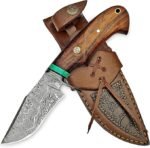


Damascus Pattern Hunting Knife with Brown Wood-Grain Handle
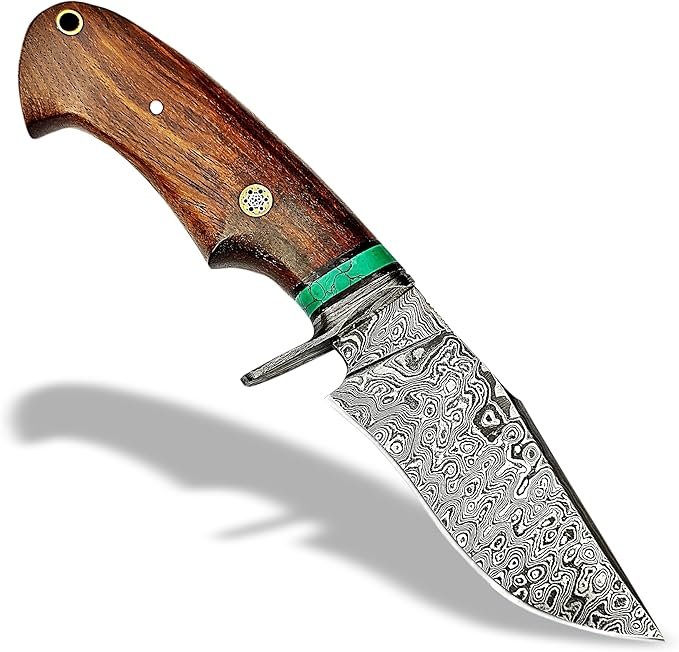
The Damascus Pattern Hunting Knife combines a distinctive layered-looking blade design with a curved brown wood-grain handle and an eye-catching green accent. Its compact fixed-blade profile brings together traditional knife styling and decorative detailing, creating a visually appealing choice for collectors, outdoor enthusiasts, and customers who appreciate unusual knife designs.
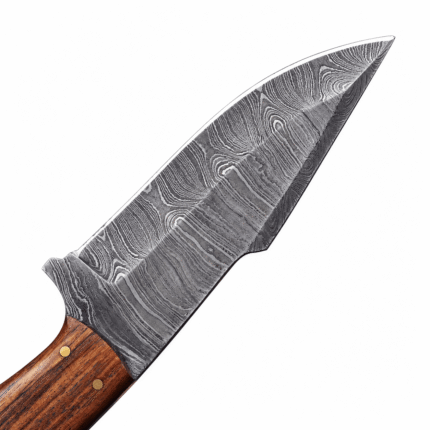
At first glance, the blade’s intricate silver-and-dark pattern immediately stands out. The surface displays flowing, overlapping circular shapes that resemble the layered appearance commonly associated with Damascus steel. These patterns extend across the blade, creating a striking contrast with the smooth-looking cutting edge and the warm brown tones of the handle.
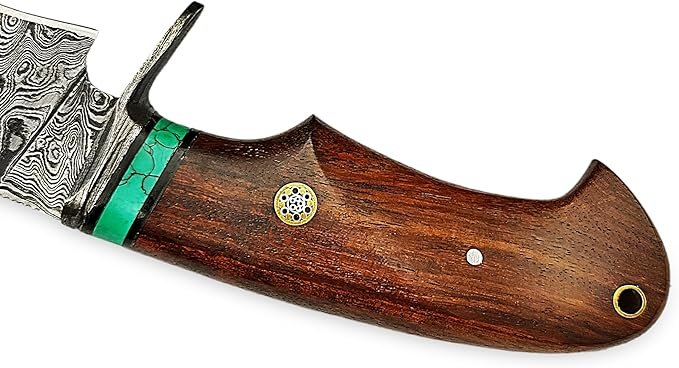
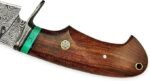
The handle adds another distinctive element. Its visible grain, shaped finger contours, metal fittings, and narrow green spacer create a balanced combination of colors and textures. Together, these details give the knife a traditional appearance without making it look overly complicated.
This knife is suitable for customers who appreciate fixed-blade designs, traditional knife aesthetics, and patterned metalwork. Its actual suitability for cutting tasks, hunting, or outdoor use depends on manufacturer-confirmed specifications and edge condition.
Distinctive Damascus-Style Blade Pattern
One of the most noticeable features of this knife is its decorative blade surface.
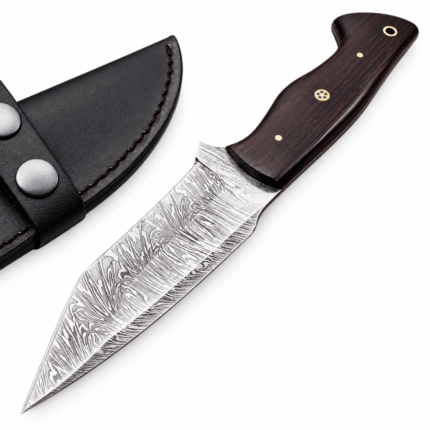
The blade has a silver-colored finish with darker swirling patterns running across much of its visible surface. These lines form a series of closely arranged shapes, producing a detailed appearance that changes across the length of the blade.
The effect resembles the layered patterns frequently seen on traditional Damascus-style knives.
Rather than displaying a plain polished metal surface, this design gives customers something more interesting to examine. The swirling detail offers a sense of depth and makes the blade the focal point of the product.
The patterns vary in direction and density, creating an organic appearance instead of a simple repeated graphic.
Near the tip, the blade narrows to a defined point. Toward the handle, it becomes broader, giving the knife a recognizable fixed-blade silhouette.
The photograph does not establish how the pattern was produced. Genuine pattern-welded steel, etched metal, and other decorative treatments can have similar appearances in product photography.
Before publishing a claim that the blade is made from genuine Damascus steel, the steel construction and manufacturing method should be confirmed with the supplier.
Broad, Pointed Blade Profile
The blade has a relatively broad shape near the handle and tapers toward a pointed tip.
Its cutting edge follows a gentle curve, while the upper portion maintains a more angular outline.
This combination creates a recognizable hunting-knife-inspired appearance.
The blade shape resembles profiles often chosen for general-purpose fixed-blade knives, although the image alone cannot establish performance or intended working specifications.
The relatively compact proportions may appeal to customers who prefer smaller knife designs rather than oversized survival-style blades.
The profile also makes the knife visually distinct from narrow daggers, straight-edged utility blades, and folding pocket knives.
Its detailed patterned finish further emphasizes the curvature and shape.
Curved Brown Wood-Grain Handle
The handle is an important part of the knife’s design.
It features warm brown coloring with darker grain lines extending along its length. The surface has a polished, wood-like appearance that complements the metallic blade.
Unlike a plain cylindrical handle, this one has a shaped profile with several visible contours along the underside.
These contours create defined areas for finger placement and add character to the overall silhouette.
The rear of the handle curves outward slightly, giving it a recognizable finish.
The handle also includes small circular metal pins and a decorative mosaic-style pin.
These fittings provide attractive contrasting details against the darker brown surface.
At the end of the handle, a metal-lined opening is visible. This type of opening is commonly used as a lanyard hole, although its exact intended use should be confirmed.
The handle’s overall appearance is traditional, with enough decorative detail to distinguish it from simple unfinished wooden grips.
Natural-Looking Grain and Warm Color
The wood-grain appearance gives this knife a classic outdoor-inspired character.
Brown tones range from medium amber to darker reddish-brown areas, while the grain follows the curved direction of the handle.
This visual variation gives the handle a less uniform appearance than a solid-color synthetic grip.
The surface appears smooth and finished, although its exact coating or treatment is unknown.
The grain provides an appealing contrast to the intricate blade pattern.
Where the blade emphasizes silver, grey, and black, the handle introduces warm earthy tones.
This combination creates a balanced appearance suitable for customers who prefer traditional materials and natural-looking finishes.
The exact handle material cannot be verified from the photograph. It should not be described as walnut, rosewood, pakka wood, or another specific species without supplier confirmation.
Distinctive Green Handle Spacer
One of the design details that distinguishes this knife from many other brown-handled models is the narrow green accent positioned between the handle and blade.
The spacer has a bright green appearance with darker lines running through it.
Its color creates a noticeable visual separation between the metal blade area and the brown handle.
Although small, this feature contributes significantly to the knife’s overall appearance.
The green tone introduces a modern decorative touch while still complementing the traditional wood-grain styling.
Because the spacer is positioned near the blade connection, it is also visible when the knife is viewed from the side.
This makes the detail particularly useful for product photography and close-up presentation.
The material used for the spacer is not confirmed. It could be a decorative synthetic or composite material, but its exact composition requires supplier verification.
Metal Guard and Handle Details
The knife features a small metal projection near the connection between the blade and handle.
This element resembles a single-sided finger guard.
Its polished metallic appearance contrasts with both the patterned blade and the brown handle.
The guard adds a traditional fixed-blade detail to the knife’s silhouette.
It also creates a visible transition between the blade and the shaped handle.
The actual protective effectiveness of the guard cannot be determined from the photograph.
The handle’s decorative pins add additional metallic accents.
A small circular mosaic-style pin appears near the middle of the handle, while another simpler pin sits closer to the upper section.
These features create a coordinated design without distracting from the blade.
The decorative elements make the product especially interesting for customers who appreciate the visual details of knife construction.
Traditional Fixed-Blade Styling
A fixed-blade knife has a blade that remains in a permanently extended position rather than folding into the handle.
This product clearly has that general configuration.
Its appearance differs from folding pocket knives, which typically include pivots, locks, and folding mechanisms.
Fixed-blade designs are commonly found in hunting, outdoor, utility, and collector knife categories.
However, the absence of a folding mechanism does not establish the knife’s internal tang construction, strength, or suitability for demanding use.
This particular model focuses visually on its patterned blade and curved handle.
The combination gives it an appearance associated with traditional outdoor knives and small collectible fixed-blade designs.
Customers who enjoy comparing blade shapes and handle styles may appreciate its relatively compact silhouette.
The decorative finish also makes it suitable for displaying alongside other traditional knife designs in a secure collection.
A Distinctive Choice for Knife Collectors
Collectors often look for knives with recognizable design features rather than models that all share the same appearance.
This Damascus Pattern Hunting Knife offers several notable visual characteristics.
The blade’s intricate circular pattern is particularly eye-catching.
Its curved brown handle adds a natural-looking contrast, while the green spacer introduces a distinctive color accent.
Small metal pins provide further detail.
Together, these features make the knife visually different from standard black-handled utility knives or plain stainless-looking models.
It may appeal to collectors interested in traditional knife designs, decorative blade finishes, wood-grain handles, and compact fixed-blade profiles.
The knife can be displayed with other collectible pieces using a suitable stand or protective enclosure.
If it has a sharpened edge, it should be stored safely and kept away from unauthorized handling.
For customers building a collection around patterned metalwork, this knife offers an attractive design to explore.
Hunting-Inspired Design and Outdoor Appeal
The shape of this knife is consistent with the general styling of compact hunting and outdoor knives.
Its pointed blade, curved edge, finger-contoured handle, and guard-like projection give it a practical-looking form.
These features may attract customers interested in hunting equipment and outdoor accessories.
However, product photography does not establish whether the knife is suitable for field dressing, wood processing, camping tasks, or other specific applications.
Those capabilities depend on several important technical details.
Steel composition, heat treatment, edge thickness, blade geometry, handle attachment, and overall construction can affect how a knife performs.
Because these specifications have not been supplied, it would be inaccurate to promise professional hunting performance or heavy-duty outdoor durability.
Customers intending to use the knife for demanding tasks should request the manufacturer’s technical specifications before purchasing.
For buyers who value appearance, the knife’s traditional styling and distinctive decorative details are clearly visible.
What Makes This Knife Visually Different?
Many hunting-style knives use a plain blade with a dark or neutral handle.
This model offers a more decorative combination.
The patterned blade introduces intricate surface detail rather than relying on a uniform polished finish.
The handle includes several contrasting elements rather than using a single material color.
Its brown grain, circular pins, green accent, and metal guard create a layered visual design.
The handle’s pronounced curves also contribute to its distinctive silhouette.
These details work together to give the knife an appearance that is both traditional and recognizable.
The contrast is particularly attractive against a plain white background, where the blade pattern and handle grain can be viewed clearly.
For customers comparing multiple fixed-blade models, the green spacer is likely to be one of the easiest features to recognize.
This small decorative addition makes the knife stand out without overwhelming the rest of the design.
Suitable for Collectors and Decorative Displays
This fixed-blade knife can be considered as part of a secure collection of traditional and decorative knives.
Its patterned blade and contrasting handle make it an interesting option for customers who enjoy close-up displays of metalwork.
The silver and dark grey blade pattern can be paired visually with other steel-finish collectibles.
The brown handle adds a warmer appearance, complementing wood, leather, and other rustic-looking display materials.
For a collection featuring multiple blade types, this knife provides an example of a compact fixed-blade profile.
Its green accent also adds variety among knives with more conventional black or brown handles.
Any decorative display should account for the presence of a pointed blade and potentially sharpened edge.
Use a secure stand, protective cover, or enclosed cabinet suitable for the product’s actual dimensions and weight.
Avoid leaving the knife on open surfaces where it could fall or be handled unexpectedly.
Gift Considerations for Knife Enthusiasts
A knife with distinctive decorative features may appeal to an adult collector who appreciates traditional metalwork and unusual designs.
The patterned blade, brown handle, and green spacer give the product a recognizable appearance.
It could be considered for someone who enjoys collecting fixed-blade knives, studying traditional blade patterns, or comparing different styles of knife construction.
Before purchasing it as a gift, buyers should confirm local ownership and shipping requirements.
A suitable protective package should also be used for transportation and presentation.
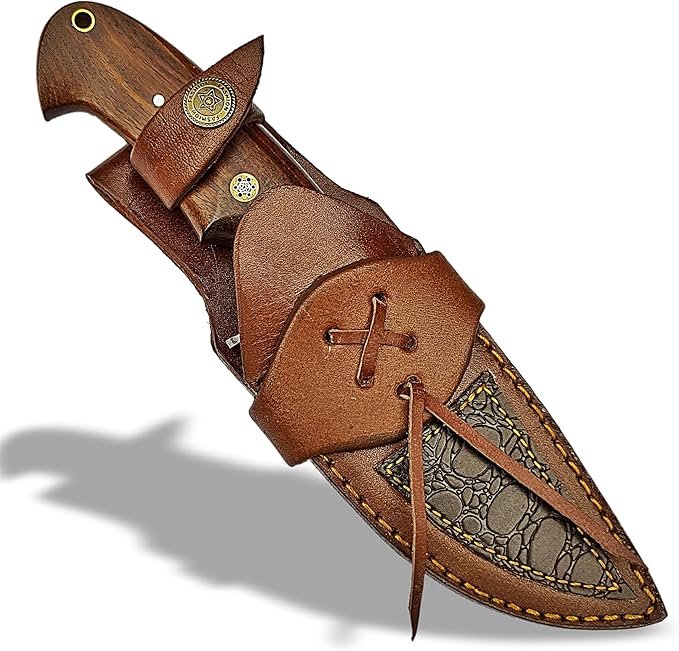
The image does not show a sheath, display box, or additional accessory, so these items should not be included in the product description unless the supplier confirms they are supplied.
Gift packaging and personalization options are also unverified.
Blade Care and Maintenance
Proper maintenance helps preserve the appearance of patterned metal blades.
After handling, wipe the blade gently with a clean, dry cloth.
Avoid leaving moisture on the blade surface.
If the blade is made from carbon steel or another corrosion-prone material, the manufacturer may recommend an appropriate protective oil.
Follow the supplier’s care instructions for the confirmed steel type.
Harsh chemical cleaners and abrasive polishing compounds should be avoided unless their compatibility with the blade finish is established.
Decorative surface patterns can be affected by unsuitable cleaning methods.
For cleaning around the handle and guard, use a soft cloth and avoid allowing water to collect around joints.
Any cleaning product should be suitable for the actual handle and spacer materials.
Maintaining the Handle
The handle has a smooth wood-grain appearance.
To maintain that finish, wipe away dirt and moisture after handling.
Avoid soaking the handle or exposing it to prolonged humidity.
Keep the knife away from extreme heat and excessive direct sunlight, particularly during extended storage.
If the handle is made from natural wood, the supplier may recommend an appropriate wood-conditioning product.
However, oils, waxes, and solvents should not be applied without confirming the handle material and finish.
Some synthetic or stabilized materials may require different care than unfinished wood.
Careful maintenance will help preserve the knife’s visible colors and decorative details.
Safe Storage and Handling
Always handle fixed-blade knives carefully.
A pointed blade should be treated as potentially sharp unless the supplier specifically confirms otherwise.
Keep fingers away from the cutting edge and blade tip.
Store the knife in a secure location inaccessible to children and unauthorized users.
If a suitable sheath is available, it can help cover the cutting edge during storage, provided it is compatible with the knife.
A sheath is not visible in the uploaded image, so its inclusion must be confirmed before purchase.
For long-term storage, ensure that the blade is clean and dry.
Avoid storing the knife in damp environments where corrosion or finish damage may occur.
Inspect the handle, guard, and visible joints periodically for looseness or damage.
Do not use a knife with a compromised handle or blade connection.
What to Confirm Before Ordering
The uploaded image provides a clear representation of the knife’s appearance, but several technical details require confirmation.
Customers should verify the overall length, blade length, blade thickness, weight, steel composition, and hardness.
It is also important to confirm whether the Damascus-style pattern is produced through pattern-welded steel or a decorative surface treatment.
The exact handle material, spacer composition, and tang construction should be established.
If the knife is intended for outdoor use, the manufacturer should provide guidance on appropriate applications and limitations.
Buyers should also ask whether a sheath, protective packaging, or other accessory is included.
Product color and grain appearance may vary between physical items, especially when natural or individually patterned materials are involved.
The extent of any variation should be confirmed with the seller.
These details allow customers to make informed purchasing decisions and help prevent misunderstandings.
A Traditional Design with Distinctive Details
The Damascus Pattern Hunting Knife stands out through its combination of a decorative patterned blade, curved brown wood-grain handle, and bright green spacer.
Its compact fixed-blade silhouette gives it a classic outdoor-inspired appearance, while the visible metalwork adds a distinctive collectible quality.
The handle contours and decorative pins provide additional visual interest without taking attention away from the patterned blade.
For collectors and enthusiasts who appreciate traditional-style knives, the product offers an appealing combination of shape, finish, and detail.
Whether considered for a knife collection or explored as a hunting-inspired design, this model is distinguished by its carefully coordinated appearance.
Explore the Damascus Pattern Hunting Knife and discover a compact fixed-blade design with distinctive patterned metalwork and traditional styling.




Reviews
There are no reviews yet.