


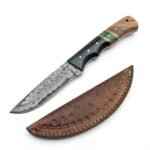

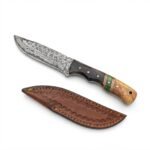
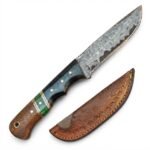
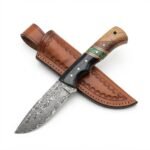
Green Accent Damascus Pattern Hunting Knife with Decorative Sheath
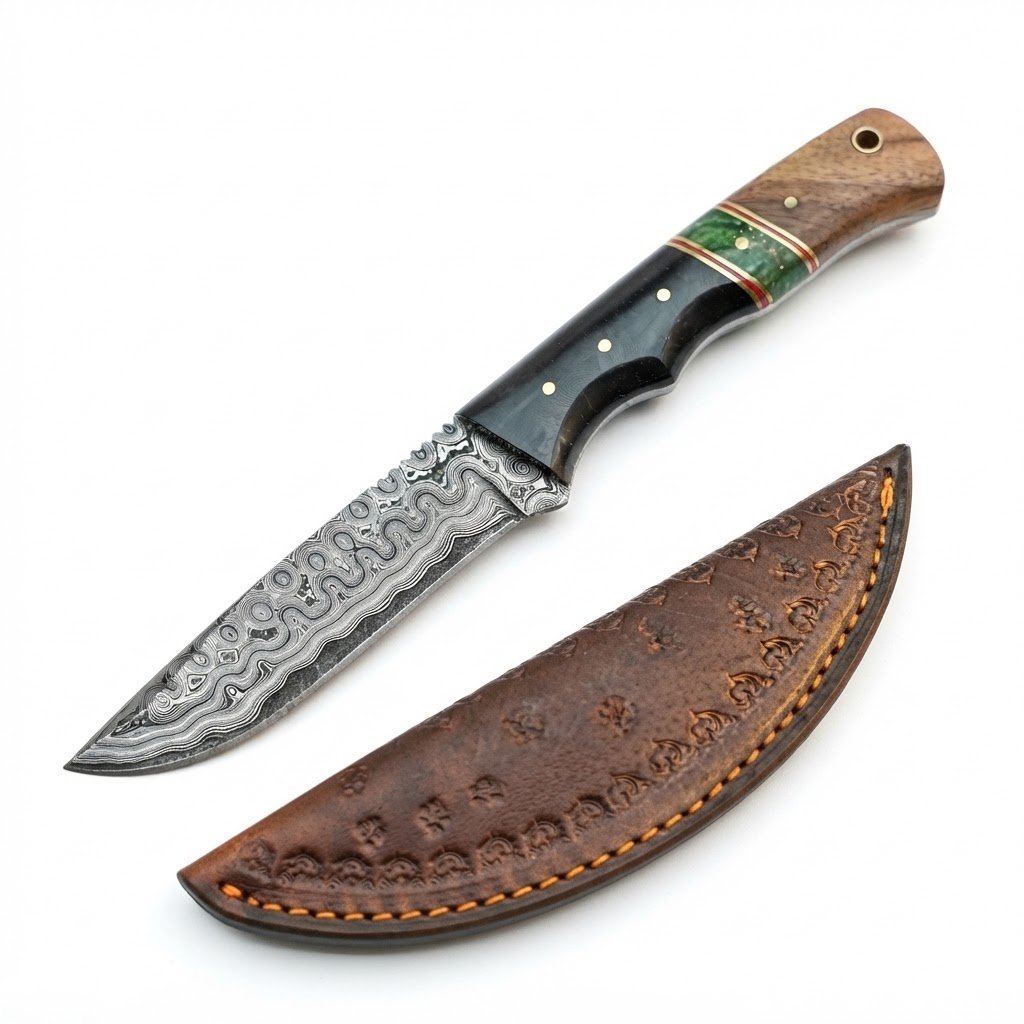
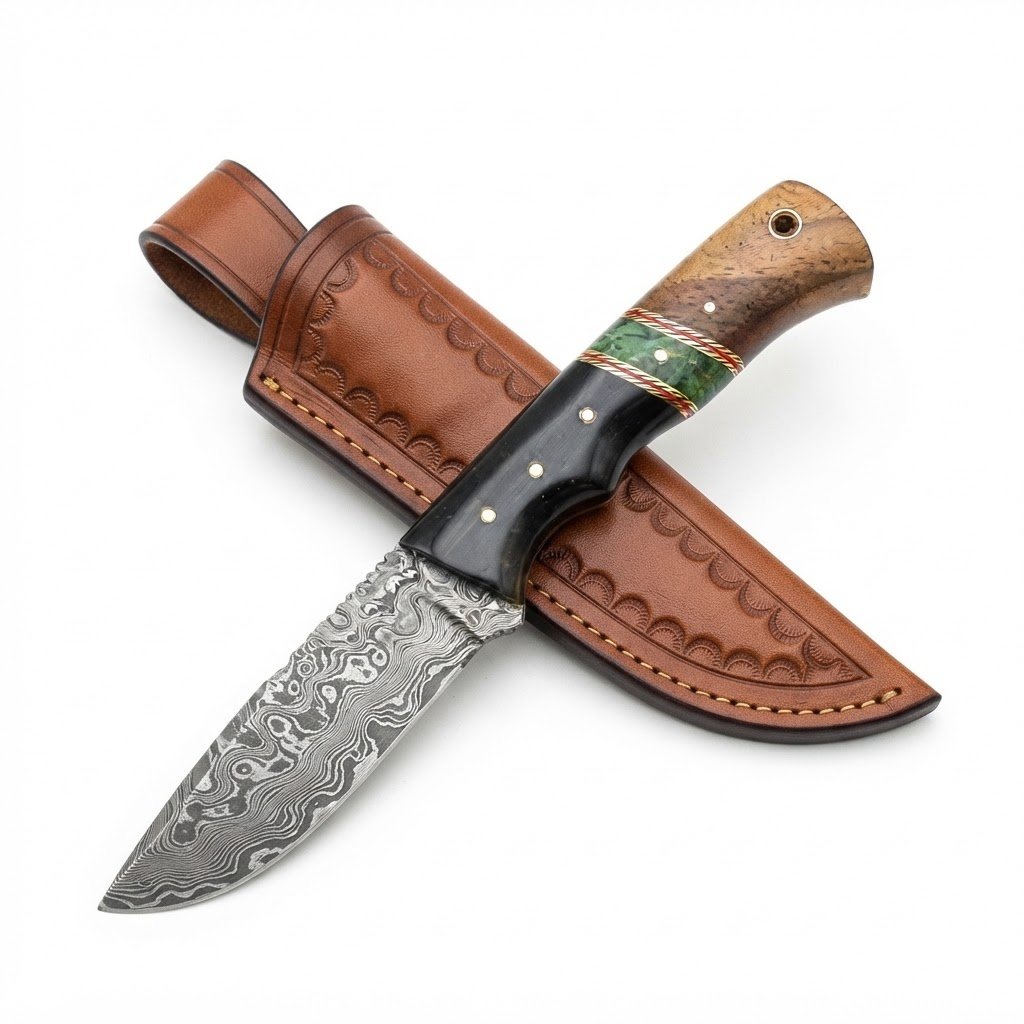
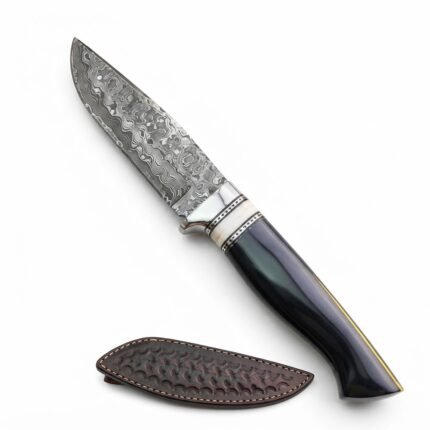
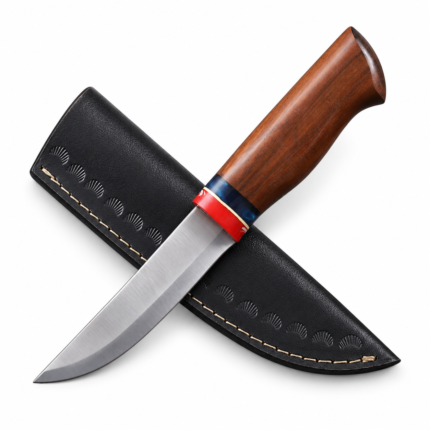
The Green Accent Damascus Pattern Hunting Knife brings together an intricate patterned blade, a distinctive three-tone handle, and a decorated brown sheath in one traditional outdoor knife design. Created around a fixed-blade profile, this knife stands out through its flowing silver and gray blade patterns, carefully arranged handle colors, and detailed exterior finish.
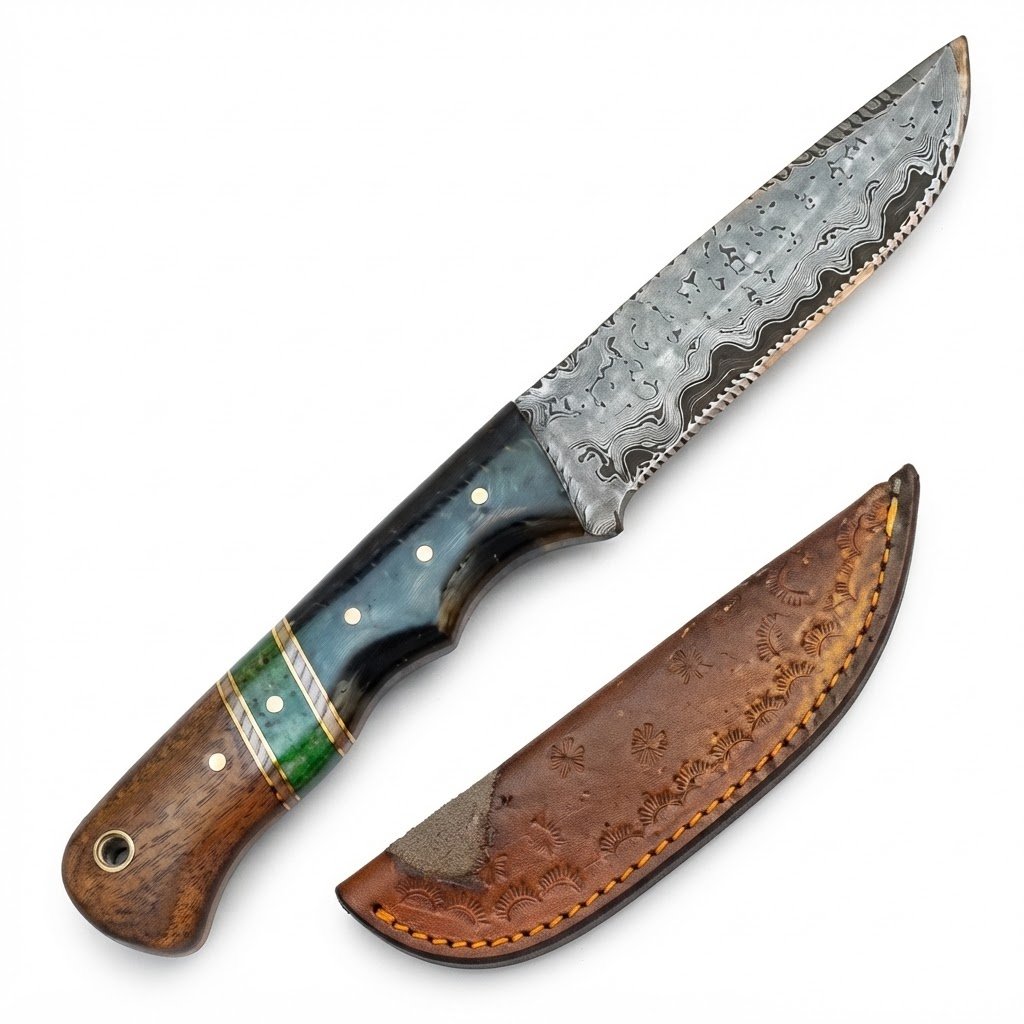
The blade features a prominent layered-looking surface pattern that resembles the flowing lines and circular formations associated with Damascus-style metalwork. These markings extend across much of the visible blade, creating an appealing combination of light and dark tones. Along the spine near the handle are several small decorative notches that add texture to the overall design.
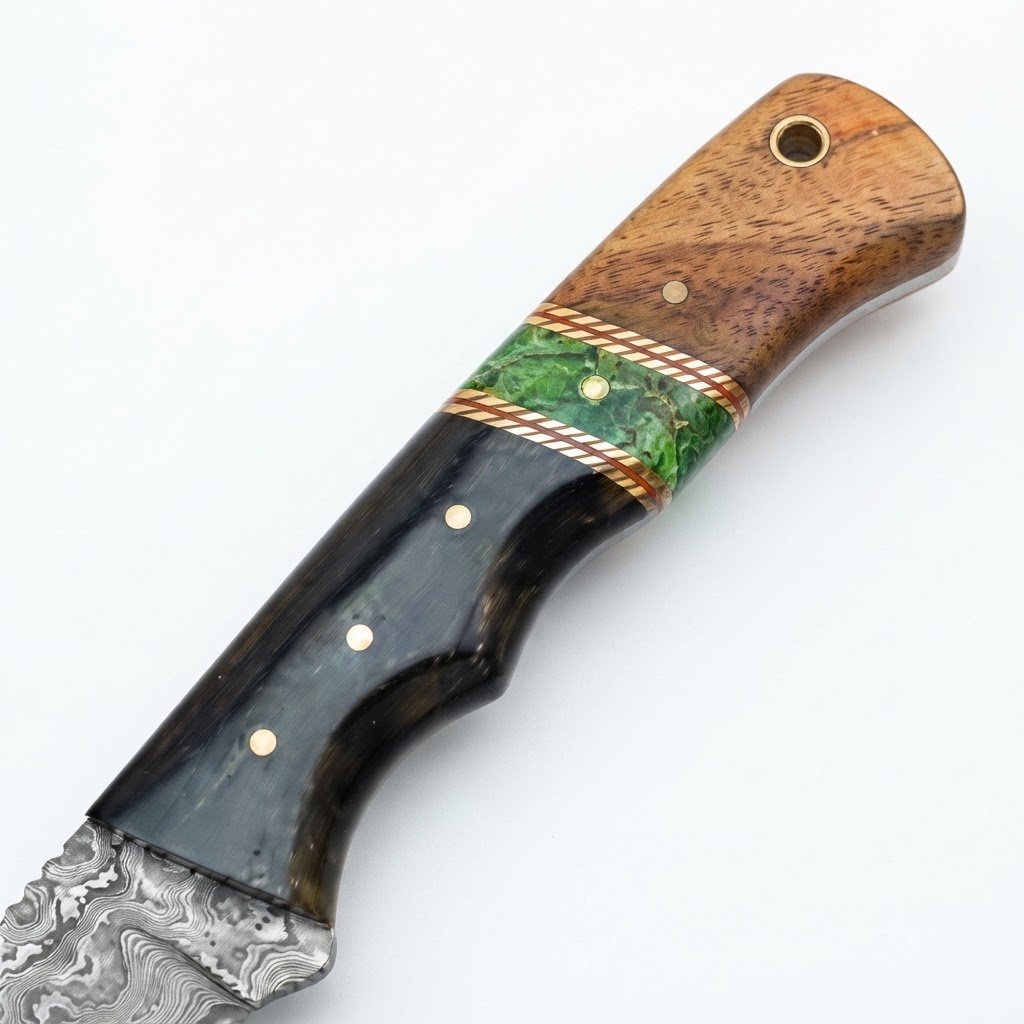
The contoured handle combines a dark black front grip section with a green central accent and a brown wood-grain rear portion. Thin red and gold-colored separator lines border the green section, making the color transition especially noticeable. Small circular gold-colored fittings run along the handle, while a metal-lined opening at the rear resembles a traditional lanyard hole.
Alongside the knife is a brown sheath with visible edge stitching and embossed decorative motifs. Its curved outline follows the general silhouette of the blade, and the contrasting stitching complements the earthy colors of the grip.
Together, these features create an attractive hunting-style knife for customers interested in traditional fixed-blade designs, outdoor cutlery, and decorative knife collections.
This description focuses on the characteristics visible in the product image. Exact dimensions, blade composition, production methods, and performance specifications should be confirmed with the manufacturer before publication.
Traditional Fixed Blade Hunting Knife Design
A fixed-blade knife is distinguished by its permanently extended blade, which does not fold into the handle.
This configuration is common among hunting-style knives, outdoor utility knives, and traditional field cutlery.
The photographed product follows this recognizable form with a straight-forward blade-to-handle arrangement.
Its blade is moderately broad at the base and gradually tapers toward a pointed tip. The cutting edge has a gentle upward curve, creating a versatile-looking profile associated with traditional hunting knife designs.
The handle follows a slightly curved line, with visible finger contours along the lower edge.
Unlike a folding knife, there is no visible pivot, locking mechanism, or moving blade component.
The design emphasizes a continuous fixed-blade silhouette.
The knife may appeal to collectors of traditional outdoor cutlery as well as customers comparing hunting-style products.
However, its actual suitability for cutting tasks depends on the blade steel, edge geometry, thickness, and construction.
These performance characteristics cannot be determined through the photograph alone.
Damascus Pattern Blade with Flowing Silver and Gray Details
The blade’s most distinctive visual feature is its Damascus-style pattern.
Across the visible metal surface, alternating silver and gray markings create irregular waves, flowing lines, and rounded formations.
Some areas feature closely packed parallel curves, while others display larger, swirling designs.
This gives the blade an intricate appearance that contrasts with the relatively simple blade outline.
Near the spine, several circular and curved patterns are visible.
Toward the lower part of the blade, the flowing markings become more elongated and follow the direction of the cutting edge.
The pattern extends close to the tip, helping create a consistent design across the blade.
These details are particularly noticeable because the darker markings contrast with the lighter metal surface.
The image does not establish whether the pattern results from layered steel forging, etching, surface treatment, or another manufacturing process.
For an accurate product listing, the blade should be called Damascus-patterned until the manufacturer verifies its construction.
Actual Damascus steel composition, layer count, and heat treatment should never be assumed from visual patterning alone.
Understanding the Blade Profile
The knife features a relatively narrow, pointed hunting-style blade.
Its spine runs forward from the handle before gradually descending toward the tip.
The cutting edge follows a gentle curve, becoming more pronounced toward the pointed end.
This creates a blade profile resembling a traditional drop-point hunting knife.
The photographed blade does not have a straight, rectangular cleaver-style shape.
It is also noticeably different from a long, narrow fillet knife.
The overall form is more consistent with compact outdoor cutting designs.
The blade’s shape is one reason it fits naturally within the fixed-blade hunting knife category.
A pointed tip and curved edge are common visual elements in many traditional knife designs.
However, specific applications should be based on the manufacturer’s intended-use guidance.
The photograph does not establish the knife’s exact cutting performance.
It also does not show the opposite side of the blade, so symmetrical finishing and complete grind geometry cannot be verified.
Decorative Spine Notches
Near the junction between the blade and handle, several small notches are visible along the upper blade edge.
These details create a textured section immediately in front of the grip.
They are arranged close together and have a scalloped appearance.
On some knife designs, spine grooves or jimping may be used to provide thumb placement or tactile feedback.
However, the specific function of these notches has not been confirmed.
They may be primarily decorative, functional, or a combination of both.
For this product, the accurate image-based description is a series of decorative-looking spine notches.
Their presence adds visual detail to the area where the blade meets the handle.
The patterned blade surface continues around this section, making the transition particularly distinctive.
Customers comparing similar hunting knife models can use this feature to identify the photographed design.
Black Contoured Handle Section
The front portion of the handle has a smooth-looking black surface.
This section begins immediately behind the blade and extends toward the green decorative band.
It makes up a substantial part of the grip.
Several small, circular gold-colored pins are visible along the black section.
The handle’s lower edge features a series of shallow finger contours, while its upper edge follows a smoother curve.
These shapes contribute to the knife’s distinctive grip profile.
The black finish contrasts sharply with the silver-gray patterned blade.
It also provides a neutral background that emphasizes the brighter green central accent.
Although the material appears solid and polished, its exact composition is unknown.
It could be made from wood, a synthetic composite, or another handle material.
The photograph alone cannot confirm whether it is ebony, horn, resin, or another material.
Therefore, the product should be described using its visible black color and smooth-looking finish rather than a specific unverified material name.
Green Accent Band with Decorative Separators
One of the most recognizable details is the green decorative section near the rear of the handle.
This accent appears between the main black grip and the brown wood-grain end piece.
Its surface has a green, slightly mottled appearance.
Thin red and gold-colored separator lines run across both sides of the green section.
These separators create a layered visual effect.
The result is a carefully defined color transition from black to green and then to natural brown.
A small gold-colored pin is visible within the green section.
The contrasting colors make this handle distinctive from conventional single-material wooden handles.
The green accent may be a decorative inlay or a separate handle component, but its precise material is not established.
It should not be identified as jade, turquoise, stabilized wood, or another particular material without verification.
The accurate description is a green accent section with contrasting red and gold-colored separator lines.
This combination adds character without changing the traditional overall shape of the knife.
Natural Brown Wood Grain Handle End
The rear portion of the handle features a warm brown wood-grain appearance.
Its color varies between lighter tan and deeper brown tones.
The grain pattern follows the length of the handle and is clearly visible near the rounded butt.
This section creates a natural-looking contrast against the darker black front grip.
The brown rear end also complements the color of the sheath shown in the image.
The handle gradually becomes wider toward its rear section before finishing in a rounded, slightly flared shape.
A circular metal-lined opening appears near the top of the butt.
The surface looks smooth and finished.
Although the photograph strongly suggests a wood-grain material, the exact wood species cannot be confirmed.
The grip should not automatically be advertised as rosewood, walnut, olive wood, or another particular species.
Likewise, its stabilization, treatment, and moisture resistance are unknown.
For a reliable product listing, these details should be supplied by the manufacturer.
Contoured Grip and Finger Placement
The knife’s handle has a gently curved profile with several defined contours along its underside.
These contours are most visible on the black front section.
The shape differs from a completely straight cylindrical handle.
Its profile is intended visually to follow the natural outline of a hand-held knife grip.
The front portion narrows slightly before meeting the blade.
The rear portion widens and finishes in a rounded butt.
These proportions create a balanced-looking silhouette.
However, physical balance, comfort, and grip security cannot be verified through an image.
Actual ergonomic performance depends on several factors, including handle length, circumference, texture, material, and knife weight.
The handle may suit different users differently.
For that reason, customers who intend to use the knife regularly should review its confirmed measurements.
The product page should include handle length and overall knife weight when those details become available.
Gold Colored Pins and Handle Fittings
Small circular pins are distributed across the handle.
They appear as bright gold-colored dots against the black, green, and brown sections.
Their arrangement provides a consistent decorative theme.
Several pins are visible on the black grip, one is positioned in the green section, and another appears near the wooden-looking rear portion.
These fittings may form part of the handle assembly.
Pins are frequently used in fixed-blade knife manufacturing to secure handle scales or decorative pieces.
However, their exact function cannot be established from the image.
Their material is also unknown.
Although they resemble brass, they should not be advertised as solid brass without supplier confirmation.
The gold-colored appearance is nevertheless an accurate feature to mention.
It complements the thin separator lines around the green inlay and gives the handle a coordinated finish.
Rear Lanyard Hole
A round opening is positioned near the end of the handle.
The opening has a metallic-looking ring.
Its location and appearance are consistent with a lanyard-style hole.
This feature is commonly found on outdoor knives and other hand tools.
The opening can also serve as a distinctive design detail.
In the product image, it is located within the brown wood-grain section near the rounded butt.
Its metal-colored border contrasts with the surrounding brown surface.
The hole’s diameter and internal construction are not known.
The manufacturer should confirm whether it is intended for attaching a wrist lanyard or other accessory.
No cord or lanyard is shown in the photograph.
For this reason, a lanyard should not be listed among the included accessories.
Decorative Brown Knife Sheath
A separate brown sheath appears alongside the knife.
The sheath has a curved shape, darker edge finishing, decorative embossing, and visible stitching.
Its outline is consistent with a protective cover intended for the photographed knife.
The surface has a warm dark brown appearance.
Small embossed motifs are distributed across the visible side.
Along the curved edge is a line of orange-brown stitching.
The stitching stands out against the darker sheath surface.
The exterior has a textured appearance resembling leather.
However, genuine leather composition cannot be confirmed from the image alone.
The product should therefore be described as having a brown leather-look sheath until the supplier confirms its material.
The sheath is shown as part of the product presentation, although actual package inclusion should be confirmed before checkout details are finalized.
Embossed Sheath Decoration
The sheath includes multiple embossed decorative markings.
These are visible along the upper and lower areas of the sheath.
The designs resemble small floral or ornamental impressions.
They add texture to the otherwise smooth-looking brown surface.
The embossed patterns create a traditional decorative appearance.
They are particularly noticeable around the curved outline.
This gives the sheath a more distinctive look than a plain, undecorated cover.
The surface treatment used to create the impressions is not known.
Likewise, the photograph does not establish whether the sheath was stamped by hand or produced using another method.
It is therefore best to describe the visible motifs without making claims about handcrafted production.
Customers comparing similar knife sets may find the sheath decoration an important aesthetic feature.
Contrasting Edge Stitching
A continuous line of orange-brown stitching runs close to the sheath’s curved outer edge.
The stitches are relatively evenly spaced in the photograph.
Their contrasting color makes them easy to see.
The stitching contributes to the sheath’s traditional appearance.
It also creates a clear border around the visible edge.
The photograph does not establish the thread material, stitching technique, or seam construction.
Those details should not be invented.
The sheath’s appearance is compatible with traditional outdoor cutlery styling.
Its dark brown surface, curved shape, decorative embossing, and warm-colored stitching also complement the knife’s brown rear handle section.
This coordinated appearance makes the knife and sheath visually suitable for a single product presentation.
A Distinctive Three Tone Handle Design
Many hunting knives are made with handles featuring one or two colors.
This model uses three noticeably different sections.
The front grip is black.
The central accent is green.
The rear section has a natural brown wood-grain appearance.
The small separator lines introduce additional red and gold-colored details.
Together, these colors create a distinctive appearance without relying on a brightly colored blade.
The black section provides visual contrast.
The green accent draws attention to the center of the handle.
The brown section brings a traditional wood-grain finish to the rear.
The result combines natural-looking and decorative elements.
This makes the knife particularly recognizable in product photographs.
The three-tone handle is an important detail for buyers searching for unusual fixed-blade hunting knife designs.
Traditional Hunting Knife Appearance
The overall design fits within the broad category of traditional hunting knives.
Its fixed-blade construction, curved edge, pointed tip, and shaped handle are all consistent with common hunting-knife styling.
The patterned blade adds a decorative element that distinguishes it from plain-finished models.
Its sheath also contributes to the traditional appearance.
The knife is visually appropriate for catalogs featuring hunting-style outdoor cutlery and collectible fixed-blade knives.
However, the photograph does not demonstrate whether the product has been tested for specific hunting applications.
Blade strength, cutting characteristics, edge retention, and corrosion resistance remain unverified.
The manufacturer should identify the appropriate intended uses.
Customers should not assume that a knife is suited to every outdoor task merely because it has a hunting-style design.
The product’s appearance and confirmed technical specifications should be considered separately.
Damascus Pattern Versus Genuine Damascus Steel
The term Damascus is widely used in the knife market.
It may refer to genuine pattern-welded steel produced from different steel layers.
It may also be used commercially to describe surface patterns that resemble traditional Damascus designs.
The two should not be confused.
In genuine pattern-welded steel, visible patterns are associated with the layered construction and finishing process.
In other products, decorative patterns may be produced through alternative treatments.
Both can display complex flowing designs.
The supplied photograph shows a Damascus-style surface pattern, but it does not establish how that pattern was produced.
No manufacturing documentation, steel composition report, or layer count has been supplied.
For this reason, the product description should use the term Damascus pattern rather than claiming a specific forged construction.
If the manufacturer later verifies that the blade is pattern-welded Damascus steel, the product listing can be updated.
Blade Material and Performance Considerations
The exact blade material is an important technical detail.
Different knife steels can have different levels of corrosion resistance, toughness, and edge retention.
Heat treatment also affects a blade’s performance.
A decorative surface pattern does not provide enough information to determine these characteristics.
The product image cannot establish the knife’s hardness or steel grade.
It should not be advertised using unverified terms such as high-carbon steel, stainless Damascus, 1095 steel, or 15N20 steel.
Likewise, an HRC rating should only be published when supported by manufacturer specifications or testing.
The blade’s silver and gray appearance is a visible characteristic.
Its mechanical properties require independent confirmation.
Customers purchasing a knife for practical outdoor use should review verified specifications rather than relying only on appearance.
Blade Length and Overall Measurements
There is no ruler or known scale in the image.
Therefore, the exact blade length cannot be determined.
The overall length is also unknown.
The knife appears to have a relatively compact hunting-style profile, but its actual dimensions should not be guessed.
Important measurements include overall length, blade length, blade thickness, blade width, and handle length.
Weight is another useful specification.
These details allow customers to compare different models accurately.
They also help determine compatibility with sheaths, cases, and storage accessories.
The photographed sheath appears to correspond to the blade’s general shape.
However, its dimensions are not available.
Accurate product specifications should be supplied before making claims about precise size or weight.
Tang Construction and Handle Assembly
The knife has a fixed blade, but its internal tang construction is not visible.
A tang is the part of the blade structure extending into the handle.
Fixed-blade knives can use several different tang designs.
Some have full-tang construction.
Others use hidden or partial tang configurations.
The photograph does not show enough of the internal assembly to determine which is used here.
Visible handle pins do not necessarily establish full-tang construction.
The listing should therefore avoid unsupported descriptions such as full tang or one-piece forged construction.
The maker should confirm the tang type and method of handle attachment.
These details may be important for customers comparing practical outdoor knives.
A Knife for Traditional Cutlery Collections
The product has several features that may appeal to enthusiasts of traditional knives.
The blade’s flowing gray and silver pattern gives it a decorative appearance.
The black, green, and brown handle sections create a distinctive color combination.
Gold-colored fittings provide small points of contrast.
The accompanying decorated sheath adds another traditional design element.
These details make the knife visually suitable for collections featuring fixed-blade hunting-style designs.
Collectors often compare blade patterns, handle materials, fitting styles, and overall proportions.
This knife provides several identifiable details in each of those areas.
However, it should not be advertised as rare, handmade, limited edition, or historically authentic without supporting evidence.
Its collection appeal comes from its visible design.
Outdoor Utility Considerations
A fixed-blade hunting-style knife may be considered by customers interested in outdoor utility equipment.
However, practical suitability depends on the manufacturer’s specifications.
A blade designed for light cutting may not be appropriate for heavy-duty tasks.
Likewise, corrosion resistance and maintenance needs depend on the exact steel composition.
The image does not establish whether this knife is intended for food preparation, camping, field dressing, carving, or another specific application.
Those uses should be verified before being promised in sales copy.
The decorative sheath should also be assessed for fit and secure retention.
A visually attractive accessory is not necessarily suitable for every carry arrangement.
Customers should use the product only for manufacturer-approved applications.
General Blade Maintenance
Appropriate knife maintenance depends on the metal composition.
As a general precaution, the blade should be cleaned after use.
Dirt and moisture should be removed carefully.
The blade should be dried thoroughly before storage.
A clean, soft cloth may be suitable for routine wiping.
If protective oil is recommended by the manufacturer, follow the specified application method.
Avoid using harsh chemicals or abrasive cleaning products without confirming compatibility with the blade finish.
Decorative blade patterns can be affected by inappropriate polishing.
The manufacturer should provide guidance for maintaining the appearance of the patterned surface.
Inspect the cutting edge for visible damage.
If the blade becomes chipped, loose, or otherwise damaged, discontinue use until its condition is assessed.
Caring for the Multi Color Handle
The three-tone handle combines several decorative-looking materials.
Each section may have different maintenance requirements.
The black section appears smooth.
The green section has a mottled decorative finish.
The brown rear section has a wood-grain appearance.
Because the materials are not confirmed, the safest general approach is gentle cleaning.
A soft cloth can be used to remove loose dust.
Avoid prolonged exposure to moisture or extreme heat unless the manufacturer confirms that the handle can tolerate those conditions.
Do not apply wood oils, solvents, or chemical cleaners without checking the actual material composition.
Inspect the handle fittings and pins periodically.
The visible color separation should be preserved through appropriate care.
Sheath Cleaning and Storage
The brown sheath has a leather-like textured surface.
Its exact material should be confirmed before applying cleaning or conditioning products.
For routine care, remove loose dust with a soft, dry cloth.
Avoid soaking the sheath.
Do not expose it to excessive heat.
If the sheath is confirmed to be genuine leather, follow the supplier’s leather-care recommendations.
Different leather finishes can require different products.
If it is made from a synthetic leather-like material, the appropriate care method may differ.
The decorative embossing and edge stitching should be handled carefully to preserve their appearance.
Long-term knife storage should follow manufacturer guidance, particularly where moisture may affect either the blade or sheath.
Storage and Safe Handling
A fixed-blade knife should be handled with care because the cutting edge remains exposed when it is outside its cover.
The blade should be protected during storage.
A properly fitted sheath can help separate the cutting edge from surrounding objects.
However, sheath retention and suitability should be confirmed.
The knife should be kept away from children and unauthorized users.
Avoid storing it loosely among other tools.
Check the blade, handle, and sheath for damage before use.
Customers should also follow local laws governing the purchase, possession, transport, and importation of knives.
Legal requirements differ by location.
This product should be used only for lawful purposes and applications approved by the manufacturer.
Features Visible in the Product Image
The Green Accent Damascus Pattern Hunting Knife has several identifiable features:
- Fixed-blade hunting-style construction
- Silver and gray Damascus-style blade pattern
- Gently curved cutting edge
- Pointed drop-point-style blade profile
- Small notches along the spine near the grip
- Smooth-looking black front handle section
- Green decorative central handle accent
- Thin red and gold-colored separator lines
- Brown wood-grain rear handle section
- Multiple gold-colored circular pins
- Contoured finger-grip outline
- Rear metal-lined lanyard-style hole
- Brown decorative sheath with embossed details
- Contrasting orange-brown sheath stitching
These details are based on visible characteristics rather than unverified technical specifications.
Technical Specifications Requiring Confirmation
Product Type: Fixed-blade hunting-style knife
Blade Appearance: Damascus-patterned silver and gray finish
Blade Profile: Drop-point-style design
Blade Edge Appearance: Plain, curved cutting edge
Handle Colors: Black, green, and brown
Handle Design: Contoured, three-tone finish
Visible Fittings: Gold-colored pins and metal-lined rear opening
Sheath Appearance: Brown, embossed, leather-like finish
Blade Steel Grade: Not verified
Steel Layer Count: Not verified
Blade Hardness: Not verified
Overall Length: Not verified
Blade Length: Not verified
Blade Thickness: Not verified
Handle Material: Not verified
Tang Construction: Not verified
Weight: Not verified
Sheath Material: Not verified
Exact Package Contents: Not independently verified
Warranty: Not verified
Manufacturer: Not verified
Once the supplier provides accurate specifications, these fields can be added to the product page.
What to Consider Before Purchasing
Customers evaluating this knife should consider both its appearance and verified product information.
The blade pattern is a prominent decorative feature.
The three-tone handle provides distinctive color contrast.
The sheath adds visual appeal.
These features can be assessed from the image.
However, material composition, dimensions, balance, cutting performance, and construction quality require additional information.
Customers who prioritize decorative appearance may be interested in the patterned blade and coordinated handle.
Customers seeking a specific working knife should confirm blade steel, hardness, tang type, and manufacturer-recommended applications.
They should also review exact package contents, warranty terms, and care requirements.
Accurate information helps customers make informed purchasing decisions.
A Distinctive Addition to a Hunting Knife Collection
The Green Accent Damascus Pattern Hunting Knife combines a traditional fixed-blade silhouette with a silver-gray patterned blade, contoured black grip, green decorative accent, and brown wood-grain handle end.
Gold-colored pins, thin separator lines, and a metal-lined lanyard-style opening provide additional visual detail.
The brown embossed sheath complements the knife’s traditional styling.
Its overall design is suitable for customers interested in distinctive hunting-style knives and decorative fixed-blade cutlery.
The product’s exact steel, construction, dimensions, and material specifications should be confirmed before purchase.
Explore this hunting-style knife for its recognizable Damascus-pattern appearance, unique three-tone handle, and coordinated decorative sheath.







Reviews
There are no reviews yet.