





Cream Handle Damascus Pattern Hunting Knife with Polished Bolster
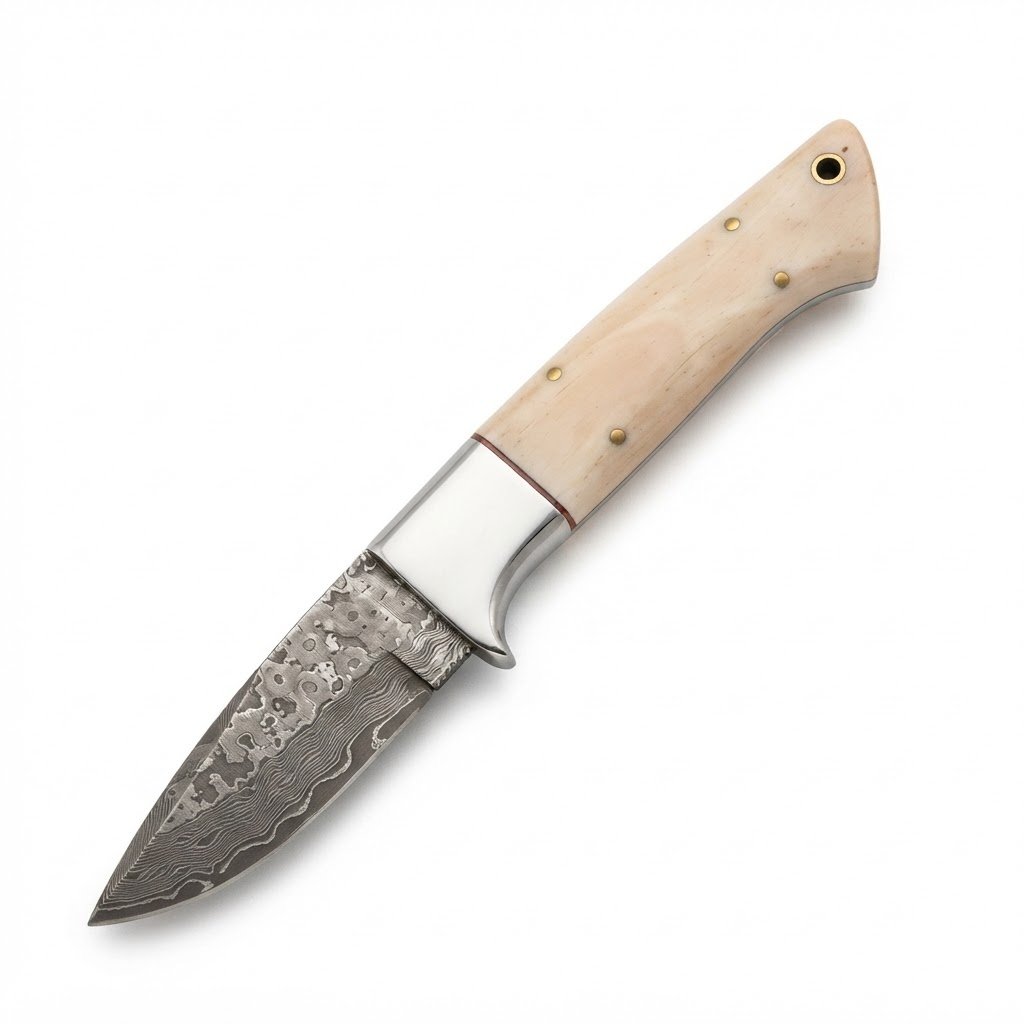
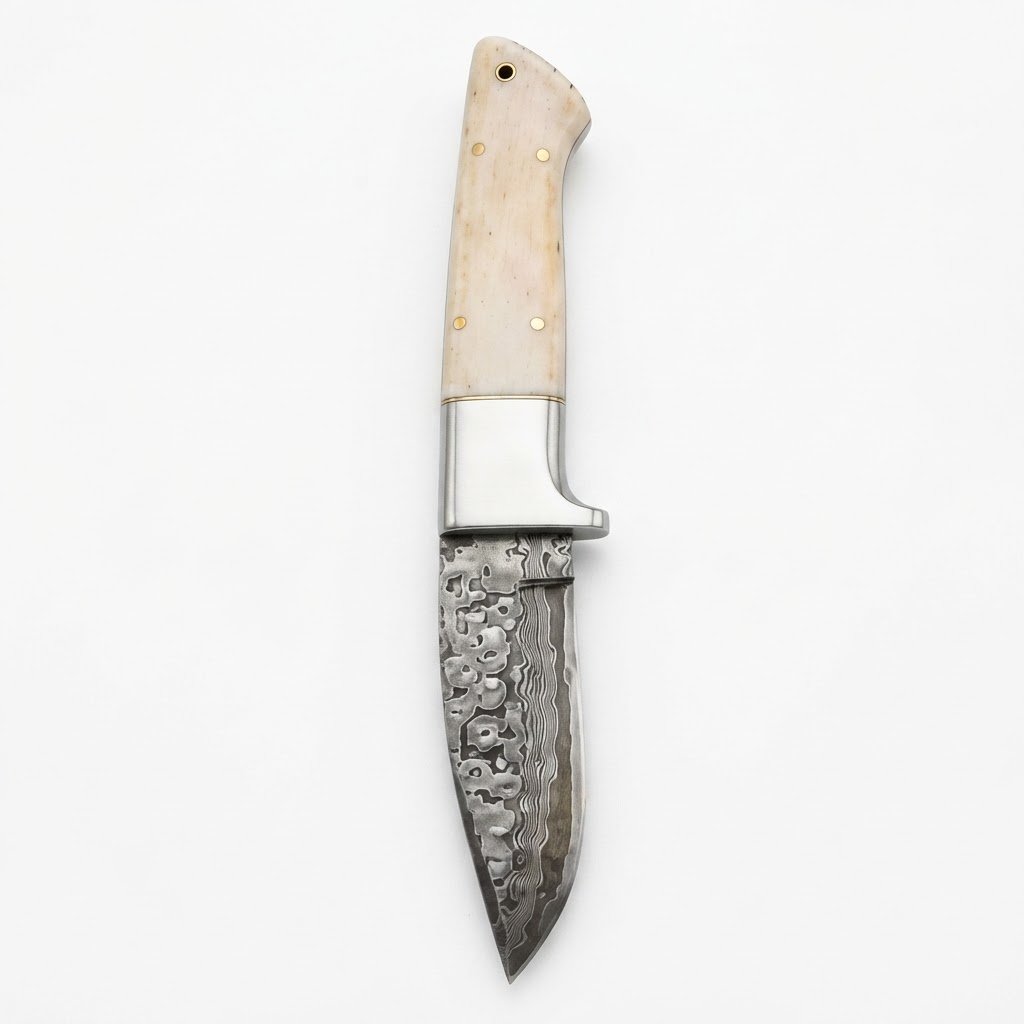
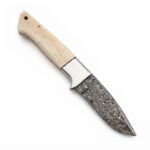
The cream handle damascus pattern hunting knife combines a striking patterned blade with a clean, traditional handle design. Featuring flowing black-and-silver blade patterns, a polished metal bolster, and a smooth cream-colored grip, this fixed-blade knife offers an attractive combination of classic styling and contemporary detailing.
Designed in the style of a traditional outdoor hunting knife, it has a pointed blade with a gently curved cutting edge and a broad profile near the handle. Its distinctive appearance makes it an interesting option for knife collectors, outdoor enthusiasts, and customers who appreciate decorative blades with carefully coordinated handle details.
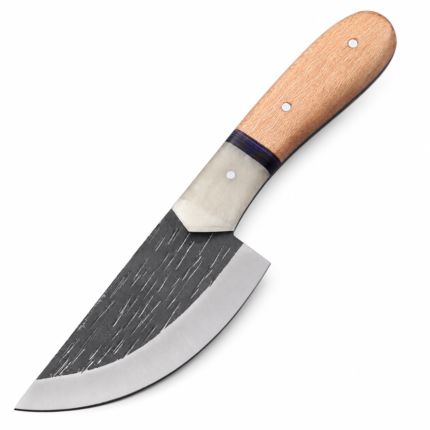
The handle features a light cream finish that contrasts with the darker blade pattern. Four small gold-colored pins, a narrow red spacer, and a circular metal-lined hole near the handle’s end complete the design.
The photograph establishes the knife’s visible construction and appearance. Exact blade composition, dimensions, hardness, handle material, and production technique should be confirmed with the manufacturer before these details are advertised as technical specifications.
Distinctive Damascus-Style Blade Pattern
One of the most noticeable features of this hunting knife is its elaborate blade pattern.
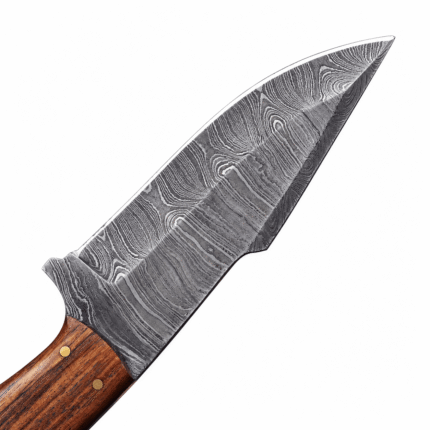
The blade displays alternating dark and light lines arranged in sweeping curves, circular formations, and irregular layered shapes. These markings create a highly decorative appearance across much of the visible blade surface.
Near the tip, the lines become narrow and closely spaced. Toward the handle, several rounded and circular formations interrupt the flowing pattern, adding contrast and visual depth.
The overall result is a blade with an intricate patterned finish that distinguishes it from conventional plain-surface knives.
What Makes the Blade Pattern Different?
Unlike a standard polished blade, this knife displays an extensive decorative pattern extending from the tip toward the bolster.
The visible design includes:
- Closely spaced silver-colored lines against a dark background.
- Circular and oval pattern formations near the upper blade area.
- A pointed blade tip.
- A gently curved lower cutting-edge profile.
- A contrasting polished metal section at the blade-to-handle transition.
Damascus steel is commonly associated with layered metal patterns produced through particular forging and finishing methods. However, visually similar patterns can also be produced through decorative surface treatments.
For this reason, the exact steel construction should be verified before describing this specific product as forged or pattern-welded Damascus steel.
Regardless of its production method, the intricate pattern gives the knife a distinctive visual identity.
Cream-Colored Handle with Traditional Styling
The handle is another prominent design feature.
Its light cream-colored surface creates a strong contrast with the black-and-silver blade. Rather than using an elaborate multicolored grip, the design relies on smooth surfaces, subtle contours, and a small number of metallic details.
The handle gradually widens toward its rear end and features a shaped underside with a visible finger-contour area.
Its profile gives the knife a traditional hunting-knife appearance while maintaining a relatively simple silhouette.
Smooth Handle Surface
The visible handle has a uniform cream tone with slight tonal variation. Its smooth finish creates a clean appearance that complements the polished metal bolster.
The photograph does not establish whether the handle is manufactured from natural bone, resin, synthetic composite, or another material. These materials can appear similar in product photography.
Until the supplier confirms the composition, cream-colored handle is the most accurate product description.
Decorative Gold-Colored Pins
Four round gold-colored pins are visible along the handle.
The pins are positioned at intervals from the front section toward the rear. Their warm metallic appearance contrasts with the light handle and gives the knife an understated decorative finish.
The pins may serve a structural or decorative purpose, but their exact construction and attachment method cannot be determined from the photograph.
The overall arrangement helps create a balanced visual design.
Polished Metal Bolster and Red Spacer
A substantial polished silver-colored bolster separates the blade from the handle.
This section has a smooth, reflective finish that contrasts with the elaborate pattern of the blade and the softer cream color of the grip.
The bolster follows the knife’s curved profile and includes a shaped section beneath the blade-to-handle transition.
This creates a defined visual separation between the cutting portion and the handle.
Subtle Red Accent Detail
A narrow red spacer is visible immediately behind the bolster.
Although small, this detail adds character to the knife’s appearance.
The red line provides a subtle transition between the reflective metal and the cream-colored handle. It also introduces an additional color without distracting from the primary blade pattern.
Together, the polished bolster and red spacer create a carefully coordinated appearance.
Fixed Blade Hunting Knife Design
The knife has a fixed-blade configuration rather than a folding mechanism.
Fixed-blade knives feature a blade that remains in its working position without opening or closing. This gives them a different overall construction from pocket or folding knives.
The photographed knife has a broad blade near the handle, a sweeping lower edge, and a tapered pointed tip.
Its general silhouette resembles traditional hunting and outdoor utility knife designs.
Blade Profile and Shape
The blade has a gently curved cutting-edge profile and an upward-tapering point.
A relatively broad section near the handle transitions toward a narrower blade tip.
This configuration is visually characteristic of many outdoor knives, although actual performance depends on factors that cannot be evaluated from an image alone.
These factors include blade geometry, steel grade, heat treatment, edge finish, thickness, and manufacturing quality.
The precise blade classification should be checked against the supplier’s specifications, although the visible outline is broadly consistent with a drop-point-inspired hunting knife.
Blade and Handle Proportions
The photograph shows a substantial handle in relation to the blade.
Its shape includes a slightly curved underside and a broader rear section. This gives the knife a distinctive, traditional profile.
The proportions may suit users who prefer an outdoor knife with a visibly defined handle rather than a narrow, straight grip.
However, ergonomic comfort is personal and cannot be guaranteed from the photograph.
Customers should refer to actual handle dimensions and product measurements before purchasing.
Decorative Details and Finishing
This knife stands out because several different finishes have been combined into one design.
The blade has a complex patterned surface. The bolster features a clean polished appearance. The cream handle has a comparatively smooth, understated finish.
Small gold-colored pins and the red spacer provide additional accents.
These elements create a contrast between decorative metalwork and the simplicity of the handle.
Black and Silver Blade Contrast
The blade’s dark areas emphasize the lighter, flowing pattern lines.
This contrast makes the pattern visible across the blade’s broad surface.
Some areas display tight parallel lines, while others feature swirling formations.
The variation adds visual interest without requiring additional color or printed graphics.
Classic Handle and Modern Presentation
The cream handle has a traditional appearance, while the crisp metal finish gives the knife a more contemporary presentation.
The combination would fit naturally within a product collection featuring outdoor knives, decorative fixed blades, and hunting-style accessories.
Its appearance is particularly suitable for customers who appreciate knives with strong visual contrast.
Metal-Lined Lanyard Hole
A circular opening is visible near the rear of the handle.
The opening features a gold-colored metal lining that matches the other metallic accents on the knife.
This detail is commonly referred to as a lanyard hole.
On suitable knife designs, a lanyard hole may provide an attachment point for a compatible cord or accessory.
The photograph confirms the presence of the opening, but not its dimensions or load-bearing capacity.
Any intended use involving a cord or attachment should be consistent with the manufacturer’s guidance.
Coordinated Handle Hardware
The lanyard-hole lining and handle pins share a similar gold-colored appearance.
This gives the handle a coordinated finish.
Rather than featuring several unrelated decorative materials, the design uses recurring metallic accents to maintain visual consistency.
The result is a handle that looks distinctive while remaining relatively simple.
Suitable Applications and Customer Interests
The cream handle damascus pattern hunting knife belongs to the broader category of fixed-blade outdoor knives.
Its design may appeal to different types of customers, particularly those interested in decorative metalwork and traditionally styled outdoor equipment.
Knife Collectors
Collectors often value design details that distinguish one knife from another.
The intricate blade pattern, cream handle, polished bolster, and gold-colored accents give this product several visually identifiable characteristics.
It may be suitable for an adult knife collection, depending on individual collecting preferences and applicable local laws.
The exact manufacturing method should be confirmed before the knife is described as handmade, forged, or produced in a particular region.
Outdoor Equipment Enthusiasts
Customers interested in camping, hunting, and outdoor equipment may appreciate its traditional fixed-blade silhouette.
The knife has the appearance of a conventional outdoor cutting tool, although its suitability for specific activities should depend on verified manufacturer specifications.
Factors such as blade material, dimensions, edge retention, and corrosion resistance should be confirmed before making any performance claims.
Decorative Knife Displays
The patterned blade and contrasting handle also make this knife visually suitable for a secured adult collection or display.
Its appearance can be appreciated independently of its practical function.
For decorative presentation, the knife should be stored in a secure display arrangement that prevents accidental contact with the blade.
Gift Considerations
For adults who collect knives or appreciate decorative metalwork, the design may be of interest as a collectible gift.
Its patterned blade and coordinated handle details provide a recognizable visual style.
Gift packaging, a storage case, and other presentation accessories should only be advertised if confirmed as included by the supplier.
How This Knife Compares with Plain Blade Designs
The most noticeable difference between this product and a conventional plain-finish knife is the blade surface.
A standard polished blade often features a relatively uniform metallic appearance.
This knife instead displays extensive flowing patterns in contrasting shades.
The patterned appearance becomes its primary decorative feature.
The cream handle creates another point of distinction.
Many hunting-style knives use dark-colored handles, while this design uses a lighter finish that makes the grip stand out against the blade.
The polished bolster also provides a clearly defined transition between the different parts of the knife.
These visual differences may appeal to customers who prefer more decorative outdoor knives.
The appearance alone does not establish superior cutting performance, durability, or material quality.
Blade Material and Construction Considerations
The term Damascus is frequently used in the knife market to describe blades with characteristic flowing or layered patterns.
However, material descriptions should always be based on the actual manufacturing process.
Genuine Pattern-Welded Damascus Steel
Pattern-welded steel is generally produced by combining and working different steel layers to create a patterned structure.
The specific properties of a completed blade depend on the steels used, heat treatment, geometry, and finishing process.
Different manufacturers may use different steel combinations and production techniques.
It is therefore important to obtain accurate technical documentation for the specific knife being sold.
Decorative Damascus-Style Finishes
Some products feature Damascus-inspired surface patterns without having pattern-welded construction.
Such designs may still be visually attractive, but the underlying construction differs.
For this product, the safest image-based description is Damascus-pattern blade until the actual material and production technique have been verified.
This distinction helps customers understand exactly what they are purchasing.
Information That Should Be Confirmed
Before the product listing is finalized, the manufacturer should supply details about the steel grade, blade length, overall length, blade thickness, hardness, and handle material.
The construction method should also be confirmed.
If available, these details can be added to the product’s technical specifications section.
Providing accurate specifications is especially useful for buyers comparing several fixed-blade knives.
Handle Material and Appearance
The handle’s pale color may resemble certain natural or synthetic materials.
However, color and surface finish alone cannot reliably establish composition.
Natural materials and manufactured composites can produce similar visual results.
For that reason, the handle should not automatically be described as bone, ivory, horn, or resin.
The current photograph establishes only its cream-colored appearance, visible shape, pins, and lanyard opening.
Once the supplier confirms the actual handle material, the product description can be updated with the correct terminology.
This also helps avoid misleading claims relating to natural or restricted materials.
Storage and Routine Care
Regular maintenance can help preserve the appearance of many fixed-blade knives.
The appropriate cleaning and protection method depends on the actual blade and handle materials.
Since the precise specifications of this product have not been confirmed, the following are general care recommendations rather than manufacturer-specific instructions.
Cleaning the Blade
After appropriate use, clean the blade carefully with a method suitable for its confirmed steel grade and finish.
Avoid abrasive cleaning products that may alter decorative surface patterns.
Do not leave moisture or residue on the blade for prolonged periods.
A soft, dry cloth is generally useful for removing surface moisture.
If the blade is made from carbon steel or another corrosion-sensitive alloy, additional protective care may be necessary.
Protecting the Decorative Finish
The patterned blade is one of the knife’s main visual features.
Avoid unnecessary contact with hard or abrasive surfaces that could mark the finish.
Do not use aggressive polishing methods without confirming that they are suitable for the blade’s construction.
Decorative etched finishes may require different care from plain polished steel.
Follow the supplier’s maintenance recommendations whenever available.
Maintaining the Handle
Keep the handle clean and avoid prolonged exposure to conditions that could affect its finish.
The appropriate maintenance products depend on whether the handle is made from wood, bone, resin, or another material.
Do not apply oils, solvents, or treatments until material compatibility has been established.
Use a soft cloth for routine surface cleaning where appropriate.
Safe Storage
Store the knife securely in a dry location away from children and unauthorized users.
A properly fitting protective sheath or storage case may help protect the blade during storage or transport, but a sheath is not shown in the uploaded photograph.
Its inclusion should therefore be confirmed before being stated in the product listing.
For longer-term storage, follow the manufacturer’s guidance for the specific steel and handle materials.
Always comply with applicable knife ownership, transport, and storage regulations.
Choosing the Right Fixed Blade Knife
When comparing outdoor knives, customers should consider more than appearance.
The blade shape, steel composition, handle design, dimensions, and intended application all influence whether a particular knife meets their requirements.
Consider the Blade Geometry
The photograph shows a broad blade transitioning into a pointed tip.
This shape is a defining characteristic of the product’s appearance.
Actual blade thickness, grind geometry, and cutting-edge dimensions are not available from the image.
Customers looking for a knife for a particular purpose should compare those specifications with their requirements.
Consider the Handle Shape
The cream handle has a shaped underside and a broader rear section.
These visible contours may influence how the knife feels in the hand.
However, actual comfort and suitability depend on hand size, handle dimensions, surface texture, and personal preference.
Manufacturer measurements are important for making an informed decision.
Consider the Materials
Before purchasing, customers should confirm whether the blade is genuine pattern-welded Damascus steel or features a decorative Damascus-style finish.
They should also verify the handle material, metal fittings, and any included accessories.
Clear material information makes it easier to compare products accurately.
Why Choose This Cream Handle Damascus Pattern Hunting Knife?
The cream handle damascus pattern hunting knife offers a distinctive combination of patterned metalwork and traditional handle styling.
Its visual identity comes from several clearly identifiable features.
The blade displays intricate black-and-silver lines and circular formations.
The polished metal bolster creates a reflective transition between the blade and the grip.
A narrow red spacer adds a subtle accent behind the bolster.
Four gold-colored pins complement the handle’s cream finish, while the metal-lined lanyard hole completes the rear section.
Together, these features create a cohesive design suited to customers who appreciate decorative fixed-blade knives.
The knife’s appeal lies primarily in its visible craftsmanship-inspired styling, balanced color arrangement, and traditional outdoor-knife silhouette.
Its technical performance and material characteristics should be evaluated using confirmed manufacturer specifications rather than appearance alone.
Product Specifications
| Attribute | Description |
|---|---|
| Product Type | Fixed Blade Hunting-Style Knife |
| Blade Appearance | Black and Silver Damascus-Style Pattern |
| Blade Profile | Broad, Curved Edge with Pointed Tip |
| Handle Color | Cream |
| Handle Shape | Contoured with Shaped Underside |
| Bolster | Polished Silver-Colored Metal |
| Spacer | Narrow Red Accent |
| Handle Pins | Four Gold-Colored Pins Visible |
| Lanyard Hole | Yes, Metal-Lined |
| Steel Composition | Not Verified |
| Handle Material | Not Verified |
| Overall Length | Not Verified |
| Blade Length | Not Verified |
| Blade Thickness | Not Verified |
| Blade Hardness | Not Verified |
| Sheath Included | Not Confirmed |
| Manufacturing Method | Not Verified |
Final Thoughts
The cream handle damascus pattern hunting knife brings together an expressive black-and-silver patterned blade, a polished bolster, and a distinctive light-colored handle.
Its curved blade profile, coordinated metallic details, and traditional fixed-blade silhouette make it an appealing design for adult collectors and enthusiasts of decorative outdoor knives.
For customers who value intricate blade patterns and classic handle styling, this knife is worth exploring. Review the verified material specifications, available accessories, and product dimensions before choosing it for your collection or intended use.







Reviews
There are no reviews yet.