

Green Wood Handle Fixed Blade Hunting Knife with Polished Blade
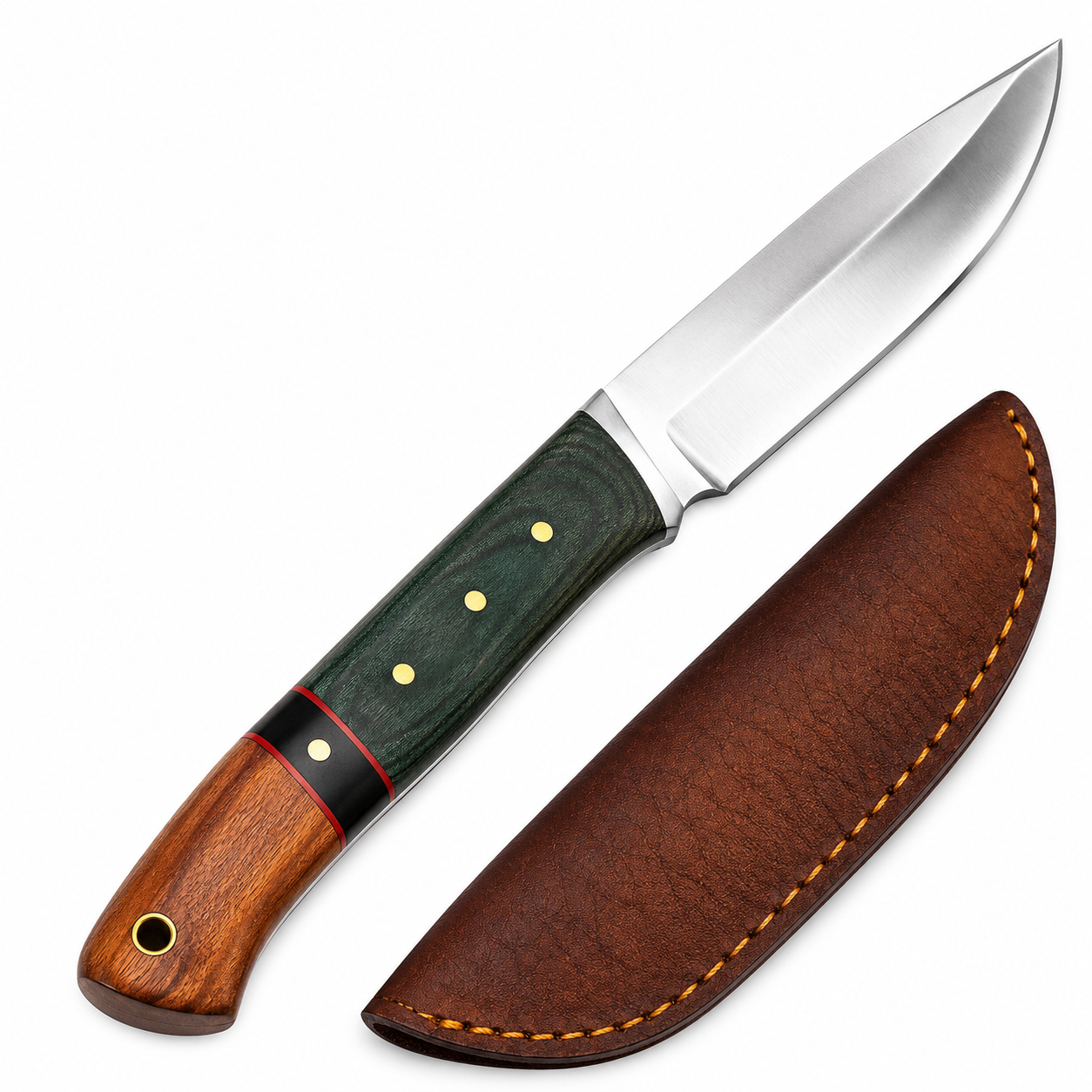
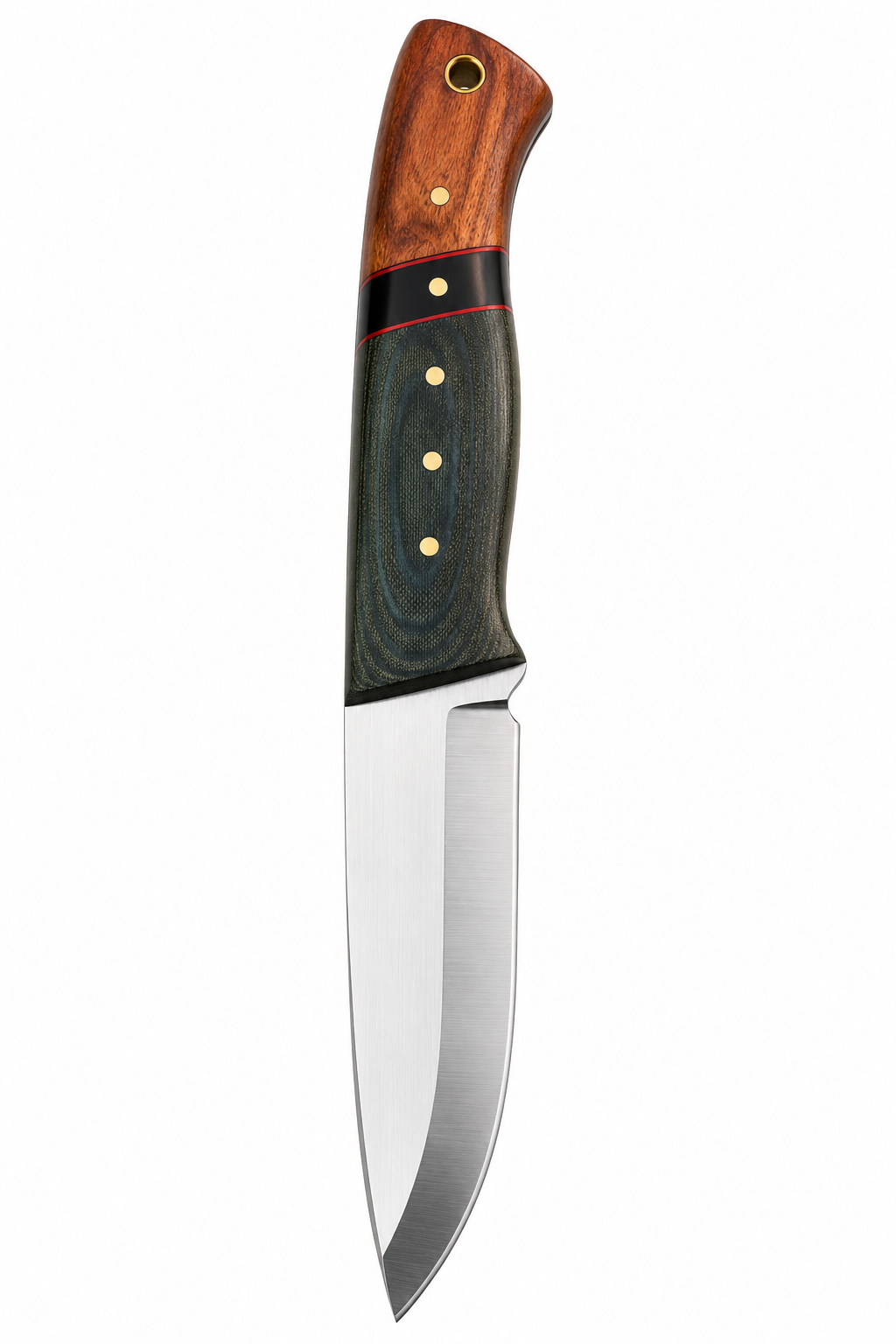
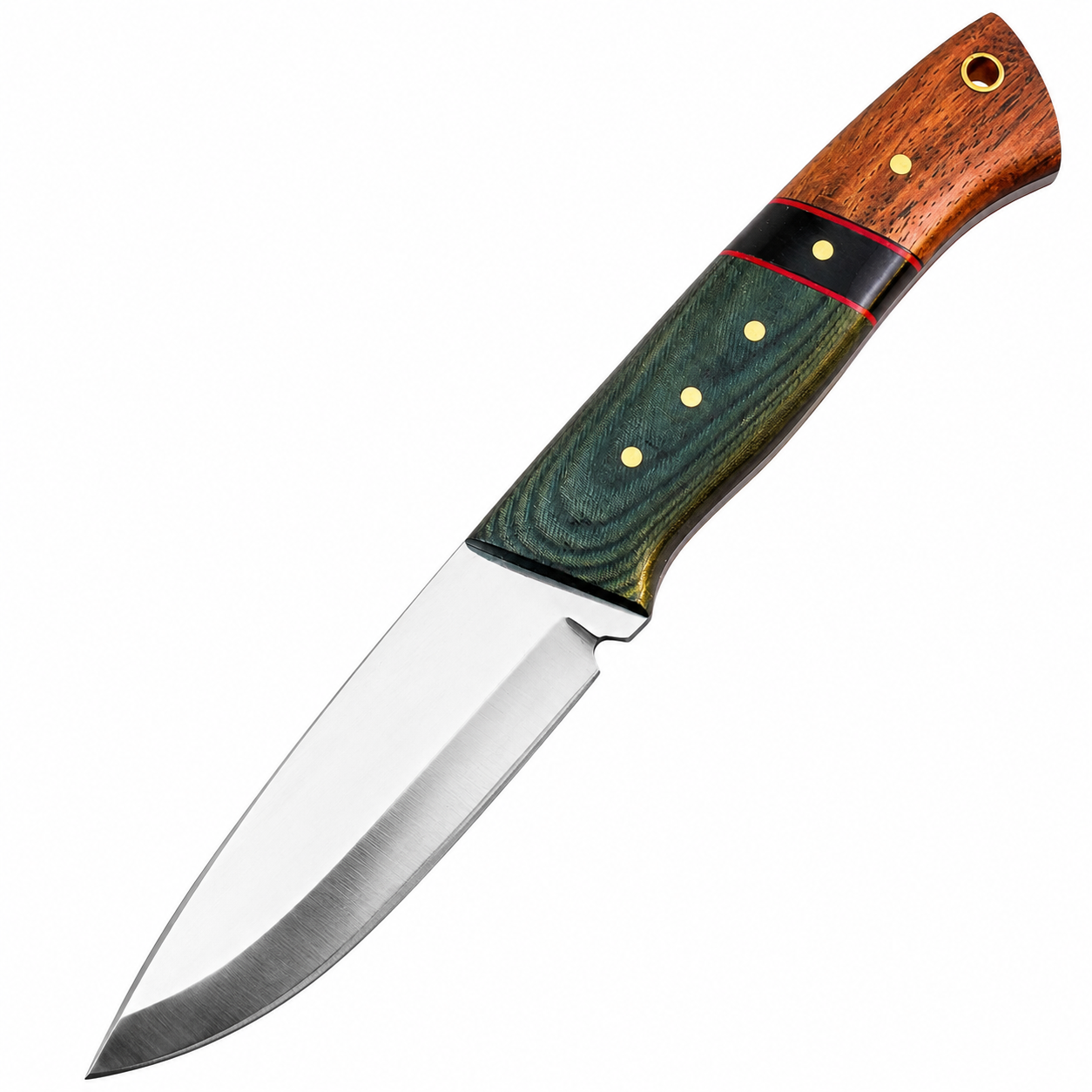
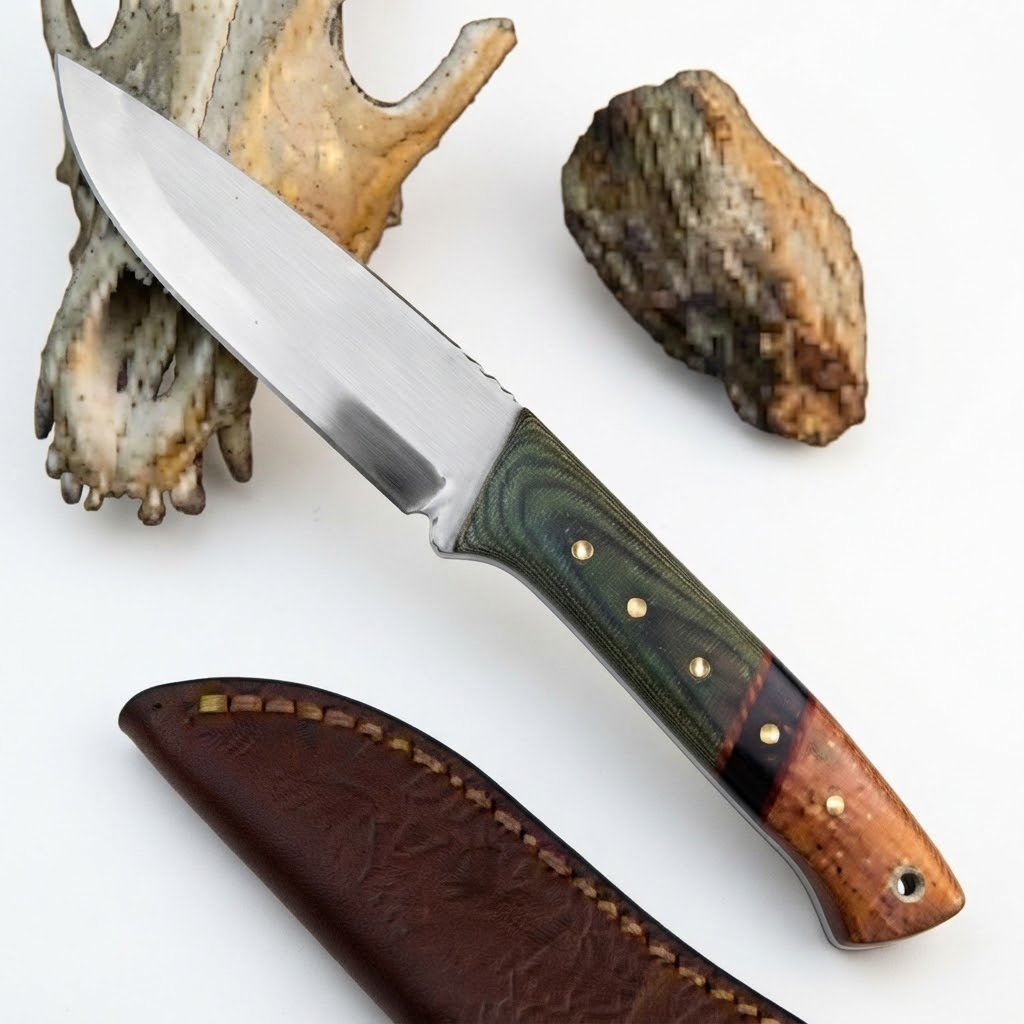
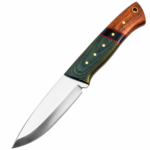
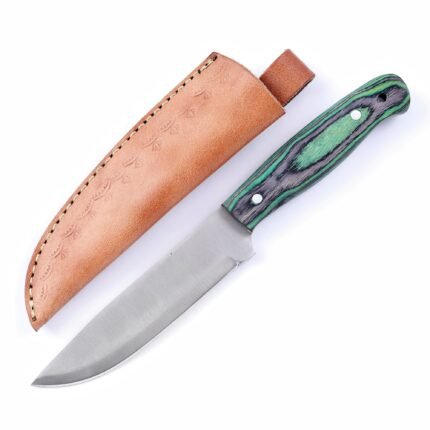
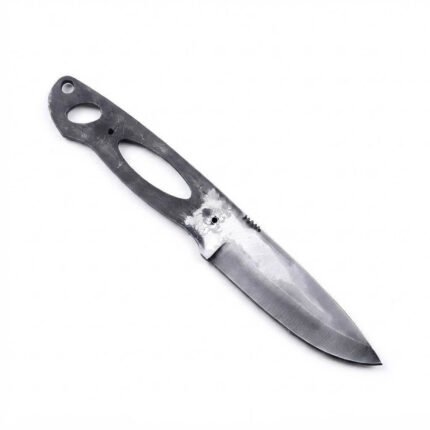
The Green Wood Handle Fixed Blade Hunting Knife brings together a traditional outdoor knife silhouette, a polished silver-colored blade, and a distinctive two-tone handle. Its dark green wood-grain center section, warm brown rear section, and contrasting decorative fittings create a design that feels classic without looking ordinary.
A long, gently curved blade gives the knife its recognizable hunting-style profile. The silver-colored finish reflects light across the blade, highlighting its smooth bevel and pointed tip. At the handle, the polished metal transitions into a dark green section secured with visible gold-colored pins.
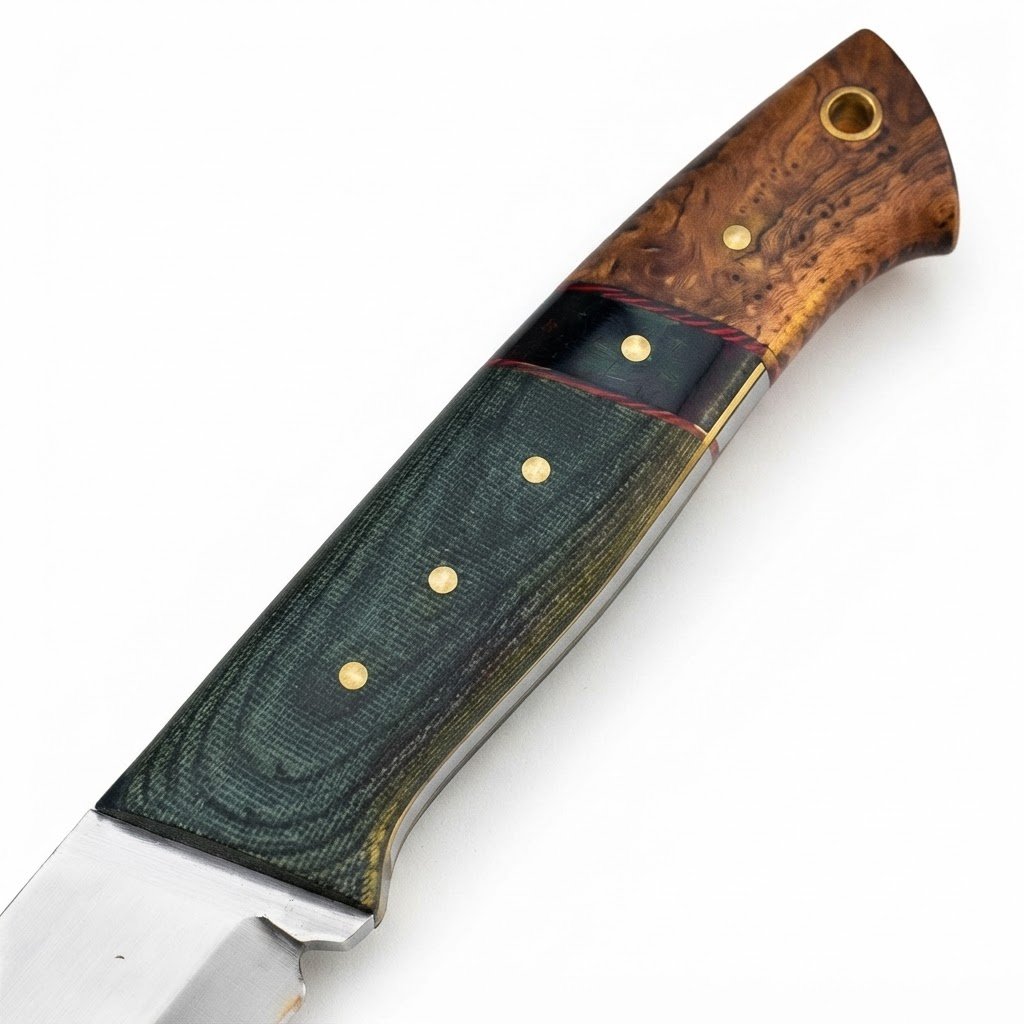
The rear portion of the handle features a warm brown wood-grain appearance. A black spacer with narrow red accents separates the two colored sections, creating an attractive contrast. A gold-colored opening near the butt provides another distinguishing detail.
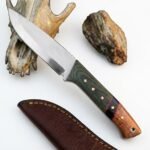
A brown, leather-looking sheath is displayed alongside the knife. Its curved outline follows the blade profile, while contrasting tan stitching gives the accessory a traditional outdoor appearance.
The combination of polished metal, green and brown handle sections, and a coordinated sheath makes this an interesting choice for outdoor cutlery enthusiasts and collectors who appreciate traditional fixed-blade designs.
The knife’s exact dimensions, steel grade, handle materials, and performance specifications require manufacturer confirmation. This description focuses on the design and features visible in the supplied product photograph.
Traditional Hunting Knife Design
The most recognizable characteristic of this model is its traditional fixed-blade construction.
Unlike a folding pocket knife, a fixed-blade model has a permanently extended blade. There is no visible folding joint or opening mechanism.
This straightforward configuration is widely associated with hunting, camping, bushcraft, and general outdoor knife designs.
The photographed knife has a relatively long blade with a smooth, continuous cutting edge. Its spine slopes gradually toward the tip, producing a balanced-looking profile.
The blade also features a wide beveled area that extends along much of the cutting section.
At the handle, the metal narrows into a shaped transition with a subtle finger-guard-like contour.
This gives the knife a clearly defined separation between blade and grip.
The overall design avoids an oversized metal crossguard, instead emphasizing smooth transitions and a streamlined handle.
The result is a hunting-style knife with a traditional appearance and decorative details.
Its intended working applications should be confirmed against the manufacturer’s specifications before making claims about heavy-duty performance.
Polished Silver-Colored Blade
The blade’s polished appearance is one of the most noticeable features of this knife.
Its silver-colored surface is bright, smooth-looking, and reflective.
Fine linear finishing marks are visible across portions of the metal, giving the blade a satin-polished character.
The bevel is clearly distinguished from the upper blade surface, creating a refined transition toward the cutting edge.
This gives the knife a clean and conventional outdoor-cutlery appearance.
The polished finish contrasts particularly well with the darker green handle.
Unlike dark-coated or patterned blades, a polished silver-colored surface places more emphasis on the blade’s shape and finishing.
The photograph does not establish the steel composition.
Although many outdoor knives use stainless steel or carbon steel, neither material can be confirmed solely from the finish.
Likewise, the image does not provide enough information to identify the blade’s hardness, heat treatment, or corrosion resistance.
The safest description is a polished metal blade with a silver-colored finish.
The manufacturer should confirm the grade and relevant technical details before the knife is advertised with performance-specific claims.
Long Blade with a Gently Curved Cutting Edge
The knife features a long cutting section extending from the handle to a pointed tip.
The edge follows a smooth curve rather than a completely straight profile.
Its spine is comparatively straighter through the central portion before tapering toward the tip.
The blade’s upper and lower lines gradually converge, forming a recognizable hunting-style point.
A broad bevel is visible on one side.
This bevel contributes to the blade’s finished appearance and visually distinguishes the cutting section from the upper blade body.
The image suggests a blade designed in the general style of outdoor utility and hunting knives.
However, performance depends on several technical factors, including blade thickness, edge geometry, material, and heat treatment.
These cannot be confirmed from the photograph.
A customer choosing a knife for a particular task should compare verified technical specifications rather than relying on appearance alone.
The blade’s shape remains a clear visual feature of this model.
Dark Green Wood-Grain Handle
The central section of the handle features a deep green finish with visible grain-like lines.
Dark green tones blend with subtle black and lighter green details, creating an appearance similar to stained wood.
The surface is visually textured by the grain pattern, although its tactile texture cannot be evaluated from the image.
Three gold-colored pins are visible along this section.
The pins create a decorative contrast against the dark green finish.
This green handle section is one of the features that distinguishes the knife from conventional brown or black hunting knives.
The color is relatively subdued, making it suitable for customers who prefer natural-looking outdoor accessories rather than brightly colored designs.
The exact handle material remains unverified.
It may be natural wood, stabilized wood, a laminate, or another decorative material.
The photographed grain pattern alone is not sufficient to determine the composition.
Until this information is confirmed, the product should be described as having a green wood-grain handle rather than a particular wood species.
Warm Brown Handle Section
The rear portion of the handle features a contrasting brown wood-grain appearance.
Its color ranges from warm reddish brown to darker brown around the visible grain lines.
The transition from the green center to the brown rear section gives the handle a distinctive two-tone design.
This combination creates a more detailed appearance than a handle made from one uniform color.
The brown section also complements the brown sheath displayed beside the knife.
A circular opening with a gold-colored border is visible near the end of the handle.
This appears consistent with a lanyard-style opening, although its exact construction and intended use should be confirmed.
The rear portion is slightly rounded, with an angular transition along the lower edge.
The warm brown finish adds a traditional detail to an otherwise distinctive green-and-silver design.
As with the green handle section, the exact material cannot be determined from appearance alone.
Black Spacer with Red Accent Lines
Between the dark green section and the brown rear section is a black decorative spacer.
Two narrow red lines are visible along its boundaries.
This detail creates a clear separation between the handle colors.
The black spacer provides visual contrast, while the red accents add a subtle decorative element.
The black, green, brown, and red combination is one of the more unusual characteristics of this knife.
Unlike simple wooden handles made from one continuous piece, the photographed design uses several visually distinct sections.
The spacer appears to be integrated into the handle assembly.
However, its composition and attachment method are not confirmed.
It should not be described as a particular metal, synthetic material, or resin without supporting documentation.
For an accurate online listing, its visible appearance can be described as a black spacer with thin red accent lines.
Gold-Colored Handle Pins
Three round gold-colored pins are visible on the green section of the handle.
Another small gold-colored fitting appears on the black spacer.
The pins are arranged along the length of the grip.
Their bright color contrasts with the darker surrounding materials.
Pins are commonly used in fixed-blade knife handle construction, although the exact structural role of these particular fittings has not been verified.
The image does not establish whether they are made from brass or another metal.
For that reason, they should be described as gold-colored rather than solid brass.
The fittings contribute to the traditional appearance of the handle.
Their arrangement also provides an additional visual detail that customers can identify in product photographs.
These features may be useful when distinguishing this model from other fixed-blade knives with similar blade profiles.
Contoured Handle Shape
The handle has a relatively straight upper profile with a gently shaped lower edge.
Near the blade, a subtle inward contour helps distinguish the front of the grip.
The handle then widens slightly toward the middle before tapering toward the rear.
The brown end section has a rounded butt.
These shapes combine to create a streamlined grip profile.
The product image clearly shows the handle’s outline but does not establish its thickness or dimensions.
Consequently, grip comfort cannot be guaranteed from the photograph.
Ergonomic performance depends on factors such as handle length, shape, surface material, weight, and individual hand size.
Customers should consult manufacturer measurements when deciding whether this knife is appropriate for their preferences.
The handle’s visible contours remain an important design characteristic.
Its two-tone finish makes these contours particularly easy to distinguish.
Fixed Blade Construction and Outdoor Styling
The Green Wood Handle Fixed Blade Hunting Knife has the recognizable structure of a conventional outdoor knife.
The blade extends forward from a solid-looking handle assembly.
There is no visible hinge or folding mechanism.
Its polished blade and wood-grain handle sections create a traditional appearance often associated with hunting and camping equipment.
Fixed-blade knives are produced in many sizes and construction types.
Some are designed for light utility work, while others are intended for particular field applications.
The photographed model’s actual suitability depends on its technical specifications.
Its tang construction cannot be confirmed.
Although the metal appears to continue along the handle, the photograph does not prove that the knife has full-tang construction.
Claims about full-tang construction, impact resistance, strength, or heavy-duty suitability should be based on manufacturer information.
The accurate description is a fixed-blade hunting-style knife with a contoured two-tone handle.
Brown Leather-Looking Sheath
A brown sheath is displayed next to the knife in the supplied photograph.
It has a long, tapered profile that follows the general shape of the blade.
The sheath has a warm brown surface with a slightly textured appearance.
Contrasting tan stitching runs along its curved outer edge.
The stitching adds a traditional decorative detail.
The sheath’s opening is visible near the handle end of the knife.
Its overall design resembles the leather sheaths commonly paired with hunting knives.
The photograph strongly suggests a leather-style material, but genuine leather composition cannot be independently verified.
The listing should therefore avoid claiming a specific leather grade or thickness without manufacturer confirmation.
The actual fit and retention of the sheath also cannot be assessed from the photograph.
Customers should ensure that any sheath supplied with the knife is designed for the correct blade dimensions and offers appropriate coverage.
Coordinated Knife and Sheath Appearance
The knife and sheath share a traditional color palette.
The green handle creates a contrasting accent against the polished blade.
The rear brown handle section visually complements the sheath.
The tan stitching adds another warm-colored detail.
Together, these features create a coordinated presentation.
The sheath is shown as a separate accessory rather than fitted over the blade.
This helps display the knife’s full profile while showing the appearance of the accompanying cover.
For a complete product listing, the manufacturer should confirm whether the photographed sheath is supplied with each knife.
If it is included, it can be identified in the package contents.
If it is optional, that distinction should be clearly stated.
Accurate package information helps customers understand what they will receive.
A Traditional Look for Outdoor Knife Enthusiasts
Many outdoor knife enthusiasts appreciate designs that combine a recognizable blade shape with distinctive handle materials.
This model offers that combination through a polished silver-colored blade and contrasting wood-grain sections.
The green color gives the handle a less conventional appearance than standard natural brown wood.
At the same time, the warm brown pommel and metal pins retain a classic aesthetic.
The design may appeal to customers looking for a hunting-inspired fixed blade that also has decorative value.
The knife’s overall presentation is straightforward, without visible serrations or complicated accessories.
Its sweeping cutting edge and pointed tip remain central elements of its appearance.
Although this style is associated with outdoor utility, the knife’s approved applications should be confirmed by the manufacturer.
Descriptions should focus on its verified construction and appearance rather than promising performance that has not been tested.
A Distinctive Choice for Knife Collectors
Collectors often consider blade profiles, handle designs, surface finishes, and accessory presentation when evaluating knives.
The Green Wood Handle Fixed Blade Hunting Knife has several features that may attract attention.
Its polished blade gives it a traditional appearance.
The dark green handle section introduces a distinctive color.
The brown pommel creates a natural-looking contrast.
Gold-colored pins and narrow red accent lines add additional decorative detail.
The matching brown sheath completes the photographed presentation.
Together, these features create a knife that looks different from many plain black-handled or single-color models.
However, the photograph does not establish whether the knife is handmade, limited edition, or produced by a particular manufacturer.
Such claims require supporting documentation.
It can accurately be described as a traditional hunting-style fixed blade with a distinctive two-tone handle.
Evaluating the Blade Material
Blade steel is an important specification when choosing any knife.
Different materials can vary in hardness, toughness, corrosion resistance, and maintenance requirements.
Manufacturers also use different heat-treatment procedures.
These factors influence the behavior of a finished blade.
A polished appearance does not identify the underlying steel grade.
Many grades can be finished to a similar silver-colored appearance.
Consequently, it would be inaccurate to label this knife as D2, 1095, 440C, or any other grade based solely on its photograph.
The blade should not be described as stainless steel unless the supplier confirms that specification.
Customers interested in performance should request the steel grade and relevant manufacturing information.
A verified blade specification is more useful than a broad claim such as premium steel or superior hardness.
Understanding Blade Size and Balance
Knife dimensions affect handling and intended use.
Important measurements include overall length, blade length, blade thickness, handle length, and finished weight.
The photograph does not include a ruler or another reliable size reference.
Therefore, these measurements cannot be determined accurately.
The blade appears relatively long compared with the handle, but this observation does not establish its actual size.
Its weight also cannot be estimated reliably.
The combination of blade thickness, tang construction, handle materials, and fittings influences the overall weight.
Customers should obtain confirmed measurements before selecting this knife for a particular activity.
For a retail website, publishing accurate dimensions also helps distinguish one knife from another.
Exact measurements are particularly useful when similar models have different blade profiles or handle designs.
Handle Materials and Construction
The handle appears to contain multiple decorative sections.
The central green section has a wood-grain finish.
The rear brown section has a different wood-grain appearance.
A black spacer with red accent lines separates them.
These components appear to form a single assembled grip.
The photograph shows several visible pins and a rear circular fitting.
However, it does not reveal the internal construction.
The handle may contain natural wood, stabilized wood, laminate, or another material.
Its finish may also involve staining, coating, or a decorative treatment.
None of these processes can be confirmed from the image alone.
Manufacturer documentation should identify the handle materials and construction method.
That information is important for both product accuracy and appropriate maintenance.
Caring for the Polished Blade
Knife maintenance should follow the manufacturer’s instructions.
As a general precaution, clean the blade after use and remove visible residue.
Use a soft cloth when appropriate.
Dry the metal thoroughly before placing the knife into storage.
Avoid leaving moisture on the blade.
The correct maintenance products depend on the actual steel composition and surface finish.
Because the steel grade is not verified, specific corrosion-resistance claims should not be made.
Likewise, the blade should not be advertised as rust-proof or maintenance-free.
If cleaning products or protective oils are required, customers should use those recommended for the confirmed blade material.
Regular inspection can help identify damage or surface wear.
These steps support responsible ownership and help preserve the blade’s appearance.
Maintaining the Two-Tone Handle
The handle features two visually different wood-grain sections.
Its dark green center contrasts with the warm brown rear portion.
To preserve the finish, avoid exposing the handle to unnecessary moisture or excessive heat.
Clean it with a soft cloth as appropriate.
Do not use aggressive solvents unless they are approved for the actual material.
Different handle materials require different maintenance methods.
Natural wood may have different care requirements from stabilized wood or synthetic composites.
Because the precise material has not been verified, no specific treatment oil or polish can be recommended confidently.
Customers should also inspect the visible pins and fittings.
If components become loose or damaged, the knife should not be used until it has been assessed.
Following material-specific care instructions is the best way to preserve its appearance.
Caring for the Brown Sheath
The photographed sheath has a brown leather-like surface with tan stitching.
Its care requirements depend on the actual material.
If genuine leather is confirmed, appropriate leather-care products may be suitable.
If the sheath uses a synthetic leather-look material, cleaning recommendations may differ.
Avoid prolonged exposure to moisture and direct heat.
Inspect the stitching and edges for visible wear.
A sheath should fit the knife properly and cover the cutting edge.
The image does not confirm whether the supplied cover includes any additional retention mechanism.
When storing the knife, follow the manufacturer’s recommendations regarding long-term blade contact with sheath materials.
Some materials can retain moisture, making storage practices important.
A clean, properly maintained sheath complements the knife’s overall presentation.
Product Uses and Customer Considerations
This model is visually consistent with hunting-style and general outdoor fixed-blade knives.
Customers may consider it when browsing hunting knives, camping knives, outdoor cutlery, and collectible fixed blades.
Its polished blade and colored handle also make it visually interesting for knife collections.
However, intended applications should be based on manufacturer recommendations.
The photograph does not verify cutting performance, edge retention, impact resistance, or suitability for heavy fieldwork.
These characteristics depend on material and construction details.
A responsible product listing should distinguish between the knife’s appearance and documented capabilities.
Customers who need a working knife should review the confirmed blade specifications, handle dimensions, and approved uses.
Those selecting a collectible knife may place greater emphasis on appearance, materials, and presentation.
Both groups benefit from accurate product information.
Comparison with Black-Coated Hunting Knives
Hunting-style knives are available with many different finishes.
Black-coated blades have a darker appearance.
Polished blades, like the one shown here, reflect more light.
This knife’s polished surface complements its green-and-brown handle.
The result is a relatively traditional design with a distinctive color combination.
A black-coated version of the same general blade shape would produce a noticeably different appearance.
The choice between finishes can depend on visual preferences and manufacturer specifications.
Coatings and polished surfaces may require different care.
Neither finish should automatically be considered superior without knowing the material and treatment.
The polished surface is a clear visual characteristic of this model.
It provides a useful distinction when organizing similar fixed-blade products within an online catalog.
Product Details Visible in the Photograph
The uploaded image provides the following identifiable information.
Knife Type: Fixed-blade hunting-style knife
Blade Profile: Long, pointed blade with a gently curved cutting edge
Blade Finish: Polished silver-colored metal
Handle Shape: Contoured, slightly curved grip
Handle Appearance: Dark green wood-grain center with a warm brown wood-grain rear section
Decorative Spacer: Black with thin red accent lines
Visible Handle Fittings: Gold-colored pins
Handle End: Rounded pommel section with a gold-colored circular opening
Sheath Appearance: Brown leather-looking cover with tan stitching
Image Background: White
These details describe the visible product without making assumptions about its manufacturing specifications.
Technical Specifications Requiring Confirmation
The following information should be requested before final publication.
Blade Steel Grade: Not verified
Steel Hardness: Not verified
Blade Length: Not verified
Overall Length: Not verified
Blade Thickness: Not verified
Handle Length: Not verified
Knife Weight: Not verified
Exact Handle Material: Not verified
Tang Construction: Not verified
Sheath Material: Not verified
Sheath Inclusion: Not independently confirmed
Manufacturer: Not verified
Country of Manufacture: Not verified
Warranty: Not verified
Providing confirmed specifications will make the product page more informative and reduce uncertainty for buyers.
Why Accurate Specifications Matter
Customers increasingly compare products online before making a purchase.
A clear title and attractive photographs help them identify a product.
Technical specifications help them understand what they are actually buying.
For fixed-blade knives, important details include steel composition, blade dimensions, handle materials, and included accessories.
When these details are missing, buyers may have difficulty comparing models.
A description should not attempt to replace missing specifications with exaggerated claims.
Instead, it should explain the design clearly and identify any information that still requires confirmation.
This creates a more transparent product presentation.
The Green Wood Handle Fixed Blade Hunting Knife already has several identifiable visual features.
Once accurate measurements and materials are confirmed, the listing can provide more complete purchasing information.
Safe Handling and Storage
Fixed-blade knives require careful handling.
Always treat the blade and point as sharp.
Keep hands clear of the cutting edge.
Inspect the blade, handle, and fittings before use.
Do not use a knife for purposes outside the manufacturer’s intended applications.
Avoid prying, striking, or applying excessive sideways force unless such use is expressly supported by the product specifications.
Store the knife securely when it is not in use.
Use a properly fitted blade cover or sheath where appropriate.
Keep knives away from children and unauthorized users.
Follow local regulations governing purchase, possession, transportation, and importation.
Responsible handling and storage are important whether the knife is intended for practical use or collection.
Final Overview of the Green Wood Handle Fixed Blade Hunting Knife
The Green Wood Handle Fixed Blade Hunting Knife features a polished silver-colored blade, a contoured two-tone handle, gold-colored decorative fittings, and a coordinated brown leather-looking sheath.
Its dark green center section and warm brown rear grip create a distinctive visual contrast.
A black spacer with narrow red accent lines separates the handle colors, while the gold-colored pins add traditional detailing.
The long, gently curved blade gives the knife a recognizable hunting-inspired profile.
The brown sheath shown alongside it complements the handle’s warm tones and completes the photographed presentation.
Exact blade steel, dimensions, handle composition, tang construction, and sheath specifications remain subject to manufacturer confirmation.
Explore this Green Wood Handle Fixed Blade Hunting Knife for its traditional blade design, distinctive two-tone grip, and polished appearance.





Reviews
There are no reviews yet.