







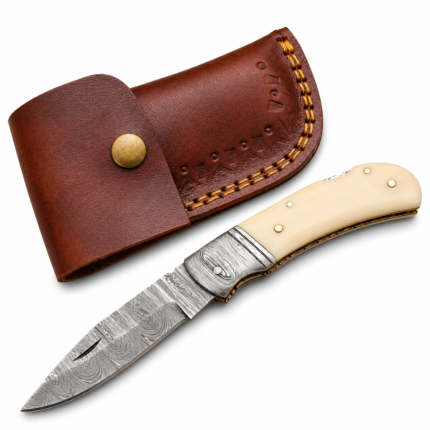
Ivory Handle Damascus Folding Knife – Decorative Pocket Knife with Leather Sheath
Introduction to the Ivory Handle Damascus Folding Knife
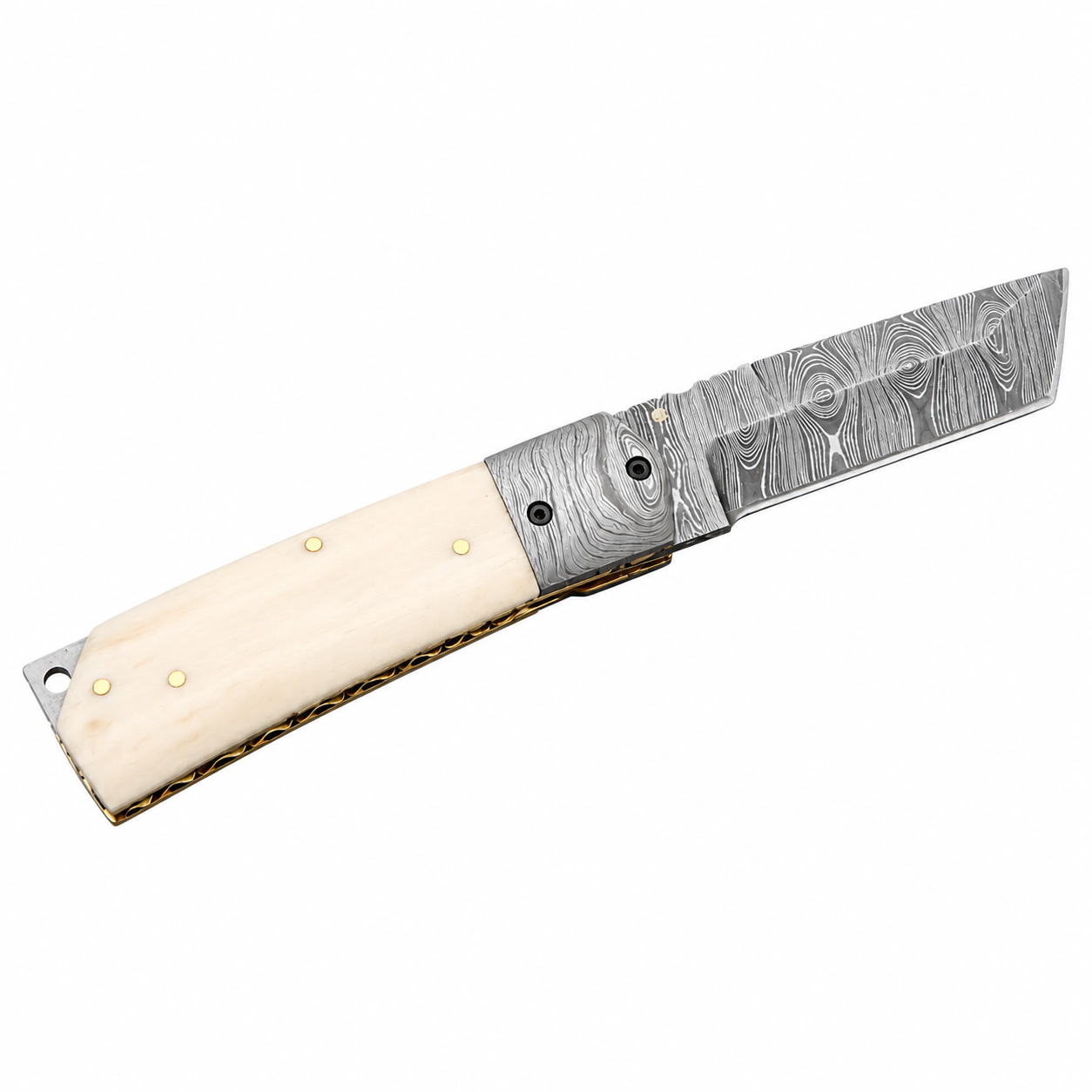
The Ivory Handle Damascus Folding Knife combines a traditional folding pocket knife silhouette with distinctive decorative features. Its silver-grey blade displays flowing Damascus-style patterns, while the elegant cream-colored handle creates a sophisticated contrast against the metallic finish.
The knife features a pointed blade, visible thumb stud, decorative spine notches, patterned metal bolster, and gold-tone handle pins. These elements create an appealing design for collectors and enthusiasts who appreciate traditional pocket knife aesthetics.
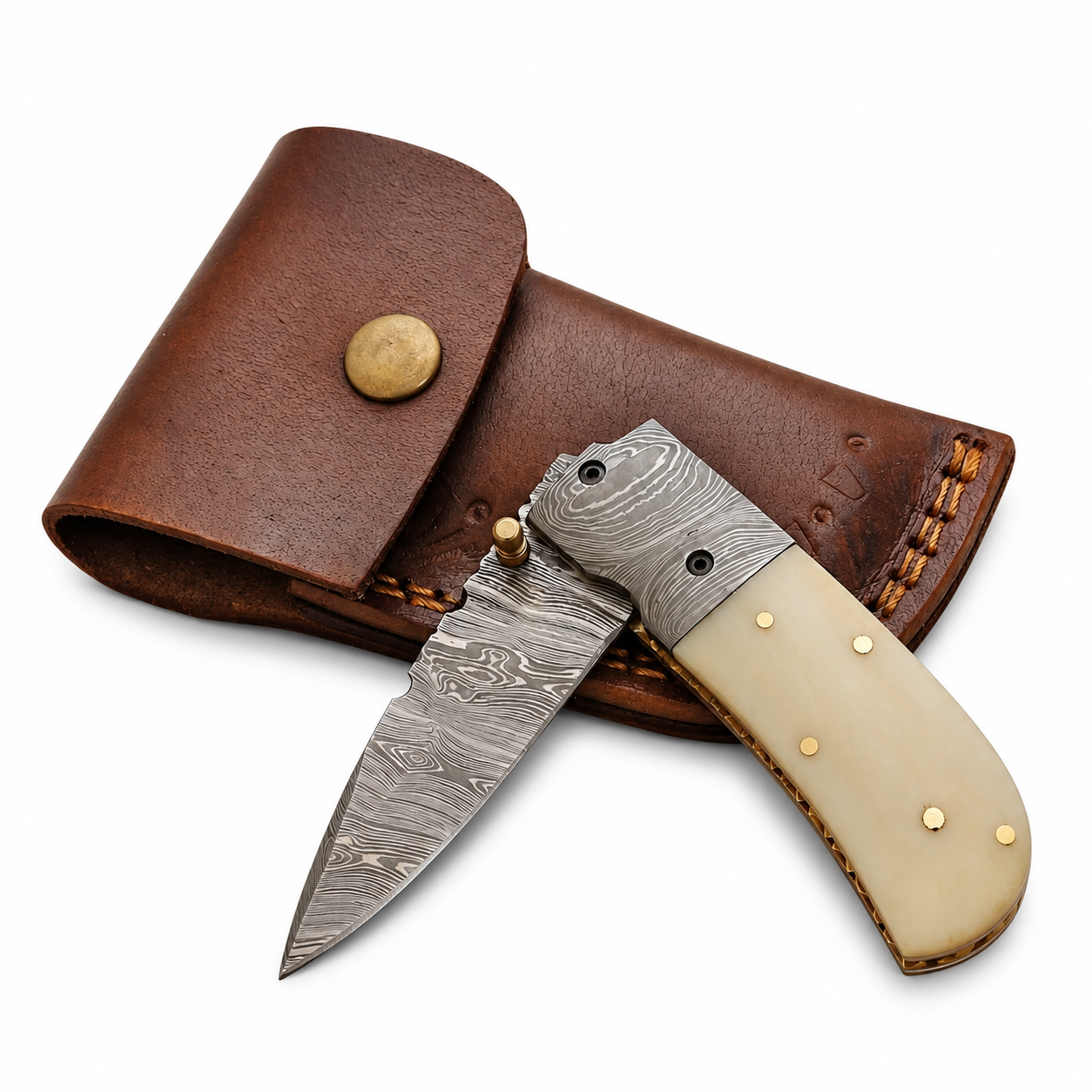
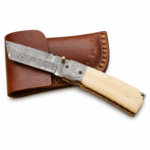
A brown leather-style carrying sheath accompanies the knife in the supplied product images. The sheath features textured material, contrasting stitching, a broad retaining flap, and a metal snap fastener.
Together, the folding knife and sheath create a coordinated presentation that emphasizes classic materials, metallic accents, and decorative craftsmanship.
The blade’s layered appearance is particularly noticeable in the side-view photographs, where contrasting silver and grey lines form intricate patterns.
The ivory-colored handle contributes a clean and understated appearance, making it an attractive contrast to more conventional dark-colored pocket knife grips.
This model is particularly suitable for inclusion in decorative folding knife collections and specialty cutlery catalogs.
1. Distinctive Damascus-Style Patterned Blade
One of the most prominent features of the Ivory Handle Damascus Folding Knife is its intricately patterned blade.
The silver-grey surface contains numerous flowing lines that form layered, wave-like designs.
These markings resemble the visual patterns traditionally associated with Damascus steel.
Some sections of the blade display closely spaced lines, while others form circular and irregular shapes.
The resulting appearance provides a distinctive alternative to conventional plain-finished folding knives.
The blade surface also features darker grey lines that emphasize the contrast within the decorative pattern.
The appearance changes slightly depending on the viewing angle and lighting.
The pattern continues toward the pointed tip, creating visual continuity across the blade.
Although the images show a Damascus-style surface, the exact steel grade and manufacturing process require confirmation.
2. Traditional Folding Pocket Knife Design
The knife follows a recognizable manual folding pocket knife design.
Its blade is connected to the handle through a pivot assembly.
This design allows the blade to fold toward the handle rather than remaining permanently extended like a fixed blade.
Folding pocket knives are commonly included in specialty cutlery collections because of their compact form and variety of traditional designs.
The product photographs show the knife in its open position, providing a clear view of its blade and handle.
The blade and handle form a relatively streamlined silhouette.
The pivot section includes decorative metal detailing that complements the layered blade pattern.
The exact opening and locking mechanism should be confirmed through manufacturer specifications.
This ensures customers receive accurate technical information.
3. Elegant Ivory-Colored Handle
The handle is one of the most visually appealing elements of this folding knife.
It features a smooth ivory or cream-colored surface that contrasts with the silver-grey blade.
The light handle color creates an understated appearance associated with traditional collectible cutlery.
Its surface appears relatively uniform, with subtle tonal variations that contribute to its decorative character.
Several circular gold-tone pins are arranged along the handle.
These metallic accents provide contrast without overwhelming the simple handle design.
The handle is gently curved, becoming narrower near the bolster and wider toward the rounded rear.
This shape creates a distinctive profile that complements the blade.
Because the exact handle material is unknown, it is accurately described as ivory-colored rather than genuine ivory.
4. Contoured Handle Profile
The handle has a curved and tapered profile.
Near the front, it transitions into a metal bolster section.
The center is gently shaped, while the rear features a rounded finish.
The overall form is traditional in appearance.
Its smooth contours create a cohesive relationship between the handle and blade.
The shape is consistent with many collectible folding pocket knife designs.
The cream finish also makes the decorative metal fittings easier to distinguish.
Actual handling comfort depends on the knife’s dimensions, weight, balance, and individual hand size.
Those characteristics should be verified independently.
The handle can confidently be described as contoured based on its visible shape.
5. Decorative Gold-Tone Handle Pins
The ivory-colored handle includes several small gold-tone circular pins.
These pins add a subtle metallic accent to the cream-colored surface.
Their arrangement creates a decorative pattern along the handle.
The warm metallic appearance complements the golden details visible around the knife’s frame.
The pins are visible in the different product photographs.
They contribute to the traditional aesthetic of the knife without introducing complex surface decoration.
This balance between a smooth handle and understated metal fittings creates an elegant overall appearance.
The exact pin material and fastening method are not identifiable from photographs.
For product descriptions, they should therefore be identified as gold-tone handle pins rather than being assigned a specific metal composition.
6. Patterned Metal Bolster
A distinctive decorative bolster is positioned near the folding blade’s pivot.
It features flowing silver-grey patterns similar to those visible on the blade.
This creates visual continuity between the blade and handle assembly.
The bolster also provides contrast against the smooth ivory-colored handle.
Its metallic pattern includes multiple curved lines and irregular formations.
Two dark circular fittings are visible within the patterned front section.
These details contribute to the knife’s recognizable appearance.
Patterned bolsters are attractive in traditional pocket knife designs because they introduce additional surface detail.
The precise metal composition and manufacturing technique should be verified separately.
7. Visible Thumb Stud
A small gold-colored thumb stud is visible near the base of the blade.
The stud stands above the blade surface and provides an identifiable feature commonly found on manual folding knives.
Its warm metallic finish coordinates with the handle pins.
The thumb stud is particularly noticeable in the photographs showing the knife in an open position.
It creates a small decorative contrast against the silver-grey blade.
While thumb studs are generally associated with manual blade-opening designs, the precise operation of this knife should be confirmed by its manufacturer.
The feature can be accurately described as a visible gold-tone thumb stud.
Its placement contributes to the recognizable folding knife appearance.
8. Decorative Blade Spine Notches
The blade has several small notches along a section of its upper spine.
These notches are located near the pivot area.
Their evenly spaced appearance introduces an additional design element.
Spine notches are found on various traditional and contemporary knife designs.
They may serve different purposes depending on a particular model’s construction.
In this product, their visible presence contributes to the overall decorative styling.
The photographs do not establish whether the notches have a specific functional purpose.
For that reason, they are best described as decorative blade spine notches.
The combination of the notched spine and layered blade pattern provides a distinctive visual detail.
9. Pointed Blade Profile
The blade features a pointed profile that narrows gradually toward its tip.
Its overall silhouette resembles a drop-point style folding blade.
The cutting edge is gently curved, while the upper blade line transitions toward the point.
This creates a balanced and recognizable pocket knife appearance.
The design is less angular than some modern folding knife silhouettes.
Its flowing profile also complements the decorative blade pattern.
From the side view, the knife displays a clear transition between the patterned bolster and exposed blade.
The shape contributes to the product’s traditional appearance.
Its actual cutting characteristics depend on manufacturing specifications, which should be obtained from the supplier.
10. Silver and Grey Layered Finish
The blade combines light silver and dark grey tones.
Its layered pattern creates a contrast that is visible across the entire exposed cutting surface.
The pattern appears more intricate near certain areas where the lines curve and overlap.
Other sections contain narrower parallel formations.
The result is a visually rich finish that distinguishes the knife from plain polished blades.
The silver-grey appearance also coordinates with the bolster and other metallic components.
Against the cream handle, the patterned blade becomes the primary visual focus.
This combination makes the product well suited to detailed photography.
Close-up images help customers appreciate the surface pattern and overall decorative design.
11. Brown Leather-Style Carrying Sheath
The supplied product photographs show a matching brown leather-style sheath.
The sheath has a rich brown finish and a textured exterior.
Its shape is designed to accommodate the folded knife.
The material appears flexible and features a broad retaining flap.
A circular metal snap fastener is positioned on the flap.
The sheath also includes stitching along its edges.
The brown color complements the cream handle and metallic knife details.
This combination gives the product a traditional pocket knife presentation.
Although the sheath resembles leather, its exact material should be confirmed before advertising it as genuine leather.
12. Sheath Stitching and Edge Detailing
The sheath features prominent stitching around its outer edges.
The stitching appears in a lighter golden-brown tone that contrasts against the darker material.
This creates a decorative border.
The stitch pattern follows the contour of the sheath.
The contrasting color helps emphasize its shape and construction.
The sheath also displays visible surface texture and subtle decorative markings.
These details contribute to its traditional appearance.
The edges have a finished look that complements the overall design.
For an online product listing, photographs showing the sheath from multiple angles help customers examine its decorative construction.
The stitching and brown finish make the accessory visually recognizable.
13. Snap Fastening Detail
A circular metal snap fastener is visible on the sheath flap.
The fastener has a brass-like gold color.
It coordinates with the gold-tone elements of the knife.
The large retaining flap extends over the main sheath body.
This creates a traditional closure appearance.
Snap closures are commonly used on various small carrying accessories.
The photographs establish that a snap-style fastener is present.
Its exact retention strength and long-term durability are not verifiable from the images.
Customers should inspect the fastening mechanism before use.
The visible closure is an important part of the sheath’s design.
14. Coordinated Knife and Sheath Appearance
The folding knife and sheath share a traditional visual style.
The knife combines ivory coloring, silver-grey layered patterns, and gold-tone details.
The sheath introduces a rich brown finish with warm stitching and a coordinating metal fastener.
Together, these elements create a visually cohesive set.
The neutral handle color complements the darker sheath.
The patterned blade and bolster provide intricate decorative details.
The warm metallic accents create visual consistency.
This coordinated appearance makes the product attractive for specialty knife collections.
The set can also be displayed together in product photographs to show the relationship between the knife and its accompanying carrying accessory.
15. Traditional Pocket Knife Aesthetics
Traditional folding knives are often recognized by their contoured handles, metal bolsters, and straightforward silhouettes.
This model incorporates these recognizable characteristics while introducing decorative blade patterning.
The ivory-colored handle provides a classic appearance.
Its gold-tone pins contribute subtle detail.
The patterned bolster adds visual complexity near the pivot.
The blade features distinctive layered markings.
The result is a knife design that combines understated handle styling with an intricate metallic finish.
This combination is particularly attractive for enthusiasts who appreciate classic folding knife aesthetics.
The accompanying sheath reinforces the traditional presentation.
16. Appeal to Decorative Knife Collectors
Collectors often appreciate folding knives for their designs, materials, and distinctive finishes.
The Ivory Handle Damascus Folding Knife offers several visually recognizable features.
Its flowing blade pattern is a primary decorative element.
The cream-colored handle introduces a refined contrast.
The metal bolster and gold-tone fittings add further character.
The brown sheath completes the overall presentation.
These features make the knife suitable for display within a decorative cutlery collection.
However, actual collectible value depends on factors that cannot be verified from photographs alone.
These may include manufacturer identity, material composition, authenticity, condition, rarity, and production history.
Accurate product information should distinguish visible decorative details from verified provenance.
17. Product Photography and Online Presentation
The three supplied images present different views of the same folding knife.
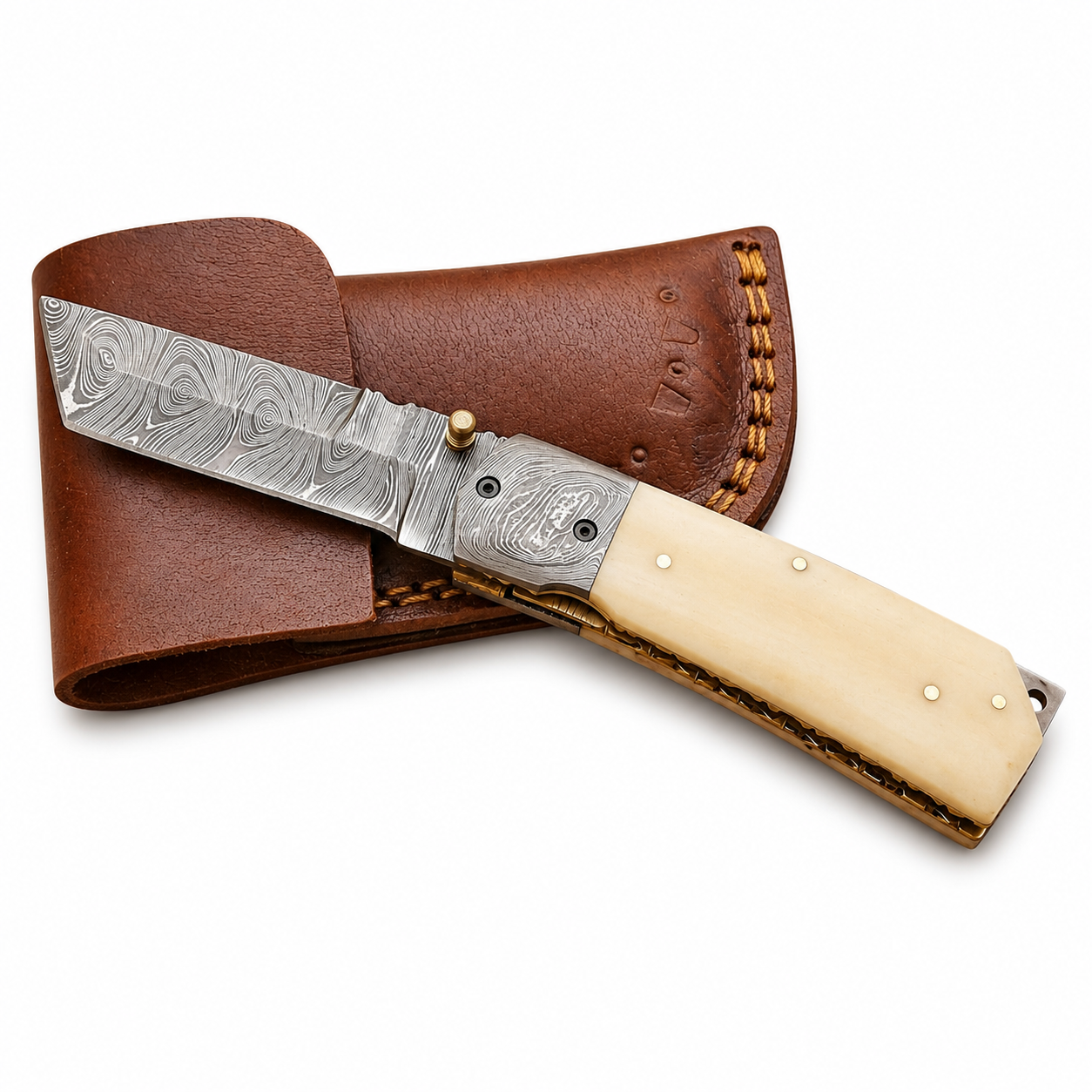
The first photograph displays the knife positioned over its brown sheath.
This view emphasizes the relationship between the knife and carrying accessory.
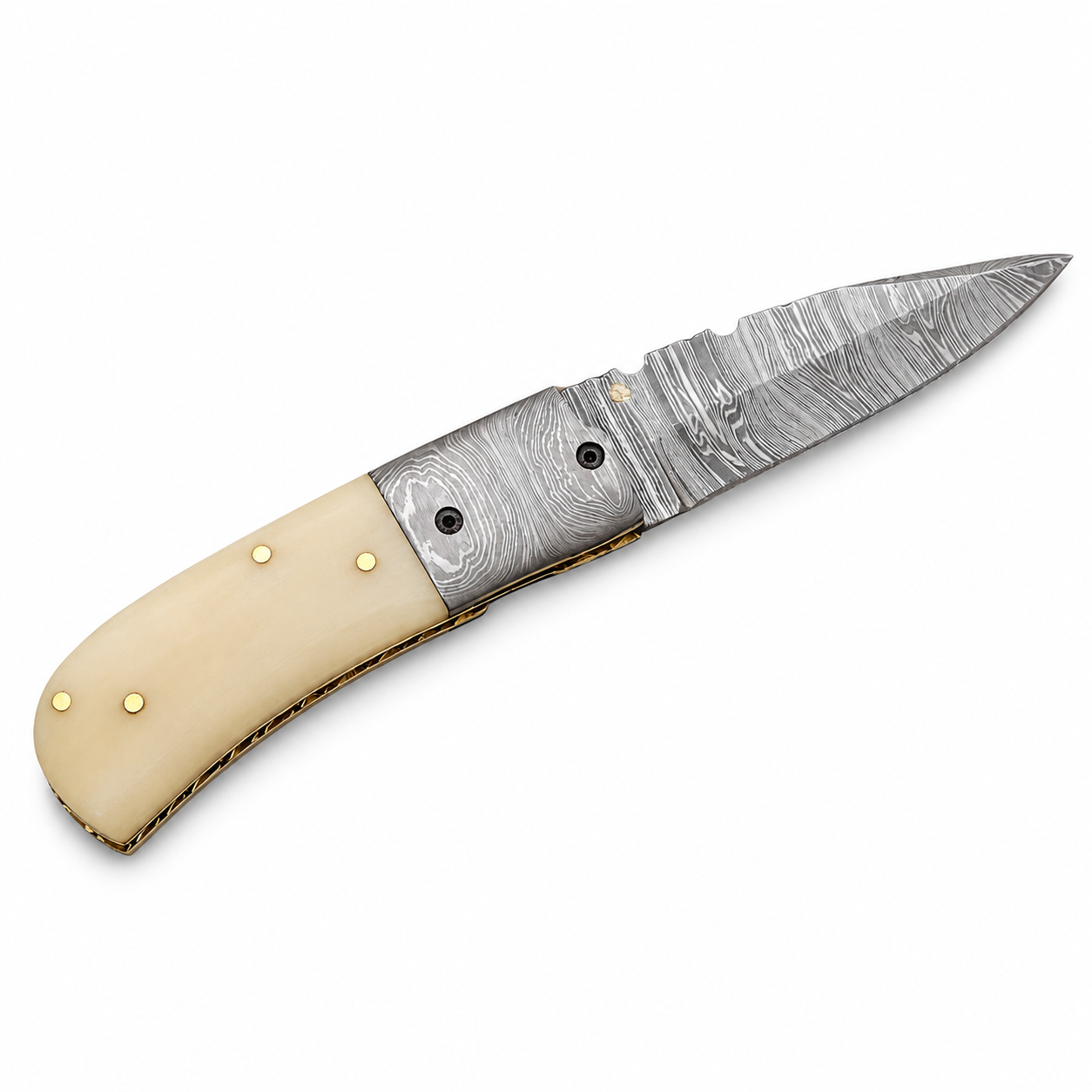
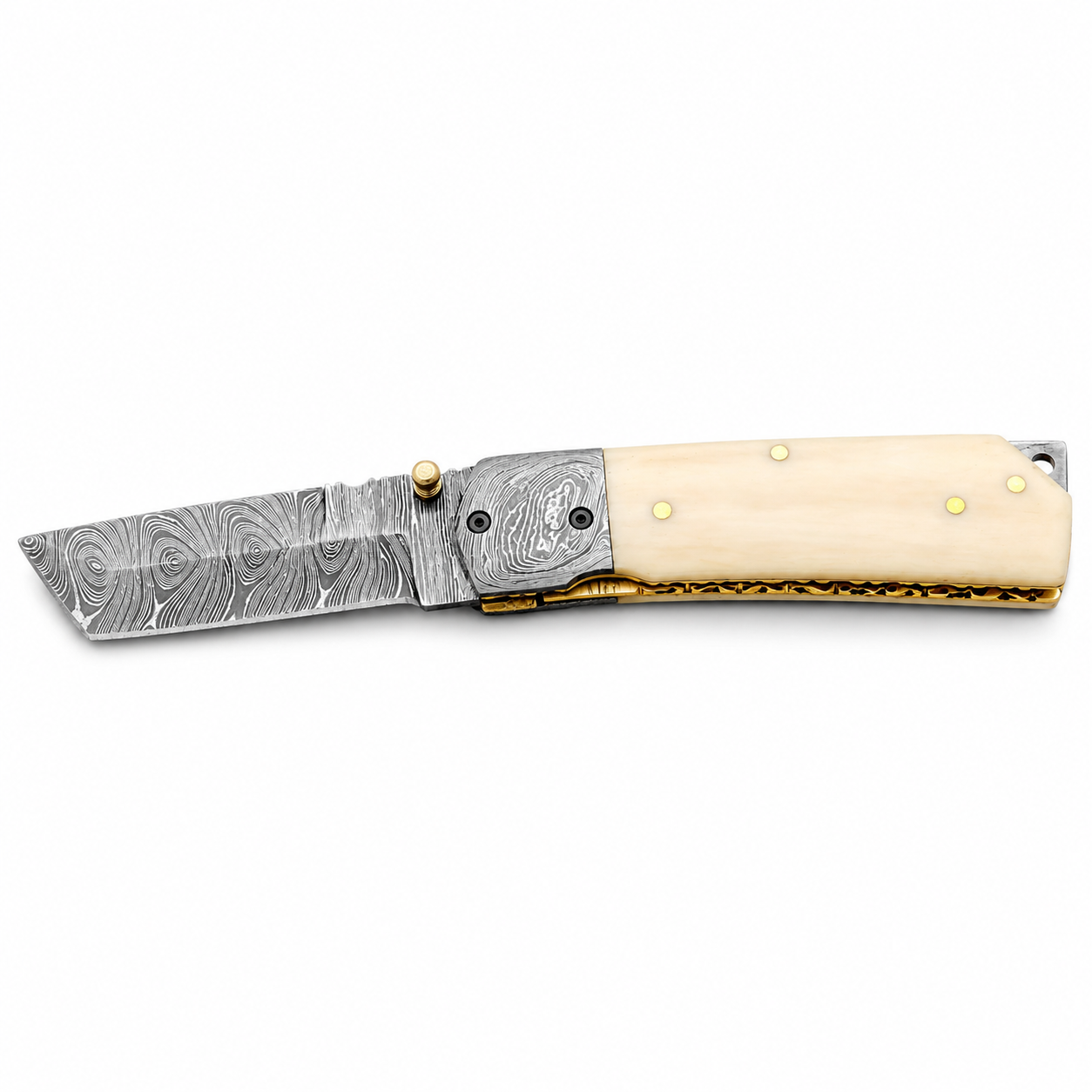
The second image provides a horizontal side view.
It clearly shows the blade shape, handle profile, decorative bolster, thumb stud, and metal pins.
The third photograph presents the knife diagonally from the opposite orientation.
This view provides additional visual information about the patterned blade.
Together, the images create a useful product gallery.
For e-commerce listings, the horizontal full-knife image is particularly suitable for showing the entire product clearly.
The remaining photographs can be used as supporting gallery images.
18. Understanding Damascus-Style Blade Patterns
Damascus-style blade patterns are known for their layered visual appearance.
These designs may resemble flowing water, woodgrain, or topographic contours.
The pattern on this knife contains multiple curved lines arranged across the blade surface.
Such patterns can be produced through different manufacturing methods.
Actual pattern-welded Damascus steel is a specific type of construction.
However, similar visual effects may also appear on blades produced by other processes.
Therefore, the presence of a layered pattern alone does not prove a particular steel composition.
Manufacturers should provide material specifications when making technical claims.
Until such information is confirmed, Damascus-style patterned blade is the most accurate description.
19. Importance of Handle Material Verification
The handle resembles traditional ivory because of its smooth cream-colored finish.
However, visual resemblance does not establish material identity.
Modern cutlery handles can be made from numerous natural and manufactured materials.
These materials may have different characteristics relating to durability, maintenance, and environmental considerations.
The exact material of this knife should be verified before publication.
It should not be described as genuine ivory, bone, resin, or another specific substance without supporting information.
This is particularly important because genuine ivory can be subject to significant legal restrictions.
The descriptive term ivory-colored provides useful visual information without making an unsupported material claim.
20. Understanding Folding Knife Construction
A folding knife contains moving components that distinguish it from a fixed blade knife.
These generally include a pivot mechanism and a handle structure designed to accommodate the blade.
Some folding knives also incorporate locking mechanisms.
The supplied photographs show an exposed pivot area and a blade in the open position.
However, the exact locking system cannot be identified conclusively.
The manufacturer should confirm whether the knife uses a liner lock, frame lock, slip joint, or another configuration.
This information is relevant to safe handling and accurate product classification.
The product should not be advertised as having a particular locking mechanism without verification.
21. Appropriate Cleaning and Maintenance
Proper maintenance helps preserve the appearance of collectible folding knives.
The exact cleaning requirements depend on the blade steel, handle material, and internal mechanism.
The blade should be kept free from unnecessary moisture and residue.
A clean, soft cloth can be used to wipe accessible surfaces carefully.
Abrasive cleaning products may damage decorative blade finishes or handle surfaces.
The pivot area should be maintained according to the manufacturer’s recommendations.
The knife should be completely dry before being placed in storage.
The sheath should also be kept clean and dry.
Material-specific care is important because the blade and handle compositions have not been confirmed.
22. Storage and Preservation
Proper storage is particularly important for decorative folding knives.
The blade should be folded and secured according to the manufacturer’s instructions before storage.
The knife should be kept away from unnecessary moisture.
Long-term storage conditions should be suitable for its verified materials.
The brown sheath can be used according to its intended design and manufacturer guidance.
For extended storage, the knife and sheath should be inspected periodically for signs of moisture or deterioration.
The decorative handle should also be protected from impact and harsh cleaning chemicals.
Careful storage helps preserve the appearance of the blade pattern, handle finish, and metallic fittings.
The knife should always be stored securely away from unauthorized access.
23. Comparison with Plain-Finish Folding Knives
Many folding pocket knives feature plain metallic blades and uniformly colored handles.
This model differs through its flowing layered blade pattern and ivory-colored handle.
Its decorative bolster also extends the patterned appearance into the handle assembly.
The gold-tone pins and thumb stud add contrasting metal accents.
The accompanying brown sheath provides another traditional detail.
These characteristics make the knife visually distinctive.
However, decorative appearance alone does not indicate superior mechanical performance.
Actual functionality and durability depend on verified material specifications, manufacturing tolerances, and construction quality.
The strongest selling points established by the photographs are the knife’s recognizable silhouette and decorative finish.
24. Product Specifications and Buying Information
The following characteristics are visible in the supplied photographs:
- Product type: Manual folding pocket knife
- Blade appearance: Silver-grey Damascus-style pattern
- Blade profile: Pointed drop-point style
- Handle color: Ivory or cream
- Handle shape: Contoured
- Handle pins: Gold-tone circular fittings
- Bolster: Decorative patterned metal
- Opening component: Visible thumb stud
- Spine details: Small decorative notches
- Accessory shown: Brown leather-style carrying sheath
- Sheath fastening: Metal snap closure
- Sheath detailing: Contrasting stitched edges
Additional technical specifications should be obtained before publication.
These include the exact blade steel, blade length, overall length, closed length, handle material, weight, blade thickness, locking mechanism, and country of manufacture.
Accurate specifications help customers understand the product beyond its appearance.
25. Frequently Asked Questions
What is an Ivory Handle Damascus Folding Knife?
It is a folding pocket knife with an ivory-colored handle, patterned silver-grey blade, decorative metal bolster, and traditional carrying sheath.
Is the handle made from real ivory?
The handle resembles ivory, but its actual material is not confirmed. It should be described as ivory-colored unless verified otherwise.
Is the blade genuine Damascus steel?
The photographs show a Damascus-style pattern. The exact steel construction must be confirmed with the manufacturer.
Does the knife have a thumb stud?
Yes. A small gold-tone thumb stud is visible near the blade’s pivot area.
Does the knife include a sheath?
A brown leather-style sheath is shown with the knife. Sellers should confirm that the sheath is included in the actual sales package.
What color is the handle?
The handle has a light cream or ivory-colored finish.
What kind of blade does it have?
It features a pointed folding blade with a gently curved edge and decorative layered pattern.
Does the knife have a locking mechanism?
The exact locking mechanism cannot be established from the supplied images.
What makes the product distinctive?
Its patterned blade, ivory-colored handle, decorative bolster, gold-tone details, and matching brown sheath create a traditional appearance.
Is the sheath made from genuine leather?
Its appearance resembles brown leather, but material authenticity should be verified.
Is the knife suitable for collectors?
Its decorative design may appeal to folding knife collectors. Collectible value depends on verified materials, maker information, condition, and other factors.
How should the knife be cleaned?
Follow the manufacturer’s instructions and use cleaning methods compatible with its verified materials.
What are the exact dimensions?
Exact dimensions have not been provided and should be obtained from the supplier.
How should the knife be stored?
Store it securely with the blade folded, in a dry location, following the manufacturer’s guidance.
Conclusion
The Ivory Handle Damascus Folding Knife combines a classic pocket knife silhouette with visually distinctive decorative details.
Its patterned silver-grey blade, cream-colored contoured handle, metal bolster, and warm gold-tone fittings create a coordinated appearance.
The accompanying brown leather-style sheath adds a traditional carrying accessory with textured material, contrasting stitching, and a metal snap fastening.
Together, these features make the knife an attractive addition to decorative pocket knife collections and specialty cutlery catalogs.
For a professional and accurate product listing, technical characteristics such as actual blade steel, handle composition, locking mechanism, and dimensions should be confirmed before publication.
With its layered blade design, elegant ivory-style handle, and classic folding knife presentation, this model offers a recognizable decorative style for enthusiasts of traditional pocket knives.






Reviews
There are no reviews yet.