


Turquoise Blue Damascus Chef Knife DF-265 – Elegant Patterned Kitchen Knife
Introduction to the Turquoise Blue Damascus Chef Knife
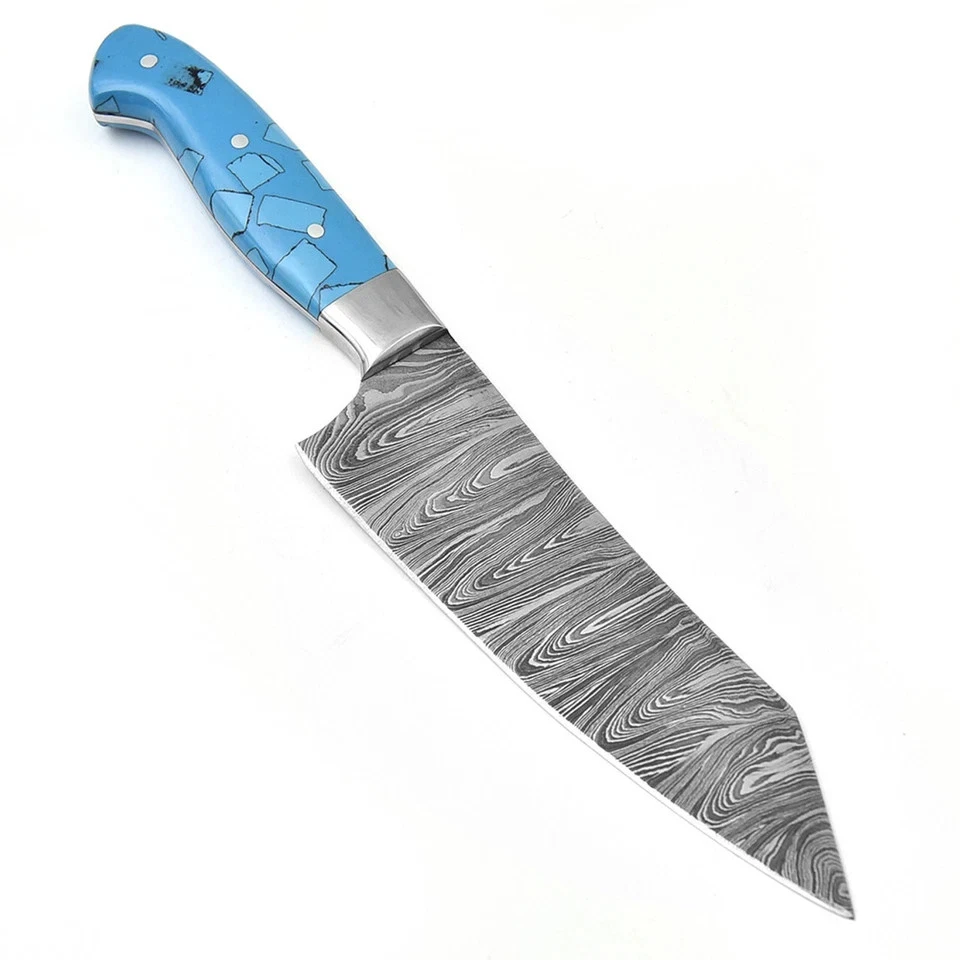
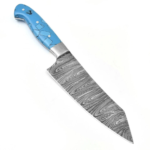
The Turquoise Blue Damascus Chef Knife DF-265 brings together traditional kitchen cutlery design, decorative blade patterning, and a distinctive turquoise-colored handle. Featuring a broad silver-grey Damascus-style patterned blade, polished metal bolster, and blue handle with dark natural-looking veins, this knife offers an appealing combination of visual elegance and classic chef knife proportions.
Its blade displays flowing, layered patterns that resemble the intricate formations traditionally associated with Damascus steel. These contrasting lines create an attractive surface that distinguishes the knife from ordinary plain-finish kitchen knives.
The turquoise blue handle provides a striking color contrast against the silver-grey blade. Its curved silhouette, subtle dark markings, and three visible metal pins complete the overall appearance.
Model DF-265 is a recognizable addition to kitchen cutlery collections, specialty knife assortments, and culinary product displays.
Whether viewed from the side or from an angled perspective, the knife demonstrates a coordinated design with attention to blade shape, handle styling, and decorative detailing.
1. Distinctive Damascus-Style Blade Pattern
One of the most prominent features of the Turquoise Blue Damascus Chef Knife is its intricately patterned blade.
The blade surface contains numerous silver and grey lines arranged in sweeping, wave-like formations.
Some sections show closely spaced parallel layers, while others form rounded patterns that resemble natural woodgrain.
These designs extend across much of the blade surface and create a visually attractive contrast between lighter and darker areas.
Patterned blades have become popular among collectors and culinary enthusiasts who appreciate decorative cutlery.
The appearance adds visual character to a knife that otherwise follows a traditional chef knife shape.
Because the exact steel composition and manufacturing process have not been verified, the surface is accurately described as having a Damascus-style layered pattern.
The pattern itself remains a defining element of the product’s appearance.
2. Classic Chef Knife Blade Profile
The DF-265 features a broad blade profile commonly associated with Western-style chef knives.
Its blade is relatively tall near the heel and gradually narrows toward a pointed tip.
The lower cutting edge follows a smooth curve that becomes more pronounced toward the front.
This distinctive silhouette makes the knife recognizable as a chef-style kitchen cutting tool.
The broad blade provides a substantial visual presence, while the tapered front creates a more refined overall appearance.
Chef knife designs are commonly selected for everyday food preparation because their geometry accommodates a variety of kitchen cutting movements.
The actual cutting performance of an individual knife depends on its steel properties, edge geometry, sharpness, and manufacturing quality.
These technical factors should be verified separately from the product photographs.
3. Silver-Grey Metallic Blade Appearance
The blade features an attractive combination of silver and dark grey metallic tones.
Its alternating patterned lines create a layered visual effect across the cutting surface.
Light reflects differently from various sections of the blade, emphasizing the intricate surface detailing.
This appearance provides a decorative alternative to standard polished stainless steel knives.
The patterned finish also complements the lighter metallic bolster.
When photographed against a white background, the blade’s layered design is particularly noticeable.
Each curve and flowing line becomes easier to distinguish.
This makes the knife suitable for visually detailed e-commerce presentations where customers want to examine the appearance of the product before purchasing.
The blade is best represented using accurate photographs rather than unsupported claims about its manufacturing process.
4. Broad Blade and Curved Cutting Edge
The generous blade width is an important visual characteristic of this model.
Near the handle, the blade has a tall profile that gradually transitions toward the pointed tip.
Its cutting edge features a gentle curve, consistent with traditional chef knife design.
This shape is commonly associated with kitchen preparation tasks such as slicing vegetables, preparing fruit, and cutting other suitable food ingredients.
The curved profile is also recognizable among culinary professionals and home cooking enthusiasts.
However, actual handling comfort and cutting efficiency depend on the knife’s verified weight, balance, dimensions, and sharpening quality.
These characteristics cannot be confirmed through photographs alone.
The DF-265 should therefore be presented as a chef-style kitchen knife, with detailed performance specifications supplied by the manufacturer.
5. Attractive Turquoise Blue Handle
The turquoise blue handle is one of the most recognizable elements of the DF-265.
Its bright blue color creates a vivid contrast with the patterned silver-grey blade.
The surface includes thin dark lines that resemble natural stone veining.
These irregular markings give the handle a distinctive decorative character.
Unlike traditional black or brown kitchen knife handles, this turquoise appearance introduces a contemporary visual element.
The handle also has a gently curved design, making it visually different from straight rectangular grips.
The turquoise finish is attractive for knife collections that emphasize unique colors and decorative materials.
The exact handle material should be confirmed by the manufacturer before describing it as genuine turquoise stone, stabilized composite, or another specific substance.
6. Natural Stone-Inspired Handle Pattern
The handle has a natural stone-inspired appearance created by its blue surface and thin black markings.
The dark lines form irregular geometric shapes across the handle.
Some markings appear angular, while others curve around the contours of the grip.
This creates a visual effect similar to natural turquoise mineral patterns.
Each side displays the decorative design differently.
The contrast between the blue surface and dark veining creates a recognizable finish without additional painted graphics.
Its appearance contributes to the knife’s individual character.
Although the visual pattern resembles turquoise stone, the photographs alone do not establish the material composition.
Describing it as a turquoise-colored or stone-inspired handle ensures an accurate and professional product listing.
7. Contoured Ergonomic-Style Handle
The DF-265 features a contoured handle with a gently curved lower profile.
The grip becomes slightly narrower near the bolster and changes shape toward the rear.
Its back section includes a subtle hook-like contour that defines the handle end.
The curved outline differs from traditional straight-sided kitchen knife designs.
These contours give the handle a distinctive profile.
The form is intended to resemble an ergonomic kitchen knife grip, although actual comfort cannot be established without handling the product.
Grip suitability varies depending on individual hand size, usage technique, and handle material.
For an accurate listing, the handle can be described as contoured and ergonomically styled.
The design combines a recognizable kitchen knife silhouette with the product’s distinctive turquoise appearance.
8. Three Decorative Metal Handle Pins
Three circular silver-tone pins are visible on the handle.
The pins are arranged along the side at regular intervals.
Their polished metallic appearance contrasts with the turquoise blue surface.
The circular design is simple and understated.
This allows the decorative handle pattern to remain the main visual feature.
The pins also coordinate with the polished metal bolster and silver-grey blade.
Together, these elements create a consistent metallic theme.
The pins are visible in the side-view and angled photographs.
Although they may form part of the handle assembly, the exact fastening method cannot be verified from images.
They can confidently be identified as three visible silver-tone handle pins.
9. Polished Metal Bolster
A polished silver-colored metal bolster is positioned between the handle and blade.
This component creates a smooth transition between the blue grip and patterned steel surface.
Its reflective finish adds a refined metallic accent.
The bolster has a slightly curved profile that follows the knife’s overall design.
It is visible from both sides and from the angled product view.
Its appearance complements the blade without distracting from the Damascus-style pattern.
In traditional kitchen knife construction, bolsters may serve several purposes depending on their design and assembly.
However, the exact structural function of the DF-265 bolster is not established by photographs.
The visible feature can be accurately described as a polished silver-tone metal bolster.
10. Full Tang-Style Appearance
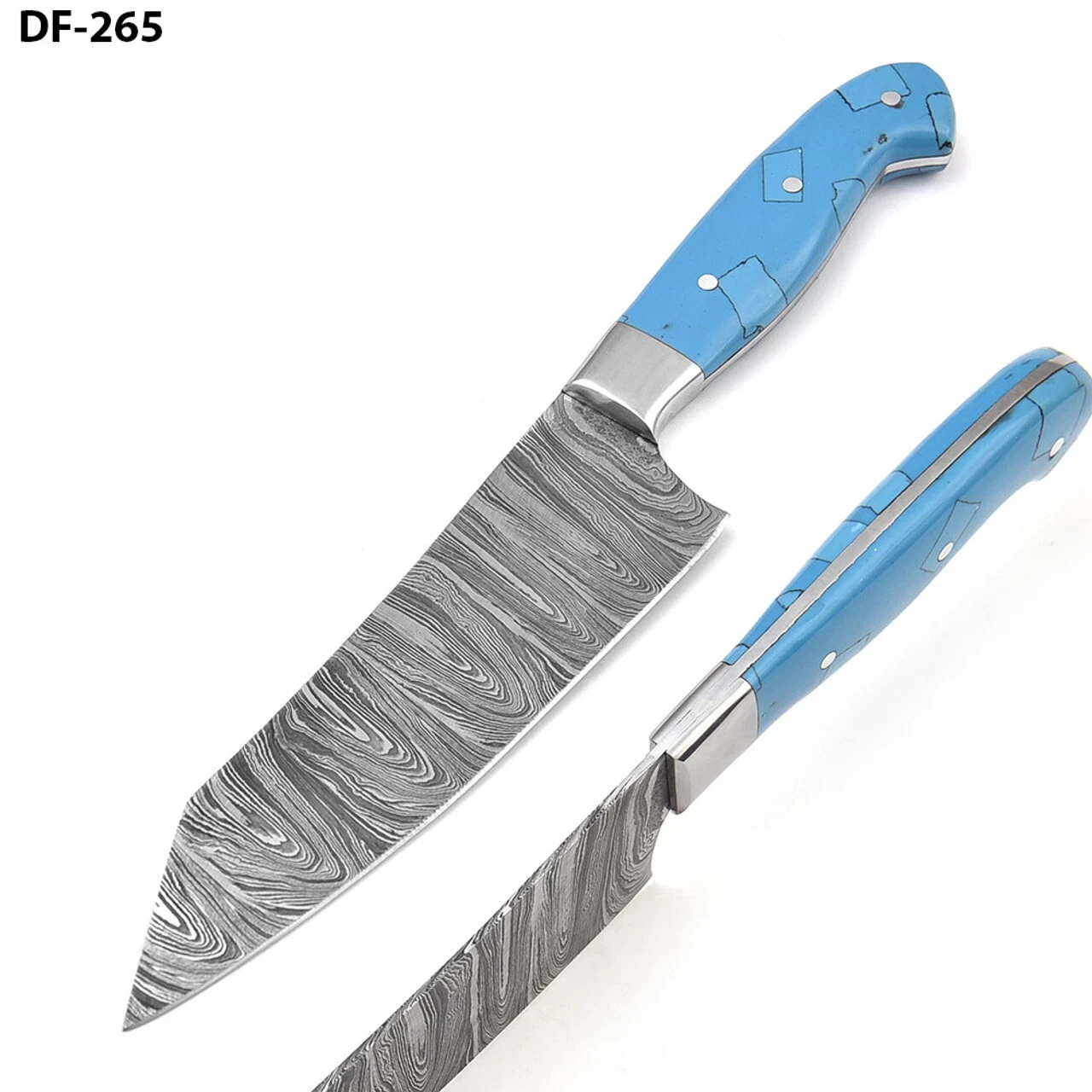
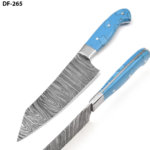
The side-angle photograph shows a visible metal section extending along the handle profile.
This gives the knife a full tang-style appearance.
Full tang construction generally refers to a blade structure in which metal extends through the handle.
Such designs are common in traditional fixed blade kitchen knives.
However, confirming an actual full tang requires detailed manufacturing information or physical inspection.
The photograph shows a metal strip along the handle, but it does not conclusively establish the internal structure.
For this reason, describing the knife as having a full tang-style appearance is more accurate than claiming verified full tang construction.
The visible metal edge contributes to the product’s traditional cutlery design.
11. Distinctive Blue and Silver Color Combination
The DF-265 is visually defined by its turquoise blue handle and silver-grey patterned blade.
The vibrant blue color creates a recognizable contrast with the metallic cutting surface.
Dark markings within the handle introduce additional detail.
The polished bolster creates a bright transition between the two major components.
Silver-tone pins complete the coordinated appearance.
This color combination differentiates the knife from conventional kitchen cutlery featuring black synthetic or natural brown wooden handles.
For online catalogs, its design provides an attractive option within decorative chef knife collections.
The overall appearance combines traditional blade styling with a more contemporary handle finish.
It is suitable for product presentations where material appearance and design are important buying considerations.
12. Traditional Kitchen Knife Silhouette
Despite its distinctive decorative appearance, the DF-265 follows a recognizable traditional kitchen knife silhouette.
The wide blade, pointed tip, and long handle create proportions associated with classic chef knives.
Its design does not include exaggerated decorative guards or complex folding mechanisms.
Instead, the blade and handle form a continuous fixed blade arrangement.
The knife’s shape is familiar within culinary cutlery categories.
This makes it easy to classify for an e-commerce product catalog.
Its turquoise grip and patterned blade provide decorative individuality while retaining recognizable chef knife proportions.
Customers browsing kitchen knives, patterned chef knives, and decorative culinary cutlery can identify the product through its overall shape.
13. Culinary Preparation Applications
Chef knives are generally associated with a variety of food preparation tasks.
Typical applications include preparing vegetables, cutting fruit, slicing suitable food ingredients, and other routine kitchen preparation activities.
The DF-265 has a chef-style blade profile consistent with this product category.
Its curved edge and broad blade shape reflect characteristics commonly seen in versatile kitchen knives.
However, the actual suitability of this specific product for a particular food preparation task depends on its verified construction and edge properties.
Before use, the blade should be inspected for correct sharpening, cleanliness, and structural integrity.
The manufacturer should also confirm whether the blade material and finish are appropriate for food contact.
This distinction helps ensure that product information remains accurate and useful.
14. Appeal to Home Cooking Enthusiasts
Home cooking enthusiasts often appreciate kitchen tools that combine familiar shapes with distinctive aesthetics.
The DF-265 offers an attractive example through its patterned blade and turquoise-colored handle.
Its broad chef knife silhouette makes it recognizable within a kitchen cutlery collection.
The layered blade finish provides decorative interest.
The blue handle introduces a brighter visual element than many conventional kitchen knives.
The metal bolster and handle pins add coordinated details.
For customers who value the appearance of their kitchen tools, this model has a distinctive visual identity.
Its suitability for daily cooking should be evaluated using verified manufacturer specifications rather than appearance alone.
15. Appeal to Culinary Knife Collectors
The Turquoise Blue Damascus Chef Knife also offers visual appeal for collectors of distinctive kitchen cutlery.
Patterned blades are often appreciated for their intricate surface designs.
The DF-265 features numerous flowing lines that create a layered appearance.
The contrasting turquoise handle adds another decorative feature.
Its polished bolster and metal pins complete the traditional fixed blade presentation.
Collectors may appreciate the combination of blade pattern, handle color, and overall silhouette.
However, collectible value depends on factors such as verified materials, maker identification, manufacturing quality, rarity, and condition.
These details should be confirmed separately where relevant.
The knife’s visible decorative characteristics provide a clear basis for presenting it as part of a specialty cutlery collection.
16. Product Display and Presentation
The DF-265 is photographed from multiple angles against a plain white background.
These views make it easier to examine the blade pattern and handle design.
The primary image presents the knife’s overall appearance.
A second photograph displays two different perspectives, including a view of the metal section along the handle.
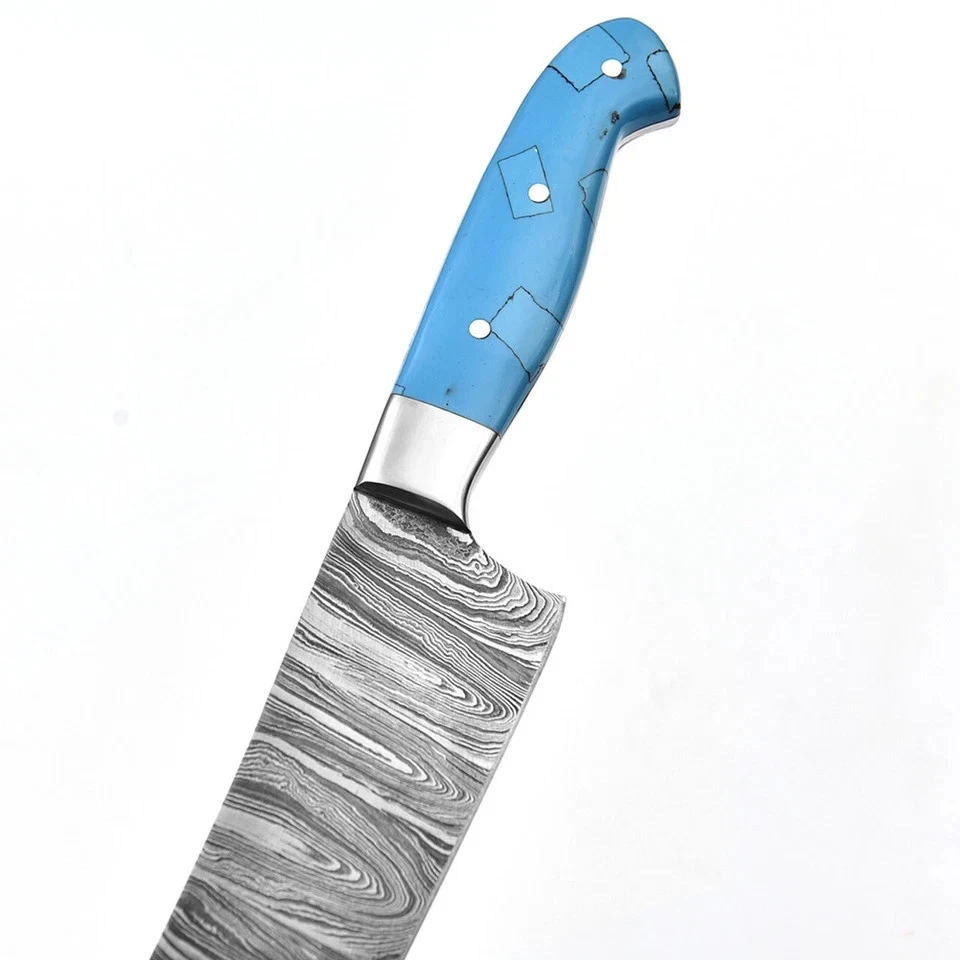
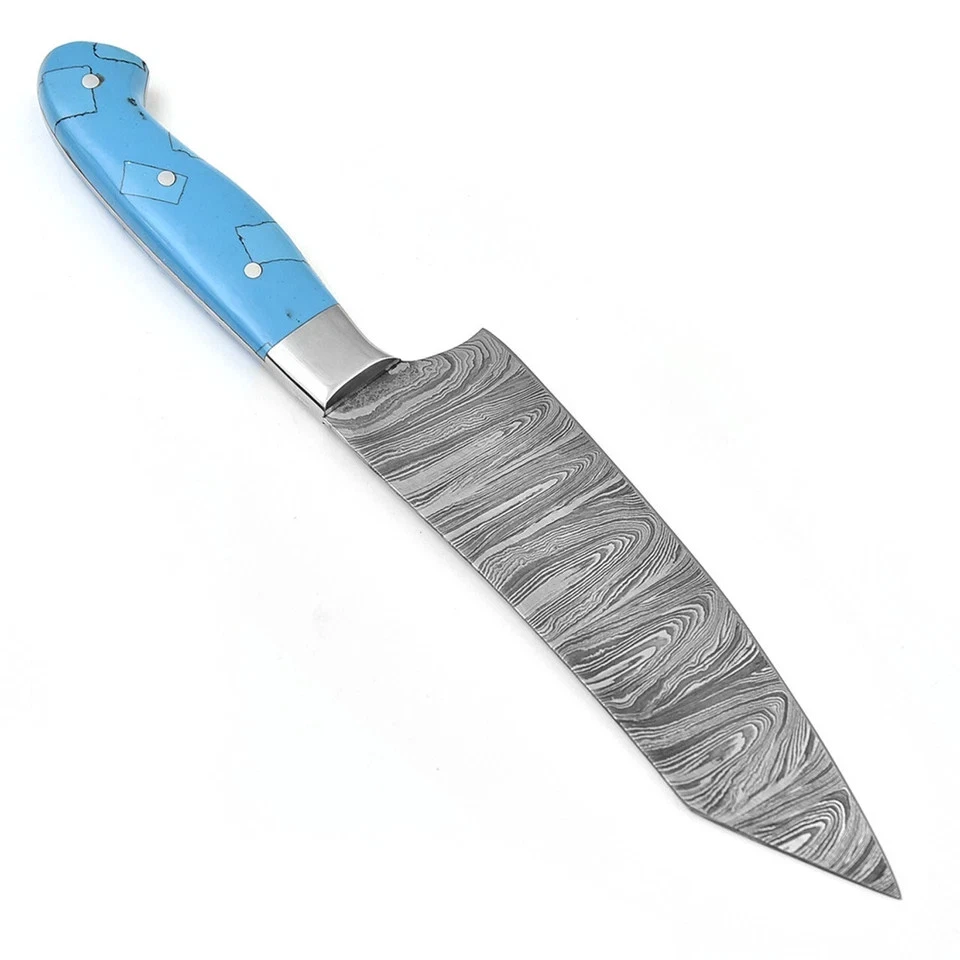
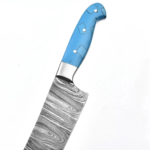
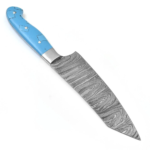
Additional photographs show the blade pattern and turquoise handle from opposite sides.
Together, these images help buyers understand the product’s shape and decorative features.
For an e-commerce listing, a complete side-view photograph is recommended as the featured image.
Additional views can be used to demonstrate the handle, bolster, layered blade pattern, and overall profile.
This approach supports a clear product presentation without unnecessary graphic elements.
17. Comparison with Plain Stainless Steel Chef Knives
Many conventional kitchen knives feature a relatively uniform metallic blade finish.
The DF-265 differs through its prominent Damascus-style layered pattern.
The blade surface contains flowing light and dark lines rather than a plain reflective finish.
The handle also differs from traditional black kitchen knife grips.
Its turquoise blue color and dark veining create a more decorative appearance.
The polished bolster provides a metallic transition between the handle and blade.
These features make the DF-265 visually distinctive within a chef knife collection.
However, decorative blade patterns do not independently establish superior cutting performance.
Actual cutting characteristics depend on blade steel, heat treatment, edge geometry, sharpening, and overall manufacturing quality.
18. Importance of Verified Blade Materials
Blade material is one of the most important technical specifications for a kitchen knife.
Different steels may have different characteristics relating to corrosion resistance, hardness, sharpening, and edge retention.
The DF-265 photographs show a layered pattern but do not identify its exact steel composition.
The appearance alone cannot determine whether the blade is pattern-welded steel, etched steel, or another construction.
Before publishing an exact blade material, sellers should obtain reliable information from the manufacturer.
This may include the steel grade, construction method, hardness range, and surface treatment.
Such information helps customers compare knives accurately.
It also improves the reliability of technical product descriptions.
Until confirmation is available, Damascus-style patterned blade is an appropriate description.
19. Proper Blade Cleaning
Kitchen knives require appropriate cleaning after use.
The correct method depends on their materials and manufacturer instructions.
The DF-265 should be cleaned according to the verified requirements of its blade steel and handle.
In general, leaving moisture or food residue on a blade may contribute to staining or corrosion, particularly with certain steel compositions.
A soft cloth can be used to dry accessible surfaces carefully.
Harsh abrasive cleaning materials may damage decorative blade finishes.
Dishwasher compatibility should never be assumed without manufacturer confirmation.
Special attention should be given to the transition between the handle and blade, where moisture may collect.
Following appropriate cleaning guidance helps preserve the appearance of patterned kitchen knives.
20. Maintaining the Turquoise Blue Handle
The turquoise blue handle features a decorative finish with dark veining.
To maintain its appearance, the handle should be cleaned using products compatible with its actual material.
A soft cloth is generally preferable to abrasive cleaning tools.
Extended exposure to harsh chemicals should be avoided unless the manufacturer confirms compatibility.
The handle should also be protected from unnecessary impact and extreme temperature changes.
The visible metal pins and polished bolster can be inspected for signs of damage or looseness.
Because the exact material composition is unknown, specialized stone cleaners, wood treatments, or resin polishes should not be recommended without confirmation.
Material-specific maintenance helps preserve the handle’s finish.
21. Knife Storage and Edge Protection
Proper storage is important for kitchen knives.
The cutting edge should not be left exposed in locations where accidental contact could occur.
Suitable knife blocks, protective blade covers, or dedicated storage systems may be used when compatible with the knife’s dimensions.
The DF-265 photographs do not show a protective sheath.
Therefore, a sheath should not be advertised as included unless confirmed by the supplier.
The knife should be completely dry before storage.
Keeping the blade separated from other utensils may reduce unnecessary contact with its edge and patterned surface.
Storage methods should follow the manufacturer’s recommendations.
Responsible storage helps protect both the user and the knife.
22. Product Specifications for E-Commerce Listings
The following details are visible in the supplied photographs:
- Product model: DF-265
- Knife type: Fixed blade chef knife
- Blade profile: Broad chef-style blade
- Blade appearance: Silver-grey layered Damascus-style pattern
- Cutting edge: Gently curved
- Handle color: Turquoise blue
- Handle detailing: Dark vein-like markings
- Handle shape: Contoured
- Metal handle pins: Three visible
- Bolster: Polished silver-tone metal
- Construction appearance: Full tang style
Several additional specifications require confirmation.
These include blade length, overall length, blade thickness, weight, hardness, handle material, and exact steel composition.
Providing accurate measurements and verified technical information is recommended before the product goes live.
23. Benefits of Detailed Product Images
Clear product photographs help customers understand the physical appearance of a knife.
The four supplied DF-265 images present several useful perspectives.
They show the broad blade shape, decorative layered pattern, handle contour, and metallic hardware.
A combined-angle photograph also provides additional information about the knife’s side profile.
These images should be placed within a single product gallery rather than listed as separate products.
Using consistent product photographs helps avoid duplicate listings.
Each image should have a descriptive filename and unique alt text.
Alt text should describe the actual view instead of repeating the same keyword unnecessarily.
This improves image accessibility and provides additional context for search engines.
24. Product Quality and Manufacturing Considerations
A professional kitchen knife listing should distinguish appearance from verified construction quality.
The DF-265 has several attractive visible features, including its patterned blade, polished bolster, and turquoise handle.
However, important manufacturing information is not available in the supplied images.
These details may include blade steel, heat treatment, handle attachment, dimensional tolerances, and factory quality-control procedures.
Such factors can influence actual product performance and long-term durability.
Retailers should obtain technical specifications directly from the supplier.
If available, product inspection results and material declarations may also be useful.
Publishing verified information supports more informed purchasing decisions and reduces the possibility of misleading performance claims.
25. Frequently Asked Questions
What is the Turquoise Blue Damascus Chef Knife DF-265?
It is a fixed blade chef-style kitchen knife featuring a silver-grey Damascus-style patterned blade, turquoise blue handle, and polished metal bolster.
Does the knife have a real Damascus steel blade?
The photographs show a Damascus-style layered pattern. The actual steel grade and blade manufacturing process require manufacturer confirmation.
What color is the handle?
The handle is turquoise blue with thin dark vein-like markings.
How many pins are visible on the handle?
Three circular silver-tone pins are visible.
Does the knife feature a bolster?
Yes. A polished silver-colored metal bolster is positioned between the blade and handle.
Is the handle made from genuine turquoise stone?
The handle resembles turquoise stone, but its actual material has not been verified.
What type of knife is DF-265?
DF-265 has a broad, pointed, chef-style blade commonly associated with kitchen cutlery.
Does the knife include a protective sheath?
A sheath is not shown in the supplied photographs. Any included accessories should be confirmed with the seller.
What is the exact blade length?
The blade length is not provided and should be verified before publication.
Can this knife be used for food preparation?
Its shape is consistent with a chef knife. The manufacturer should confirm blade material, food-contact suitability, and intended uses.
What makes this model visually distinctive?
Its flowing layered blade pattern, turquoise-colored handle, dark veining, and polished metal fittings create a distinctive appearance.
How should the knife be maintained?
Follow the manufacturer’s instructions for blade cleaning, handle care, edge maintenance, and safe storage.
Conclusion
The Turquoise Blue Damascus Chef Knife DF-265 brings together a traditional chef knife silhouette and distinctive decorative features.
Its silver-grey patterned blade provides intricate layered detailing, while the turquoise blue handle creates a strong visual contrast.
The contoured grip, three metal pins, and polished bolster complete the coordinated design.
With its broad blade profile, gently curved cutting edge, and recognizable kitchen knife proportions, the DF-265 is a distinctive addition to patterned kitchen cutlery collections.
For the most accurate product presentation, technical specifications should be verified before publication, including blade composition, handle material, dimensions, hardness, and manufacturing details.
The result is a visually recognizable chef knife design suitable for specialty kitchen knife catalogs and culinary cutlery collections.






Reviews
There are no reviews yet.