







Patterned Folding Knife with a Distinctive Green Handle
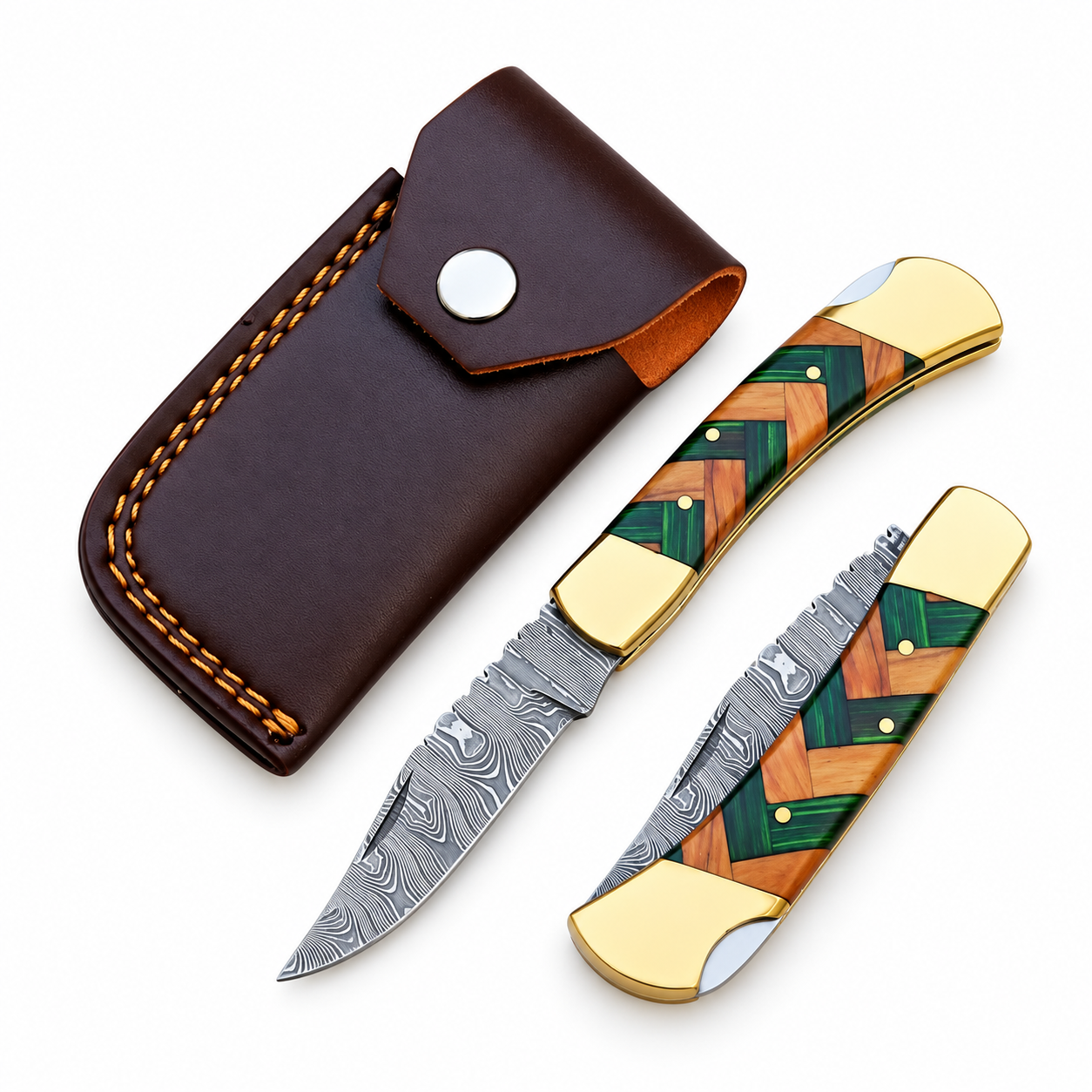
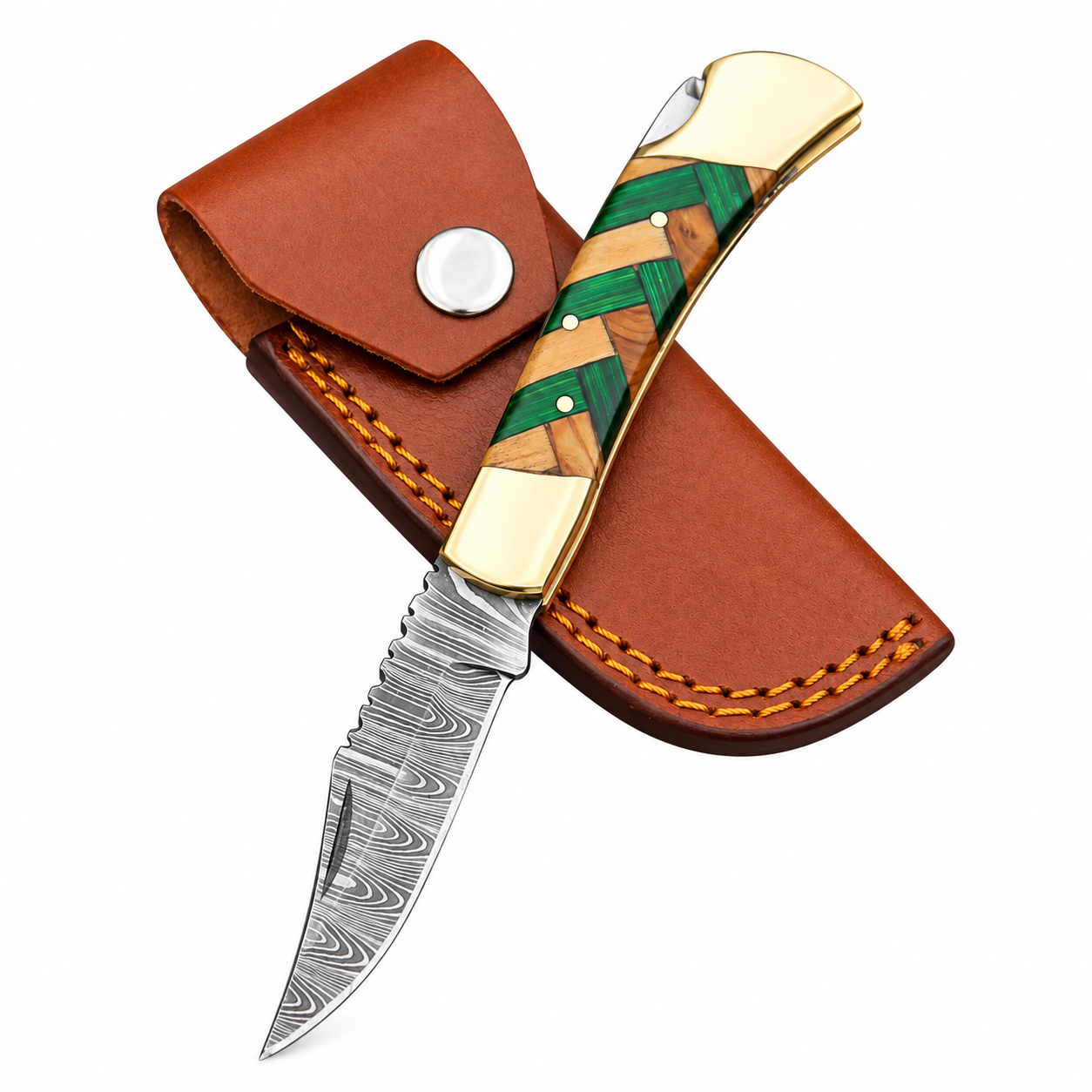
This patterned folding knife combines a flowing blade pattern with a green-and-tan geometric handle and polished-looking gold-tone ends. Shown with its blade open, it has a traditional pocket-knife appearance with decorative details across both the blade and handle. The contrasting colours make the handle a defining part of the design rather than a plain background to the blade.
The photograph shows a single blade with a curved plain cutting edge, a pointed tip, and an elongated nail nick near the upper edge. Small scalloped details run along part of the blade spine. Three round gold-tone pins are visible across the handle, which curves gently toward a broader rear end.
For customers interested in decorative folding knives, this model offers several recognisable features to compare: the flowing blade lines, angular handle pattern, contrasting end bolsters, and shaped profile.
Flowing Detail Across the Blade
The blade displays closely spaced silver-grey lines against a darker background. These lines curve into repeated arches and elongated shapes, creating a Damascus-style appearance across the visible blade face. The pattern extends from near the handle junction toward the pointed tip.
This contrast gives the blade a detailed appearance even without prominent branding or lettering. Some areas show tightly grouped lines, while others have wider dark spaces between them. That variation makes the blade visually different from a plain polished or uniformly coated surface.
“Patterned” and “Damascus-style” describe what is visible. They do not confirm genuine pattern-welded Damascus steel, a specific alloy, layer count, or forging method. Customers who require a particular steel construction should check the documented material specification before ordering. The decorative pattern alone does not establish cutting performance or durability.
Curved Plain Edge and Pointed Profile
The cutting edge follows a smooth curve toward the tip, with no visible serrations along its length. A lighter edge line separates the patterned blade face from the outer cutting profile. The forward section narrows noticeably, giving the knife a slender, pointed appearance when open.
A plain edge is a useful identifying feature when comparing this knife with partially serrated or fully serrated models. The blade’s outline also distinguishes it from broader, rounder designs and from knives with a straight, squared-off tip.
Its actual cutting capability depends on details that cannot be measured from the photograph, including blade thickness, edge geometry, heat treatment, and sharpness. If you are choosing the knife for a specific material or task, use those confirmed specifications alongside the visible shape.
Nail Nick and Spine Details
An elongated nail nick is visible near the upper part of the blade. This recessed feature is associated with traditional manual-opening knife designs and contributes to the familiar pocket-knife appearance. There is no visible thumb stud on the photographed side.
A series of shallow, rounded notches also appears along part of the spine nearer the handle. These details add texture to the blade outline and provide another point of distinction when comparing similar-looking products.
The photograph does not demonstrate the opening action, closing resistance, or any locking mechanism. It therefore should not be used to identify the knife as a particular lock type or to claim one-handed operation. Those operating details need confirmation from the product specification or a demonstration of the actual knife.
Green-and-Tan Geometric Handle
The handle combines deep green sections with tan and warmer brown sections in an angular arrangement. The pieces form a repeating zigzag-like pattern rather than simple parallel stripes. Visible grain-like markings add another layer of detail within the coloured sections.
This arrangement gives the handle a strong visual identity. The green provides a bold colour contrast, while the tan and brown areas maintain a warmer, traditional appearance. Together, they create a decorative design that stands out from a single-colour grip.
The photograph supports describing the surface as wood-grain in appearance, but it does not establish the exact handle material. Solid wood, laminated materials, composites, and decorative finishes can resemble one another in an image. No wood species, dye treatment, or stabilisation process is confirmed for this product.
Gold-Tone Bolsters at Both Ends
Broad gold-tone bolsters frame the central handle section. The front bolster sits beside the blade junction, while the rear bolster follows the widened curve at the end of the handle. Their relatively plain surfaces contrast with the busier geometric pattern between them.
The warm metallic colour also complements the tan and brown handle sections. This gives the knife a coordinated appearance, with similar tones repeated in the bolsters and small circular handle pins.
Although the colour resembles brass, the photograph does not verify the metal composition or surface treatment. These parts are therefore described as gold-tone rather than solid brass. Their visible finish also does not establish scratch resistance, corrosion resistance, or how their appearance may change with use.
Three Visible Handle Pins
Three small, round gold-tone pins are visible on the photographed side of the handle. Their positions follow the length of the decorative centre section without covering much of the geometric pattern. The simple circular shape contrasts with the angular green-and-tan arrangement around them.
These pins provide useful visual reference points when identifying the design. Along with the two bolsters, they help distinguish this handle from similar models that use screws, larger decorative rivets, or a different number of fasteners.
Only one side of the knife is shown. The opposite side’s finish, pin arrangement, and other details cannot be confirmed from this photograph. The image also does not establish the internal fastening method or whether any component is intended to be removed by the owner.
Folding Format and Storage Considerations
The knife is presented in an open folding configuration. This format is intended to bring the blade into the handle when closed, giving it a different storage arrangement from a fixed blade knife. The curved handle and visible metal structure along its edge are consistent with that traditional folding layout.
For customers comparing pocket knives, closed dimensions are particularly useful. They help determine whether a product will suit a chosen pouch, storage compartment, or display arrangement. Neither the closed length nor the closed thickness is provided by this image.
A pouch, sheath, clip, or storage box is not shown. Their inclusion should be checked separately. The photograph also does not establish how securely the blade is retained when closed or what mechanism holds it in its open position.
Who May Appreciate This Design?
This knife may appeal to customers who enjoy decorative blades, traditional folding profiles, and colourful handle patterns. Its design combines flowing lines on the blade with angular shapes on the handle, offering two different visual styles within the same piece.
Collectors comparing appearance may find the green-and-tan arrangement especially useful as an identifying feature. The gold-tone bolsters give the handle clearly defined ends, while the small pins keep the central pattern visible.
For customers considering practical use, appearance is only part of the decision. General cutting tasks, outdoor use, and other applications should be matched to the supplier’s confirmed guidance. This photograph does not establish suitability for heavy work, food preparation, prolonged use, or any specialised cutting application.
Assessing Size and Handle Fit
The handle curves along its length and broadens toward the rear. These contours are visible, but the photograph does not show enough information to determine how the knife will feel in a particular person’s hand. Handle thickness and edge shaping are not clear from this side view.
There is no ruler or reliable scale reference in the image. Overall length, blade length, closed length, and weight therefore remain unconfirmed. The close-up presentation should not be interpreted as evidence that the knife is especially small, large, or lightweight.
Before ordering, compare actual measurements with your preferences. If you already own a folding knife that fits comfortably, its dimensions can provide a useful reference when assessing this model’s confirmed specifications.
General Care for the Decorative Surfaces
Care requirements depend on the blade composition, handle material, and bolster finish. Follow the supplier’s instructions once those details are available. The following points are general considerations rather than verified maintenance instructions for this particular knife.
Remove residue after use and dry the knife before storage. Avoid prolonged soaking when the handle material is unknown, and do not assume that the knife is dishwasher safe. Check compatibility before using metal polish, solvents, oils, or other treatment products.
Different parts may need different care. A product suitable for one metal finish may affect a coloured handle or patterned blade surface. If preserving the original appearance is important, ask the supplier which cleaning products are appropriate before polishing or treating any section.
Opening, Maintenance, and Accessories
Confirm the operating mechanism before using or maintaining the knife. A nail nick indicates an opening feature, but it does not explain how the blade is retained or released. Instructions for the actual model are more useful than guidance for a similar-looking folding knife.
Sharpening also depends on the verified blade material and edge geometry. The photograph does not provide a recommended angle or identify a suitable sharpening method. Obtain those details before carrying out edge maintenance.
If you want a pouch or presentation case, check the closed dimensions first. Accessories advertised for another folding knife may not fit this one. No customization service, engraving option, interchangeable component, or replacement part is confirmed by the supplied image.
Details Worth Confirming Before Purchase
The visible design is clear, but several specifications remain important to a complete buying decision. These include blade and handle materials, dimensions, weight, lock or retention mechanism, and package contents. Confirming them helps ensure that the product matches your expectations beyond its appearance.
When comparing listings, look for the same green-and-tan geometric arrangement, broad gold-tone bolsters, three visible pins, nail nick, and scalloped spine detail. A knife that shares only a patterned blade or green handle may be a different product.
Explore the close-up image and confirmed specifications to decide whether this patterned folding knife suits your preferred style, collection, and intended use.




Reviews
There are no reviews yet.