



Raindrop Damascus Pattern Fixed Blade Knife – Distinctive Blade Design and Traditional Styling
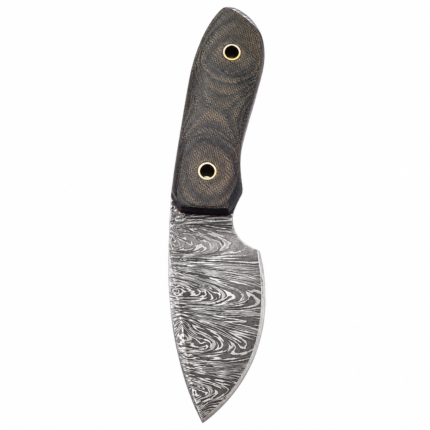
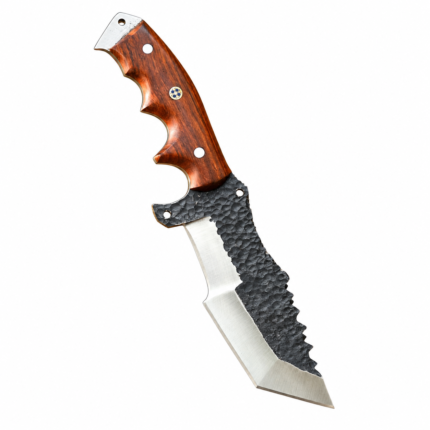
The Raindrop Damascus Pattern Fixed Blade Knife combines a striking ornamental blade with the warm appearance of a traditional brown wooden handle. Its most distinctive feature is the silver-and-gray blade surface, covered in intricate circular markings and flowing patterns that resemble the appearance of raindrop Damascus steel.
Unlike a plain metal blade, this knife features an elaborate surface design that immediately draws attention. The circular markings vary in size and are arranged across the blade alongside fine, wave-like lines. Together, these details create a rich decorative appearance that makes the knife particularly interesting to collectors and enthusiasts of traditional cutlery.
The handle provides a contrasting finish. Its reddish-brown surface has visible dark grain-like markings, while two large silver-colored circular pins add simple metallic details. The handle curves gently toward the rear, creating a distinctive silhouette that complements the blade.
The knife is shown against a clean white background, allowing the shape and decorative elements to stand out.
For customers who appreciate patterned fixed-blade knives, this model offers an attractive combination of ornamentation, warm handle colors, and a recognizable cutting-tool design.
Its suitability for practical cutting tasks depends on specifications that require manufacturer confirmation. However, its decorative character and visible design features can be appreciated directly from the photograph.
Intricate Raindrop Damascus-Style Blade Pattern
The blade’s surface is the central feature of this knife.
It displays numerous circular formations resembling concentric rings. These markings appear throughout the broad blade surface, with some circles positioned close together and others surrounded by irregular flowing lines.
The circular patterns create a distinctive layered visual effect.
Many of the rings have darker outlines that contrast with the lighter metallic areas. Their arrangement resembles the raindrop pattern commonly associated with decorative Damascus steel.
Between these circular markings, narrow wave-like lines follow the contours of the blade.
The combination of circular and flowing patterns creates a richly detailed appearance without relying on colored coatings or printed graphics that are visibly distinguishable in the photograph.
Toward the pointed end, the blade becomes narrower, and the decorative lines continue along its elongated profile.
The image clearly shows the patterned appearance, but it does not confirm the underlying manufacturing process.
Some knives with this type of appearance are manufactured using pattern-welded steel, while others use decorative surface treatments.
Because that distinction cannot be established from the photograph, the blade is described as having a Damascus-style pattern rather than being guaranteed genuine pattern-welded Damascus steel.
This is particularly important for customers who purchase knives according to blade composition, hardness, and manufacturing technique.
Long, Curved Fixed-Blade Profile
The knife features an elongated blade with a pronounced pointed tip.
Its upper edge rises gradually toward the tip, while the lower cutting-edge profile has a more noticeable curve.
This creates a sweeping shape that distinguishes it from a standard straight-edged utility knife.
The blade’s broad central area provides ample visual space for the ornamental pattern.
Near the handle, the lower portion of the blade has an angular transition before the cutting edge begins.
The overall silhouette combines flowing lines with a more structured base.
This makes the knife visually appealing to customers interested in traditional fixed-blade designs.
The blade remains extended from the handle, indicating a fixed-blade construction rather than a folding mechanism.
A fixed-blade knife does not fold into the handle for storage.
This is an important consideration for customers evaluating the product’s handling and storage requirements.
A suitable protective sheath or storage case may be required, but no sheath is shown in the uploaded photograph.
The exact blade dimensions and internal construction are not available.
Consequently, its suitability for specific cutting activities should be verified through manufacturer specifications rather than inferred from the photograph.
Attractive Brown Wood-Grain-Look Handle
The handle has a warm reddish-brown color with darker natural-looking grain patterns.
Its appearance resembles polished wood, giving the knife a classic visual character.
The surface contains irregular lines and tonal variations rather than a flat, uniform color.
These markings contrast with the cooler silver-and-gray tones of the patterned blade.
The handle has a gently curved profile, with a narrower section near the blade and a wider, rounded rear end.
Its shape contributes to the overall flowing silhouette of the knife.
Two large silver-colored circular pins are clearly visible along the handle.
These pins create simple decorative accents against the darker surface.
The combination of the brown grip and bright metallic pins gives the knife a traditional appearance associated with many classic cutlery designs.
The photograph does not establish whether the handle is solid natural wood, stabilized wood, resin composite, or another manufactured material.
For accuracy, it is described as having a wood-grain appearance.
This allows customers to understand its visible design without being misled about unverified material composition.
Two-Pin Handle Styling
The two circular handle pins are among the most recognizable features of the grip.
One appears closer to the blade, while the second is positioned toward the rounded rear section.
Both have a light silver-colored finish.
Their simple circular design contrasts with the elaborate blade pattern.
These details give the handle a restrained appearance that balances the highly decorative blade.
The pins may form part of the handle’s construction, but their exact function cannot be confirmed from the image alone.
It would be inaccurate to conclude that the knife has a full-tang construction based only on the visible pins.
Similarly, the internal handle assembly and the method by which the grip is attached to the blade are not established.
For collectors, the visible pins contribute to the knife’s traditional style.
For customers considering practical use, the actual construction should be verified through supplier documentation.
Elegant Contrast Between Blade and Handle
The knife’s visual appeal comes partly from the contrast between its two principal components.
The blade has a cool silver-and-gray appearance with numerous fine decorative markings.
The handle, by comparison, displays warm reddish-brown tones and darker grain-like patterns.
A narrow dark section separates the blade from the handle.
This transition creates a clear visual boundary between the patterned metal and the wood-look grip.
Because the handle design is relatively simple, attention naturally shifts toward the elaborate blade surface.
The result is a coordinated design in which the blade remains the main decorative feature.
The two silver-colored pins also complement the blade’s metallic appearance.
These design choices give the knife a distinctive identity without depending on prominent branding or oversized ornaments.
For customers searching for decorative fixed-blade knives, the combination of detailed blade patterns and traditional handle colors can be particularly appealing.
A Distinctive Addition to Knife Collections
Knife collectors often appreciate differences in blade shape, handle styling, patterns, and finishes.
This Raindrop Damascus Pattern Fixed Blade Knife offers several visually recognizable characteristics.
The concentric circular markings create a blade pattern that differs from traditional straight-line or random-wave designs.
The long, upward-curving blade adds another distinguishing feature.
The dark brown wood-look handle provides a classic contrast, while the two prominent pins create a simple finishing detail.
Together, these elements make the knife suitable for consideration as a decorative collectible.
It could complement a collection featuring different patterned blades, traditional handle designs, or fixed-blade silhouettes.
Collectors may also appreciate comparing its circular decorative pattern with other Damascus-style appearances, such as ladder, twist, or flowing-wave designs.
However, any claim about the blade’s actual metallurgical pattern should be supported by verified manufacturing information.
For display purposes, the knife should be placed in a secure case or stand that protects the blade and prevents accidental contact.
No display accessories are shown in the photograph.
Traditional Appearance for Adult Enthusiasts
The knife has a timeless appearance that may appeal to adults who enjoy classic cutlery designs.
Rather than using a brightly colored tactical-style handle or an unusually shaped grip, it features a familiar brown wood-grain look.
The silver-colored blade provides a decorative contrast through its circular and wave-like markings.
This combination gives the knife visual character while retaining a relatively straightforward overall design.
Customers interested in decorative metalwork may be drawn to the fine patterns across the blade.
Others may prefer the warm handle colors and traditional two-pin appearance.
Its fixed-blade silhouette also makes the knife recognizable among classic outdoor-style and utility-style knife designs.
The product may be considered as a collectible gift for an adult knife enthusiast, provided that applicable local laws and the recipient’s interests are taken into account.
Gift packaging, a protective sheath, and personalization services have not been verified.
These should only be advertised if they are actually offered.
Understanding Damascus-Style Blade Finishes
Damascus-style knives are known for their visually distinctive blade patterns.
These patterns may include flowing waves, irregular lines, circular formations, or repeated geometric markings.
The photographed knife displays a particularly noticeable circular pattern across much of the blade.
This appearance is commonly described as a raindrop or raindrop-inspired design.
However, similar-looking patterns may be produced using different manufacturing methods.
Pattern-welded blades are made through specific metallurgical processes, while some decorative knives feature surface-applied designs.
The photograph cannot establish which method was used.
It also does not confirm the steel alloy, number of layers, hardness, or heat-treatment process.
These details matter for customers comparing knives on technical performance rather than appearance alone.
A supplier specification sheet should identify the actual steel and construction method.
Until such information is available, describing the blade as Damascus-patterned is accurate and avoids unsupported claims.
Decorative Appeal Versus Practical Performance
The knife has the outward appearance of a functional cutting tool.
Its long, curved blade and fixed construction are characteristics found in different types of utility and outdoor knives.
Nevertheless, visible shape does not determine whether a knife is suitable for professional cutting, food preparation, or outdoor use.
Actual performance depends on the steel composition, blade thickness, edge geometry, tang design, heat treatment, and assembly quality.
These specifications are not available from the image.
The product should therefore not be described as heavy-duty, professionally tested, or exceptionally sharp without reliable evidence.
Customers who intend to use it regularly should confirm the manufacturer’s recommendations.
For collectors interested primarily in decorative design, the knife’s visible characteristics provide a clear basis for evaluating its appearance.
This distinction helps customers make informed purchasing decisions.
General Blade Care and Cleaning
Appropriate maintenance can help preserve the appearance of decorative fixed-blade knives.
After suitable use, carefully wipe the blade with a soft, clean cloth.
Remove moisture, fingerprints, and visible residue before storage.
Avoid leaving the knife exposed to water for prolonged periods.
Because the blade steel is not confirmed, no specific corrosion-resistance rating can be assumed.
When additional cleaning is required, use products appropriate for the verified steel and surface finish.
Harsh abrasives should be avoided because they may affect the decorative blade pattern.
For long-term storage, follow the manufacturer’s recommendations for any protective oil or coating.
The blade should be handled carefully during cleaning.
Keep fingers away from the cutting edge and pointed tip.
These are general care precautions and should be supplemented with material-specific guidance from the supplier.
Caring for the Brown Handle
The handle’s grain-like appearance is an important part of the knife’s design.
Keeping its surface free from excessive dirt and moisture may help maintain its appearance.
A soft cloth can be used for ordinary cleaning.
Avoid strong solvents, aggressive polishing compounds, and prolonged exposure to water unless the manufacturer confirms that the handle material can tolerate them.
Different handle materials require different maintenance methods.
Natural wood may require different care from stabilized wood or resin-based composites.
Because the actual material is unknown, applying wood oil or other conditioners without confirmation is not recommended.
The visible pins can be wiped gently along with the surrounding handle surface.
If any part of the handle appears damaged or loose, the knife should not be used until its condition has been assessed.
Safe Storage and Handling
As a fixed-blade knife, this product requires appropriate storage because the blade does not fold into the handle.
A properly fitted sheath can help cover the blade during storage or transport.
No sheath is visible in the supplied image, so one should not be assumed to be included.
Keep the knife in a secure location away from children and unauthorized users.
Avoid placing it where the exposed blade could be touched accidentally.
When handling the knife, maintain awareness of the cutting edge and tip.
Do not use the knife for tasks outside its verified intended purpose.
Inspect the blade and handle before any practical use.
Customers should also review applicable laws governing knife ownership, possession, transport, and importation.
Responsible handling is important whether the knife is purchased as a collectible or evaluated for functional use.
Product Specifications That Require Confirmation
The photograph provides a clear view of the knife’s visible design, but it does not provide reliable measurements.
The overall length, blade length, handle length, blade thickness, and total weight remain unknown.
Its exact blade steel and manufacturing process are also unverified.
The reddish-brown handle resembles wood but may use another material.
The visible pins do not establish the internal tang configuration.
No sheath, case, or additional accessory is shown.
Buyers interested in practical performance should request a complete specification sheet before purchase.
Collectors may also benefit from additional photographs showing the opposite side of the blade, the spine, and any identifying markings.
These details can help establish exactly which product is being purchased.
Why Choose This Raindrop Damascus Pattern Fixed Blade Knife?
The main attraction of this knife is its detailed decorative blade design.
The circular raindrop-style pattern creates a distinctive metallic appearance, while the elongated curved blade provides a recognizable silhouette.
Its reddish-brown wood-grain-look handle adds warmth and traditional character.
Two prominent silver-colored pins complete the restrained handle design.
The combination makes this knife visually different from plain fixed-blade products.
It may appeal to adult collectors, decorative cutlery enthusiasts, and customers who appreciate patterned blades.
Its material composition and practical performance should be confirmed before functional use.
Explore the Raindrop Damascus Pattern Fixed Blade Knife if you appreciate intricate circular blade patterns, classic brown handles, and traditional fixed-blade styling.








Reviews
There are no reviews yet.