



Stag Handle Bowie Knife – Traditional Design with a Distinctive Textured Blade
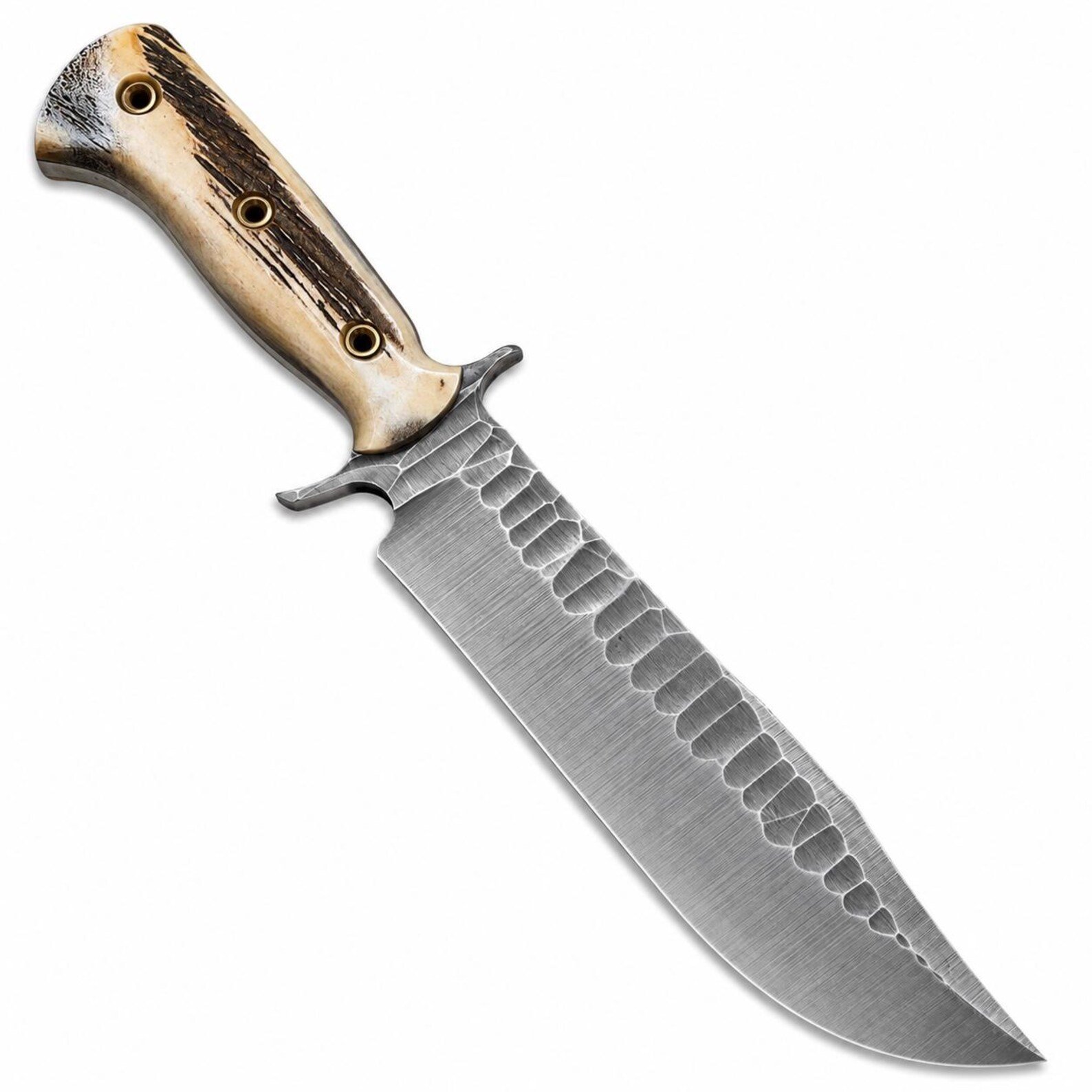
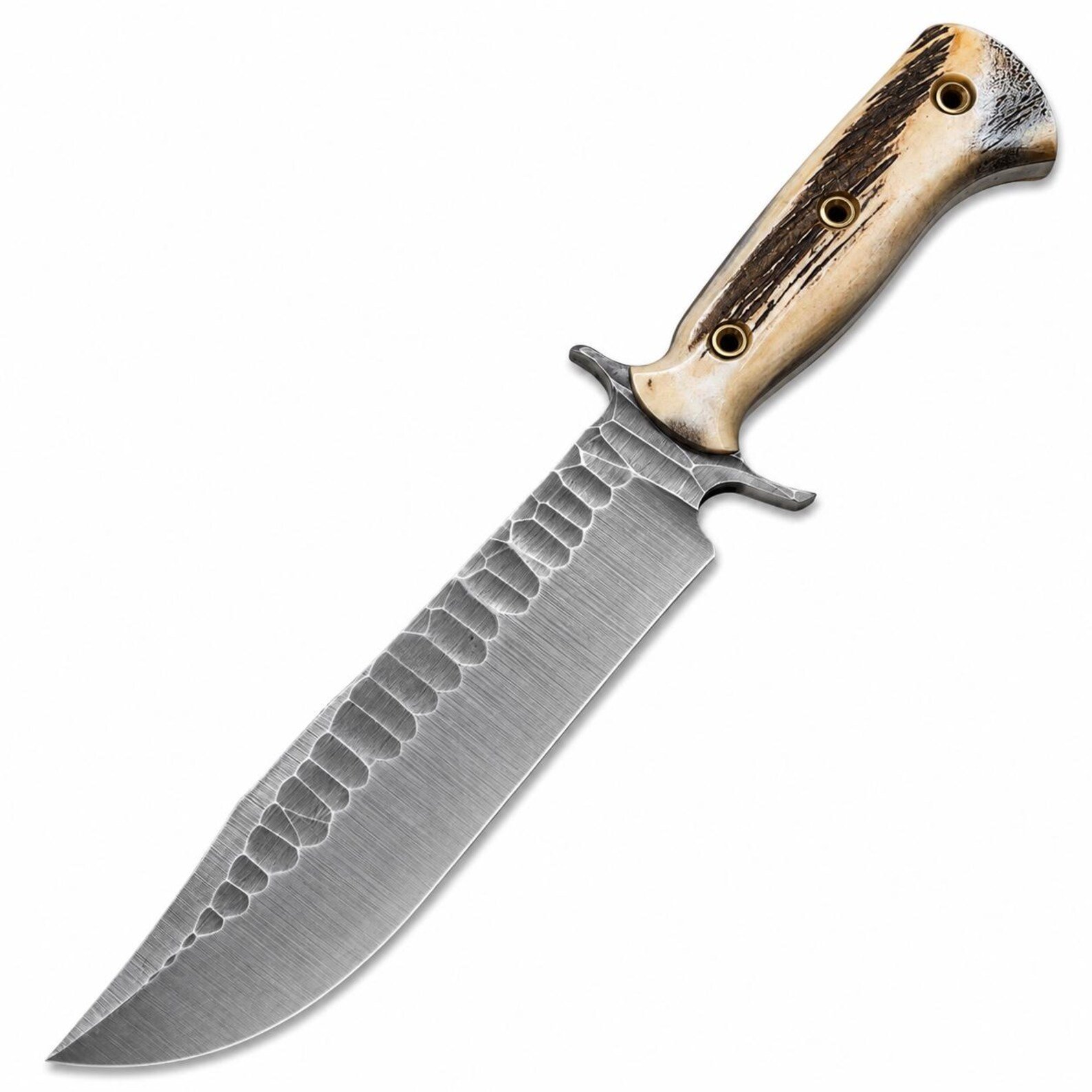
The Stag Handle Bowie Knife combines a traditional fixed-blade profile with a distinctive two-tone handle and a broad silver-colored blade. Its design features a pronounced metal guard, curved cutting edge, pointed tip, and a series of textured impressions along the upper portion of the blade.
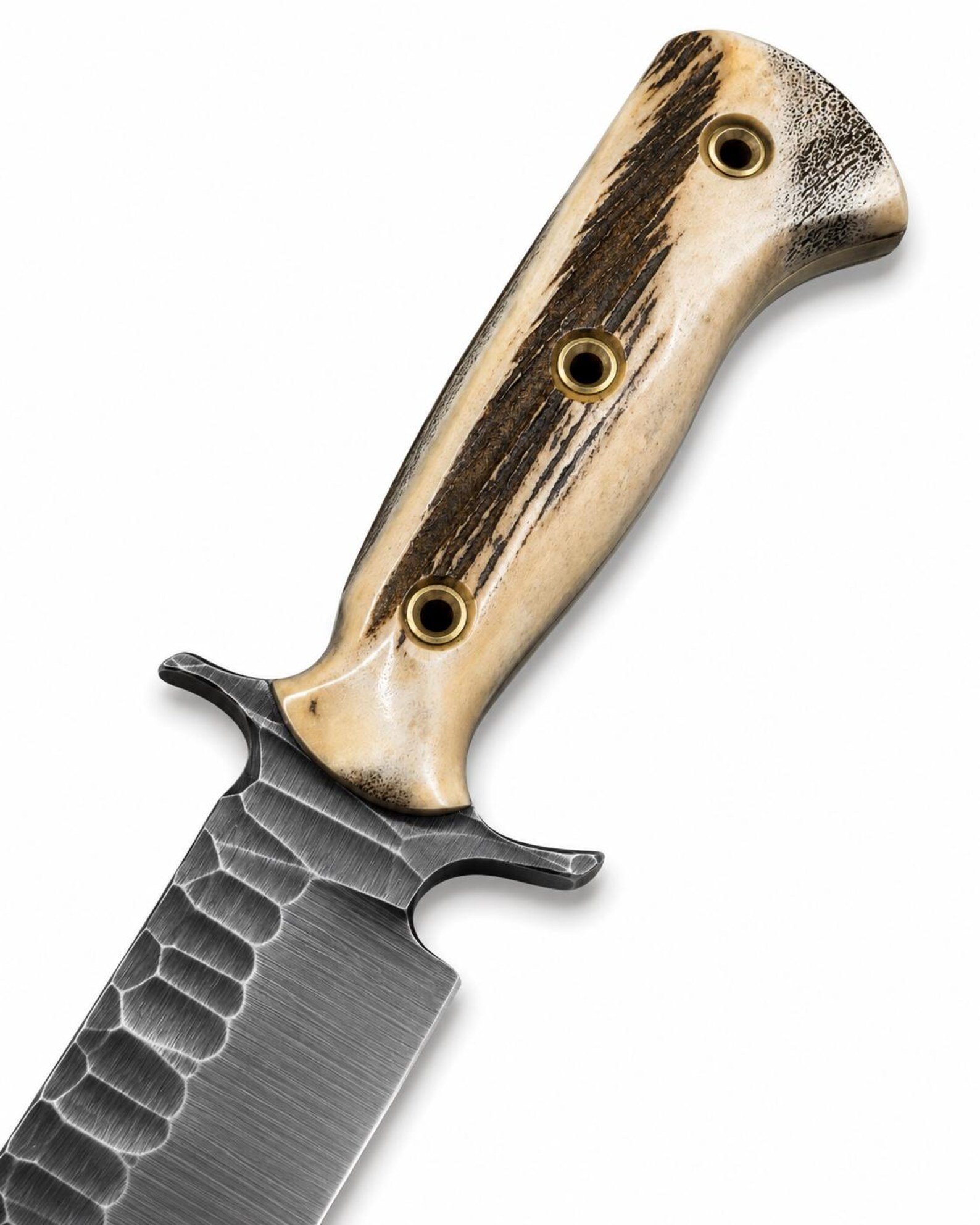
The handle is one of the most recognizable aspects of this knife. Its cream-colored surface includes dark brown and black streaking that creates a natural, rustic appearance similar to antler. Three circular metal-lined openings run along the visible side, adding another decorative feature.
The blade has a smooth satin-style metallic finish, with fine grinding lines visible across its surface. A row of overlapping, scalloped impressions follows the upper section from the base of the blade toward the point.
These details create a design that stands apart from ordinary polished fixed-blade knives.
With its traditional Bowie-inspired silhouette, contrasting finishes, and decorative handle, this knife is particularly relevant to customers interested in distinctive outdoor knife designs and collectible fixed-blade cutlery.
Broad Bowie-Style Blade Profile
The blade has a broad body that gradually narrows toward a pointed tip.
Its cutting-edge outline is slightly curved, while the spine maintains a comparatively straighter profile before approaching the tip.
This shape is characteristic of many Bowie-style knives, although individual Bowie designs vary considerably.
The broad blade makes a strong visual impression, especially when viewed alongside the relatively narrow handle.
A prominent silver-colored cutting section occupies most of the blade surface.
The finish has a subtle brushed appearance rather than a highly reflective mirror polish.
Fine parallel marks are visible across the metal, contributing to its satin-style appearance.
The blade shape is suitable for classification as a fixed-blade Bowie-style design. However, exact dimensions and cutting characteristics cannot be determined from the photograph.
Distinctive Textured Blade Detailing
A series of overlapping decorative impressions follows the upper portion of the blade.
These impressions resemble shallow hammered facets or scalloped indentations.
They begin close to the guard and continue toward the front of the blade, gradually becoming smaller near the tip.
The textured region creates visual contrast against the smoother central blade surface.
This detailing gives the knife a distinctive appearance and is one of its most noticeable features.
The precise method used to produce the texture is not confirmed. It may have been created through forging, grinding, machining, or another finishing process.
For this reason, describing it as a hammered-look blade is more accurate than claiming that it was hand-forged.
The decorative pattern contributes to the knife’s traditional aesthetic without requiring unsupported claims about its performance.
Stag-Style Cream and Brown Handle
The handle displays a striking combination of cream, ivory-like coloring, dark brown streaks, and black markings.
The lighter areas contrast with the darker textured sections, creating an organic appearance reminiscent of natural stag antler.
Its shape curves slightly and widens near the rear.
The handle has a defined profile with a visible lower contour and a wider rear end.
Three circular metal-lined openings are arranged along the handle.
These features contribute to the knife’s overall decorative character.
Although the handle resembles natural antler, the photograph does not establish whether it is genuine horn, bone, resin, composite material, or another substance.
Therefore, the product’s confirmed material should be obtained from the manufacturer before publication.
The term stag-style handle accurately describes the visible appearance without presenting the material as verified.
Three Metal-Lined Handle Openings
Three circular openings are visible along the handle.
Each has a metallic rim with a golden or brass-colored appearance.
The openings are positioned at different points along the handle’s length.
Their circular shape provides a repeated design element against the irregular color pattern of the grip.
They may be associated with handle construction or decorative fittings, but their exact engineering purpose is unknown.
The photograph does not reveal the reverse side of the handle or the internal construction.
As a result, their attachment mechanism and structural function should not be assumed.
What can be confirmed is their visible appearance and placement.
They add contrast and detail to the cream-and-brown grip.
Traditional Metal Crossguard
A metal crossguard separates the handle from the blade.
It extends outward on both sides of the knife.
The guard has a shaped profile with gently curved ends.
Its silver-gray appearance complements the metallic finish of the blade.
This component is a recognizable feature of traditional Bowie-style designs.
It also creates a clear visual boundary between the decorative handle and the exposed blade.
The guard’s actual material, thickness, and attachment method cannot be determined from the photograph.
Its appearance suggests a shaped metal component, but further technical information is needed before making performance claims.
Satin-Style Silver Blade Finish
The blade has a light silver-gray appearance.
Its relatively smooth central section contrasts with the decorative impressions running along the upper blade.
Fine linear finishing marks are visible across the surface.
The cutting edge forms a clearly defined line along the lower portion of the blade.
This appearance is consistent with a satin-style blade finish.
However, the photograph does not verify the actual sharpening angle, hardness, or edge retention.
It also does not establish whether the blade is made from stainless steel, carbon steel, or another steel alloy.
Buyers requiring specific materials should consult the supplier’s technical specifications.
Traditional Fixed-Blade Construction
The knife has a fixed-blade configuration.
Unlike a folding knife, the blade is shown permanently extended from the handle.
There is no visible hinge, folding mechanism, or opening system.
This makes it appropriate for categorization under fixed-blade knives.
Its overall shape includes a curved handle, substantial blade, and prominent guard.
These elements create a traditional Bowie-style silhouette.
The internal tang construction is not visible.
Consequently, the knife should not be described as full tang or hidden tang until the manufacturer confirms its construction.
Rustic and Decorative Appearance
One of the defining characteristics of this knife is the contrast between its metallic blade and organically patterned handle.
The blade presents a relatively uniform silver finish.
The handle has darker streaks that appear irregular and natural.
The metal-lined openings introduce small golden-colored accents.
The crossguard provides a visual transition between these different surfaces.
Together, these details create a design that combines traditional knife styling with distinctive decorative finishing.
The knife is visually suited to collections featuring Bowie-style cutlery, stag-look handles, and statement fixed-blade designs.
Suitable Product Categories
This knife fits naturally into several retail classifications, although the most accurate primary category is Bowie Knives.
It can also be grouped with fixed-blade knives, traditional knife designs, and collectible outdoor cutlery.
For customers browsing by blade shape, the Bowie category communicates the product’s distinctive silhouette.
For customers browsing by appearance, a stag-style handle category may also be useful.
For customers browsing general product construction, fixed-blade knives provide a broader classification.
A clear category structure helps customers locate the product without relying on exaggerated or unsupported claims.
A Distinctive Addition to a Knife Collection
Collectors often compare knives based on blade profile, handle appearance, guards, finishing details, and overall presentation.
This model offers several visually distinctive elements.
Its broad blade gives it a traditional character.
The row of decorative impressions adds texture to the metal surface.
The cream-and-brown handle provides a rustic appearance.
The metal crossguard creates a clear separation between the blade and grip.
The circular fittings add further visual interest.
These elements make the knife recognizable among traditional Bowie-inspired designs.
The image does not establish whether it is a limited edition, handmade product, or collectible from a particular manufacturer.
Such claims should only be included when supported by supplier documentation.
Blade and Handle Proportions
The knife has a relatively long, broad blade compared with its handle.
Its pointed profile follows a gradually narrowing outline toward the tip.
The handle has a gently curved shape.
The crossguard is noticeably wider than the handle at the point where they meet.
The blade features a substantial width near its base.
These design choices create a balanced visual composition.
However, visual proportions should not be confused with verified weight distribution or handling characteristics.
The product’s overall length, blade length, blade thickness, grip length, and weight remain unspecified.
Accurate measurements are important for buyers comparing Bowie-style knives.
Material and Manufacturing Information
Although the image clearly shows a metallic blade, it does not identify the exact steel composition.
The knife should not be advertised as Damascus steel, high-carbon steel, D2 steel, or stainless steel unless verified.
The visible texture does not demonstrate a particular steel grade or forging technique.
Similarly, the handle’s cream-and-brown appearance does not prove that genuine stag antler was used.
The guard and handle fittings appear metallic, but their composition is unknown.
A reliable supplier specification sheet should confirm these details.
The same applies to hardness, heat treatment, finish durability, and country of manufacture.
Providing accurate technical information allows buyers to compare products confidently and reduces the likelihood of misunderstandings.
General Care and Storage
Proper storage helps maintain the appearance of a fixed-blade knife.
The blade should be kept clean and dry.
After handling, remove moisture or visible residue using a suitable soft cloth.
Avoid prolonged exposure to damp conditions.
The correct corrosion-prevention method depends on the actual steel grade and finish.
Do not assume the blade is corrosion-resistant until its material is verified.
Avoid harsh cleaning products that could affect the decorative handle or metal fittings.
Keep the cutting edge protected during storage.
If a suitable sheath is supplied, follow the manufacturer’s guidance regarding long-term storage.
No sheath is visible in the uploaded image, so a sheath should not be advertised as included without confirmation.
Always store the knife securely, away from children and unauthorized users.
Product Specifications
| Attribute | Description |
|---|---|
| Product Type | Fixed Blade Knife |
| Design | Bowie-Inspired |
| Blade Color | Silver |
| Blade Finish | Satin-Look Metallic Finish |
| Blade Detail | Hammered-Look Scalloped Texture |
| Blade Shape | Broad, Curved-Edge Pointed Blade |
| Handle Appearance | Cream, Brown, and Black |
| Handle Style | Stag-Look Grip |
| Handle Detail | Three Metal-Lined Openings |
| Guard | Shaped Metal Crossguard |
| Steel Grade | Not verified |
| Handle Material | Not verified |
| Tang Construction | Not verified |
| Overall Length | Not verified |
| Blade Length | Not verified |
| Blade Hardness | Not verified |
| Sheath | Not shown |
| Country of Origin | Not verified |
Why Consider This Bowie-Style Knife?
This product combines several traditional design elements in one recognizable fixed-blade silhouette.
The polished-looking metallic blade provides a clean visual surface.
The scalloped texture adds distinctive detailing.
The cream-and-brown handle introduces contrast.
The crossguard reinforces the traditional Bowie-inspired appearance.
For buyers choosing knives primarily by visual design, these characteristics provide a clear way to compare this model with other fixed-blade products.
For buyers whose decision depends on steel composition, dimensions, edge condition, or construction quality, the manufacturer’s specifications should be reviewed before purchase.
Final Product Overview
The Stag Handle Bowie Knife brings together a broad satin-look blade, decorative hammered-style detailing, a metal crossguard, and a cream-and-brown stag-style grip.
Its traditional silhouette makes it a distinctive choice within the Bowie knife category.
Explore this design as part of a traditional fixed-blade knife collection, with material and technical specifications confirmed before ordering.






Reviews
There are no reviews yet.