






Stag-Style Gut Hook Knife with a Patterned Blade
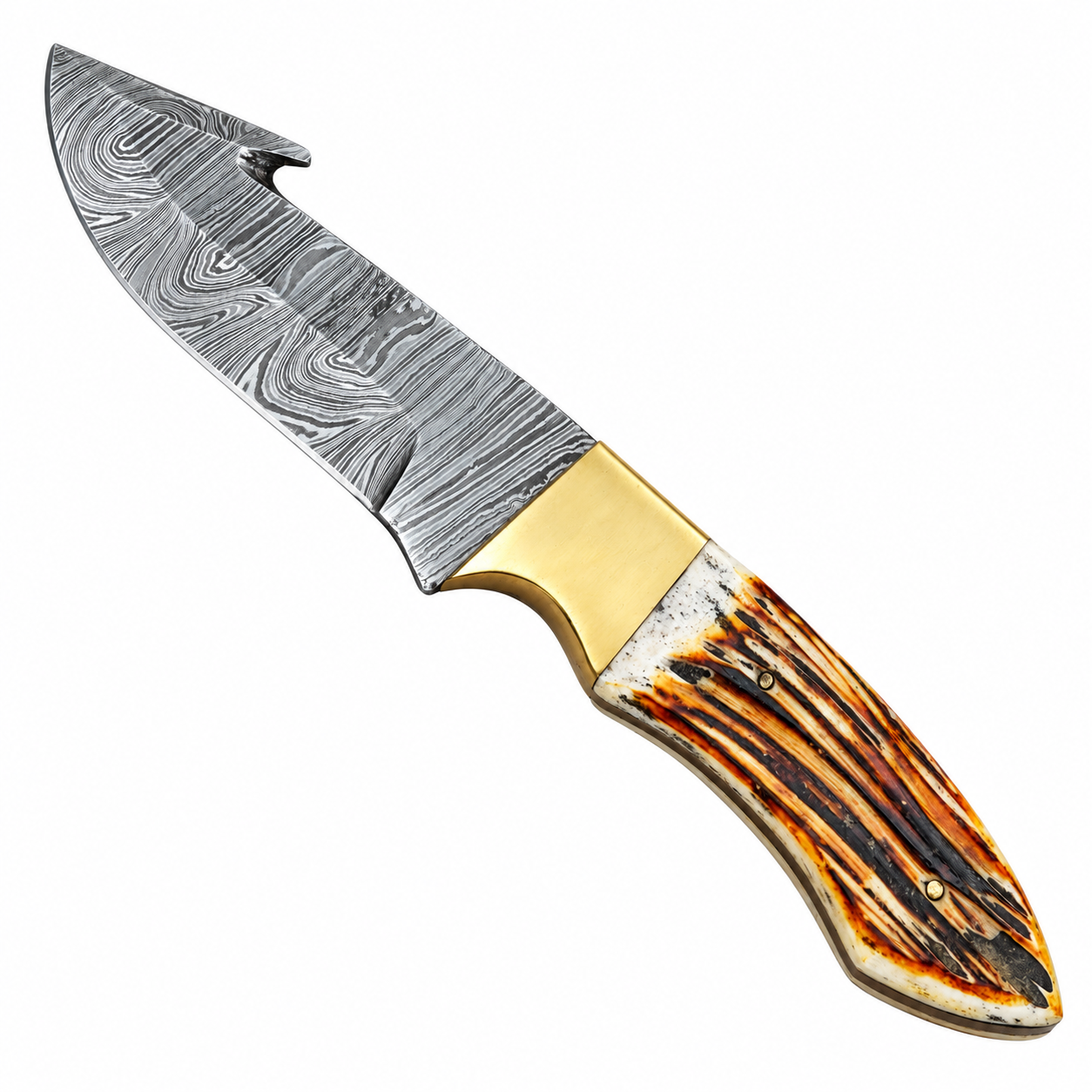
This stag-style gut hook knife combines a broad patterned blade with a curved brown-and-cream handle and a prominent gold-tone bolster. Its hunting-inspired profile is immediately recognisable through the hooked opening near the blade tip and the sweeping curve of the main cutting edge. The handle introduces warmer colours, while the grey-and-silver blade provides a contrasting finish.
The design offers several details to appreciate at close range. Dark streaks run along the handle, two round gold-tone pins sit within its surface, and flowing lines cover much of the blade face. Between them, the smoother bolster creates a clear transition from grip to blade.
“Stag-style” and “Damascus-style” describe the appearances shown in the image. Genuine antler, bone, layered steel and brass have not been confirmed. The visible design can be described accurately while keeping those material specifications separate.
A Recognisable Gut-Hook Profile
The most distinctive blade feature is the hook-shaped opening along its upper edge near the front. This cut-out gives the knife its gut-hook classification and sets it apart from a conventional plain-spine hunting knife.
Gut-hook designs are associated with field-dressing tasks, where a separate hooked cutting area serves a different purpose from the main edge. For this particular product, however, the photograph establishes the shape rather than the hook’s sharpness, dimensions or tested performance.
Customers browsing hunting-style knives can use this feature to identify the category they are looking for. Anyone selecting the knife for practical field use should also check the manufacturer’s intended application and the specification of the finished hook. A recognisable outline is useful, but it does not replace information about the actual cutting geometry.
A Broad Blade with a Curved Belly
The blade broadens toward its forward section and has a pronounced curved lower edge. This creates a fuller profile than a narrow utility or fillet blade, giving the knife a substantial appearance relative to the handle.
The curve also provides a large area for the patterned finish. Instead of being confined to a narrow strip, the flowing lines remain visible across the central and forward blade sections. The result is a design in which the blade shape and surface detail contribute equally to its appearance.
This broad belly is consistent with skinner-style knife profiles. It should not, by itself, be taken as proof of cutting efficiency or suitability for a particular type of game. Those capabilities depend on the finished edge, steel, dimensions and intended use.
Flowing Grey-and-Silver Blade Markings
The blade face displays closely spaced grey-and-silver lines that change direction across its surface. Some follow longer paths, while others gather into rounded or angular formations. The variation gives the blade a layered, flowing appearance.
These markings extend across much of the visible blade, including the area near the hook. Their contrast makes the surface more detailed than a uniformly polished or coated blade and gives customers another feature to examine beyond the outline.
The appearance resembles patterns commonly described as Damascus-style. The image does not establish how the pattern was created, whether the blade is pattern-welded, or how many layers it contains. Those are manufacturing and material claims that need confirmation for this exact product rather than assumptions based on a similar-looking knife.
A Plain Main Cutting Edge
The lower cutting edge appears continuous and non-serrated. It runs along the underside of the blade before curving upward toward the forward end. The separate gut hook remains above it, making the two features visually distinct.
This arrangement gives the knife an uninterrupted main edge rather than a combination of plain and toothed sections. The image makes that outline easy to assess, particularly for customers comparing different hunting-knife profiles.
Sharpness and edge preparation remain unverified. The photograph cannot show whether the knife arrives ready for a specific task, what sharpening angle has been used or how well it retains an edge. Those details should come from the actual product specification. The listing can accurately describe the visible edge without promising a cutting standard that has not been established.
Detail around the Blade Base
Near the handle, the blade has a defined base section before the main lower edge begins. Changes in the surface angle create a visible transition between this area and the broader cutting portion.
The patterned finish continues through the base, helping the blade retain a coordinated appearance. Rather than ending abruptly at a plain metal section, the lines remain part of the design close to the bolster.
This area is useful when comparing the pictured knife with similar models because blade-to-handle transitions can differ considerably. However, the image does not reveal precise thickness, grind geometry or internal attachment. It supports a description of the visible form while leaving technical construction details to the manufacturer’s specifications.
A Warm Brown-and-Cream Handle
The handle combines cream-coloured areas with amber-brown tones and darker streaks. Much of the darker detail runs along its length, producing an antler-like or textured bone-like appearance.
The colour arrangement creates a strong contrast with the cool grey blade. Cream areas remain especially noticeable near the bolster and along parts of the lower handle, while the darker streaking becomes more prominent through the upper and rear sections.
This handle is one of the product’s main identifying features. It gives the knife a traditional-looking character without relying on printed graphics or bright synthetic colours. Its composition, however, is not confirmed. The terms stag-style and brown-and-cream describe what is visible without claiming a particular natural material or manufacturing process.
Lengthwise Streaking and Surface Character
Long dark markings create a directional pattern across the grip. Their irregular spacing and varying width make the handle visually different from a smooth, evenly coloured surface.
The markings also complement the blade pattern without repeating it exactly. The handle uses warmer tones and broader streaks, while the blade carries finer grey-and-silver lines. This difference helps each part retain its identity within the complete design.
The image does not establish whether all the darker channels are deeply textured or primarily changes in colour. For that reason, the surface should not be described as a proven non-slip grip. Its visible character can be appreciated independently of handling claims, which require information about the actual material, finish and conditions of use.
A Curved and Tapered Grip
The handle has a curved lower outline and a rear section that rises into a tapered end. Its shape is more sculpted than a straight-sided grip, with the broader rear and narrower middle creating a distinctive silhouette.
This outline works with the lengthwise streaking, directing attention along the handle toward the blade. The cream area near the front provides a lighter transition before the gold-tone bolster begins.
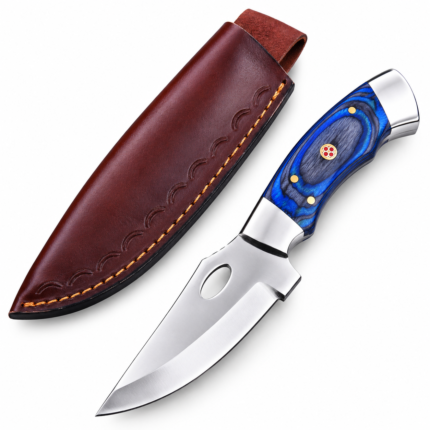
Fit and comfort cannot be confirmed from the side view alone. Handle thickness, cross-section and overall length all influence how the knife feels in the hand. Customers planning regular use should consider those measurements alongside the visible contour. A familiar knife can provide a useful reference when comparing confirmed handle dimensions.
Two Gold-Tone Handle Pins
Two circular gold-tone pins are visible on the handle face. One sits nearer the rear, and the other is positioned closer to the middle. Their simple shapes provide small points of contrast within the irregular brown-and-cream markings.
The pin colour also relates visually to the larger bolster, helping connect the handle details with the blade junction. This creates a coordinated appearance without adding extensive ornamentation or lettering.
The pins’ composition and structural role are not established by the photograph. They should not be described as brass rivets or used as evidence of a particular tang design without confirmation. What can be stated is that the visible circular accents contribute to the handle’s appearance and are part of the pictured arrangement.
A Prominent Gold-Tone Bolster
A broad gold-tone bolster sits between the handle and blade. Its comparatively smooth surface contrasts with the surrounding streaks and blade pattern, creating a clear visual break between the two detailed sections.
The bolster has a shaped lower edge that curves inward before meeting the blade. This gives the junction a more defined outline than a simple rectangular fitting and continues the sculpted appearance of the grip.
Its colour is accurately described as gold-toned. The image does not establish whether it is brass, another alloy or a surface finish over a different material. Similarly, its appearance does not reveal the attachment method. Buyers interested in those construction details should refer to specifications for the exact model.
A Balanced Combination of Colours
The knife brings together three distinct visual elements: a warm patterned handle, a gold-tone transition and a cooler patterned blade. Each occupies a clear area, so the design remains easy to read despite the detail.
The smoother bolster is especially important to this arrangement. It separates the two patterns and prevents them from meeting without a visual pause. The small handle pins then repeat its colour farther back along the grip.
For customers choosing on appearance, this combination may appeal more than a plain black handle or an entirely silver-tone design. It offers contrast through both colour and surface detail, while retaining a traditional hunting-inspired look. The image provides a useful basis for deciding whether that style fits an existing collection.
Fixed-Blade Configuration
The knife is presented as a fixed-blade model, with no folding pivot or closing mechanism shown. The blade remains extended from the handle, giving the product a continuous overall form.
This format affects storage and accessory selection. A suitable sheath would need to accommodate the full blade profile, including the hook, rather than simply fit a folded handle.
The internal construction cannot be confirmed from the image. A fixed blade does not automatically establish full-tang construction, nor do the visible pins prove how far the blade material extends through the grip. Such details matter when assessing practical capability and should come from the manufacturer. This listing identifies the visible configuration without attaching an unsupported strength claim.
Hunting-Inspired Design and Intended Use
The gut hook and broad curved blade place this knife within a hunting and skinning-style category. That makes it relevant to customers browsing these designs, whether their interest is practical use, collecting or a combination of both.
A category description is not the same as a performance guarantee. Before choosing the knife for field work, buyers should review the stated blade material, dimensions, edge preparation and manufacturer-approved applications.
The pictured finish may be appealing, but it does not establish how the knife performs under use. Keeping design and capability distinct helps customers make a more informed choice. Someone selecting primarily for appearance can assess the visible features, while a practical user can look for the additional specifications needed to support their decision.
Decorative Appeal for Adult Collectors
Collectors may appreciate the way this knife combines a recognisable gut-hook profile with contrasting decorative surfaces. The handle’s broad streaks and the blade’s finer lines offer different details to inspect.
The gold-tone bolster adds another point of distinction, particularly when compared with knives that have no separate fitting or a plain silver-tone junction. Its shape contributes to the overall outline as well as the colour scheme.
No rarity, historical origin or limited production run is established. The knife can be considered on the strength of its visible design without an invented background. Buyers who collect according to maker, production method or material should obtain that information separately, since those factors cannot be determined from the supplied image.
Considering the Knife as a Gift
This design may be worth considering for an adult who enjoys hunting-style knives or decorative fixed blades. Its combination of patterned blade, warm handle colours and gold-tone details gives it a clear visual identity.
The recipient’s preferences remain important. Some enthusiasts focus on appearance, while others prefer a specific steel, handle material or size. Matching the product to those interests is more useful than relying only on a striking photograph.
Presentation accessories are not confirmed. The image does not show a gift box, sheath, stand or personalised engraving. If those details matter to the purchase, the selected product option should state exactly what is included. A knife-only listing should not be assumed to arrive as a complete gift set.
Dimensions and Handling Information
The image contains no ruler or dependable scale reference. Overall length, blade length, handle length and blade thickness therefore cannot be calculated accurately from it.
Those measurements are useful for comparing this design with another knife. A handle that looks suitable in a close-up image may feel different depending on its width and thickness, while blade size influences storage requirements and intended use.
Weight and balance are also unconfirmed. The broad bolster and textured-looking handle do not provide enough information to estimate either reliably. Buyers who already own a comfortable knife can compare its measurements with the confirmed dimensions of this model. That creates a practical reference to accompany the visual impression.
Sheath Fit and Included Accessories
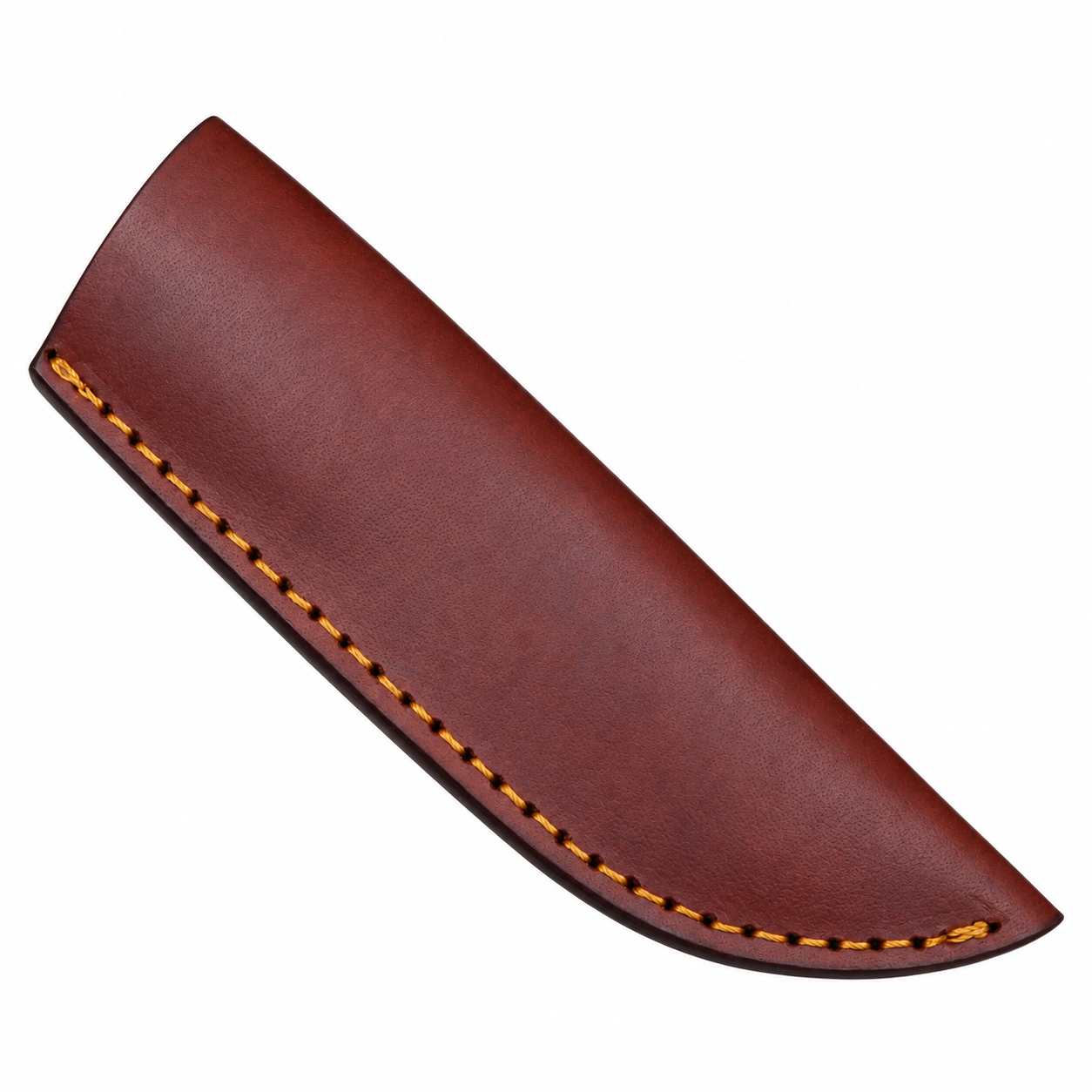
Only the knife is visible in the supplied image. No sheath, protective blade cover, sharpening accessory or storage pouch is shown.
If a sheath is offered, it should be confirmed as suitable for this exact blade shape. The gut hook introduces an opening and projecting area along the spine, so compatibility should be based on the actual product rather than a general resemblance to another hunting knife.
Package contents also matter when comparing supplier prices. A knife supplied with a fitted sheath is a different offer from a knife-only product. Checking those details helps prevent assumptions about what will arrive and allows the buyer to assess the complete purchase more accurately.
Materials and Construction to Confirm
The main material questions concern the blade, handle, bolster and pins. The image shows their appearances, but not their composition.
For the blade, useful specifications include steel grade, hardness and how the visible pattern was produced. For the handle, confirmation would establish whether the stag-like appearance comes from natural material or a manufactured alternative. The bolster and pins should likewise be identified through product information rather than colour.
Manufacturing claims such as handmade, hand-forged or individually carved also require evidence. These details can add meaningful context when verified, but they should not be borrowed from a similar Alibaba listing. The specifications must refer to the actual knife being sold.
Care for the Finished Product
Care instructions should match the confirmed materials and finish. Without that information, it would be inaccurate to prescribe a specific oil, polish, cleaner or treatment for the handle.
The seller’s guidance should cover cleaning, drying, storage and maintenance of the main edge and gut hook. These two cutting areas have different shapes, so any sharpening instructions should be appropriate to the actual product.
The patterned blade and warm handle finish are important parts of the appearance. Material-specific guidance can help the buyer care for those features without assuming that every Damascus-style knife requires the same treatment. The correct instructions should accompany or be available for the selected model.
Choosing This Stag-Style Gut Hook Knife
The design brings together a curved hunting-style blade, a visible gut hook, warm handle markings and a broad gold-tone bolster. These features give it a recognisable appearance that can be assessed directly from the image.
Its strongest visual quality is the contrast between detailed and smooth surfaces. The handle and blade each carry their own pattern, while the bolster separates them and the small pins repeat its colour. This creates a coordinated design without relying on extensive decoration across every component.
Explore the image alongside the confirmed specifications and package contents to decide whether this stag-style gut hook knife suits your collection or intended purchase. Choose the appearance that appeals to you, supported by verified information about the exact item.





Reviews
There are no reviews yet.