





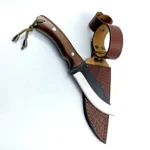


Wood Handle Hunting Knife with Black Blade and Lanyard
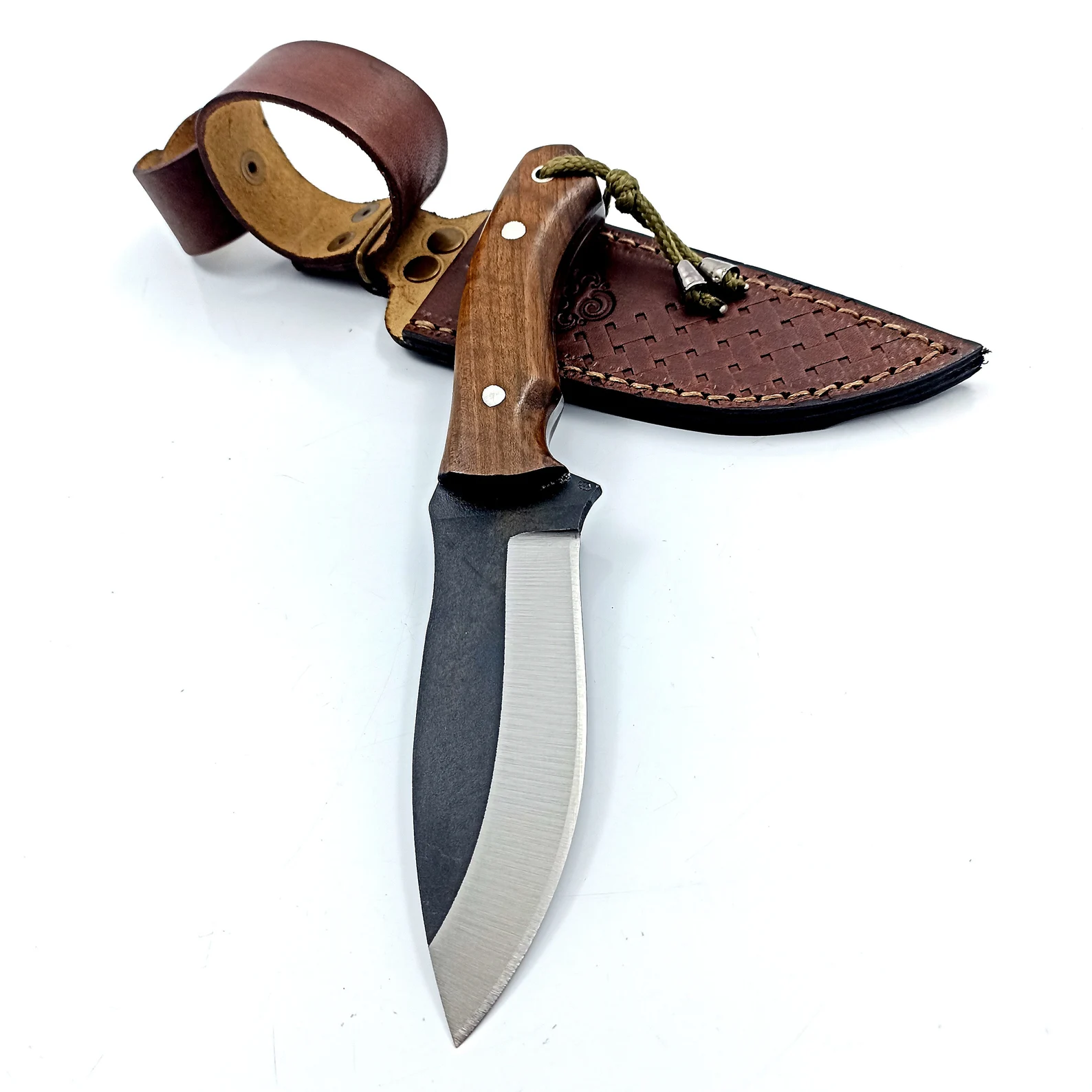
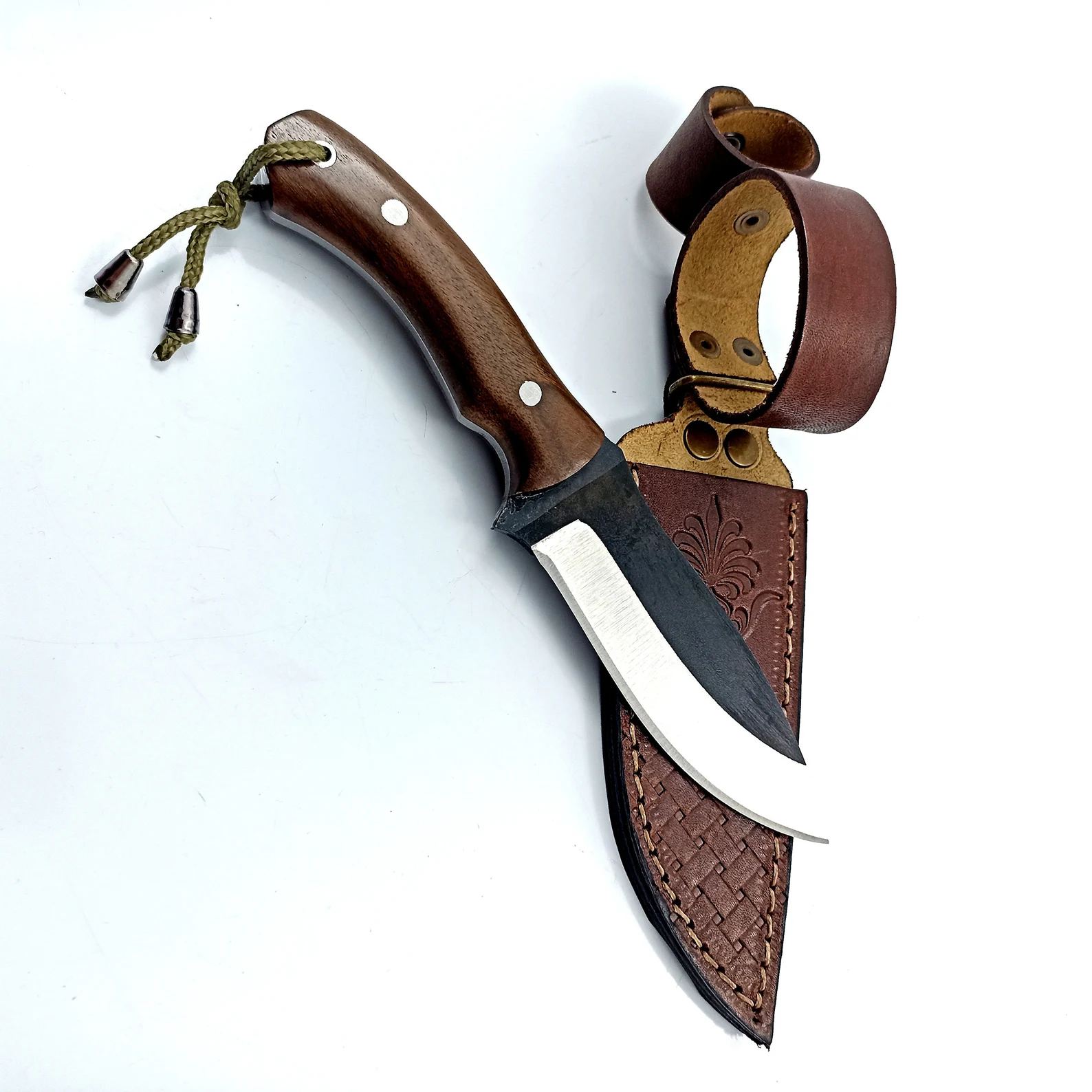
The Wood Handle Hunting Knife brings together a distinctive curved blade, a warm brown handle, and contrasting dark metalwork in a classic outdoor-inspired design. With its sweeping cutting-edge profile, visible handle fittings, and olive-green cord lanyard, this knife offers an attractive combination of traditional styling and contemporary details.
Its most recognizable feature is the contrast between the dark blade surface and the bright silver-colored cutting bevel. The two finishes follow the blade’s curved outline, giving the knife a clean and recognizable appearance. The brown handle adds a natural-looking finish, while the small green lanyard provides a subtle splash of color.
The knife features a fixed-blade configuration rather than a folding mechanism. Its curved handle and blade profile are visually consistent with hunting and outdoor utility knives, although the exact manufacturing specifications and intended cutting applications have not yet been confirmed by the supplier.
For collectors and customers interested in distinctive outdoor cutlery, this knife presents a balanced-looking design with several appealing visual features.
Wood Handle Hunting Knife with Curved Blade Design
The blade is one of the most prominent features of this knife. It has a broad-looking profile near the handle and gradually curves toward a pointed tip.
Unlike knives with completely straight cutting edges, this design features a noticeably sweeping lower edge. The broad curve creates a different silhouette from conventional straight-backed utility knives.
The blade appears to have a dark charcoal or black-coated main surface, with a contrasting silver-colored section following the cutting edge.
This two-tone treatment gives the blade an attractive appearance and makes its curved shape especially noticeable.
The dark portion extends from the area near the handle toward the tip, while the lighter beveled section follows the cutting edge.
The photograph also shows a small projection near the lower end of the handle-to-blade transition.
Although the overall profile resembles a compact hunting or skinner-style knife, the exact intended use, cutting performance, and blade measurements require manufacturer confirmation.
Customers choosing a knife for practical outdoor tasks should always consider its verified material, construction, and edge specifications.
Natural-Looking Brown Wooden Handle
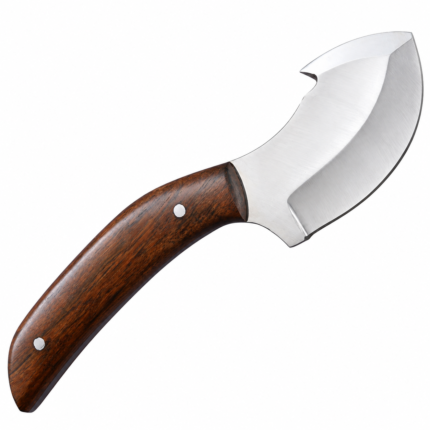
The handle has a warm brown appearance with visible grain patterns running along its length.
Its color varies slightly between lighter and darker brown areas, creating a natural-looking surface that contrasts with the blade.
The shape is gently curved rather than completely straight. A slight inward contour near the blade gives the handle an ergonomic-looking outline, while the rear section curves upward.
This profile contributes to the knife’s recognizable appearance.
Two circular, silver-colored fittings are visible on the handle. These appear consistent with handle pins used in certain fixed-blade knife constructions.
However, the image does not reveal the internal structure or confirm the fittings’ exact function.
The edges of the handle also appear to reveal a narrow metallic section along parts of the knife’s outline.
This may be consistent with an exposed tang, but full-tang construction cannot be confirmed without additional photographs or manufacturer specifications.
The handle has the appearance of natural wood, although the photograph alone cannot distinguish solid wood from stabilized wood or a wood-effect composite.
For an accurate product listing, the exact material should be confirmed before making claims about wood species, durability, or moisture resistance.
Distinctive Black and Silver Blade Finish
The contrast between black and silver is a key part of the knife’s design.
The dark upper blade section has a matte-looking charcoal finish, while the cutting bevel appears brighter and more reflective.
These contrasting finishes create a visual separation across the blade.
The curved silver section follows the lower edge, becoming wider toward the front portion before tapering toward the tip.
This gives the knife a distinctive appearance that differs from the uniform finishes found on many traditional outdoor knives.
The black surface may be a coating, treatment, or other finish, but its composition and protective properties are not visible.
Therefore, it should not be described as corrosion-resistant, scratch-resistant, or a specific coating type without supplier verification.
Similarly, the silver section should be described as a visible cutting bevel rather than proof of a particular sharpening method or edge angle.
These details are useful for customers comparing the appearance of different knife models, but they should not replace verified technical information.
Olive-Green Cord Lanyard with Metallic Tips
Another noticeable feature is the short olive-green cord attached to the rear of the handle.
The cord passes through an opening near the handle’s end and forms a knotted loop with two loose ends.
Each end features a silver-colored metallic cap.
The lanyard introduces an outdoor-inspired element to the knife’s appearance and complements the natural-looking handle.
Its woven texture contrasts with the smooth wood-like surface and metallic blade.
Lanyards are commonly associated with portable tools and outdoor equipment, although the strength and intended function of this particular cord have not been established.
The photograph confirms the presence of the cord and decorative metallic tips.
Customers should not assume that it is designed for supporting the knife’s weight, securing it during demanding activities, or functioning as a safety retention system without manufacturer confirmation.
For product presentation, the lanyard can be highlighted as an included visible design feature, subject to confirmation that the photographed configuration is the version being supplied.
A Traditional Fixed-Blade Appearance
Fixed-blade knives are characterized by blades that remain extended rather than folding into the handle.
This knife visibly follows that general configuration.
The blade and handle create a continuous overall shape, with no folding hinge or opening mechanism shown.
The blade’s dark surface continues close to the front of the handle, where the two components meet.
The curved handle profile complements the sweeping blade and gives the entire knife an organic-looking silhouette.
Its appearance may appeal to people who prefer traditional hunting-style designs rather than modern folding pocket knives.
However, important construction characteristics remain unknown.
The image does not establish the steel composition, tang construction, manufacturing process, heat treatment, blade thickness, or attachment method used for the handle.
These factors are important when evaluating the knife’s suitability for practical applications.
Until they are verified, the product is best described using its visible design rather than untested performance claims.
Designed for Outdoor Knife Enthusiasts
This knife has a visual style associated with outdoor equipment and traditional field knives.
Its curved blade, brown handle, and braided cord make it an interesting option for customers who appreciate outdoor-inspired cutlery.
Different knife designs suit different tasks, and users should select tools according to verified specifications and manufacturer guidance.
A curved cutting-edge profile can be relevant when comparing knives intended for controlled slicing tasks. However, whether this particular model is appropriate for hunting, skinning, camping preparation, or other field activities cannot be determined from appearance alone.
Customers planning regular outdoor use should verify the blade material, edge geometry, handle security, and the availability of a correctly fitting sheath.
They should also consider environmental conditions, maintenance requirements, and safe handling.
The supplied photograph does not show a sheath, storage case, or additional accessories.
These items should not be advertised as included unless confirmed by the supplier.
A Distinctive Addition to a Knife Collection
Beyond its outdoor-inspired design, this knife may appeal to collectors interested in variations in blade shape and handle construction.
The sweeping blade edge is especially noticeable.
The dark blade surface provides a modern-looking contrast to the brown handle, while the bright silver bevel creates a clean visual outline.
The two circular handle fittings add traditional cutlery styling.
The olive-green lanyard provides another detail that distinguishes it from plain fixed-blade knives.
These elements can make the product appealing to customers who enjoy comparing different decorative finishes and knife silhouettes.
A securely displayed collection can showcase variations in blade patterns, handle materials, and design approaches.
For collectors, accurate product photography and reliable specifications are important factors when making a purchasing decision.
Visible Product Features
The photograph reveals several distinctive design details.
Curved fixed blade: The knife features a broad-looking blade that narrows toward a pointed end, with a smoothly curved cutting-edge profile.
Two-tone blade finish: The main blade surface appears charcoal-black, while the edge bevel has a bright silver-colored finish.
Brown wood-grain handle: The handle shows natural-looking grain patterns and subtle variations in brown coloring.
Curved handle shape: The handle follows a gently contoured profile with a noticeable inward curve near the blade.
Circular handle fittings: Two silver-colored circular details are visible along the handle.
Lanyard opening: An opening near the rear end accommodates the attached cord.
Olive-green woven cord: The knotted lanyard has two short ends with metallic-looking caps.
No visible folding mechanism: The knife appears to have a fixed-blade configuration.
These observations describe what can reasonably be identified from the supplied product image.
They do not confirm the knife’s steel grade, dimensions, mechanical strength, or manufacturing method.
An Attractive Combination of Natural and Industrial Styling
One reason this knife stands out is its combination of contrasting visual elements.
The brown handle introduces a natural, traditional appearance.
The dark blade creates a stronger, more contemporary look.
The silver-colored cutting bevel acts as a visual highlight between these elements.
Together, the dark blade and brown handle produce an understated color combination associated with outdoor-style cutlery.
The olive-green cord contributes a small additional accent without overpowering the overall design.
This combination may appeal to customers who prefer products with functional-looking details and relatively simple decoration.
Unlike knives featuring elaborate engravings or brightly colored blade designs, this model relies primarily on its shape, surface finishes, and handle grain.
For a retail display or online catalog, those characteristics can be communicated through clear product photographs showing the entire knife and close-up views of the handle.
What to Consider Before Purchasing
Choosing a knife involves more than selecting a particular appearance.
The size, weight, construction, and intended use all influence whether a product is appropriate for an individual customer.
For this model, the photograph does not provide a scale reference, so its actual dimensions remain unknown.
The blade may appear relatively compact, but its length cannot be confirmed from the image.
Likewise, the exact handle size and overall weight have not been established.
Customers should obtain confirmed measurements before deciding whether the product suits their storage arrangements or preferred handling requirements.
The blade steel is another important consideration.
Different steels can vary in hardness, corrosion resistance, edge retention, and maintenance needs.
None of these performance properties can be established simply by looking at the dark blade finish.
The manufacturer’s specification sheet should therefore be used to confirm any technical characteristics.
General Cleaning and Maintenance
Proper care helps preserve the appearance of a knife and its decorative features.
The following recommendations are general knife-maintenance guidelines. Any manufacturer-specific instructions should take priority.
Clean Carefully After Appropriate Use
Use a soft cloth to remove visible dirt and debris.
If suitable for the confirmed blade and handle materials, mild soap and water may be used.
Avoid harsh cleaning chemicals or abrasive scouring pads that could damage the blade finish.
Dry the Blade and Handle
After cleaning, dry the knife thoroughly with a soft cloth.
Take particular care around the area where the handle meets the blade.
Moisture can collect around fittings and between joined components.
Protect the Dark Finish
Avoid aggressive polishing compounds unless the manufacturer confirms that they are suitable.
Certain treatments and coatings can be affected by abrasive cleaners.
The precise finish shown in the image is unknown, so conservative cleaning is recommended.
Care for the Wooden-Looking Handle
Do not leave the handle submerged in water.
Prolonged exposure to moisture may affect some natural woods, stabilized materials, and composite handle constructions.
Any oil or conditioning treatment should be selected according to the manufacturer’s confirmed material specification.
Check the Cord Lanyard
Inspect the lanyard for visible fraying or loose knots.
Keep it clean and dry during storage.
Do not rely on the cord as a load-bearing or safety attachment unless the manufacturer expressly confirms that function.
Store the Knife Securely
Store the knife in a protective cover, suitable sheath, or secure storage location.
Avoid leaving the blade exposed among other tools or personal belongings.
Keep it away from children and unauthorized users.
Important Specifications Requiring Verification
The following details cannot be established from the supplied photograph:
- Exact blade material and steel grade
- Blade length and overall knife length
- Blade thickness and weight
- Hardness rating
- Tang construction
- Exact handle wood or composite material
- Blade coating composition
- Edge angle and factory sharpness
- Corrosion resistance
- Country of manufacture
- Included sheath or storage packaging
- Manufacturer warranty
- Available customization options
These specifications should be confirmed with the supplier before being added to the online store.
Claims such as handmade construction, full-tang strength, high-carbon steel, stainless steel, or professional hunting performance should not be published without reliable supporting information.
Why Choose This Wood Handle Hunting Knife?
This knife is visually distinctive because of its combination of curved metalwork, wood-grain styling, and simple outdoor-inspired accessories.
The dark blade creates a strong contrast with the silver-colored cutting bevel.
The handle’s warm brown coloring softens the overall appearance and complements the blade profile.
The green lanyard adds a finishing detail that gives the knife recognizable character.
For collectors, these features provide an interesting design to examine and compare with other fixed-blade models.
For customers interested in outdoor-style knives, its appearance may make it worth considering once the specifications are available.
The knife’s suitability for any particular cutting application depends on its actual construction and manufacturer recommendations.
Explore This Distinctive Outdoor Knife Design
The Wood Handle Hunting Knife with Black Blade and Lanyard brings together a sweeping two-tone blade, brown wood-grain handle, and olive-green cord in a clean fixed-blade design.
Its contrasting finishes and recognizable profile make it an attractive option for enthusiasts who appreciate traditional outdoor knife styling.
Explore this distinctive knife for your collection, and review the confirmed dimensions, materials, and construction details before making your purchase.






Reviews
There are no reviews yet.