


A distinctive starting point for a custom handle project
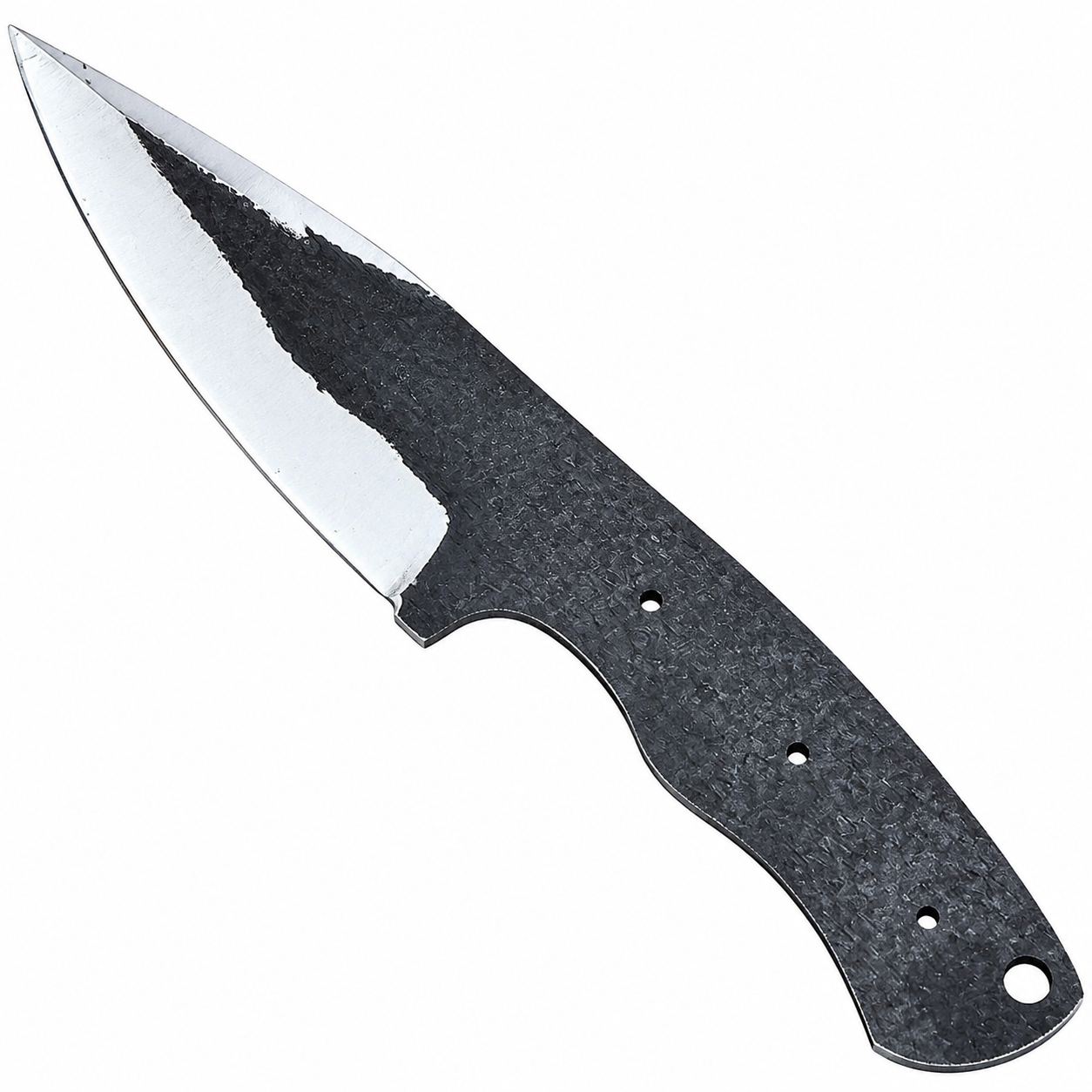
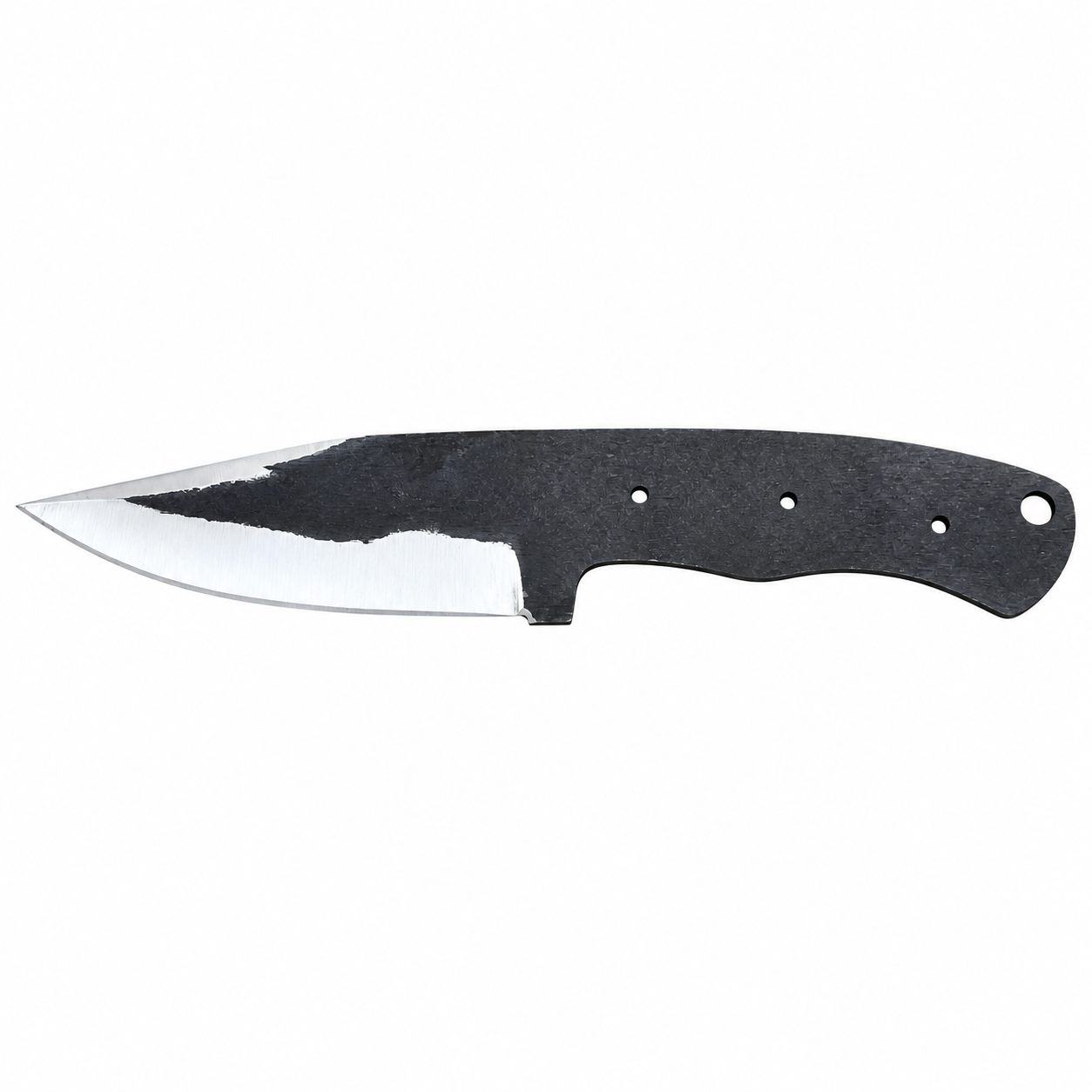
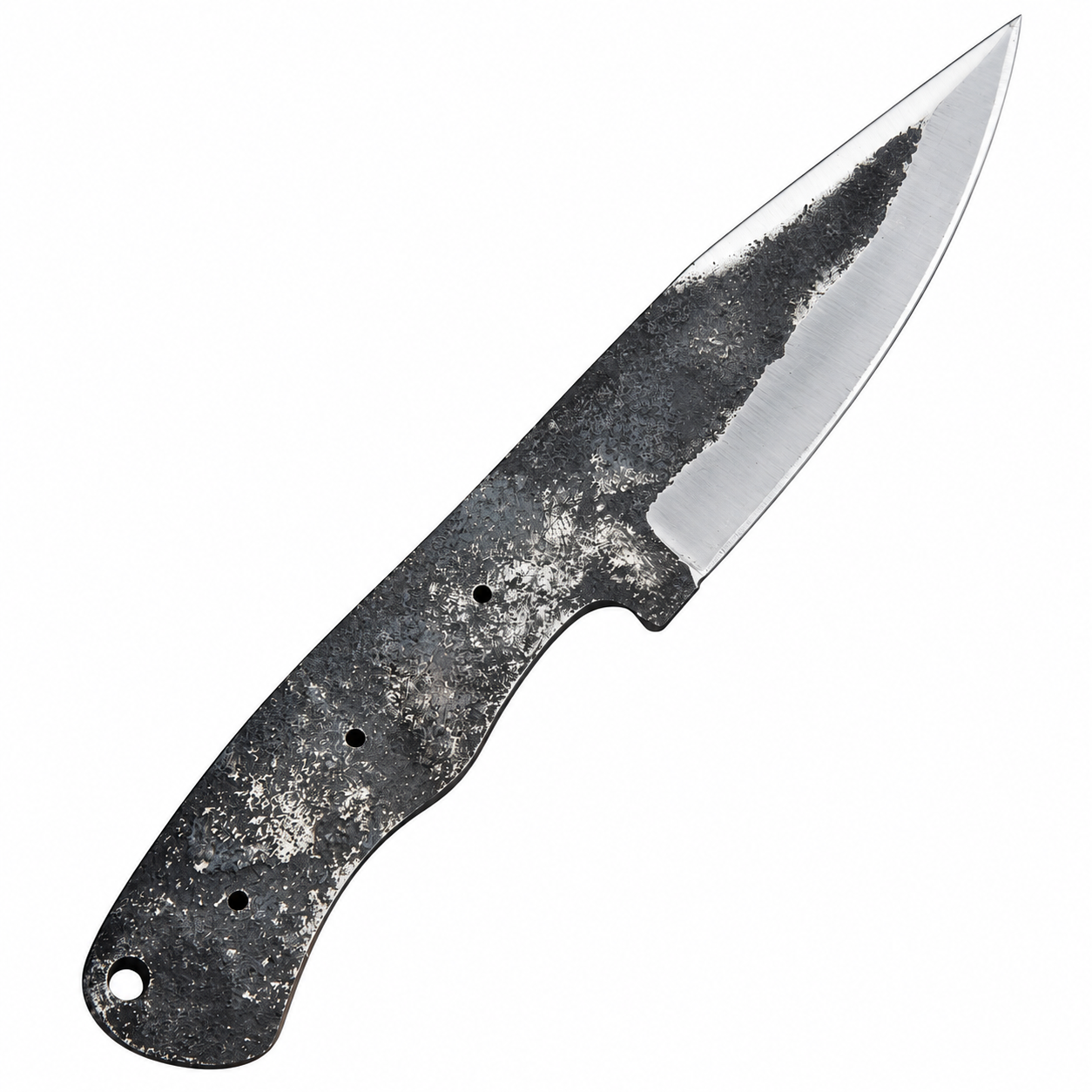
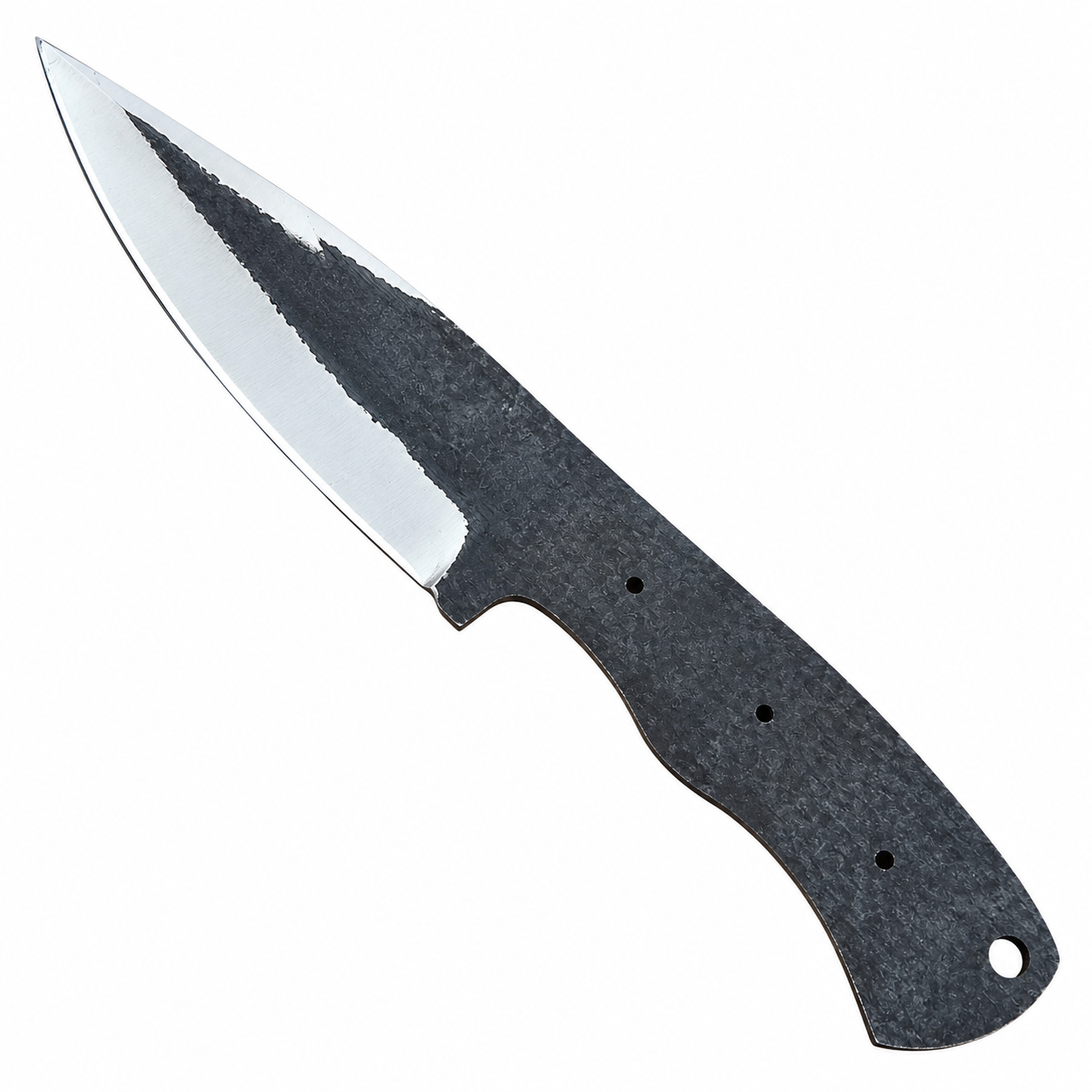
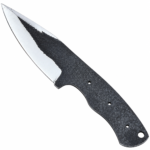
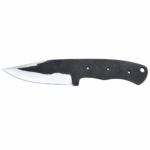
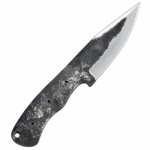
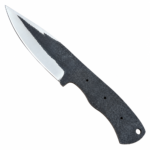
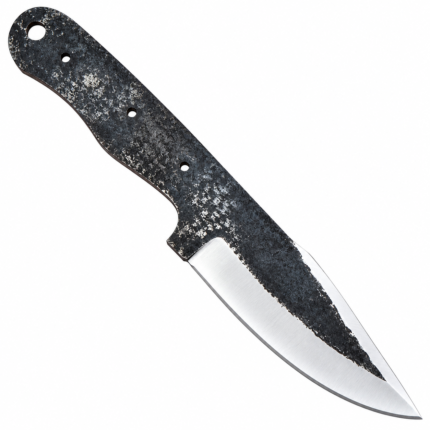
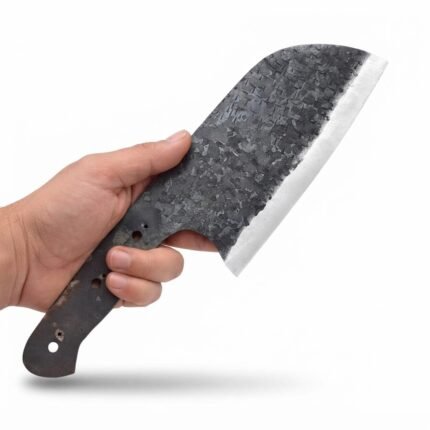
This textured full tang knife blank combines a dark, irregular surface with bright silver-colored bevels and a clean, pointed blade profile. Supplied in the form shown, it has an exposed handle section without fitted scales, leaving the handle’s appearance and final shape open to your project. The contrast between the dark blade face and lighter ground areas gives the blank a rustic appearance while keeping its outline clearly defined.
The photograph shows a continuous blade-and-tang profile, a curved lower edge, and a contoured handle section. Three small circular holes run along the tang, with a larger circular opening near the rear. A pronounced inward curve separates the underside of the handle from the blade, and the rear of the tang broadens into a rounded end.
For someone choosing a blank on appearance, these details offer a clear starting point: a dark blade face, visible surface texture, bright bevels, and a handle outline with existing contours. The finished handle can become a central part of the design rather than an already settled feature.
This is a knife-making component rather than a complete knife with an installed handle. Its suitability for a particular project depends on specifications that the photograph cannot establish, including dimensions, steel grade, thickness, and heat-treatment status.
Dark texture and bright bevels
The most noticeable feature is the contrast across the blade. Much of its visible face is charcoal-black, with small irregular marks and variations that continue onto the bare tang. The lower bevel is substantially brighter, showing fine linear marks in the photographed surface.
The boundary between these areas is uneven rather than a perfectly straight decorative line. It follows the blade toward the point, creating a tapered dark section between the bright lower bevel and a narrower bright area along the upper portion near the tip. Together, these surfaces give the blade a strong visual identity without colored accents or visible branding.
The texture supports describing the blank as rustic-looking, but it does not establish how the surface was produced. The image alone cannot distinguish a forged surface from another manufacturing or finishing process. Likewise, the black appearance does not confirm a protective coating, chemical treatment, or corrosion-resistant finish.
For buyers who appreciate contrast, the appeal is straightforward: the blade brings together a dark textured face and lighter ground surfaces. That combination can remain the visual focus of a completed handle project.
A pointed blade with a continuous curved edge
The blade narrows toward a clearly defined point. Its lower edge follows a continuous curve from the rear blade area toward the tip, without visible serrations or a gut hook. The blade is broader near its base and becomes progressively narrower toward the front.
A narrow bright strip is also visible along part of the upper blade near the point. This contributes to the appearance of the profile, but the photograph does not establish whether that area is sharpened. It should not be treated as evidence of a second cutting edge.
The broad lower bevel is easy to distinguish from the darker blade face. However, its exact grind geometry, edge angle, and thickness behind the edge cannot be measured from this view. Those details matter when assessing a blank for a particular finished application.
The outline has the visual character associated with many outdoor-style fixed blades. Its actual suitability for outdoor cutting, workshop tasks, or other uses still depends on the material, treatment, dimensions, and finished assembly. The shape provides a design direction; it does not, by itself, confirm performance.
An exposed full tang
The handle portion is visibly continuous with the blade profile and extends to the rear of the blank. No handle scales cover it in the photograph, so the shape of the tang is available to inspect directly.
This exposed layout is useful when considering the appearance of a future handle. You can see the front recess, the broad middle section, the inward sweep underneath, and the widened rear. Those features will influence how fitted scales sit against the blank and how much of the metal outline remains visible.
The top of the tang follows a comparatively gentle line, while the underside has more pronounced shaping. This gives the handle section an asymmetric outline, with a clearer transition near the front and a broad termination at the rear.
Full tang describes the visible construction layout. It does not establish the blank’s strength, balance, or resistance to demanding use. Those characteristics depend on more than the outline, including the metal itself, its treatment, and the quality of the completed handle.
Four visible holes in the handle section
The tang contains three smaller circular holes and one larger circular hole near the rear. Their positions are visible in the supplied image, which helps distinguish this blank from designs with two holes, elongated slots, or a solid handle section.
For a handle project, the existing hole arrangement is an important compatibility detail. Hardware must correspond to the actual hole diameters, spacing, and available clearance. These measurements are not provided by the photograph, and the image should not be used as a scale drawing.
The larger rear opening may be relevant to a lanyard arrangement, depending on the final handle design and the supplier’s intended configuration. Its presence does not confirm that a lanyard, tube, or other fitting is included.
No pins, screws, bolts, or handle hardware are pictured. Before selecting separate components, obtain the measured hole dimensions and confirm what comes with the blank. That avoids choosing parts based only on how large the openings appear on a screen.
A contoured handle outline
The tang has an obvious front recess beneath the transition from blade to handle. Behind it, the lower edge curves through the handle section before reaching the broader rear end. These contours give the blank a more defined silhouette than a simple straight strip.
From a design perspective, that outline can help establish the direction of a custom handle. A maker can consider whether to follow the visible perimeter closely or develop the outer handle shape through the thickness and rounding of the scales.
The photograph does not provide enough information to promise a comfortable fit for a particular hand. Handle length, finished thickness, edge rounding, and the chosen scale material all influence how the completed piece feels.
Buyers comparing blanks should therefore consider the outline alongside measured dimensions. A shape that looks suitable in a close-up photograph may feel different once its actual size is understood. The front recess and widened rear are visible features; ergonomic performance remains something to assess in the completed design.
Room for a personal finish
One of the reasons to choose a blank is the opportunity to decide how the handle should look. Here, the dark blade face and bright bevels provide a restrained palette around which to plan that choice.
As design possibilities, a brown wood-look handle could emphasize the rustic appearance, while darker scales could create a more uniform overall look. A lighter handle could make the black tang and blade face more prominent. These are aesthetic ideas, not supplied variations or confirmed material options for this product.
Hardware color can also affect the finished appearance. A contrasting fitting may draw attention to the three smaller hole positions, while a less contrasting choice may keep the emphasis on the blade. Actual hardware selection must follow the blank’s measurements and the intended assembly.
The blank gives you a visible starting shape, but it is not evidence of a supplier customization service. Available handle materials, engraving, alternate finishes, or made-to-order changes need separate confirmation.
Understanding the supplied stage
A knife blank can be offered at different stages of completion. Some require significant additional work; others have already undergone treatment, grinding, or sharpening. The photograph shows formed bevels and an exposed tang, but it cannot establish the complete production stage of this item.
The bright areas demonstrate that parts of the blade have a different surface finish from the dark face. They do not prove that the blank is ready for immediate handle fitting or that no further work is required.
Before choosing it for a project, establish whether heat treatment has been completed, whether the edge is sharpened, and whether additional finishing is expected. These answers help determine whether the blank suits the equipment and experience available to you.
This distinction is particularly useful for buyers who want to focus primarily on handle design. A visually finished blade may still have requirements that are not apparent in a product photograph. Knowing the supplied stage makes the purchase easier to assess and the project easier to plan.
For makers who value visible character
The blank’s main visual appeal lies in its textured dark surface and contrasting bright bevels. It may interest hobby knife makers and custom handle makers who want those features to remain part of a finished piece.
The bare tang makes it possible to examine the handle outline before choosing scales. The hole arrangement is also visible, allowing buyers to identify the information they need for compatible fittings rather than relying on a completed handle that conceals the underlying layout.
Someone planning a display-oriented project may be particularly interested in the balance of colors and surfaces. Someone planning a functional finished knife will also need material and treatment information. Those are different purchasing priorities, and the blank should be assessed against the one that matters to your project.
It should not be assumed to suit every experience level. Whether it is appropriate for a first handle project depends on how much work remains, what components are needed, and whether the supplier provides adequate specifications.
Measurements that help you choose confidently
The supplied image has no ruler or other reliable size reference. Overall length, blade length, handle length, and thickness therefore remain unverified.
These measurements help answer practical questions. Overall length affects the scale of the finished piece. The usable handle length helps establish whether the proposed handle design has enough room. Tang width and thickness influence the choice of scales and fittings.
Hole spacing is equally important. Three small holes may look evenly arranged, but compatibility should be based on actual center-to-center measurements. The diameter of the larger rear opening also matters if it will form part of the final design.
For buyers with a particular size in mind, a dimensioned drawing or photographs beside a ruler would be more useful than an enlarged product image. The close-up view is valuable for inspecting appearance, but it should not be used to estimate measurements or assume that the blank belongs to a particular size category.
Material information matters
The visible surface is metallic, but the photograph does not identify its composition. A dark finish and bright bevels cannot confirm carbon steel, stainless steel, tool steel, or a specific alloy designation.
This is important because similar-looking blanks may use different materials and manufacturing processes. A supplier’s description of a visually related product cannot establish the specifications of the blank shown here.
For a functional project, request the exact steel grade and the supplier’s heat-treatment information. If hardness is stated, it should relate to this particular product rather than to a general range of items from the same business.
Material information also helps determine appropriate maintenance and any further work required. Until it is available, claims such as rust-resistant, high hardness, superior edge retention, or easy sharpening would be unsupported. The confirmed selling points are the visible design, contrasting surfaces, bare full tang, and hole arrangement.
Planning the complete project
The photograph presents the blank by itself. There are no fitted scales, loose handle parts, sheath, storage case, or accessories shown around it.
That makes it important to distinguish the blade component from the complete project. If separate scales and fittings are needed, their compatibility should be checked before ordering. If a sheath is wanted for the completed piece, its suitability will depend on the final dimensions and handle configuration.
The photo alone does not establish package contents. A seller may offer a blank individually or as part of a wider kit, but no kit is confirmed here. An itemized contents list is the clearest way to understand what the purchase provides.
For someone comparing several options, this can make a meaningful difference. A lower-priced blank may require additional components or finishing work, while another offer may include more of what the project needs. Comparing equivalent packages is more useful than comparing the initial price alone.
Looking closely at the finish
The dark face is not visually uniform. Small marks and tonal changes are visible across both the blade and tang, while the brighter bevel areas show a more directional surface pattern.
These details are part of the appearance shown in the photograph. They should not be interpreted as proof of age, handmade production, a particular forging method, or a specific protective treatment.
If the texture is the main reason for choosing this design, additional photographs can help establish how it looks across the other side and along the spine. The uploaded image provides one clear face view, but it does not show every surface.
It is also useful to confirm whether the pictured blank represents the exact item supplied or a sample of a product line. The image does not establish how closely separate units will match in texture, bevel boundaries, or tone. For appearance-sensitive projects, current photographs of the available item can help resolve those details.
Care information for the actual material
No verified care instructions accompany the image. The correct approach depends on the metal, the dark surface treatment, and the materials eventually used for the handle.
A black appearance should not be taken as evidence that the blank is protected against corrosion. Equally, a bright bevel should not be used to identify it as stainless steel. Both areas need to be understood in the context of the actual material specification.
Ask for the supplier’s recommendations on cleaning, storage, and any protective product suitable for the finish. Once a handle is fitted, its material may introduce additional care requirements.
If preserving the dark texture is a priority, confirm which finishing and cleaning methods are compatible with it before making changes. The photograph shows the desired appearance, but it cannot establish how that appearance will respond to abrasives, chemicals, moisture, or other treatment.
Comparing this blank with other designs
When looking at alternatives, compare the entire outline rather than the dark color alone. The curved edge, pointed front, bright upper area near the tip, front tang recess, and widened rear all contribute to this blank’s identity.
The four-hole arrangement is another useful comparison point. A similar blade with a different hole pattern may require different fittings or a revised handle design. Likewise, a narrower tang or a different rear shape can change the overall appearance of the finished piece.
Compare confirmed dimensions and material information alongside those visual details. Two blanks can look closely related in photographs while differing significantly in thickness, size, or supplied stage.
This approach keeps the decision tied to the project you want to complete. The right choice is the one whose appearance, measurements, material, and remaining work fit together—not simply the one with the most similar thumbnail or the lowest advertised starting price.
Key visible details
- Exposed full-tang knife blank without fitted handle scales.
- Dark charcoal-black texture across the blade face and tang.
- Bright silver-colored lower bevel.
- Narrower bright area along the upper blade near the point.
- Continuous curved lower edge without visible serrations.
- Contoured tang with a pronounced front recess.
- Three smaller circular tang holes.
- One larger circular opening near the rear.
- Broad, rounded rear tang profile.
- No visible branding or supplied accessories in the photograph.
Choose a blank around your finished design
This textured full tang knife blank offers a distinctive combination of dark surface character, bright bevels, and a clearly defined handle outline. Its exposed construction makes the contours and hole arrangement easy to inspect, while the absence of fitted scales leaves room for a personal handle design.
Review the measurements, material specification, supplied stage, and package contents before choosing the components for your project. If the visible profile and contrasting finish suit the piece you have in mind, explore this blank as the starting point for your next custom handle project.








Reviews
There are no reviews yet.