


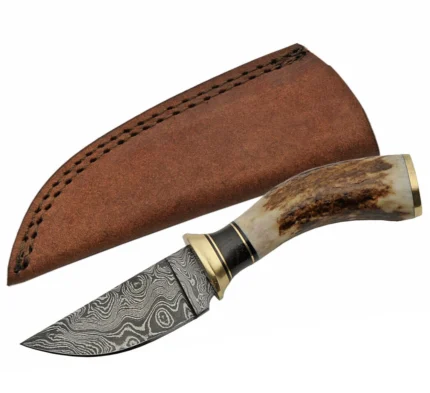
Damascus Pattern Hunting Knife with Black Grooved Handle and Brown Sheath
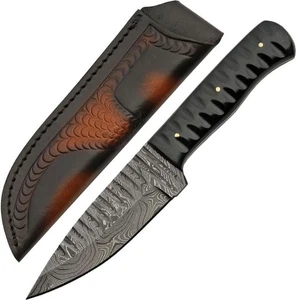
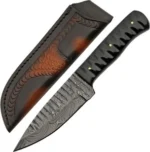
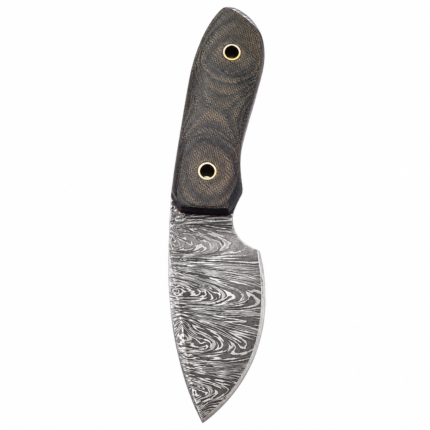
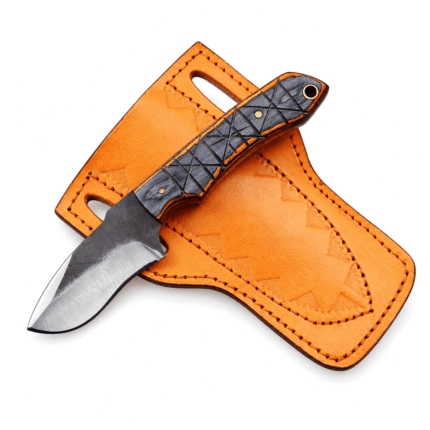
The Damascus Pattern Hunting Knife is a distinctive fixed-blade knife featuring a flowing patterned blade, a black contoured handle with pronounced diagonal grip grooves, and a matching brown-and-black decorative sheath. Combining traditional hunting knife styling with contemporary handle detailing, this knife offers an attractive appearance for outdoor enthusiasts, knife collectors, and buyers who appreciate carefully styled fixed-blade designs.
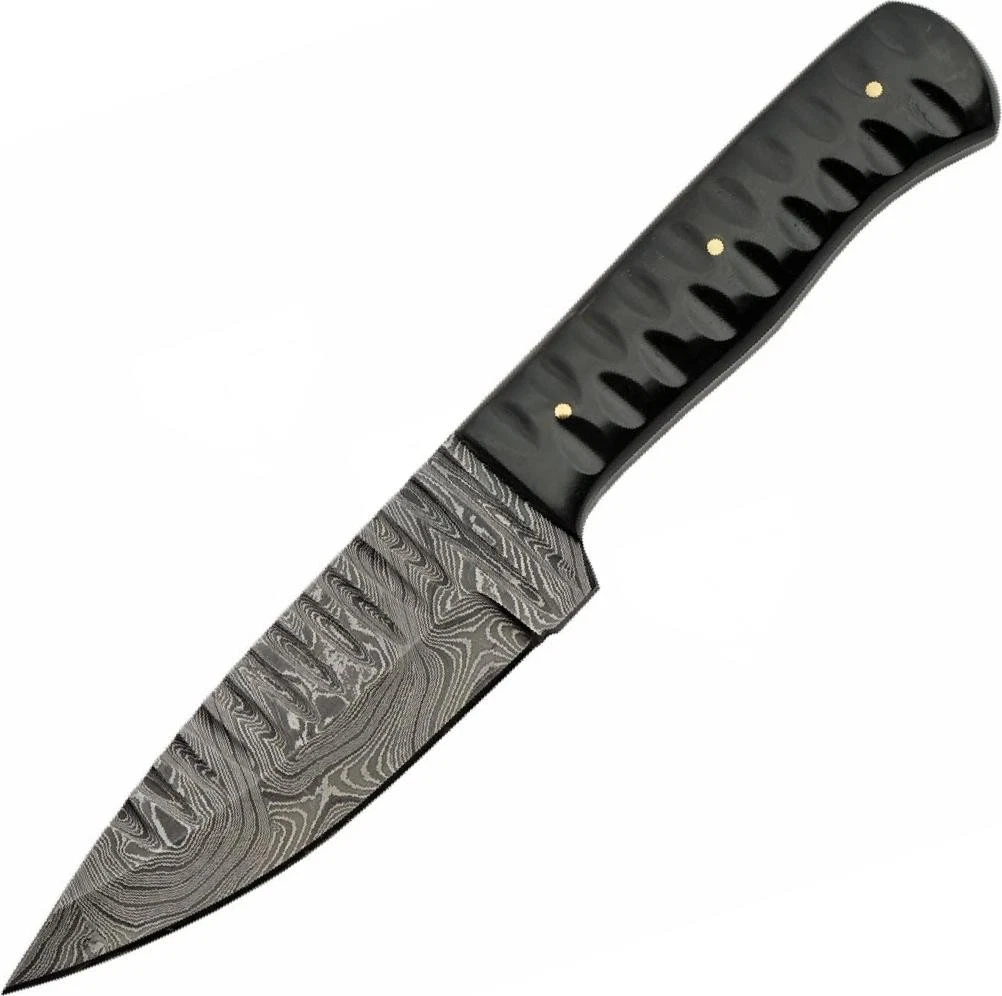
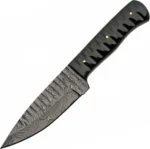
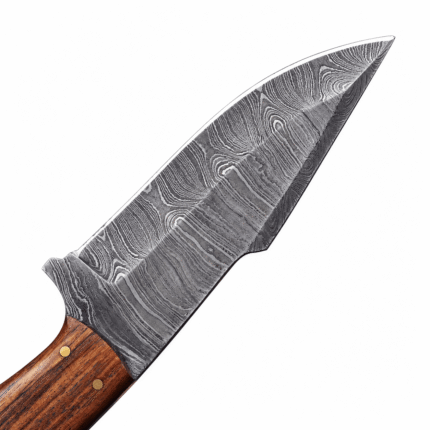
The blade displays intricate silver-and-gray patterns reminiscent of Damascus steel. These flowing lines give the surface an eye-catching appearance, while the gently curved cutting edge and pointed blade tip provide the familiar silhouette associated with general-purpose hunting knives.
Its black handle has a series of deep diagonal grooves that create a textured, sculpted appearance. Small gold-colored pins add subtle contrast to the dark handle, complementing the silver tones of the blade.
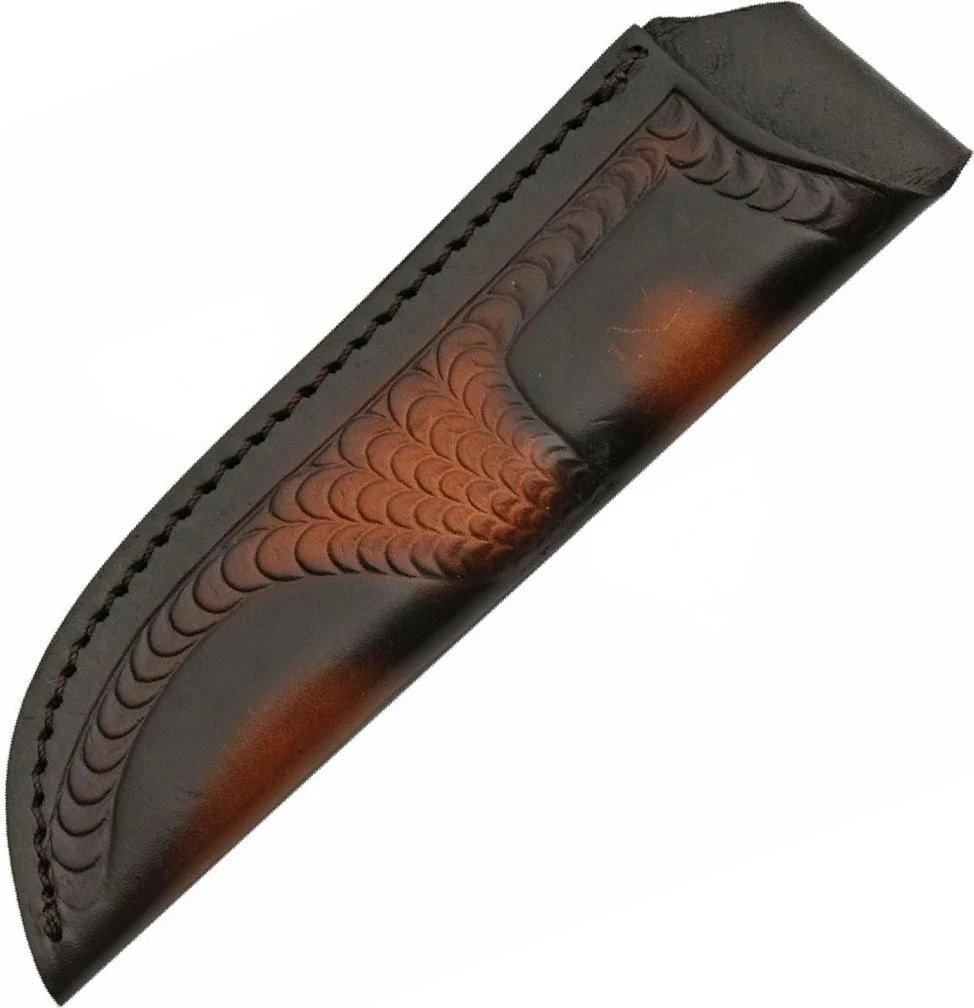
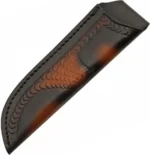
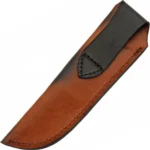
Alongside the knife is a fitted sheath with warm brown and darker shaded areas, ornamental tooling, and visible stitching. This combination creates an appealing presentation that distinguishes the knife from simpler fixed-blade designs.
The overall styling makes it a noteworthy option for customers exploring traditional hunting knives, patterned blades, and collectible outdoor cutlery.
Classic Fixed Blade Hunting Knife Design
A fixed-blade hunting knife is recognized by its permanently extended blade and separate handle. Unlike a folding knife, it does not contain a visible opening or closing mechanism.
This model follows that recognizable design.
Its blade has a broad base that gradually tapers toward a pointed tip. The cutting edge curves smoothly, giving the knife a traditional hunting-style profile.
The upper blade surface features a distinctive pattern that extends from the handle area toward the point.
The handle is relatively straight with a rounded end and several diagonal grooves. This produces a noticeable contrast between the smooth curved blade profile and the heavily textured grip.
The knife is shown beside a decorative sheath designed to accommodate a fixed blade.
Together, these visible elements establish its identity as a hunting-style fixed-blade knife.
For buyers comparing knife designs, the combination of a pointed blade, sculpted black handle, and brown sheath offers a distinctive alternative to plain stainless-colored knives.
Damascus-Style Patterned Blade
One of the most prominent features of this hunting knife is its patterned blade.
Across the visible metallic surface, flowing lines create an intricate gray-and-silver design.
Some areas feature tightly grouped waves, while others display broader curved patterns.
The pattern extends across a substantial portion of the blade, creating a detailed decorative appearance.
Damascus-style patterns are popular among knife enthusiasts because they introduce visual complexity that ordinary polished blades do not display.
The different shades of gray provide contrast without requiring bright colors or additional ornamental fittings.
The blade maintains a traditional metallic appearance while displaying a more decorative finish.
It is important to distinguish between a Damascus-style appearance and verified Damascus steel construction.
Modern patterned blades may be manufactured using different materials and processes.
Some contain pattern-welded layers, while others have patterns created through surface treatments.
The photograph alone cannot identify the manufacturing process.
Therefore, this product is described as having a Damascus-pattern blade.
The actual steel grade, layer composition, forging method, and heat treatment should be confirmed with the supplier before they are included as technical specifications.
Distinctive Pointed Blade Profile
The blade has a moderately broad profile near the handle and narrows toward its pointed tip.
Its lower edge follows a gentle curve.
This produces a familiar hunting knife silhouette that is often associated with general-purpose outdoor cutlery.
The knife does not have an extremely wide cleaver-style blade or a strongly hooked cutting profile.
Instead, the blade combines a pointed front section with a gradually curved edge.
The visible geometry makes it appropriate to categorize the product as a hunting-style knife rather than a kitchen cleaver or specialty carving knife.
The photograph does not provide a scale reference.
Consequently, the exact blade length and overall dimensions cannot be established.
Buyers comparing different knife sizes should review verified measurements before purchasing.
Blade length, thickness, width, weight, and material can all affect the feel and application of a knife.
Those specifications should be obtained from the manufacturer rather than estimated from photographs.
Silver and Gray Blade Appearance
The blade features a predominantly gray metallic finish with lighter silver-colored pattern lines.
This creates a layered visual effect.
The lines flow in different directions and appear to follow the blade’s natural contours.
Near the blade’s base, several patterns become more concentrated.
Toward the tip, the silver-and-gray design remains clearly visible.
The result is a detailed finish that gives the knife a distinctive appearance.
The metallic color also creates contrast with the black handle.
This combination is well suited to customers who prefer traditional knife styling with darker, understated colors.
Unlike brightly coated knives, the visual appeal of this design comes primarily from its flowing pattern and the relationship between the dark handle and metallic blade.
The visible surface appears clean, but the photograph cannot establish corrosion resistance, cutting performance, or the exact surface treatment.
These properties depend on the actual blade material and manufacturing specifications.
Black Contoured Handle
The black handle is another defining feature of this knife.
It has an elongated shape with a rounded rear section and several pronounced diagonal grooves.
The grooves create a sculpted appearance along much of the handle.
The black finish contrasts with the patterned blade and gives the knife a coordinated design.
Small gold-colored pins are visible on the handle.
These details introduce subtle decorative highlights.
The material itself cannot be identified with certainty.
Black synthetic composites, stabilized wood, and other handle materials can have similar appearances in product images.
For this reason, the listing does not identify the handle as Micarta, G10, rubber, or another specific substance without verification.
Customers interested in the handle material should consult the manufacturer’s technical specifications.
The visible handle design is best described as a black contoured grip with diagonal grooves and decorative pin details.
Diagonal Grip Grooves
The diagonal grooves are the handle’s most noticeable design detail.
They run across its visible surface in a repeated pattern.
Each groove creates a defined separation between raised sections.
This produces an appearance that is more textured than a conventional smooth handle.
The grooves also give the knife a distinctive profile when viewed from the side.
Handle texture is an important consideration for many knife buyers.
Different groove shapes, depths, and materials can influence how a handle feels during use.
However, a photograph cannot establish grip security under wet conditions or provide reliable ergonomic performance measurements.
The image supports describing the handle as deeply grooved and contoured.
Claims that it is slip-resistant, fatigue-reducing, or ergonomically tested require additional manufacturer evidence.
For customers selecting knives based on handle appearance, the diagonal pattern is a clear distinguishing feature.
Gold-Colored Handle Pins
The handle includes small round gold-colored pins.
These details stand out against the dark surface.
They provide a subtle decorative contrast without making the handle excessively ornate.
The visible pins appear to be positioned along the handle’s side.
Their appearance is consistent with hardware commonly used on knife handles.
However, the photograph does not establish the precise material or internal attachment method.
The pins should not be described as solid brass unless confirmed.
Similarly, the presence of visible pins does not independently prove full-tang construction.
The internal blade-to-handle configuration remains unknown.
For accurate product information, the pins can be described as gold-colored decorative or fastening details.
The manufacturer’s specifications should determine whether they are brass, steel, or another material.
Blade and Handle Transition
The transition between the blade and handle is visually defined.
The patterned metal blade meets the black handle at a relatively compact junction.
The blade appears to include a small shoulder near the handle.
This gives the knife a clean and recognizable fixed-blade profile.
Unlike some larger Bowie knives, the pictured design does not feature a pronounced decorative crossguard extending far above and below the handle.
Its overall appearance is more compact and straightforward.
The absence of a large guard contributes to a simpler hunting knife silhouette.
The photograph does not show the knife’s internal construction.
It therefore cannot establish whether the blade continues through the entire handle.
Buyers interested in a particular tang configuration should request confirmation from the manufacturer.
This information is especially important when comparing knives intended for different levels of use.
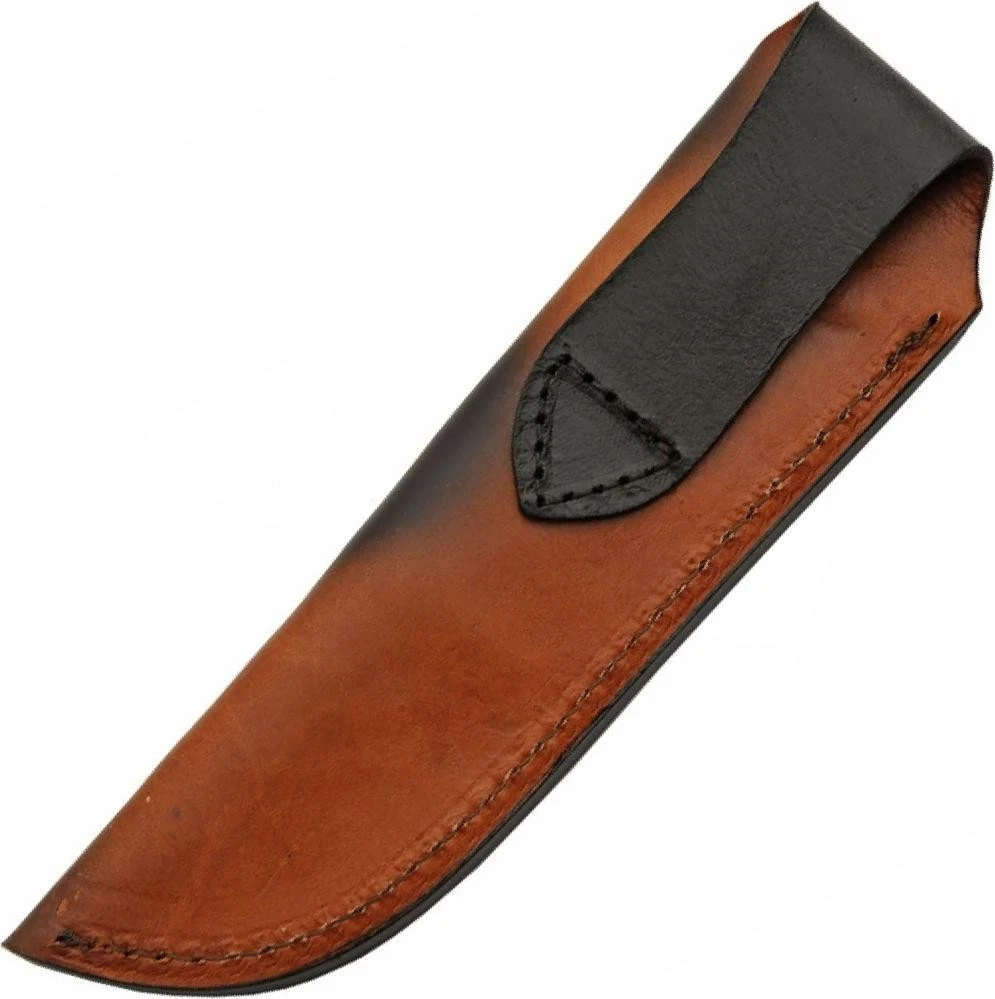
Traditional Brown and Black Sheath
A decorative sheath is shown beside the knife.
Its outer surface combines warm brown coloring with darker shaded sections.
The contrasting shades create a distinctive appearance.
The sheath has a long, tapered silhouette that follows the general proportions of the blade.
Visible stitching runs along its outside edge.
The surface also displays decorative patterns resembling overlapping scales or traditional leather tooling.
These ornamental details make the sheath visually distinctive.
The sheath appears to be a leather-style product, but the exact material cannot be confirmed from the image.
It may be natural leather, synthetic leather, or another material with a leather-like finish.
The appropriate product description is therefore a brown-and-black decorative sheath with stitched edges.
Claims about genuine leather, waterproofing, thickness, and durability should be supported by supplier information.
Decorative Sheath Pattern
The sheath displays a repeating ornamental pattern across much of its front surface.
The pattern resembles layered semicircular or scale-like shapes.
This creates a traditional decorative appearance.
The lighter brown sections contrast against the dark border and shaded areas.
The result is a sheath that appears carefully styled rather than completely plain.
Its decorative pattern complements the patterned blade.
Although the two patterns are different, both introduce visual texture.
The sheath’s warm colors also balance the knife’s black handle and gray metallic blade.
For customers who appreciate detailed outdoor accessories, this coordinating appearance can be an important feature.
The pattern’s exact manufacturing method is unknown.
It may be embossed, tooled, stamped, or otherwise applied.
The listing should describe the visible ornamentation without claiming a specific technique.
Stitched Sheath Edges
The sheath has a stitched outer border.
The stitching follows its tapered shape.
This creates a defined outline around the edge.
The thread appears darker against some of the brown sections.
On the darker parts, the border remains visible through its raised construction.
Stitching is a common design element on knife sheaths.
It contributes to the appearance and structure of many traditional sheath styles.
However, the photograph does not reveal the thread material or stitching method.
It also cannot establish the sheath’s resistance to wear or environmental exposure.
Customers should inspect the stitching and sheath fit when receiving the product.
A well-fitting sheath should cover the blade appropriately and should not expose the cutting edge during normal storage.
Its actual fit and security require physical verification.
Coordinated Knife and Sheath Presentation
The knife and sheath create a coordinated product presentation.
The blade provides detailed silver-and-gray patterns.
The handle features a dark black finish.
Small gold-colored pins add subtle accents.
The sheath introduces warm brown tones and darker decorative shading.
Together, these elements produce an attractive contrast.
The knife does not rely on a large number of additional accessories.
Instead, its visual character comes from the blade pattern, shaped handle, and decorative sheath.
This combination may appeal to knife enthusiasts who prefer darker handles and traditional blade designs.
It also offers customers an alternative to knives with brightly colored grips or completely plain blades.
The image shows one knife and one sheath.
No additional packaging, sharpening tools, or accessories are visible.
Hunting Knife Styling and Outdoor Interest
This product belongs naturally within a hunting knife collection because of its fixed-blade construction and pointed blade profile.
Traditional hunting knives are available in many shapes and configurations.
Some have narrow blades, while others feature broad cutting sections.
Handle materials and sheath designs also vary widely.
The photographed knife combines a flowing blade pattern with a sculpted black handle.
Its general appearance is consistent with the outdoor hunting knife category.
Customers exploring this category may be interested in its visual design, construction details, and potential practical applications.
However, the photograph alone does not establish suitability for specific field tasks.
The actual blade steel, hardness, edge geometry, structural construction, and quality testing should be verified before performance claims are published.
This distinction allows buyers to evaluate the product using reliable information.
Knife Collecting and Display
Collectors often appreciate knives with distinctive blade patterns, handle shapes, and coordinating accessories.
This model offers several visual details of interest.
Its patterned blade displays flowing gray lines.
The black handle has repeated diagonal grooves.
Small gold-colored pins provide contrast.
The sheath has an ornamental brown-and-black finish.
These elements make the knife visually different from a simple polished fixed blade with a plain handle.
For adult collectors, the product may be of interest as a traditional hunting-style knife.
The contrasting colors also make it suitable for product photography and responsible display.
When displaying a fixed-blade knife, appropriate protective measures should be used.
The knife should be stored securely and kept away from unauthorized access.
Collectible appeal depends on individual preference, and no limited-edition or historical status is claimed for this model.
Comparing Patterned and Plain Blades
Customers choosing between different knife designs may notice substantial visual differences between patterned and plain blades.
A plain blade often has a uniform polished, satin, or coated finish.
A Damascus-pattern blade contains visible flowing lines.
These patterns create a decorative appearance.
This particular knife features a relatively detailed pattern across the blade.
The flowing lines contrast with its black handle.
The overall effect is traditional but visually distinctive.
However, the pattern does not independently indicate a particular level of quality or cutting performance.
Steel composition, heat treatment, blade geometry, and manufacturing controls are more informative technical considerations.
Customers should therefore separate their preference for a decorative blade pattern from any assumptions about its mechanical characteristics.
This helps support informed purchasing decisions.
Comparing Black and Natural Wood Handles
Knife handles are available in many colors and materials.
Natural-looking brown handles often create a traditional appearance.
Black handles can give a knife a darker, more understated style.
The photographed knife combines a black handle with prominent grooves.
This makes the handle visually different from polished wood-grain models.
Its small gold-colored pins add detail while retaining the predominantly dark color scheme.
The handle’s pronounced grooves may also influence how it feels in the hand.
Actual comfort depends on its dimensions, material, and the user’s hand size.
The image cannot verify these characteristics.
When comparing knife handles, customers should review verified measurements and material descriptions.
They should also consider whether they prefer smooth or heavily contoured surfaces.
Understanding Blade Steel Specifications
Blade steel is a key technical characteristic of any fixed-blade knife.
Different steels may have different properties depending on composition and heat treatment.
These differences can affect corrosion behavior, sharpening requirements, and cutting-edge performance.
A patterned surface does not reveal the exact steel grade.
For example, the appearance cannot establish whether a knife contains high-carbon steel, stainless steel, or a particular combination of alloys.
The precise blade composition must come from the manufacturer or reliable documentation.
The same applies to hardness ratings.
Values such as 56 HRC, 58 HRC, or 60 HRC should never be assigned based on appearance alone.
Customers seeking a knife for regular outdoor use should request an accurate steel specification.
They should also review information about blade thickness, construction, and maintenance requirements.
These details provide a more meaningful basis for evaluating the knife than unsupported performance claims.
Blade Length and Overall Dimensions
The knife appears to have a medium-length hunting-style blade.
However, the image does not contain a reliable measurement reference.
Its exact overall length remains unknown.
The blade length, handle length, thickness, and weight also require confirmation.
These measurements should be included in the final product specification once obtained.
Dimensions help customers understand the physical size of a knife before purchasing.
They also allow buyers to compare different designs.
If the manufacturer offers multiple sizes, each variation should have its own accurate specifications.
The product page should not publish measurements estimated only from the photograph.
A ruler photograph or measured technical drawing would be useful for confirming dimensions.
Tang Construction and Handle Assembly
The tang is the portion of a fixed blade that extends into the handle.
Knife manufacturers use different tang configurations.
These may include full-tang, hidden-tang, or partial-tang designs.
The uploaded image shows a separate black handle with several visible pins.
However, the image does not clearly establish the internal blade construction.
The presence of pins does not guarantee that a knife is full tang.
Likewise, the visible shape cannot establish the method of assembly.
For accurate product information, tang construction should be confirmed by the manufacturer.
Buyers interested in structural design should review this specification before making a decision.
The final listing can be updated when reliable information becomes available.
Handle Material Verification
The black handle could be manufactured from several different materials.
Many knife handles have similar-looking finishes.
A photograph cannot reliably distinguish between certain composite materials, stabilized wood, or molded synthetic substances.
Each material may have different maintenance requirements.
For example, some materials tolerate moisture better than others.
Others may require special care to preserve their finish.
These differences should not be assumed without documentation.
Before publishing a material specification, request the manufacturer’s description.
If the handle is Micarta, G10, or another verified material, that information can be added accurately.
Until then, the visible characteristics are sufficient for a clear product description.
The handle can be described as black, contoured, and diagonally grooved.
Caring for the Patterned Blade
Proper maintenance helps preserve a knife’s appearance.
After handling, wipe the blade with a soft, clean cloth.
Avoid leaving fingerprints, moisture, or residue on the metallic surface.
Do not use harsh abrasive cleaners on the decorative pattern.
Aggressive polishing may change the appearance of a patterned finish.
The appropriate cleaning and protective products depend on the actual steel composition.
A manufacturer may recommend a light protective coating for certain carbon-steel blades.
Other materials may require different care.
Because the steel type has not been confirmed, follow the manufacturer’s care instructions once available.
For long-term storage, ensure that the blade is dry.
Inspect it periodically for discoloration or corrosion.
A Damascus-style pattern should be preserved through gentle cleaning rather than unnecessary abrasive treatment.
Maintaining the Black Handle
The handle should be cleaned according to its confirmed material.
A soft cloth can remove dust and loose surface residue.
Avoid using strong solvents unless the manufacturer specifically recommends them.
The diagonal grooves may collect dirt during handling.
A soft brush can help remove loose particles without scratching the surface.
Do not expose the handle unnecessarily to excessive heat.
Avoid prolonged moisture exposure until its material properties are known.
The gold-colored pins should also be cleaned gently.
If any handle components become loose or damaged, the knife should be inspected before further use.
Care instructions can be refined once the manufacturer confirms the exact material.
Caring for the Decorative Sheath
The brown-and-black sheath should be kept clean and dry.
Dust can be removed using a soft cloth.
Avoid soaking the sheath in water.
If it is made from genuine leather, use care products approved for that type of leather.
If the material is synthetic, a different cleaning method may be required.
Do not apply leather conditioner until the material has been confirmed.
Inspect the stitched edges for damage.
Ensure that the sheath remains properly shaped.
Before placing the knife inside, confirm that the blade is dry.
Moisture trapped inside a sheath may contribute to corrosion or material deterioration.
For extended storage, follow the manufacturer’s guidance concerning whether the blade should remain sheathed.
Responsible Knife Storage
Fixed-blade knives require careful storage.
Keep the blade covered when it is not being inspected or used.
Store the knife in a secure location away from children and unauthorized individuals.
Do not leave the exposed cutting edge loose among other objects.
A suitable sheath can help reduce accidental edge contact.
However, the actual sheath fit and retention should be checked.
Never assume that a sheath is secure simply because it appears next to the knife in a photograph.
Follow applicable local laws concerning knife ownership, transportation, and carrying.
The knife’s decorative appearance does not remove the need for responsible handling.
Product Photography and Customer Presentation
Clear product photography helps customers understand a knife’s visible design.
The supplied image shows both the knife and sheath against a light background.
The blade pattern is visible across most of the metal surface.
The handle’s diagonal grooves are also clearly shown.
The sheath displays its brown-and-black finish and decorative border.
For a complete online product listing, additional photographs would be helpful.
A close-up of the blade could show its surface pattern.
Another image could show the handle from the opposite side.
A photograph of the knife inside the sheath would help demonstrate fit.
A measurement image could establish accurate dimensions.
These additional views would help customers make a more informed decision.
All images should represent the actual product and should not be digitally modified in ways that alter its appearance.
Suitable Customers and Product Interests
This design may appeal to several types of customers.
Knife collectors may appreciate its patterned blade and contrasting handle.
Outdoor knife enthusiasts may be interested in its traditional fixed-blade styling.
Customers exploring hunting knife designs may appreciate its pointed profile and coordinating sheath.
Buyers interested in decorative knives may particularly notice the blade pattern and ornamental sheath details.
The product is not limited to one visual preference.
Its combination of black, silver, gray, and brown provides a balanced appearance.
However, suitability for particular practical tasks depends on verified specifications.
The manufacturer should confirm its intended applications, materials, and construction.
Customers should consider those details alongside the visible design.
Gift and Collection Considerations
A decorative hunting-style knife may appeal to adults who collect traditional fixed-blade designs.
The patterned blade gives the product an identifiable appearance.
The black grooved handle creates contrast.
The brown-and-black sheath adds a coordinating accessory.
These features can make the knife an interesting addition to a legal collection.
Before purchasing it as a gift, consider the recipient’s interests and the applicable legal requirements.
The photograph does not show gift packaging.
Therefore, gift boxes, display stands, certificates, or additional accessories should not be advertised unless they are confirmed.
The product should be presented accurately as the knife and sheath shown in the image.
Product Specifications
Product Type: Hunting-Style Fixed Blade Knife
Blade Profile: Pointed blade with gently curved cutting edge
Blade Appearance: Silver-and-gray Damascus-style pattern
Handle Color: Black
Handle Design: Contoured surface with deep diagonal grooves
Handle Details: Small gold-colored pins
Sheath Appearance: Brown-and-black decorative finish
Sheath Design: Tapered shape with ornamental pattern
Sheath Edge: Visible stitching
Photographed Components: One knife and one sheath
Blade Steel: Not verified
Damascus Construction: Not verified
Blade Hardness: Not verified
Blade Length: Not verified
Overall Length: Not verified
Blade Thickness: Not verified
Knife Weight: Not verified
Handle Material: Not verified
Tang Construction: Not verified
Sheath Material: Not verified
Manufacturing Method: Not verified
Customization Options: Not verified
Why Choose This Damascus Pattern Hunting Knife?
The Damascus Pattern Hunting Knife offers a visually distinctive combination of traditional fixed-blade styling and detailed decorative elements.
Its patterned blade provides an attractive silver-and-gray finish.
The pointed profile creates a familiar hunting knife silhouette.
The black handle features pronounced diagonal grooves.
Small gold-colored pins introduce contrast.
The brown-and-black sheath includes ornamental detailing and stitched edges.
Together, these features distinguish the knife from simpler fixed-blade designs.
For collectors and customers interested in patterned hunting-style knives, the overall appearance is a significant attraction.
For practical applications, verified steel, construction, and performance information should also be considered.
Final Overview
The Damascus Pattern Hunting Knife combines a pointed patterned blade, sculpted black handle, gold-colored pin details, and a coordinating brown-and-black sheath.
Its balanced use of dark colors and detailed metallic patterns gives the knife an attractive traditional appearance.
The diagonal handle grooves provide a distinctive visual feature, while the decorative sheath completes the presentation.
Explore this Damascus-pattern hunting knife as part of a traditional fixed-blade collection, and review its confirmed material specifications and dimensions before purchasing for your intended use.









Reviews
There are no reviews yet.