

Dark Patterned Fixed Blade Hunting Knife with Two Tone Wood Look Handle
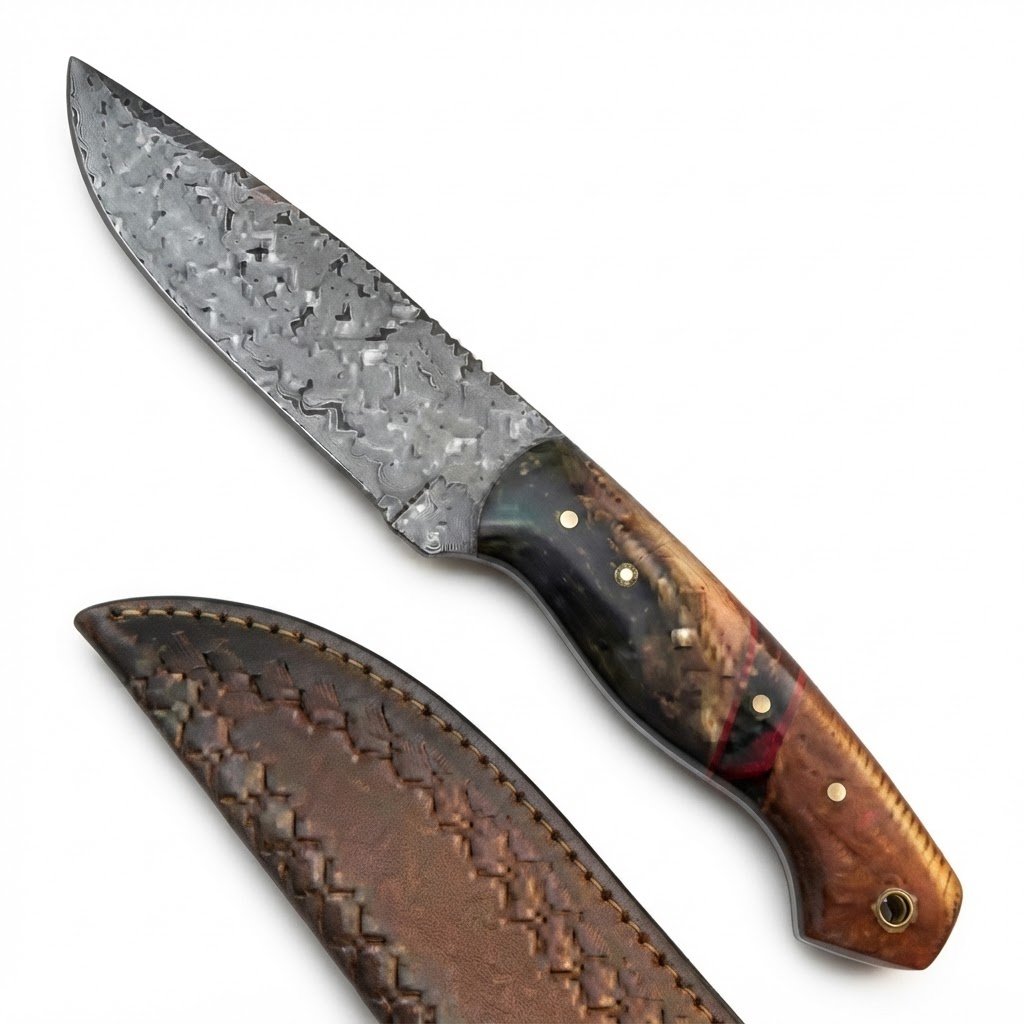
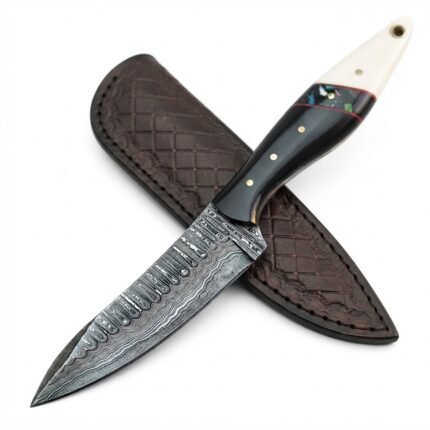
The dark patterned fixed blade hunting knife offers a distinctive combination of traditional outdoor knife styling, an irregularly patterned metal blade, and an attractive two-tone handle. Designed in a classic fixed-blade format, this knife has a broad, pointed blade and a contoured handle with contrasting dark and brown colors.
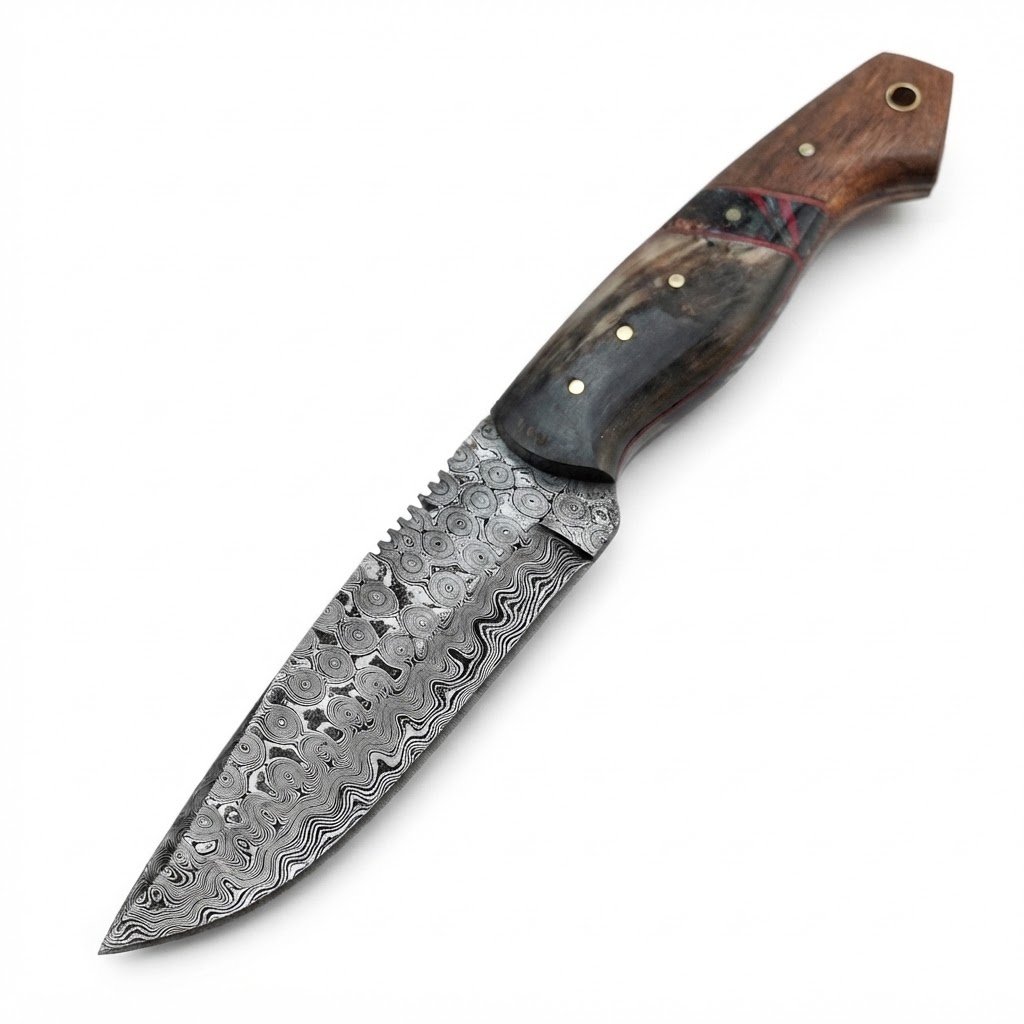
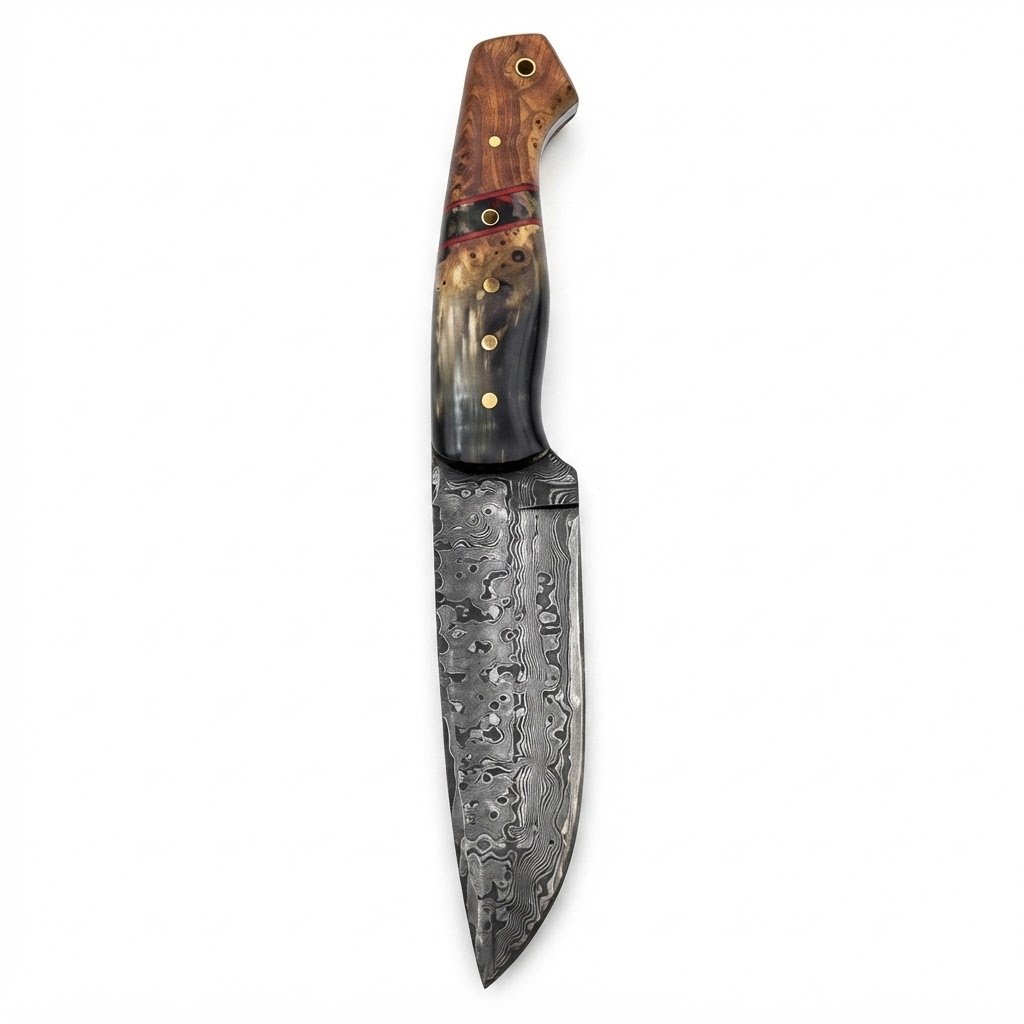
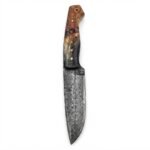
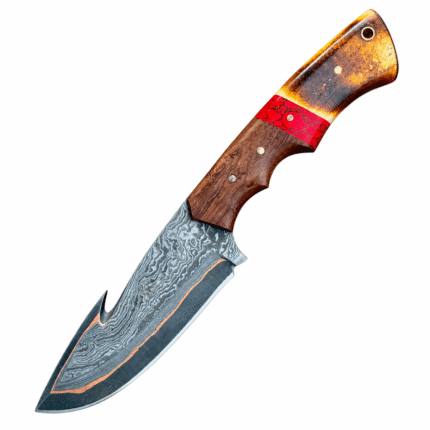
The first thing that stands out is the blade. Its surface displays a mixture of darker marks, lighter gray areas, irregular shapes, and subtle flowing patterns. Rather than having an entirely smooth or uniformly polished appearance, the blade has a textured visual character commonly associated with forged and Damascus-style hunting knives.
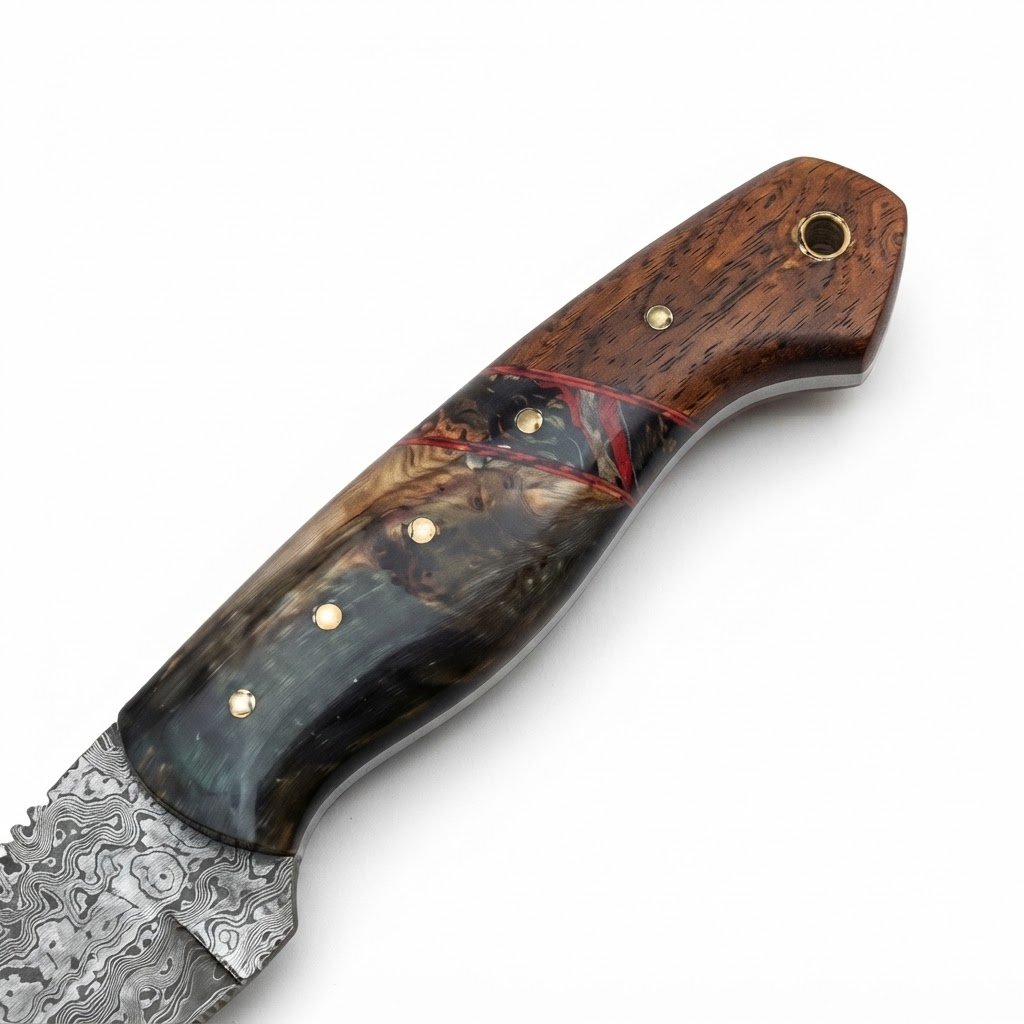
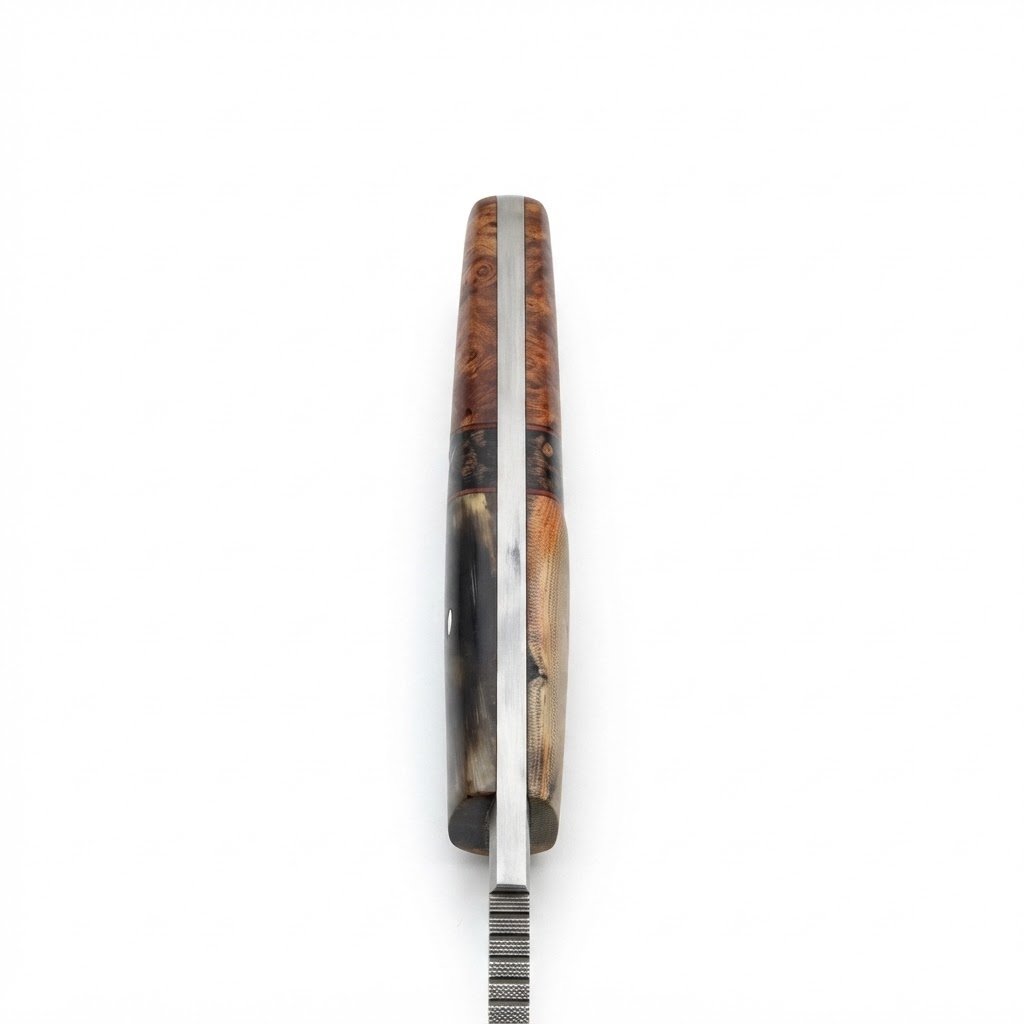
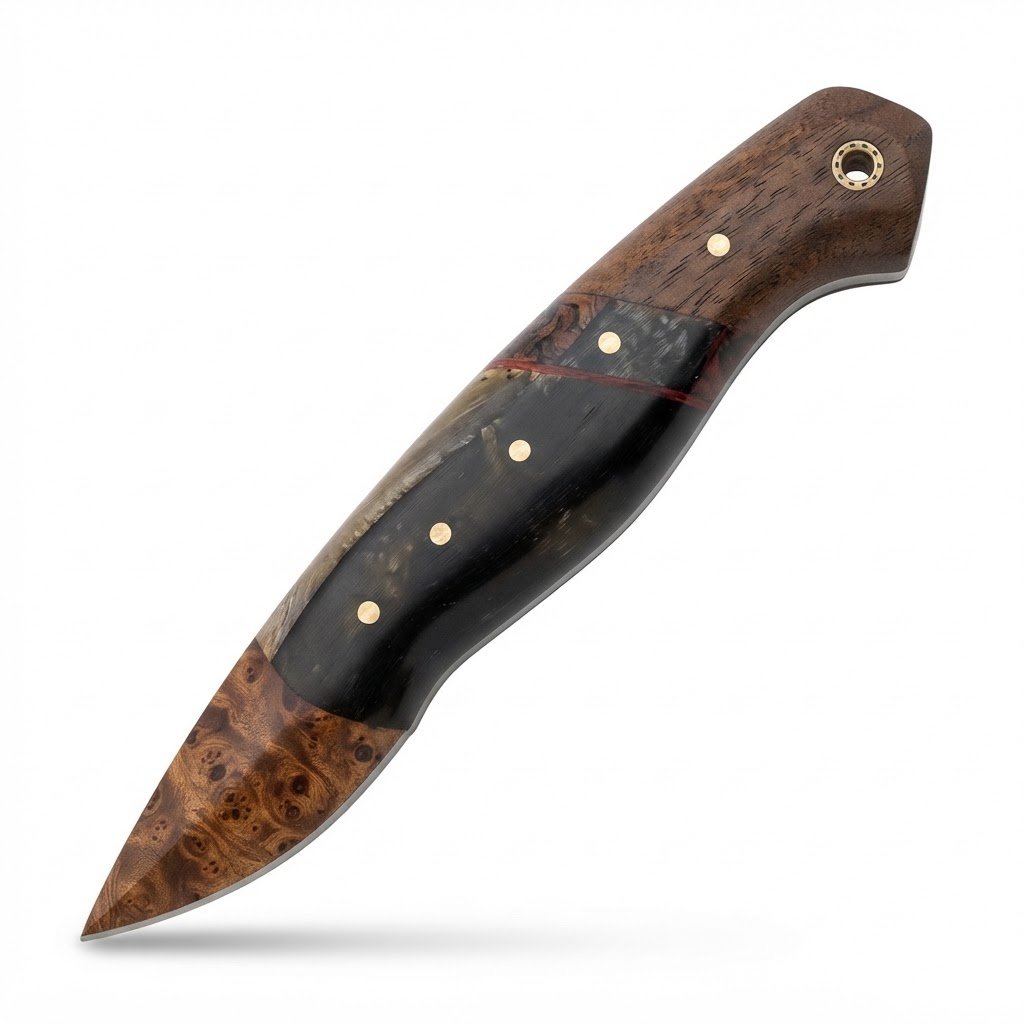
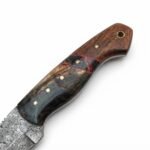
The handle is equally distinctive. It combines a dark, charcoal-and-gray section near the blade with warmer brown wood-grain-like coloring toward the rear. Small gold-tone pins, a dark accent band, and narrow red separators add detail to the overall appearance.
A brown sheath with visible stitching and basket-weave-style decoration accompanies the knife in the product photograph. Together, the knife and sheath create a coordinated, outdoor-inspired presentation.
This model may appeal to hunting knife enthusiasts, collectors, outdoor equipment buyers, and customers who appreciate knives with unusual blade patterns and natural-looking handle finishes.
Its fixed-blade design gives it a familiar hunting and general outdoor utility profile. However, suitability for particular field applications depends on the actual construction, blade dimensions, steel properties, and edge condition, which should be confirmed before use.
For buyers interested in both practical knife designs and distinctive appearances, this model offers a visually interesting alternative to plain-finished fixed-blade knives.
A Distinctive Dark Patterned Hunting Knife Blade
The blade is the central feature of this knife.
It displays an irregular gray and dark-metal pattern across much of its visible surface. The markings include small rounded details, angular shapes, flowing lines, and uneven patches that give the blade an individual appearance.
Near the tip, the metal surface has a mixture of dark and lighter gray areas. Moving toward the handle, the pattern becomes more varied, with layered-looking formations and organic markings.
The combination creates an appearance associated with decorative forged blades and certain Damascus-style finishes.
Patterned Metal Surface
A traditional polished blade often has a relatively uniform surface. This knife is visually different because its markings extend across the blade face.
The darker areas contrast with the lighter metallic details, highlighting the shape of the blade.
These markings are important to its overall appearance and help distinguish it from hunting knives with plain satin or mirror-polished finishes.
Although the pattern resembles those found on some forged or layered-steel knives, a photograph cannot establish the metal’s internal construction.
The precise steel composition, hardness, and production method require manufacturer verification.
Damascus Style Appearance
Damascus steel is commonly associated with visible patterns formed through particular manufacturing processes. However, not every patterned knife is necessarily made from pattern-welded Damascus steel.
Some blades may feature etched, textured, forged-looking, or otherwise decorative surfaces.
For this product, it is accurate to describe the visible finish as Damascus-style or irregularly patterned without claiming a specific steel formula.
If the manufacturer confirms the use of genuine pattern-welded Damascus steel, that information can be added to the technical specifications.
Until then, the decorative blade pattern should be treated as a visible feature rather than proof of a particular steel composition or level of performance.
Fixed Blade Hunting Knife Design
The knife has a non-folding blade and a contoured handle. Its blade is visibly broader near the handle and narrows toward a pointed tip.
The cutting edge follows a continuous curve, creating a recognizable hunting-style silhouette.
This design differs from folding pocket knives, which have a hinged blade that closes into the handle.
Broad Blade Profile
The blade has a relatively broad profile, especially through its central section.
Its spine and cutting edge gradually converge toward the front, forming a pointed tip.
The curved cutting edge visually resembles those found on many outdoor and hunting-style utility knives.
This shape is one reason the knife fits naturally within a fixed-blade hunting knife category.
Nevertheless, the exact blade geometry, thickness, edge angle, and cutting characteristics are unknown.
A customer intending to use the knife for regular outdoor work should review those details before purchasing.
Pointed Tip
The tip is relatively narrow compared with the blade’s broader middle section.
This creates a traditional hunting-style appearance and contributes to the overall silhouette.
The photograph shows the shape clearly, but it does not establish the tip’s strength, precise geometry, or resistance to damage.
Such properties depend on steel composition, thickness, heat treatment, and construction.
Curved Cutting Edge
The cutting edge appears to run smoothly toward the pointed tip.
A curved edge is a familiar feature of many outdoor knife designs.
Its actual cutting performance depends on the blade’s sharpening, geometry, and material properties.
The image does not establish whether the knife is supplied sharpened to a particular standard.
Customers should therefore refer to verified specifications rather than assuming an exact sharpness level.
Two Tone Wood Look Handle Design
The handle is one of the most attractive elements of the knife.
Its color combination includes brown, dark charcoal, olive-gray, and muted reddish tones.
These colors create a naturally inspired appearance that complements the blade’s irregular metal markings.
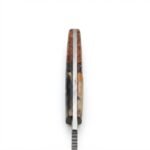
The handle has a slightly curved profile, with a shaped transition near the blade and a broader rear section.
Dark Front Handle Section
The area closest to the blade features a dark surface with gray, black, and olive-like variations.
Its irregular appearance resembles certain stabilized wood, burl, resin, or natural-material finishes.
However, the exact material cannot be established from the photograph.
Several small gold-tone circular pins are visible in this section.
A decorative circular fitting also appears near the center of the darker area.
The contrasting pins give the handle additional visual detail without making the design overly complicated.
Brown Rear Handle Section
Toward the rear, the handle changes to a warmer brown finish.
This area displays grain-like markings and a mixture of medium and dark brown tones.
The natural-looking variation contrasts with the darker front section.
The rear end is slightly wider and shaped with a curved outline.
A circular metal-lined opening is positioned near the end of the handle.
Red Accent Lines
Between the two handle sections, narrow reddish lines surround a darker band.
These subtle accents separate the different colors and add visual definition.
The reddish details also complement the warm brown rear section.
Together with the gold-tone pins, they create a coordinated appearance.
The exact materials used for the accent spacers have not been verified.
Contoured Handle Shape and Visible Hardware
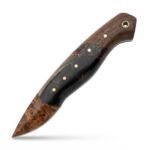
The handle follows a gently curved shape rather than a completely straight outline.
A defined inward curve is visible along its underside.
This contour creates a recognizable grip area and contributes to the knife’s traditional outdoor-tool styling.
Shaped Gripping Area
The handle’s outline includes a narrower section toward the blade and a broader rear portion.
The shape may be appealing to customers who prefer contoured handles.
However, comfort, grip security, and suitability for different hand sizes cannot be reliably determined from a product image alone.
These qualities depend on dimensions, weight, texture, and actual handling.
Decorative Handle Pins
Several small gold-tone pins are positioned along the visible side of the handle.
These fittings create contrast against the dark and brown sections.
Their exact metal composition is unknown.
Although pins are commonly used in knife-handle construction, the photograph does not establish the internal fastening method.
Metal Lined Lanyard Hole
A circular opening is visible near the rear of the handle.
It has a brass-colored metal lining and resembles a traditional lanyard hole.
This detail adds to the knife’s outdoor-inspired appearance.
No lanyard or cord is shown in the image.
Customers wishing to use a lanyard should confirm the opening’s dimensions and compatibility with their preferred cord.
Brown Basket Weave Pattern Sheath
A brown protective sheath is shown alongside the knife.
Its surface features a decorative basket-weave-style pattern and darker textured areas.
Visible stitching follows the perimeter of the sheath, creating a finished appearance.
The brown tones of the sheath complement the handle’s warm coloring.
Decorative Basket Weave Pattern
The sheath features raised and recessed areas that resemble woven strips.
This decorative pattern adds a traditional leatherwork-inspired appearance.
The surface has darker patches and tonal variations, making it look more rustic than a completely plain sheath.
Although the material looks like leather, its composition cannot be confirmed from the image alone.
The manufacturer should verify whether it is genuine leather, synthetic leather, or another suitable material.
Visible Edge Stitching
A continuous row of stitching is visible near the sheath’s outer edge.
The thread appears darker than the surrounding brown surface.
This detail contributes to the sheath’s visual finish.
The stitching method, thread composition, and long-term durability have not been independently tested.
Sheath Coverage
The sheath is shaped to accommodate a blade of similar proportions to the pictured knife.
Its form suggests that it is intended as a protective cover.
Actual fit and retention should be checked before use.
A sheath should cover the cutting edge securely and protect the blade from unnecessary contact during appropriate storage and transportation.
The photograph does not clearly establish the sheath’s belt attachment mechanism or retention system.
Traditional Outdoor Knife Appearance
This knife combines several elements commonly associated with classic outdoor equipment.
The fixed-blade profile, contoured handle, decorative metal pattern, and brown sheath create a coordinated appearance.
Its design is not dominated by bright synthetic colors or complicated mechanical components.
Instead, it relies on a mixture of natural-looking tones and visible decorative details.
Rustic Color Combination
The blade features gray and dark metallic markings.
The handle combines charcoal-like colors with warm brown areas.
The sheath adds darker brown tones and a woven decorative texture.
These elements work together to create a rustic outdoor-inspired appearance.
Decorative Yet Recognizable Design
Although the knife includes unusual surface patterns and mixed colors, its overall shape remains recognizable as a traditional fixed-blade hunting knife.
The pointed blade and shaped handle create a straightforward silhouette.
The decorative details add visual interest without changing the essential form of the product.
This balance may appeal to customers who want an outdoor-style knife that looks different from common plain-handle designs.
Why Knife Collectors May Appreciate This Design
Collectors often compare knives based on blade shapes, finishes, handle materials, decorative fittings, and overall presentation.
This knife provides several visible points of interest.
The patterned blade has a highly irregular surface design.
The handle uses contrasting sections rather than a single uniform finish.
Gold-tone pins and narrow red accents provide smaller decorative details.
The brown basket-weave-style sheath further contributes to the presentation.
An Interesting Blade Pattern
The irregular blade markings make the knife visually distinctive.
Collectors interested in comparing different patterned blade finishes may find the design appealing.
The pattern differs from more regular straight-line decorative finishes.
Its organic-looking variations give the blade a distinctive surface character.
Contrasting Handle Colors
The handle’s combination of dark and warm tones adds character.
The darker front section and brown rear section have noticeably different appearances.
This contrast may appeal to customers who enjoy mixed-material-inspired knife handles.
Coordinated Sheath
A sheath can contribute to the overall presentation of a fixed-blade knife.
The pictured sheath uses brown tones and decorative markings that complement the knife’s rustic style.
For collectors who appreciate matching accessories, the coordinated appearance is a notable feature.
Outdoor Utility and Hunting Style Applications
The knife has a form commonly associated with hunting and outdoor utility equipment.
It may be relevant to customers interested in knives for lawful outdoor activities, collecting, or traditional equipment displays.
However, visual resemblance to a particular category does not establish suitability for every task.
General Outdoor Equipment
Fixed-blade knives are commonly found in outdoor equipment collections.
Buyers may consider blade geometry, handle dimensions, construction, and materials when selecting a knife for ordinary utility tasks.
For this model, those specifications should be verified before making performance claims.
The photograph alone cannot demonstrate cutting ability, resistance to corrosion, or suitability for heavy-duty work.
Hunting Knife Collections
The pointed blade and curved cutting edge give this model a recognizable hunting-style appearance.
It can therefore be categorized alongside fixed-blade hunting knives.
Buyers should confirm local laws and the manufacturer’s intended-use recommendations before purchasing or carrying it.
Decorative Display
The knife’s patterned blade and contrasting handle also make it a visually interesting collectible.
Customers may appreciate the details when viewing the knife as part of a carefully maintained collection.
Any display should keep the blade securely protected and inaccessible to children or unauthorized individuals.
Understanding the Difference Between Appearance and Performance
The attractive appearance of a knife does not automatically establish its technical properties.
A patterned blade may look sophisticated, but actual performance depends on its material composition, heat treatment, geometry, and finish.
Likewise, a handle that resembles wood or horn may use natural materials, manufactured materials, or a combination.
These distinctions are important when evaluating a product.
Blade Steel Type
The exact steel grade is not provided.
Without a confirmed specification, claims about particular steel alloys, carbon content, hardness, or corrosion resistance would be speculative.
The manufacturer should provide accurate technical documentation.
Forging Method
The blade looks similar to some forged or patterned knives.
However, its manufacturing process cannot be established from the photograph.
It should not be advertised as hand-forged unless the supplier confirms that production method.
Tang Construction
The image shows a fixed-blade knife, but it does not reveal the internal tang.
It is therefore not possible to confirm whether the knife uses full tang, hidden tang, or another construction.
Handle Material Composition
The handle has wood-like and dark natural-material-like appearances.
Its exact composition should be verified before using terms such as walnut, exotic burl, buffalo horn, or stabilized wood.
Accurate material descriptions help customers understand the product and make informed comparisons.
Product Features Visible in the Photograph
The photographed knife shows the following design elements:
- A fixed, non-folding blade
- A broad blade narrowing toward a pointed tip
- A gently curved cutting edge
- Irregular dark and gray blade markings
- A contoured two-tone handle
- A charcoal, gray, and olive-like front handle section
- A warm brown rear section with wood-grain-like detail
- Narrow reddish separators
- Gold-tone circular handle pins
- A metal-lined rear lanyard opening
- A brown sheath with basket-weave-style decoration
- Visible stitching around the sheath edge
These details can be used to describe the product accurately.
Technical claims beyond the visible features require supporting information.
Selecting a Fixed Blade Knife for Your Needs
When comparing fixed-blade knives, customers should consider how they intend to use or collect the product.
A knife purchased primarily for its appearance may be evaluated differently from one intended for frequent outdoor use.
Collectors may prioritize blade patterns, handle styling, materials, and presentation.
Outdoor users may place greater emphasis on blade geometry, steel grade, overall weight, ease of maintenance, and handle comfort.
Both groups benefit from clear and accurate specifications.
Blade Length and Overall Dimensions
The photograph does not include a reliable scale.
Therefore, it is not possible to determine the exact blade length or total length.
These dimensions should be obtained directly from the manufacturer.
Blade Thickness
The image shows the blade’s visible face but does not establish its thickness.
The manufacturer should provide this measurement in millimeters or inches.
Weight
The knife’s weight is also unknown.
Weight is useful for comparing similar outdoor knives, but it cannot be estimated reliably from the photograph.
Included Accessories
A brown sheath is shown alongside the knife.
The seller should confirm that the sheath is included in the actual purchase package and identify any additional accessories.
A presentation box, sharpening tool, maintenance cloth, or lanyard should not be advertised unless supplied.
General Knife Care and Maintenance
A fixed-blade knife requires appropriate care to preserve its appearance and condition.
The exact cleaning and maintenance methods should follow the manufacturer’s recommendations.
Until the steel and handle compositions are verified, buyers should avoid material-specific treatments that could cause damage.
Cleaning the Blade
After suitable use, carefully remove visible residue with a soft, nonabrasive cloth.
If washing is recommended by the manufacturer, dry the blade thoroughly afterward.
Moisture left on metal surfaces may contribute to corrosion, depending on the steel type and finish.
Avoid prolonged exposure to damp conditions.
Protecting the Patterned Finish
The blade’s irregular dark and gray markings are an important decorative feature.
Harsh polishing compounds, abrasive cleaners, or aggressive surface treatment may affect its appearance.
Use gentle cleaning methods appropriate for the actual blade material.
A suitable protective oil may be recommended for some steel compositions.
However, the correct product should be selected according to the manufacturer’s instructions.
Handle Maintenance
The handle combines several contrasting finishes.
Wipe it gently with a clean cloth after handling.
Avoid prolonged water exposure and extreme temperatures until the materials are confirmed.
Natural wood, horn, resin, and composite handle materials may require different care methods.
Do not apply wood oil, mineral oil, wax, or another conditioner without confirming that it is appropriate for the actual material.
Caring for the Sheath
Keep the sheath clean and dry.
Avoid leaving it exposed to moisture for extended periods.
If genuine leather is confirmed, an appropriate leather-care product may help maintain its condition.
If the sheath is synthetic, follow the manufacturer’s cleaning instructions instead.
The material should be verified before applying any treatment.
Safe Storage
Store the knife securely with its blade protected.
Keep it away from children and unauthorized users.
A well-fitting sheath or protective case can help reduce accidental contact with the cutting edge.
For extended storage, consider separating the knife from a moisture-retaining sheath if recommended for the blade and sheath materials.
A Distinctive Choice for Knife Enthusiasts
The dark patterned fixed blade hunting knife combines a traditional outdoor knife shape with a distinctive blade finish and contrasting handle design.
Its irregular gray and dark-metal markings create an eye-catching appearance, while the contoured handle features charcoal, gray, and warm brown tones.
Small gold-tone fittings, narrow red accents, and a metal-lined lanyard hole complete the handle’s decorative styling.
The matching brown basket-weave-style sheath adds to the rustic presentation and gives the product a coordinated appearance.
For knife collectors and outdoor equipment enthusiasts who appreciate patterned blades and natural-looking handle finishes, this model offers an interesting design worth exploring.
Review the confirmed specifications, compare its features with your requirements, and consider adding this distinctive fixed-blade knife to your collection.








Reviews
There are no reviews yet.